

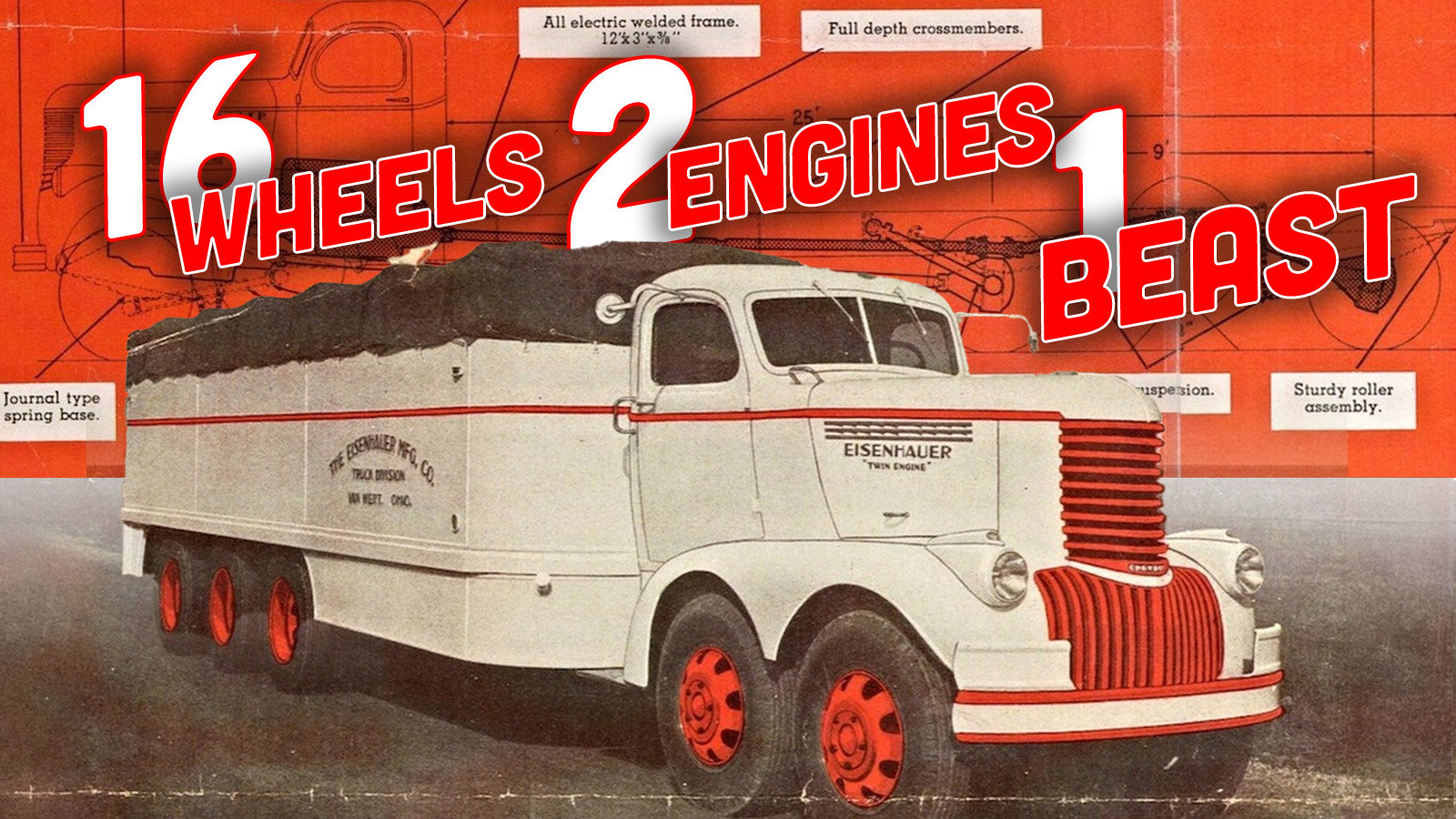
Most semi-tractors in America are built using a familiar formula. Manufacturers place a cab behind a long nose that houses a powerful diesel engine, and there are two, three, or four axles that the tractor rides on. The truck hitches to a semi-trailer, and the whole thing hauls heavy loads locally, regionally, or across the country. But what if you didn’t need a trailer at all? Back in 1945, Eisenhauer Manufacturing tried just that with the Eisenhauer Twin Engine Truck. This 35-foot-long beast had two engines, four steer tires, and five axles so it could essentially function as a truck and trailer in one. But Eisenhauer’s ambitious design would come to an unfortunate dead end.
The concept of using a vehicle to pull a cargo trailer goes back further than a century. In 1896, Alexander Winton, was a Scottish immigrant who, like many engineers of the era, cut his teeth by building bicycles. He would become a pioneer in cars after constructing a carriage propelled by a single-cylinder engine. The Winton Motor Carriage Company was founded in 1897, and Winton built his cars by hand with a painted body, a padded seat, a leather roof, gas lamps, and tires from the B.F. Goodrich Company. Winton’s cars were also quick for their day, featuring 10 HP engines and were tested to speeds as high as 33 mph.


[Editor’s Note: A Winton was also the first car to cross the (contiguous) United States, way back in 1903. The whole thing started with a bet, where the guy who said he could drive across America made the bet before he had a car, and didn’t know how to drive, even. It’s a great story, and there’s a documentary about it! – JT]
As orders rolled in during 1898, Winton discovered a problem. He couldn’t just drive the cars to customers. Not only would the cars no longer be new, but something could get worn or broken during delivery, and that was a cost that he’d have to eat. Winton’s solution was genius. He would take a Winton touring car, build a platform on its back, above the car’s rear-mounted engine. Attached to the platform was the front end of a cart, which would have a customer’s new vehicle parked on it. This contraption was a rudimentary version of the modern semi-trailer, and it allowed Winton to deliver cars in truly new condition.

Winton would later become famous for being a pioneer of diesel in America. His trucking concept would eventually become the standard in the burgeoning industry, and it remains the standard today. But there have been times when the practicality of having a truck haul a trailer was challenged.
As I have written several times throughout my series on noteworthy trucks throughout history, states used to limit the lengths and weights of trucks. These laws were often all over the place, and meant that a truck that was legal to drive in one state could not drive in a neighboring state. Illinois had one of the harshest limits in the nation as the state allegedly built its length restrictions to favor the railroads, and left truckers with only 35 feet of rig to work with.
Of course, this also had the side effect that an Illinois-legal truck was uncompetitive if it drove to a state where longer or heavier rigs were allowed to operate.
In 1945, Eisenhauer Manufacturing thought it had just the solution. If trucks were limited by length, why not just make a short truck that carried about the same weight as a tractor-trailer? This truck could operate legally in many states and eliminate a trailer entirely. This was the idea behind the Eisenhauer Twin Engine Truck, and there’s a reason why Class 8 trucks don’t really follow the formula today.
From Bogies To Washing Machines

The Eisenhauer Manufacturing Company of Van Wert, Ohio, is not really a household name, but there’s a non-zero chance you’ve owned something that the company has touched. The family-owned business got its start during the darkness of World War II, from Eisenhauer Manufacturing:
In August of 1944, the Spayd-Ohio Company was formed into the Eisenhauer Manufacturing Company by W.A. Eisenhauer, Ida J. Eisenhauer, and Leigh E. Eisenhauer Sr. At that time, the company machined “bogie wheels” for tanks during WWII. A press release quoting Bill Eisenhauer states, “We have a very full program ahead, one that will keep us going at top speed for many months. We will need the help of the people of Van Wert to keep our employment up, for we must get this most vital piece of fighting equipment – tanks – to our fighting men.”
After the war, the tank wheels were replaced with parts for Laundrall Washing Machines to meet the post war demand for appliances. Car jacks were another product of Eisenhauer Manufacturing, accommodating the varying sizes of car bumpers during the ’50s and ’60s. Expansion of the facility occurred in the ’60s with the first Stran Steel building built in Van Wert.
In 1984, James D. Russell joined the Eisenhauer Manufacturing stamping facility, and is now the Managing General Partner. Adam Benner joined Eisenhauer Manufacturing in 2001 as the Quality Manager, then promoted to Production Manager and is now the current Plant Manager. The majority of the stampings produced in the Eisenhauer Manufacturing facility today are parts for automotive and electrical motors.
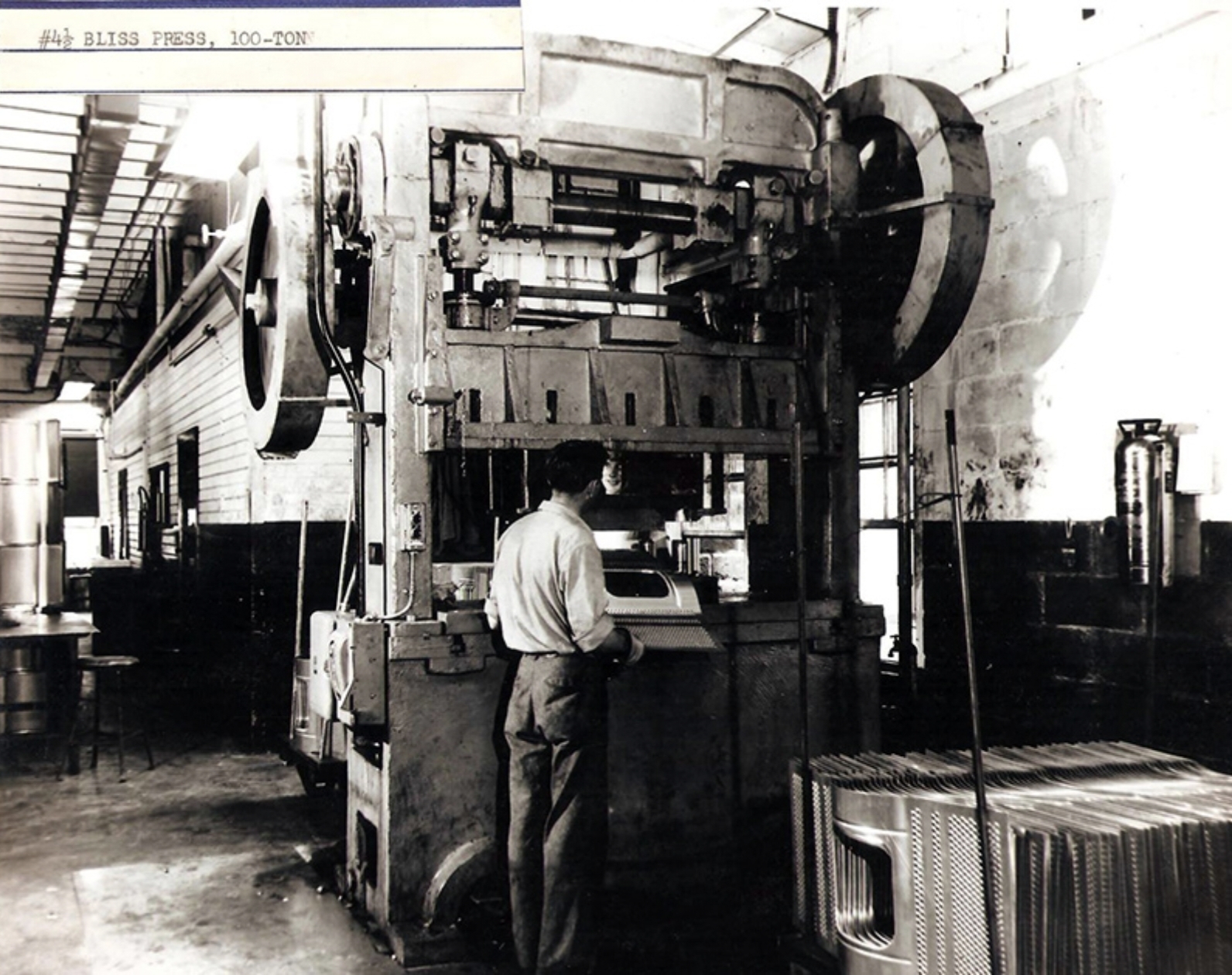
Eisenhauer was lucky enough to survive to the modern day, and most recently, it was known for producing stampings for the automotive industry. But this story takes us to the period right after World War II.
Eisenhauer says that, after the hostilities ended, so did its contracts for tank bogies. The company pivoted to washing machines to keep workers busy, but Eisenhauer knew that the washing machines were filling only a short-term hole. As the Eisenhauer factory retooled for its shift to washing machines, Leigh E. Eisenhauer Sr. found himself in a rabbit hole, studying the state of the trucking industry, and he identified numerous problems.
To the elder Eisenhauer, semi-trailers were too tricky to reverse, leading to jackknifing. He also took note of the vastly varying laws on truck lengths. His solution? What if you just got rid of the trailer entirely and made a rigid truck where every foot of space behind the cab was for cargo? In theory, you could make a long-haul heavy truck that’s so short it could drive anywhere while also being able to carry the same load as a semi-trailer.
The Eisenhauer Twin Engine Truck
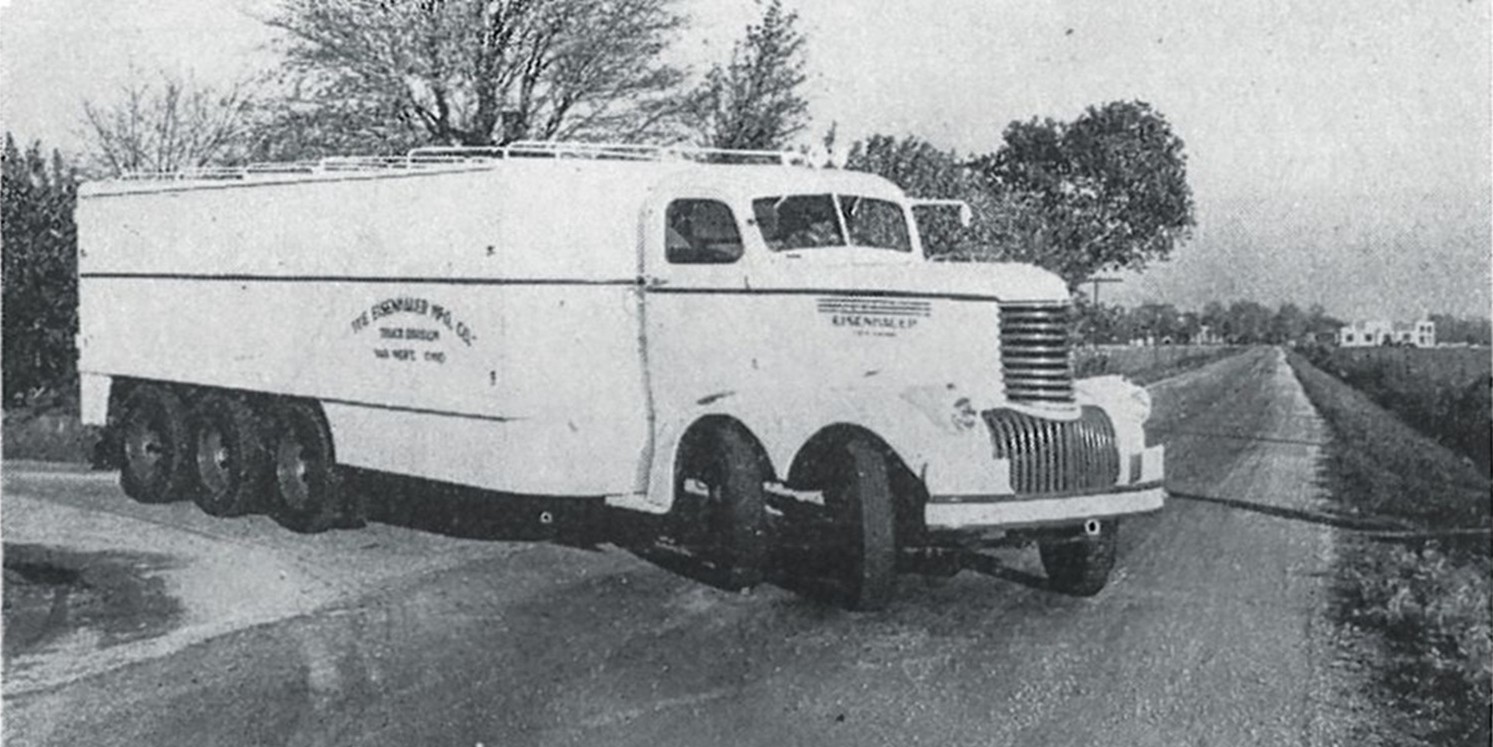
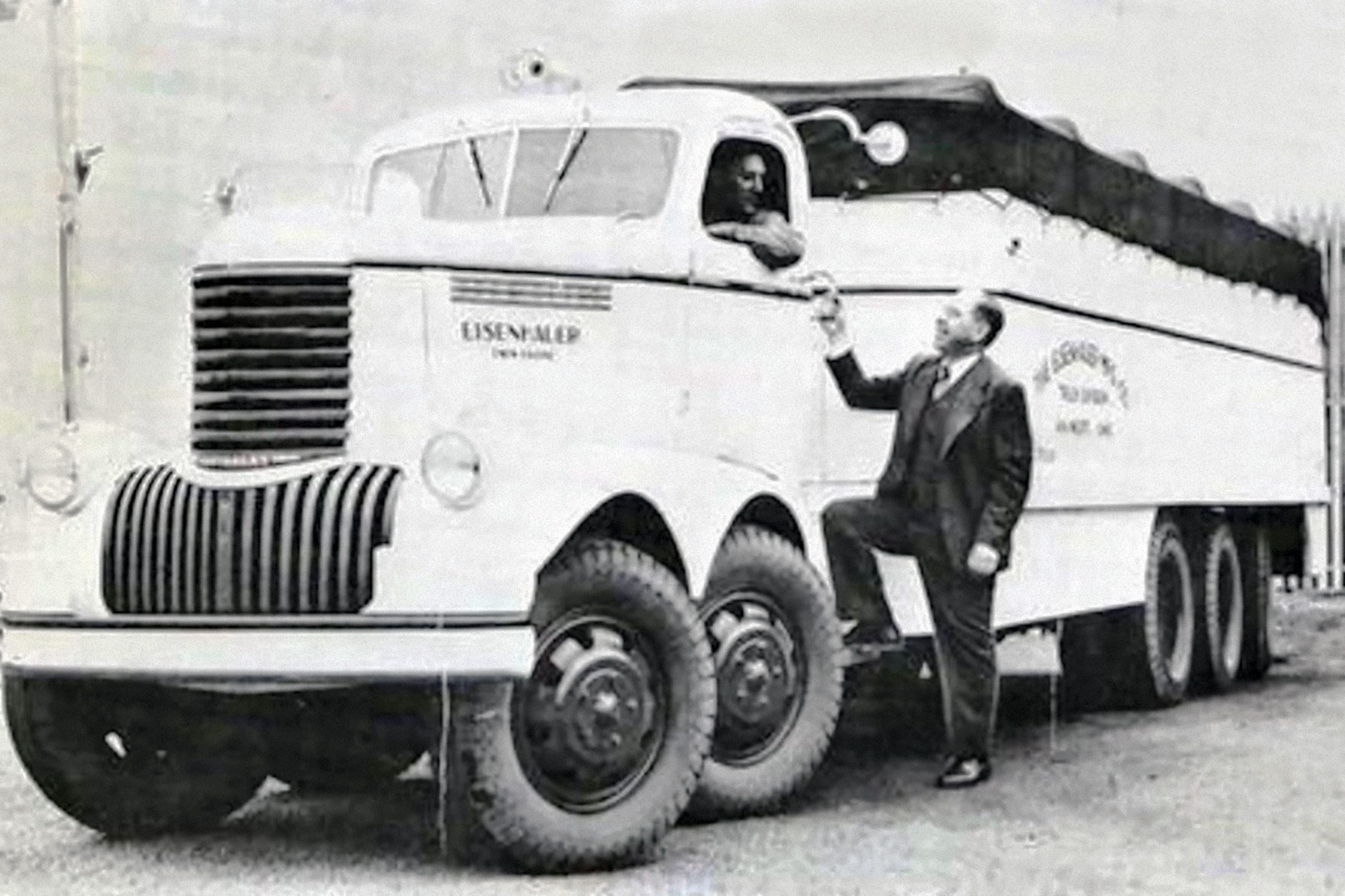
To test this idea out, Eisenhauer built a prototype truck in 1945. The very first Eisenhauer Twin Engine Truck was assembled using a plurality of parts from two Chevrolet 1.5-ton medium-duty trucks. The cab, for example, is from the Chevy trucks, but features additional sound deadening. The driver also had a sleeper. Weirdly, the sleeper in the Eisenhauer wasn’t tacked onto the back like a typical semi. Instead, the driver had a box in the cab that ran longitudinally from under the hood and dashboard to just slightly behind the seat. Making a coffin of a sleeper meant that the truck could be 35 feet long, and only 10 feet of that was for housing the driver and the engines, while the rest was for cargo. Sadly, no interior photos of the truck have survived, or else I’d be so happy to show you what the sleeper looked like.
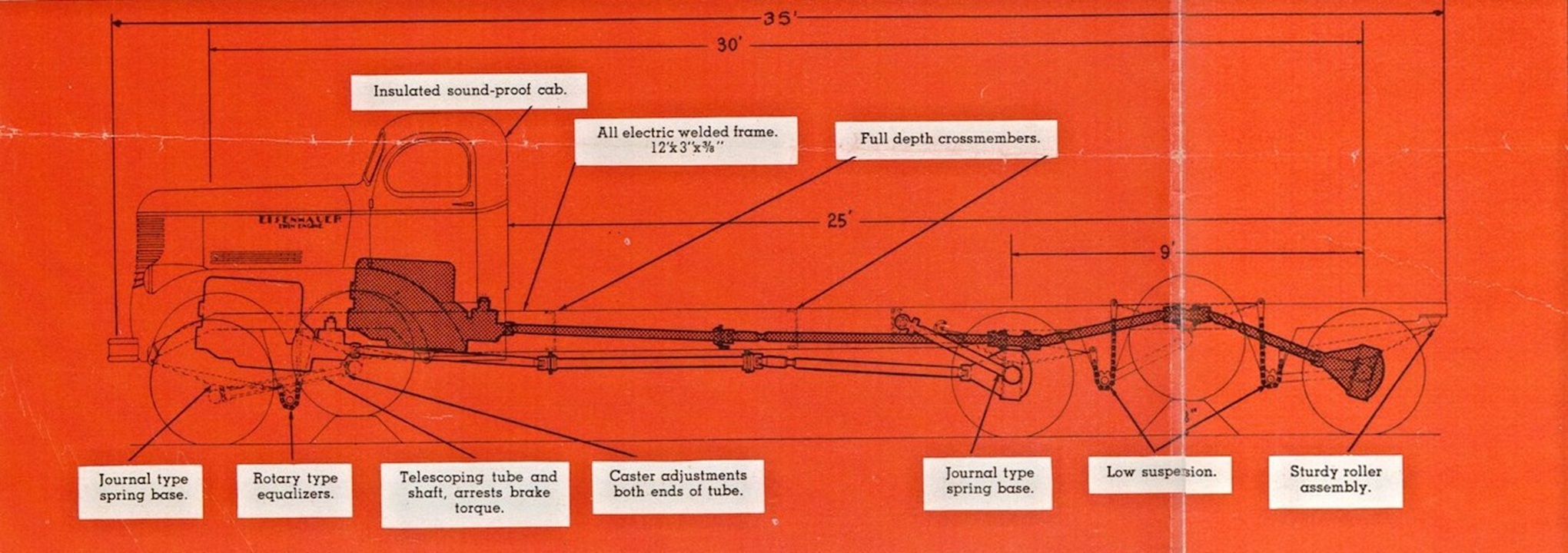
The Chevy trucks even gave up two 235 cubic-inch straight-six engines to the project, and each example produced 83.5 horsepower net and 182 pound-feet of torque. Both drivetrains were left intact, with one engine under the hood and the other under the cab. The Twin Engine Truck had five axles, of which three were in the rear. Of the rear three, the forwardmost axle was powered by the forward engine, while the rearmost axle was powered by the rear engine. Technically, the engines operated independently, but shared a common gas and clutch pedal.
A 1945 issue of Automotive and Aviation Industries explained how driving the truck worked:
Engines can be used either together or independently at the will of the driver. Power selection can be made by the driver at any road Speed and while in any gear. This is accomplished by means of a differential type synchronizer which Serves to synchronize the speed of the idle engine with that of the running engine. This maneuver is accomplished simply by starting the idle engine and pressing down on the synchronizer pedal. Moreover, this is done without touching the clutch. The driver simply Moves the gear shift lever to correspond with the engaged gear of the driving engine. At the instant the idle engine comes up to speed and is engaged in gear an automatic torque equalizer—a device operating from the manifold pressure of. both engines— comes into play to synchronize the carburetor throttles of both engines so as to properly balance their output.
Each engine mounts its own standard clutch and transmission. Both clutches are operated from the same pedal but the transmissions are shifted independently through separate gear shift levers. The throttle also is operated from one pedal.
The brake system is specially designed and does not use standard Chevrolet parts. The main brake system consists of ten wheel brakes of Midland air-over-hydraulic type. The brake system has three independent cylinders—one for the four front wheel brakes and one on each side of the three rear axles. The two propeller shaft drives are fitted with American Chain Tru-Stop brakes. The propeller shaft lines are built up of standard Chevrolet shafts, using as many multiples of the standard shaft as are necessary. For example, the system to the front rear axle consists of three separate lengths, while that to the rearmost axle has five. Each of the sections is suitably supported in standard midship bearing supports.
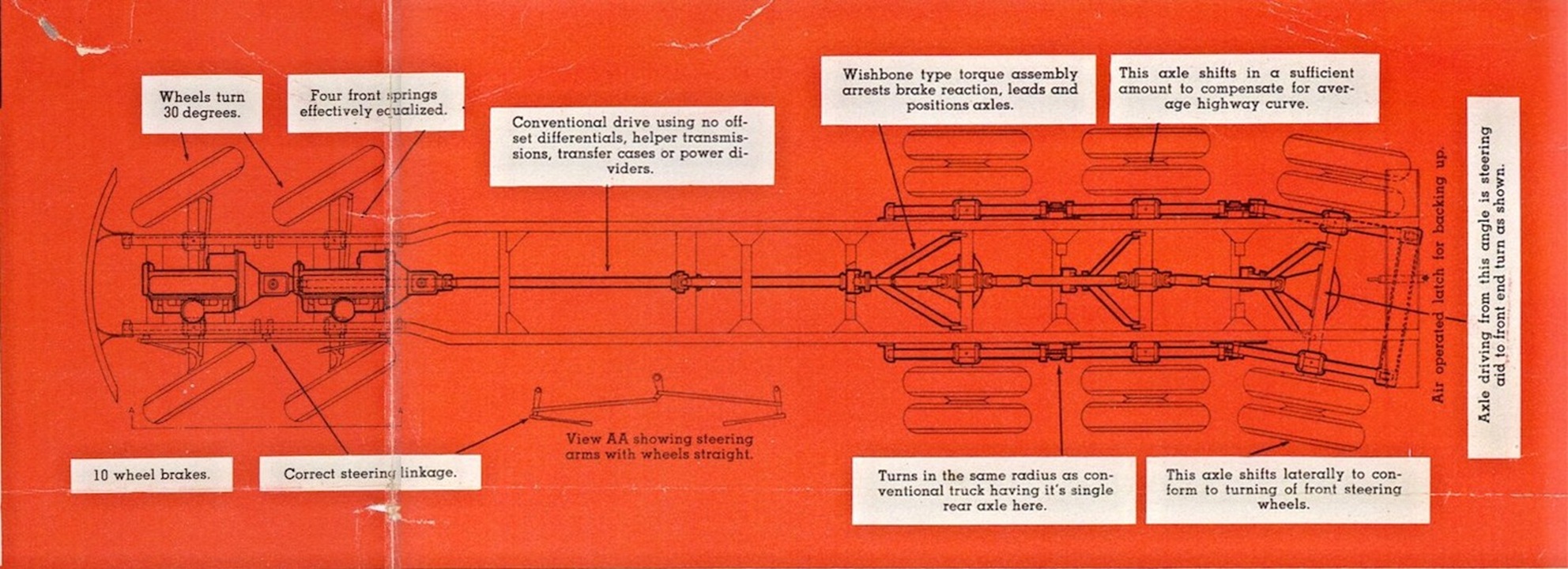
The drive wheels featured Timken two-speed rear axles, and all three of the rear axles had dual wheels. Both transmissions had individual shifters. These were not directly linked, and instead, when the driver shifted gears, it actuated an air cylinder to enact the gearchange. This goofy engine setup meant that the driver could use both engines while hauling a load or shut down the rear engine when driving empty to save on gas. It also meant that, in the event of an engine failure, the truck could still drive. The rig had a 40,000-pound gross weight when loaded, and drivers were supposed to take their Eisenhauer on long routes, so it needed both engines.
All of this rode on a spring suspension, and Eisenhauer’s logic was that springs were more flexible and would allow the truck’s tires to remain planted at all times on rough surfaces, therefore aiding in traction. Then there was the steering system. Eisenhauer wanted his rigid truck to be just as maneuverable as an articulating tractor-trailer. To facilitate this, both of the two front axles, which were equipped with single wheels, were designed to turn. In addition, the rearmost axle was able to turn through a “pivot at a ball joint on the torque tube with a movement of some eight inches laterally in each direction.”

The prototype truck was equipped with 16 Goodyear Hi-Miler tires, and Eisenhauer boasted that it could drive in all 50 states without legal issues. In 1946, Eisenhauer started advertising the Eisenhauer Twin Engine Truck, which was also called the Eisenhauer Freighter or the Eisenhauer Twin Engine Freighter, depending on which magazine you read.
Eisenhauer’s Marketing Play

Leigh E. Eisenhauer Sr. would speak to at least 65 automotive and trucking magazines to advertise his truck to the trucking industry. Here’s what he said to Fleet Owner:
“It is obvious from the pictures that several new features in truck design and engineering are incorporated into this new vehicle,” points out L. FE. Eisenhauer, in charge of the truck division. “These in clude what is believed to be the first successful appli ‘ation of a double front axle and four front steering wheels in practical commercial use, which make possible greater load capacity through better weight distribution, he said.
“This arrangement also provides easier steering, accomplished through the use of four front wheels in tandem relation, rather than in dual relation, thus eliminating the need for power steering apparatus.
“The new Eisenhauer truck has three rear axles, including two driving or ‘live’ axles, with a ‘dead’ axle in between them. Dual wheels, of course, are used on all three rear axles, and singles on the two front axles. Because of the ‘remote’ spacing of the two live axles, greater traction is achieved than if they were closer together,” Mr. Eisenhauer points out.
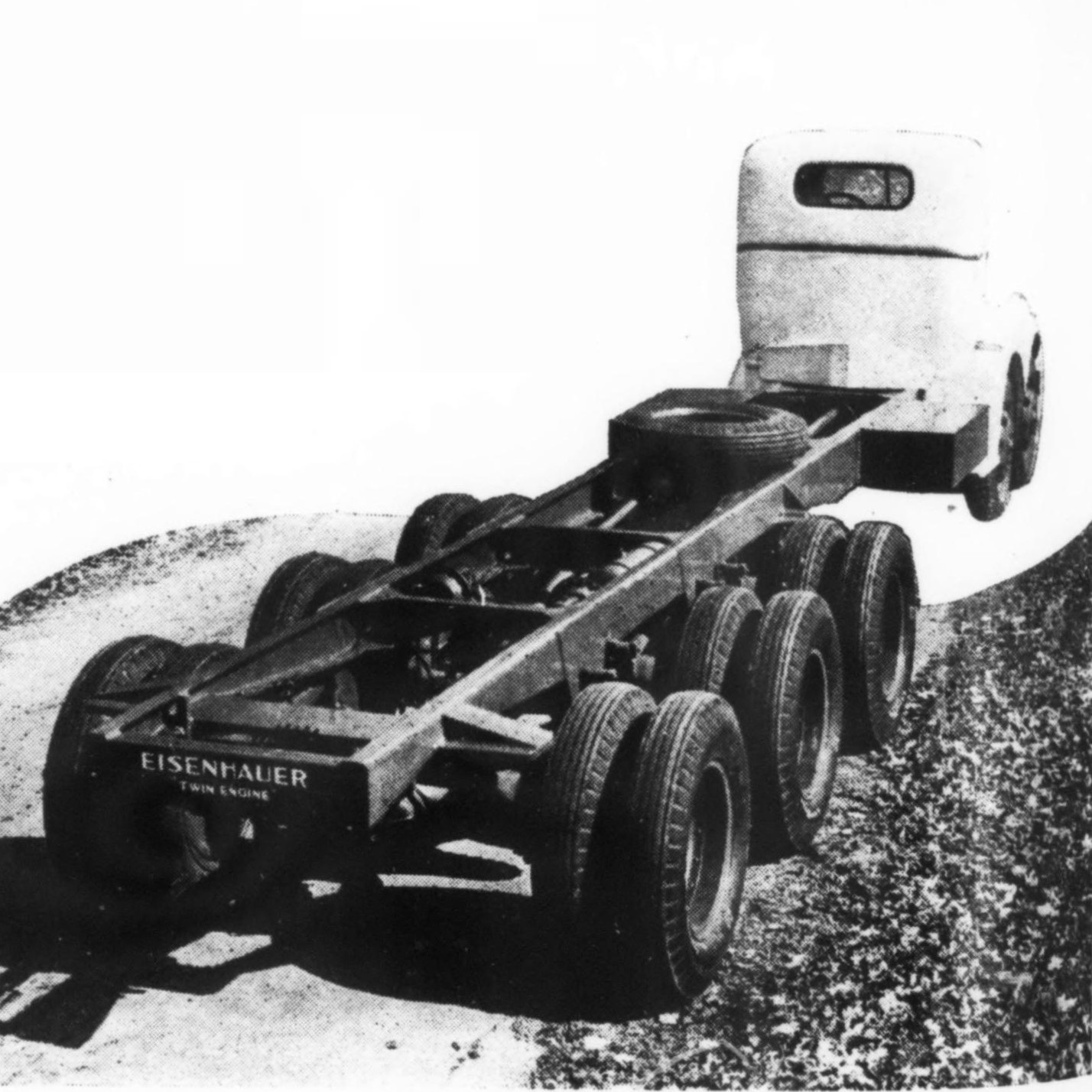
Eisenhauer said that his truck’s unique suspension also eliminated skidding on turns since only two axles didn’t move with curves. One his biggest selling points was that, since he raided the GM parts bin for the truck, 90 percent of the truck could be repaired by anyone who knew GM products and parts should be plentiful. Eisenhauer also planned to sell different cargo bodies for the truck, including a tanker, flatbed, and a dry van. In other words, it was basically what we’d call a straight truck today, but far more complex.
Talking to the magazines wasn’t Eisenhauer’s only marketing plan. On June 1, 1946, Detroit celebrated 50 years of making cars with a four-hour-long parade. Eisenhauer didn’t just get in on the action, but its truck led the whole GM section.

Eisenhauer would go on to display the prototype at a trucking show in Tampa, Florida, later that year, and then again at the 1949 Michigan State Fair. Unfortunately, while Eisenhauer successfully marketed the rig, Eisenhauer had to tell prospective customers that it couldn’t sell them a truck. In Eisenhauer’s own retrospective, it says it told truckers “manufacture is delayed because of certain conditions in the industry.”
Eisenhauer Tried Again
Eisenhauer would never build more than one of the original Freighter. But it didn’t give up. As The Drive reported in 2021, Eisenhauer updated the truck’s design, made it more complicated, and then actually built six of them. From the book, U.S. Military Wheeled Vehicles by Fred W. Crismon:
The second version of Eisenhauer’s 10×4 showed extensive design and engineering changes. The engines, now GMC’s 302 cubic inch in-line gasoline six cylinder model, were mounted side-by-side, and drove through two GMC model 303M Hydramatic transmissions into the first and third rear axles. The engines and transmissions were intentionally identical to those in the M135 series GMC 21⁄2 ton 6×6, with the engines developing 145 horsepower each from 302 cubic inches and the transmissions giving eight forward and two reverse speeds. This model of the Eisenhauer truck was on the road by 1955, and the author saw at least three; a red one with open stake body, an orange Allied moving van and a chassis/cab.
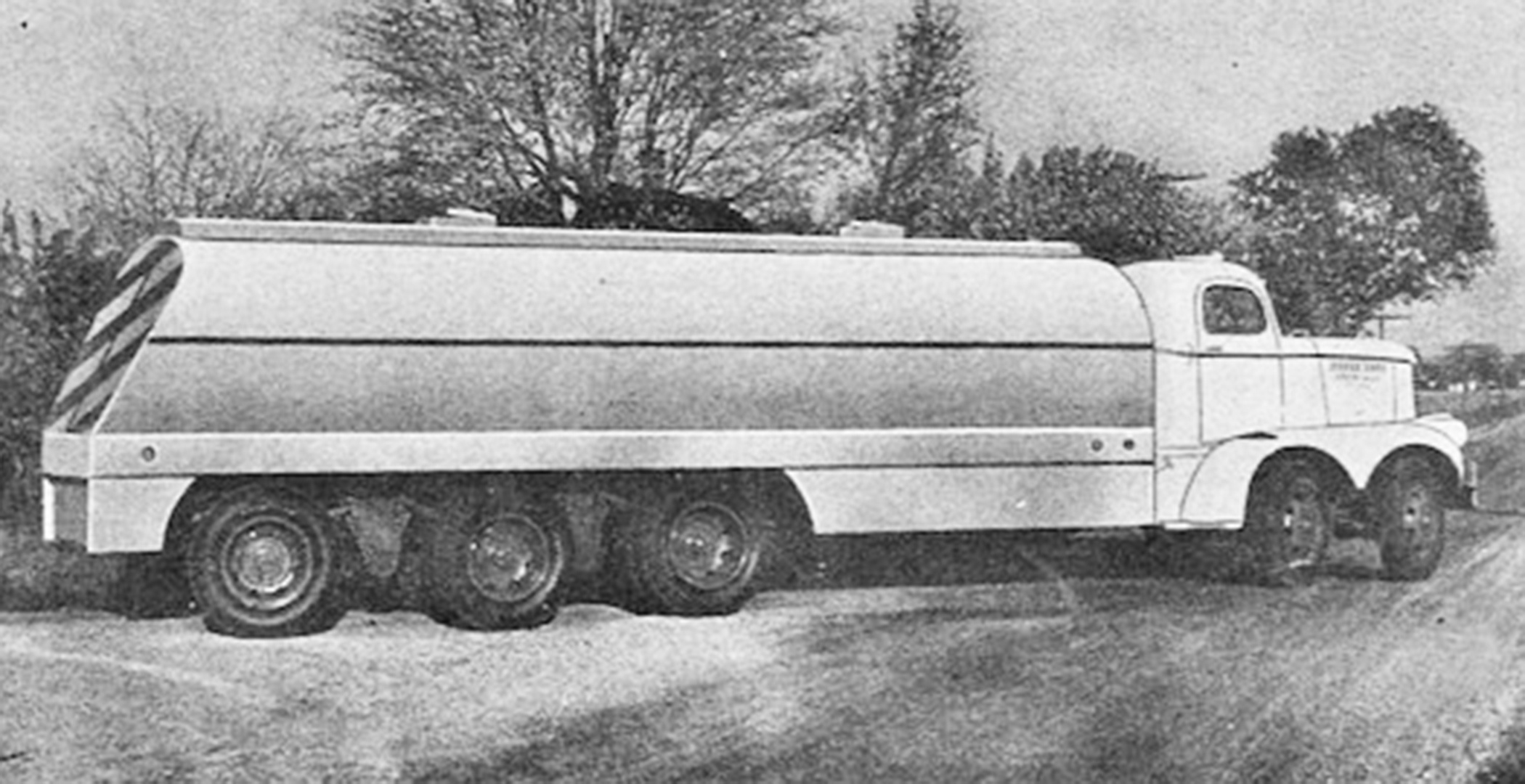
In March, 1957, Eisenhauer offered this huge tilt-cab tanker version to the Army for testing. Designated as Model X-2, it carried a 6,176 gallon body, weighed 27,880 pounds empty and could carry a 37,000 pound payload. No small truck, it was 35 feet long, 10 feet high, and 8 feet wide. The 256-inch wheelbase (measured at the center rear axle) resulted in a 56-foot turning radius. Tires were 10.00×20 on the front, with 9.00x20s on the rear. The suspension system was unique in that it used semi-elliptic springs combined with chains and sprockets (front and rear) with torque tubes for load equalization. The rear suspension was additionally unusual in that the first and third axles had leading arms and gimbal mounts designed to allow those axles to track the arc being run by the turning vehicle. Air operated valves allowed those two axles to be locked in the turning position, so that it could be backed up in the same arc. An automatic, air actuated, lubrication system to 102 chassis points was included.
The engines and transmissions were not synchronized, but testing showed that operation was very smooth, primarily because the transmissions shifted independently out of synchronization. Each engine had a completely separate electrical system, allowing operation on only one engine if necessary. The left engine drove the first rear axle, the right engine drove the last one. Three miles per gallon gave a cruising range of 300 miles on 100 gallons in the fuel tanks, at about 50 miles per hour. The Army tested the X-2 extensively, but determined that there were reliability and maneuverability problems, especially in the suspension system, and that the off-road capability was nearly non-existent.
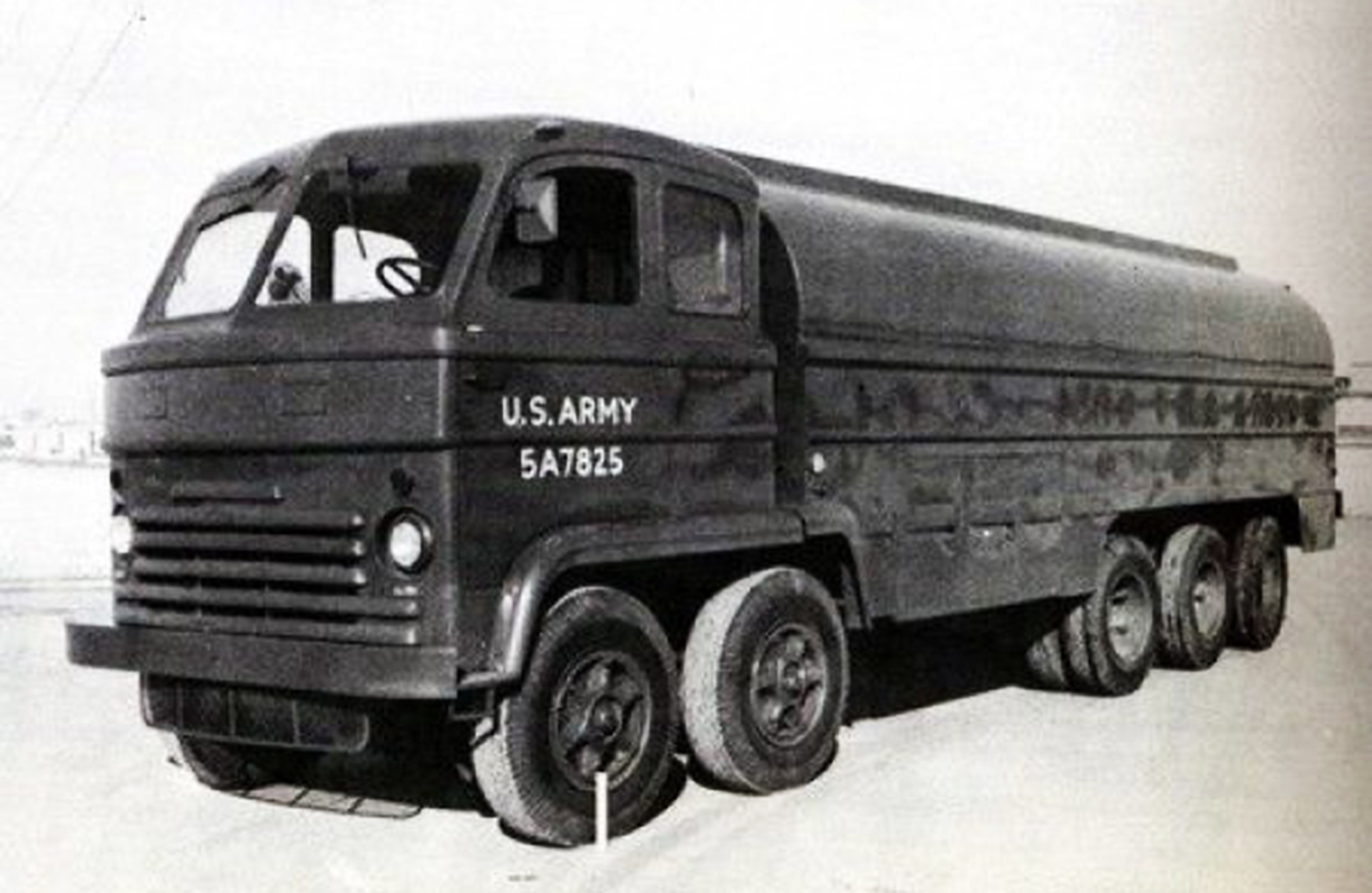
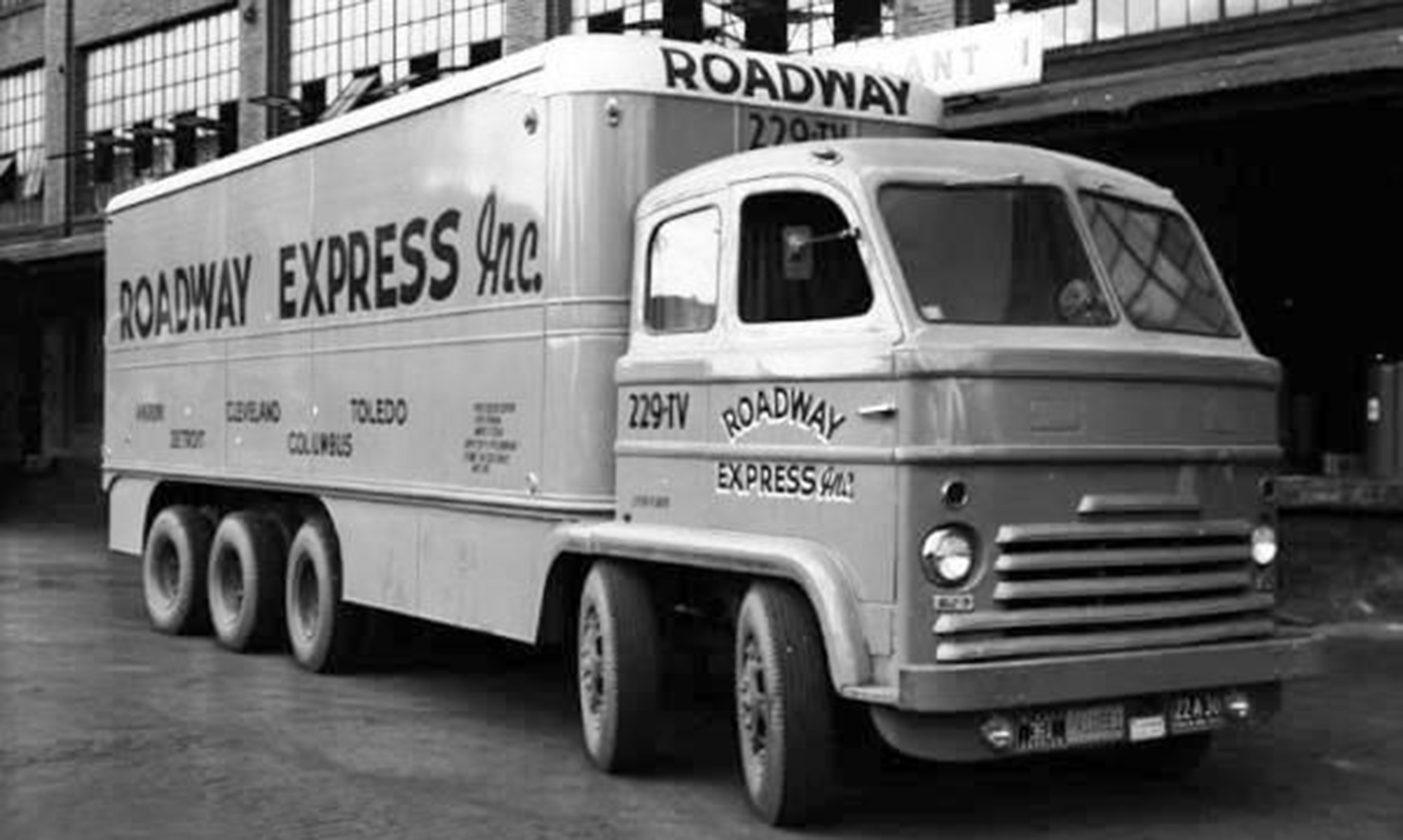
The Eisenhauer X-2 was also tested by trucking companies in the Midwest, including the aforementioned Allied and Roadway Express. According to the September/October 2003 issue of Wheels of Time magazine, the driver of an X-2 suffered an engine failure. Instead of calling for a tow, he pulled over, disconnected the driveshaft from the broken engine, and drove away on the remaining engine.
Unfortunately, this was also a dead end. The military didn’t want the X-2, and Eisenhauer was banking on the military’s support to fund the production of the truck. Eisenhauer didn’t even have the money to fix the truck’s defects, of which there were reportedly many.
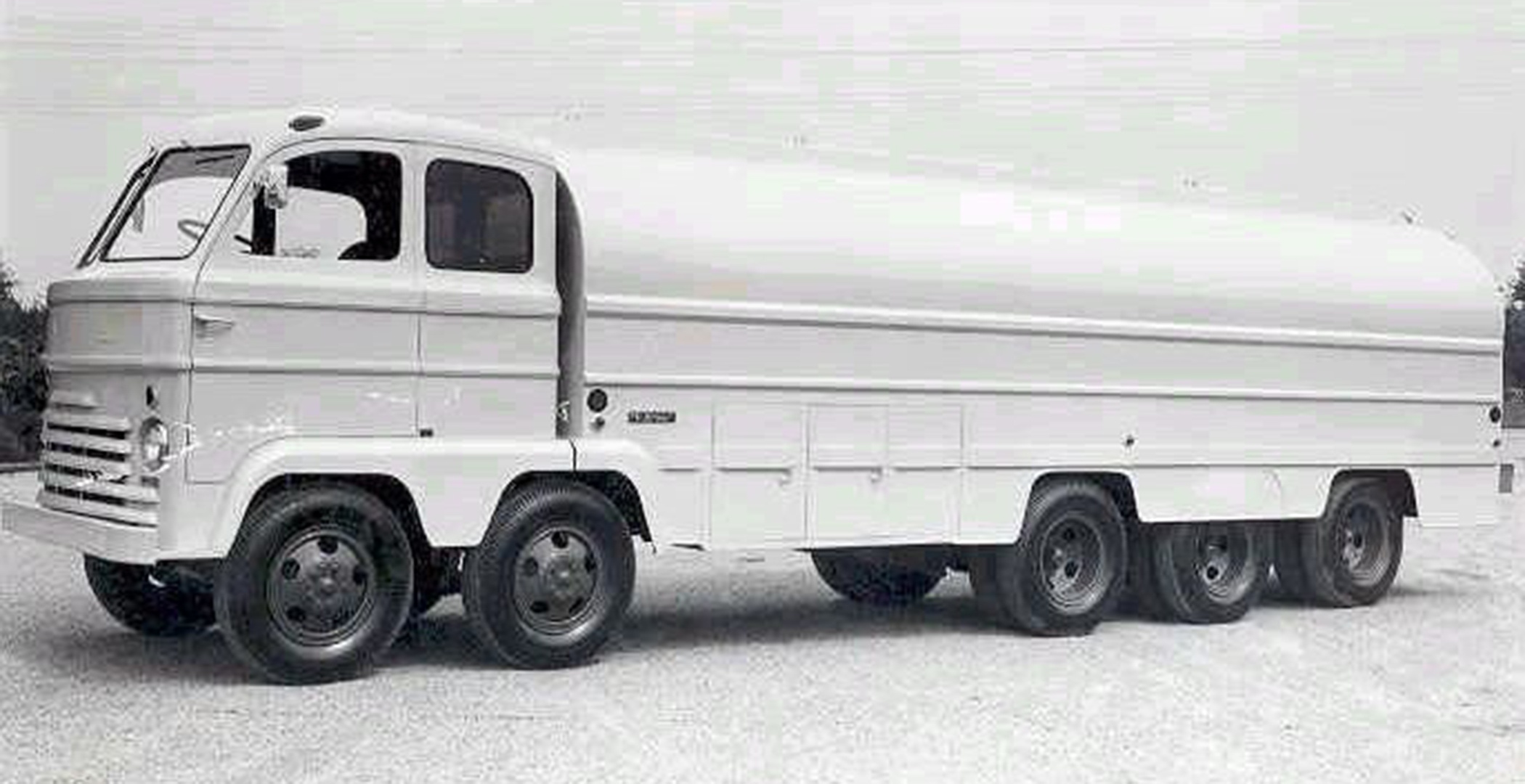
In fairness to Eisenhauer, it was a company that made bogies, stampings, and washing machines. It was not originally in the business of making trucks, let alone horribly complex ones. Either way, Eisenhauer canned the project and moved on. Nobody even bothered to preserve the prototypes, and Eisenhauer apparently doesn’t know what happened to them. That’s an unceremonious end by any definition.
The Trucking Industry Stayed Course
It would be easy to say that the Eisenhauer Twin Engine Truck failed because Eisenhauer didn’t have the money to refine the design and didn’t have the money to produce them. The original prototype truck guzzled gas, had a low power-to-weight ratio, and apparently wasn’t particularly reliable. All of those could spell death for a long-haul rig. Likewise, Eisenhauer never got past the hurdle of just getting a vehicle into series production.
However, I’m not sure the truck would have been successful even if Eisenhauer had pulled it off, and it goes back to Eisenhauer’s ambitious idea of replacing the tractor-trailer with a really long, complicated tractor.
Separating the tractor from the load carries several advantages. Long trucks are easier to maneuver thanks to the pivoting connection between tractor and trailer. A truck that’s separate from its cargo container is also versatile. A semi-tractor can haul a dry van on one load, a tanker on another, or a flatbed on the one after that. Likewise, the tractor doesn’t have to be around during loading and unloading.

The Eisenhauer Twin Engine Truck was permanently married to its cargo compartment. There was no swapping out a trailer. Likewise, in order to get the Twin Engine Truck to handle anything like a typical semi, it required the development of a novel steering system. It “simplified” trucking, but through numerous complicated steps. Ultimately, the industry mostly kept doing what already worked and continued to hitch trailers to the backs of cabover semis for decades.
Today, there are Class 8 straight trucks out there, but they utilize the proven traditional layout of having only a single set of steer tires at the front, a single engine, and fixed rear axles. There are trucks out there that have multiple sets of front and rear axles that steer, but they’re largely limited to special vehicles like mobile cranes and cement mixers.
Still, while the Eisenhauer Twin Engine Truck might have been a failure, it was one of the weirdest heavy truck designs of the first half of the 20th century. It basically forced two trucks and a trailer into an unholy marriage of 16 wheels and two engines, which is just so awesome. A part of me wonders what could have happened in an alternate history where the Eisenhauer Twin Engine Truck was successful and game-changing.
Top photo: Eisenhauer Manufacturing



Great article!
“American Chain Tru-Stop brakes”
“Yeah, but that TruCoat!” (and Tru-Stop brakes!)
“Three miles per gallon”
Wow, that’s pretty good, right?! Ha ha
I mean, all they had to do was use a Fuel Shark! (Oh, it wasn’t invented yet) I love mine…I’m so impressed with it and can’t believe how much gas I save w/ it. It’s so awesome!
Who else wants one of these for their RV project? I do wonder if these would have done better as fire trucks. Put a 110 ft. Schmeal ladder on the back with a 2000 gpm Waterous pump and still have capacity for 1000 gallons of water.
I get a ‘tingling feeling’ over dual front axle vehicles. I was a preteen when the John Player Special was racing and the original ‘Italian Job’ with its Mini hauling bus was in theaters. I was hooked
Umm, this is one of the coolest damn things I have ever seen. For someone who loves a straight 6, you’re telling me there was a truck that had 2 of them?!?! None of these survived to exist today? I have always wanted a cool COE flat deck car hauler but this would be equally as cool as a COE and I guess the original technically was a COE.
Having done an alignment on a twin steer cement truck, y’all can fuck right off with that many steering components.
Super cool truck and article, though. Thanks Mercedes!
I always wondered about alignment on one of those things
It’s exactly the same steering components. Twice.
So two of everything.
Fun fact though, a lot of heavy vocational trucks and dump trucks run twin steering boxes even with a single front axle, where the second is a slave that purely increases steering power, without a mechanical connection to the steering shaft.
I was wondering about the turning angle. It seems that each of the four wheels would have to turn at a slightly different angle
They do, but that’s all built into the knuckles to have a specific sweep (length of the connection to the tie rod end), we can’t adjust that.
On heavy trucks all we can really adjust is toe, caster, and thrust angle. We’re not set up to bend axles so we can’t change camber.
Today, I learned. Thanks!
I don’t know how you find these, but I really enjoy your series of “[X years] ago, someone tried to reinvent [transportation device] by [absurd but plausible idea].”
Should have been the Eisenhauler.
Looks like one of those Oshkosh HMETTs to me.
I think a HMETT with a mid century modern tiny house with a butterfly roof on the back would be the perfect RV
Eight decades ago in the United Kingdom they were going in the opposite direction. Instead of chasing higher payloads and immense distances with more wheels they were looking for a tractor-trailer that could maneuver as well as a horse and cart in the medieval streets of market towns.
The solution was a tractor with a single front wheel that could rotate 360 degrees, and a trailer that could be attached and detached without getting out of the cab: the Scammell Scarab.
British Rail absolutely loved them for that pesky “last mile” delivery problem, how to get the package from the rail station to the destination?
https://en.wikipedia.org/wiki/Scammell_Scarab
I think I saw one of those on the road in Italy once. It was night time so I can’t say for sure but it was a single front wheel truck.
Italy has the Piaggio Ape for 3-wheel cargo carriers; might have been one of them. The British exported Scarabs to a few of their colonies… not sure if any made it to Italy.
Typical Brits underpowering their trucks. 3 and 6 ton tractors? A 2-liter flathead should do the trick!
Didn’t see one in ‘The Man in the High Castle’, so I doubt that it had any impact in that universe.
That monstrosity had more steering axles than non-steering. At that point, why not just let all the axles pivot as needed?
Or just use a bunch of giant swivel casters and make cornering more exciting.
Let me check something
Sixteen wheels and a dozen roses
Ten more miles on his four-day run
Yep, still works, the universe wouldn’t have changed THAT much if this had caught on
This is what will always kill large straight trucks from being the dominant style. It just saves way too much time and therefore money to be able to separate the cargo from the tractor. One tractor can handle multiple trailers, the cost savings are enormous!
Europe is still making use of BDF (“Behälter-Demountier-Fahrzeug”) or “swap-body” trucks. The truck chassis is a typical long straight truck, with a removable container system on top. They usually tow a second container on a trailer, or use a dolly system to tow a semi-trailer behind. The trailers themselves may also use containers or swap-bodies similar to the trucks. It’s a flexible system that attempts to make the most use of both straight trucks and trailers.
BDFs got their start when European regulations were less favorable to US-style tractors with long semi-trailers. They were really just an evolution of what was the then-common European long-haul straight truck + trailer combination. Changes in rules have made semis far more common, but BDFs/swap-bodies still have a major role in European logistics.
BDF = Bundesverband des Deutschen Güterfernverkehrs
Or just take one ISO intermodal container off, snd plop another on. You could probably do that as fast as switching trailers.
I have an image in my mind of a weird truck that had a driver in a cab that was so low he was like a F-1 driver in it. I can’t find the story about it.
I could see someone making a truck that has a frame designed for ISO containers that has a flat engine and a cab placed between/under the frame rails. This would not be useful for driving around town because of visibility and would suck on the highway because of the aerodynamics of an ISO Box, but it would be useful at a port or shipping storage place to carry boxes around at low speeds in a controlled environment. I sort of suspect there is something out there that is basically a powered skid that goes under an ISO container.
You mean this?
https://www.theautopian.com/five-decades-ago-one-man-tried-making-trucking-more-efficient-by-putting-the-truck-under-the-trailer/
That’s where it was. Couldn’t find it. I think that truck design would work well in a port instead of using forklifts and the like.
Something I don’t see as often as I used to… TOFC Trailers On FlatCars.
Trailer-on-flatcar – Wikipedia