

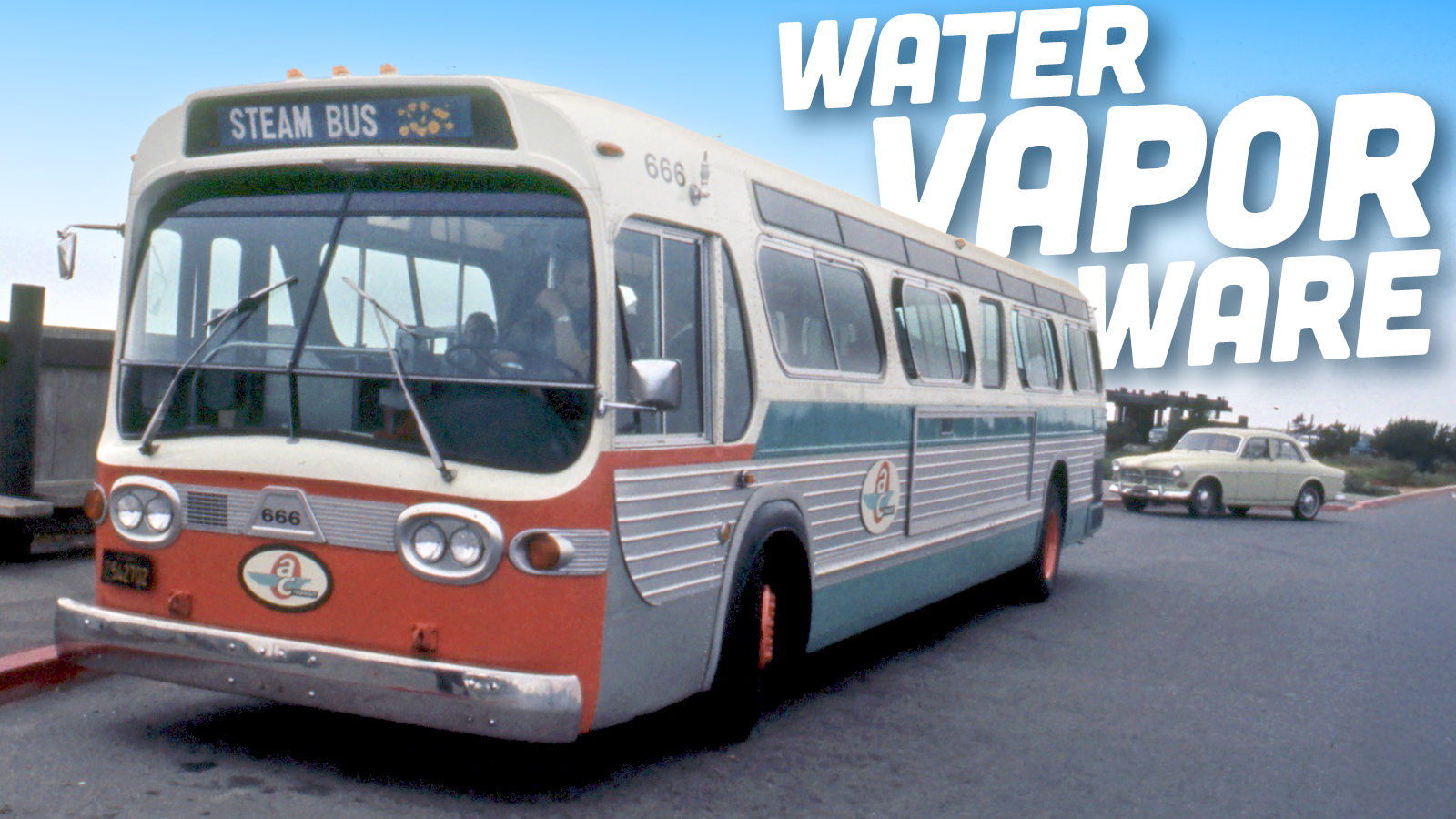
Back in the 1970s, America’s cities weren’t as cozy as they are today. Dense smog clouded the views of the beautiful skylines of Los Angeles, New York City, Chicago, San Francisco, and more. This pollution wasn’t good for the millions of people who had to breathe it. Since 1959, the California state government has been working to reduce pollution from vehicle emissions, and in 1972, the state embarked on an ambitious project. The steam engine was believed to be a possible replacement for the dirty diesel engines of the 1970s, and to test it out, multiple cities converted city buses to steam power.
Back in 1943, the South Coast Air Quality Management District writes, Los Angelenos were forced to deal with an enemy they could not fight. Plumes of smoke and fumes blanketed Los Angeles right in the middle of a heatwave. According to the Los Angeles Times, visibility was as low as three blocks. Meanwhile, residents complained about having stinging eyes and “scraping” throats.


What the city experienced was nothing new. For 40 years by that point, Los Angeles found itself draped in so much smog that, in one case, residents mistook a giant cloud of pollution for a solar eclipse. What happened in 1943 was in part a result of the rapid industrialization of American cities during World War II. As plants roared with the sounds of machinery, all kinds of toxins were released into the air. Meanwhile, car ownership was also hitting all-time highs, and what came out of their tailpipes only contributed to the mess.
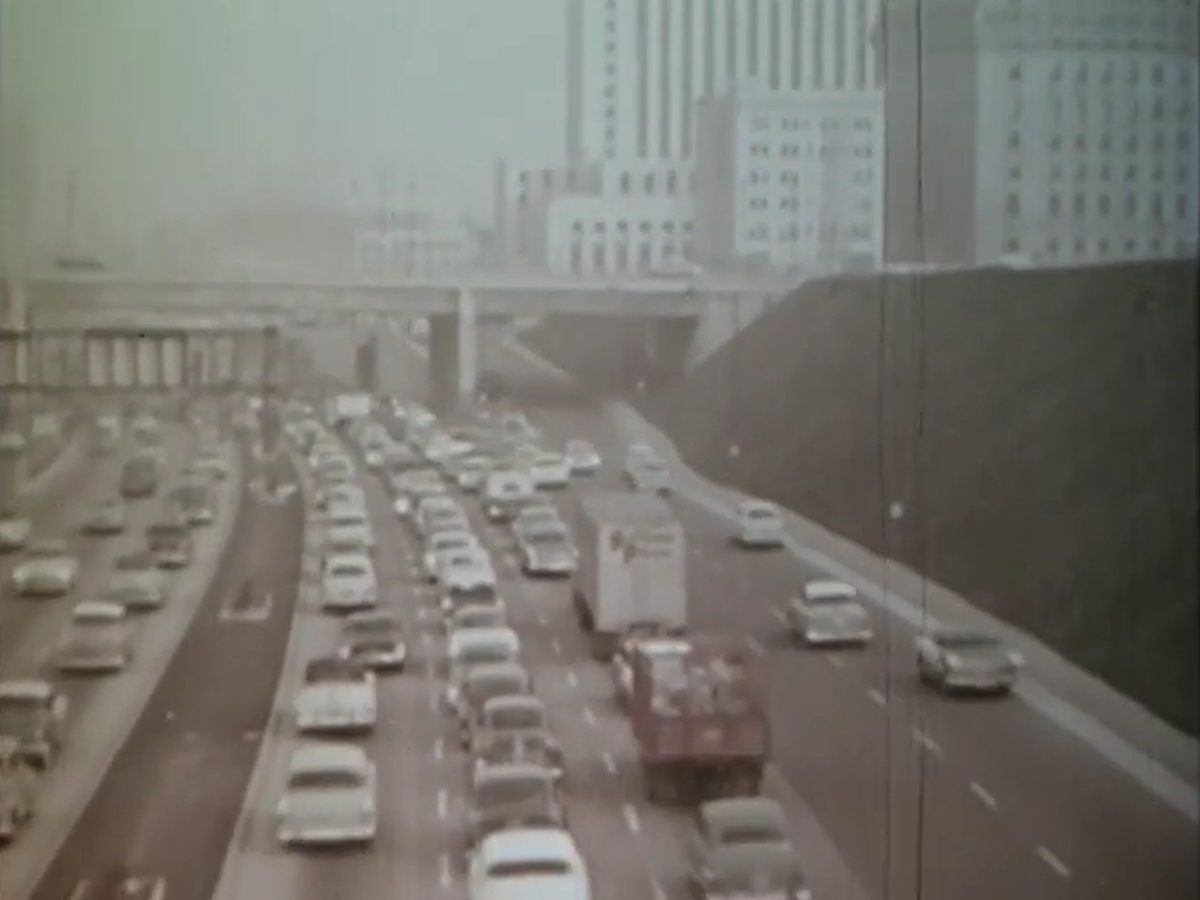
Scientists conducted research into the causes of the smog, finding that the causes were vast, ranging from toxins released by factories and car exhaust to burning trash, diesel engines, and locomotives. The mountains surrounding Los Angeles and the city’s largely stagnant winds made the situation even worse. Reportedly, there were so many awful chemicals in the air that car tires in California degraded faster than they did in other places.
In 1947, the Los Angeles County Board of Supervisors established America’s first air pollution control program. By December 1959, the state of California became the first in the nation to enact vehicle emissions standards. The standards set by the California State Department of Public Health targeted hydrocarbon (HC) and carbon monoxide (CO) tailpipe emissions and helped lay the groundwork for the landmark Clean Air Act of 1963, which was the first federal legislation that permitted the government to combat pollution.
At first, California’s emission controls did not include diesel vehicles, which were seen belching out black smoke on the state’s roads. In the late 1960s, as California sought to lower tailpipe emissions even further, the diesel engine was also targeted. One of the solutions pitched to lower diesel was to get rid of the diesel engine entirely, and going back to an old friend of locomotion: Steam power.
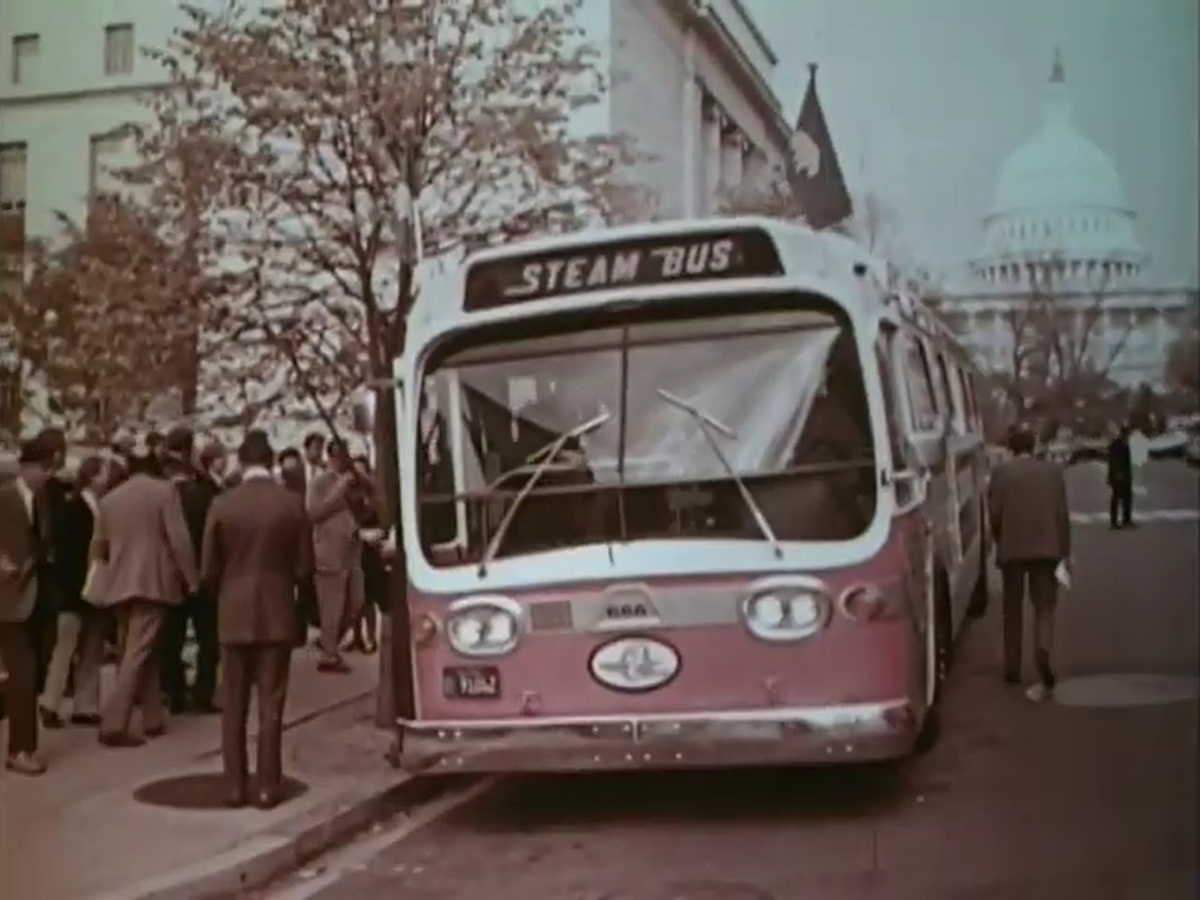
The Idea Of Steam-Powered Buses Wasn’t That Crazy
According to the Assembly Office of Research of the California Legislature, the idea to make buses run on steam did not materialize out of nowhere:
During 1967-68, studies and hearings by both state and federal agencies revealed that certain alternatives to the internal combustion engine (ICE) might be feasible as low-emission automotive powerplants. One alternative is the external combustion engine (ECE), in which fuel is burned continuously and completely to generate power. There are several types of ECE, but the most familiar is the steam engine, technically known as a Rankine cycle engine. The studies and hearings suggested that the ECE, far from being an outmoded concept, could become a workable alternative to the ICE, with the aid of modern technology. With this in mind, the California State Assembly decided to sponsor the demonstration and evaluation of ECE propulsion systems. This work was supported in part by a grant of funds from the Urban Mass Transportation Administration of the U.S. Department of Transportation.
The purpose of the California Steam Bus Project was to evaluate the technical feasibility and public acceptance of the ECE as a low-emission, quiet propulsion system, using city buses as demonstration vehicles. Emphasis was to be placed on the early demonstration of potential, rather than extensive development or technical perfection. The title “Steam Bus” was adopted after the project’s engineering contractors chose Rankine cycle systems to exemplify the ECE.

As Roy A. Renner, an engineer with International Research and Technology Corp., wrote in a paper published in SAE Transactions, there was precedent to go with steam power:
Steam-propelled road vehicles have existed for over 200 years. The French engineer Cugnot demonstrated a 3-wheeled artillery tractor during the 1760s. Steam-powered stage coaches (the first steam buses) were operated commercially in England in the first half of the nineteenth century, although they were rapidly superseded by faster and more efficient rail conveyances. The birth of the true automobile occurred during the 1890s. Until around 1910, many observers regarded steam power as superior for road transport. Lightweight, high-torque, and silent steam engines were invented and manufactured by the thousands. Steam cars were displaced by the gasoline-fueled internal combustion engines (ICE) when the latter evolved into forms that were cheaper, simpler, and more convenient to use.
Interest in the latent possibilities of steam was not totally forgotten, however. The work of Doble, Besler, Williams, and others in the interim years may yet prove to be forecasts rather than of historical interest only. Returning to bus applications, the London public transit system operated some hundreds of Clarkson steam buses until 1919. These vehicles were fueled by kerosene, and employed condensers for the recycling of the water.
The Doble technology found its way into city buses, presaging the present California experiment. During the early 1920s, the Detroit Motor Bus Co. operated two Doble-powered buses for over 30,000 miles. These vehicles had an acceleration rate which was greater than that of contemporary gasoline buses, and with a fuel consumption which was competitive. In 1929, the Doble Co. installed a steam system in a General Motors Yellow Coach. During the mid-1930s, high-grade motor fuels were in short supply in the German Third Reich. Warren Doble worked closely with the Henschel works at Kassel to introduce “Dampfomnibusse,” which could burn fuel oils derived from coal. One such bus prototype is shown in Fig. 2. The direct-drive and reversible steam engine developed a rear-wheel torque which was greater at all road speeds than the competing ICE with 4-speed transmission.
With the stage set, it was time to make modern steam-powered buses a reality.
Converting Diesels To Steam

According to the California State Legislature’s Assembly Office of Research, development began in earnest in 1970. To provide researchers and evaluators with a broad set of choices, three contractors were selected to partner up with a transit organization, and each contractor was encouraged to explore different designs to achieve the same result.
William M. Brobeck and Associates of Berkeley, California, teamed up with the Alameda-Contra Costa Transit District in Oakland. Bill Lear’s Lear Motors Corporation of Reno, Nevada, partnered with the San Francisco Municipal Railway (MUNI). Finally, Steam Power Systems of San Diego, California, hooked up with the Southern California Rapid Transit District (SCRTD) of Los Angeles.
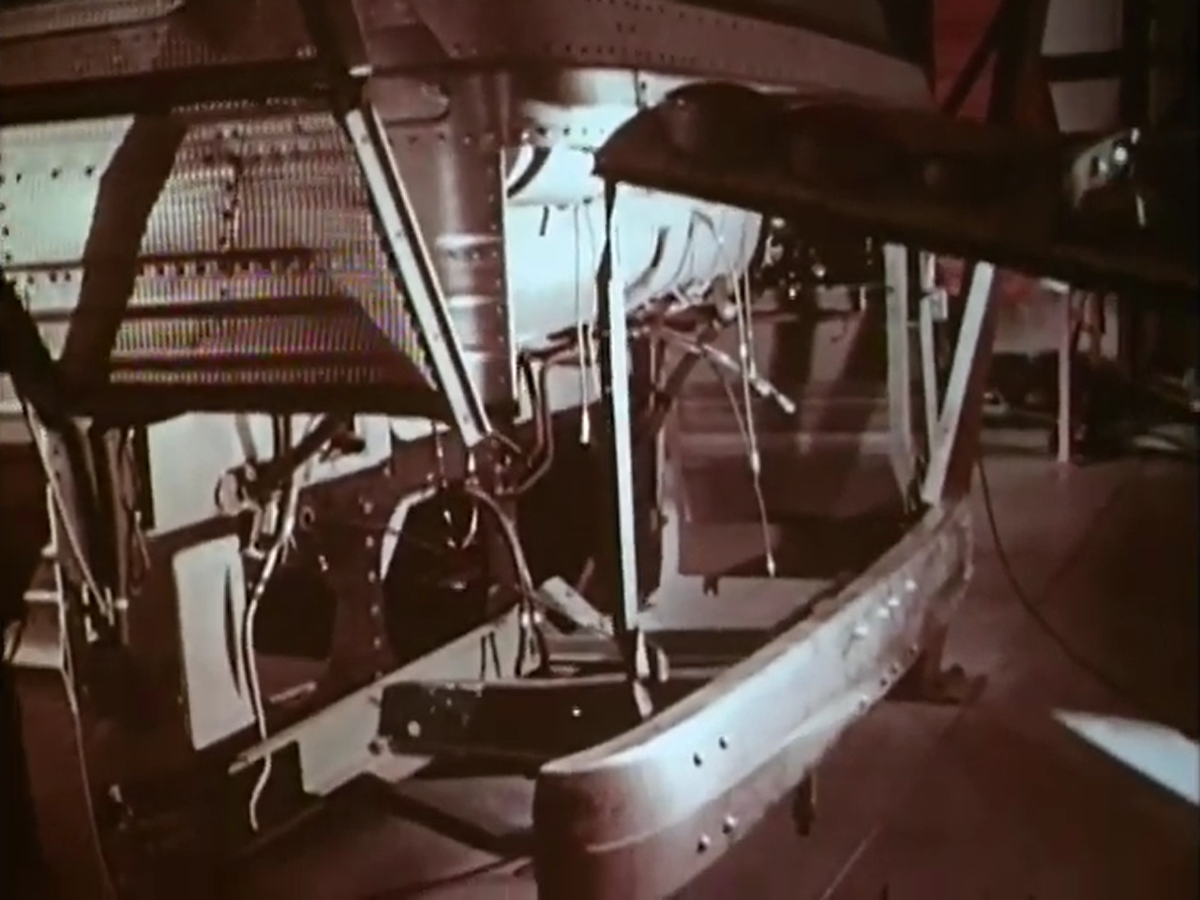
All three contractors were given a mission to remove diesel engines from standard General Motors and Flxible 40-foot transit buses and replace them with steam external combustion engines. Renner’s paper describes what sounds like chaos as engineers tried to figure out the best way to build a steam bus:
Reciprocating, rotary, and turbine expanders all reached the preliminary bench test stage. A number of working fluids other than water were examined and some were used in bench-test powerplants. Several variations of control systems, auxiliary drives, feed pumps, and burners, went on to the expensive junk pile. The present systems have some features in common. All use water as the working fluid. All generate the steam in forced-circulation, continuous-coil tubular steam generators. Final control of the steam temperature is by the “normalizer” principle, in which supplemental feed water is injected into the superheater as required. Condensing is by fan-cooled, finned tubular radiators. As an expedient in this short-term endeavor, all three buses use commercially available multi-ratio automatic torque converter transmissions. In each case, the main expander (engine or turbine) drives auxiliaries and accessories at idle. While a variety of liquid fuels may be used, most testing was conducted with No. 1 diesel.

The program did not eliminate the use of diesel entirely. Instead of burning diesel in an engine, No.1 diesel was used to heat the water. Technically, the steam systems could have run on a variety of fuels, but diesel is what was used during testing.
Renner then detailed the design each contractor landed on:
The Brobeck system is an outgrowth of the automatic monotube steam generators and compound-expansion piston engines developed earlier by Doble and Besler (10). The steam generator and its automatic controls are mounted in the original engine compartment at the rear of the bus. As shown in Fig. 3, the other systems elements are located amidships under the floor. All accessory and auxiliary units are belt driven from pulleys on the forward end of the engine crankshaft. Condenser fans are remotely driven by hydraulic motors. The transmission is a Dana- Spicer model 184 2-speed torque converter unit, locking up into direct drive at 29 mph.
Approximately one-quarter mile of tubing is used in the steam generator, varying from 0.50 in OD in the economizer section, to 1.0 in OD in the superheater. In order to reduce pressure drop through the generator, two parallel tube paths are used in the economizer and most of the evaporation zone. These are merged into a single monotube coil in the final evaporation and superheating regions. Both tangential and axial burner firing were tried, with the former yielding better results in this generator configuration. The burner uses a single air-atomizing nozzle, with automatic switching among four steady-states: off, idle, low fire, and high fire. The engine (expander) has three double-acting cylinders (Fig. 4). Compound expansion is utilized, with one high-pressure cylinder exhausting into two low-pressure cylinders. As an expedient for this early demonstration, a nonreversible fixed cutoff valve gear is used. By locating the system components in existing spaces, the original seating capacity (51 passengers) was retained.
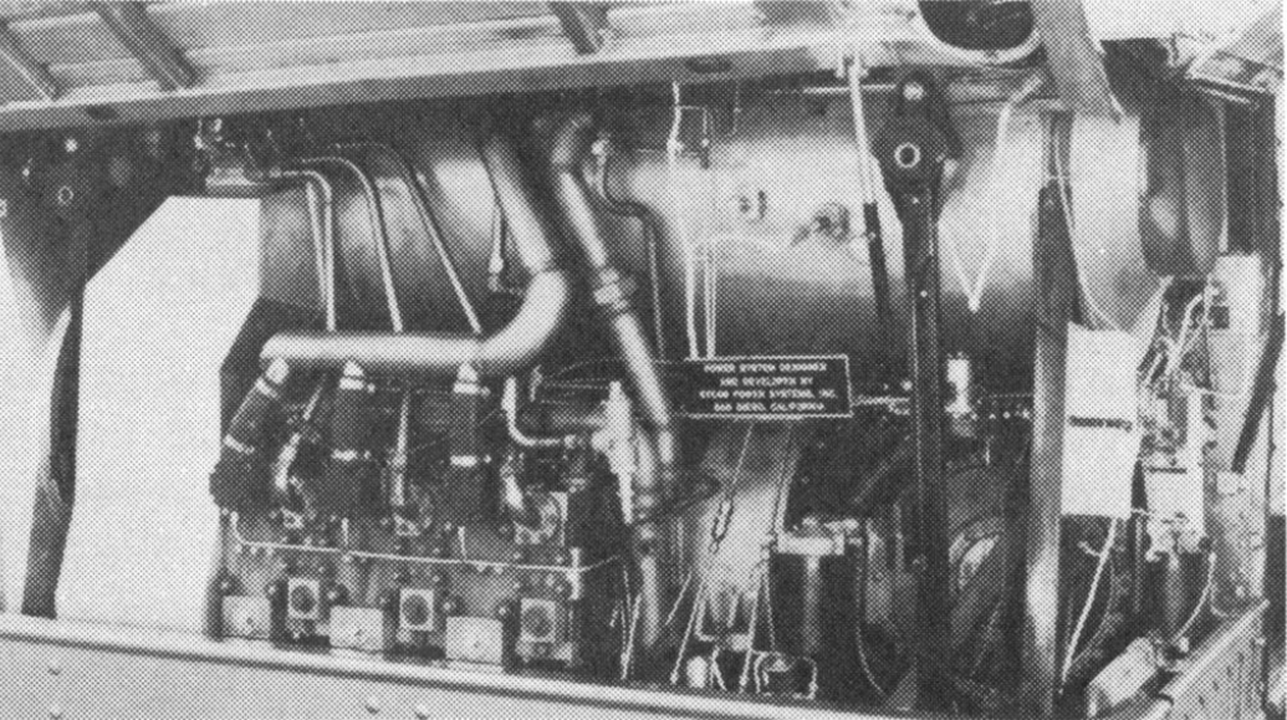
The [Steam Power Systems] powerplant (11) features a 6-cyl double-acting compound-expansion engine. The steam is reheated between the two expansion stages. Steam generation is by a series-parallel tubular boiler, with an additional section for the interstage resuperheating. The steam generator, expander, auxiliaries, and one of the condensers, are located in an enlarged rear-engine compartment. Three additional condenser cores are located under the bus, just behind the front axle. Fig. 7 shows the system installation. Of the three buses, this is the only one to retain the original transmission (GM-Allison Super V) and angle drive rear axle. It is also the only bus equipped with air conditioning. Two significant innovations were carried to the bench test phase, but were laid aside temporarily when time did not permit sufficient development to allow installation into the bus. One of these was the use of infinitely variable cutoff valve gear, and the other was the elimination of oil lubricants in the steam cylinder. The firstof these allowed engine speed control without a throttling valve and would be conducive to high-thermal efficiency. The second would avoid the old problem of oil carry-over into the condenser and boiler.
Bill Lear – famed for inventions like the Lear Jet and the automotive eight-track player – took a very different path than the other two contractors. The other two buses used reciprocating steam engines like old steam locomotives did. Lear’s design was a newer technology used in railroading that remains in use for power generation: the steam turbine.
Before we get into how Lear made its bus, let’s look into the basic function of a steam turbine. In a basic steam engine, a fuel like coal, wood, or oil is burned in a box. The heat from this fire is funneled through flues, which heat water in a boiler. The boiling water generates steam, which is under pressure since it’s in an enclosed vessel. This pressurized steam can then be directed to cylinders through slide valves. The piston can then be attached to other mechanical components to drive a locomotive, ship, or industrial machine.
In a steam turbine, the steam now drives a turbine instead of a piston and cylinder, resulting in rotary motion. An invention of the 19th century, steam turbines run faster, more efficiently, and quieter than steam engines while being smaller than equivalent steam engines.

Now, let’s look into how Renner explains the Lear turbine bus:
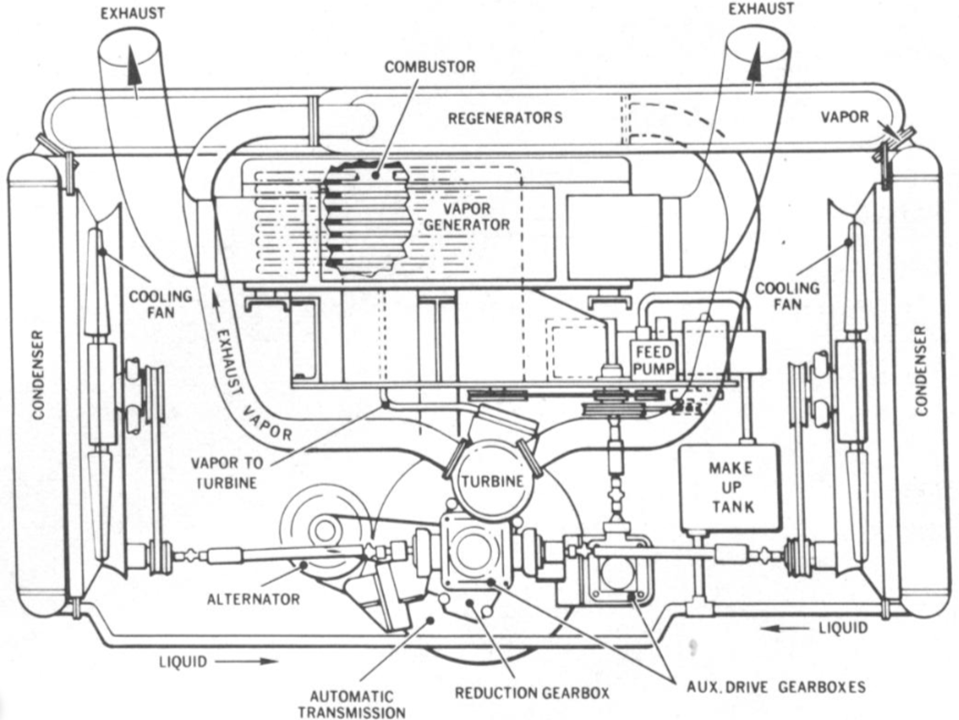
The Lear power system differs strikingly from the other two, in the use of a turbine as an expander. All major components are placed in the original rear compartment. It was necessary, however, to enlarge this compartment because of the shape of the steam generator and
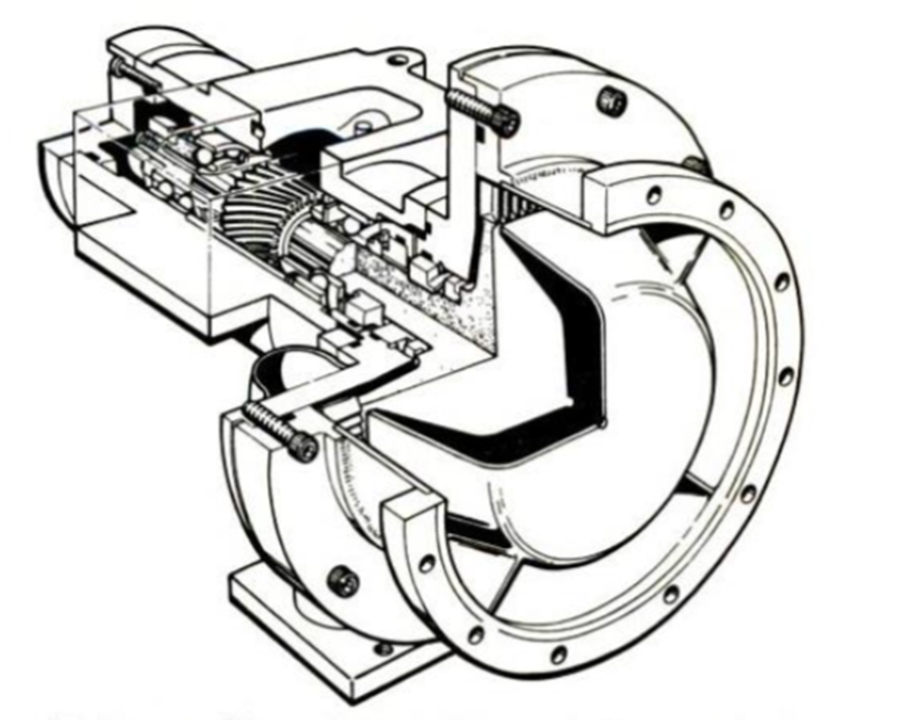
to accommodate regenerators. Lear’s steam generator features a radial outflow of the hot gases through the tube bundle. During the development period, several types of burner were tried, including vaporizing mechanical atomizing, and air atomizing. An air-atomizing burner was finally adopted.So far as is known, this vehicle is the first in history to be successfully propelled by a steam turbine. Originally, this turbine was designed to operate on an alternate working fluid having antifreeze characteristics and a molecular weight greater than that of water. During bench testing, however, it was found that this fluid deteriorated chemically at the required operating temperatures. Steam was then substituted, with redesigned turbine nozzles. The single-stage impulse turbine is very small in size (wheel diameter 5.6 in) and rotates at high speeds (to 65,000 rpm). Reduction gearing of 24:1 ratio connects the turbine, via an Allison HT-740 D 4- speed automatic transmission, to the rear axle. Most of the auxiliaries are also driven from the speed-reducing gearbox, including the feed water pump, two condenser fans, and the burner blower.
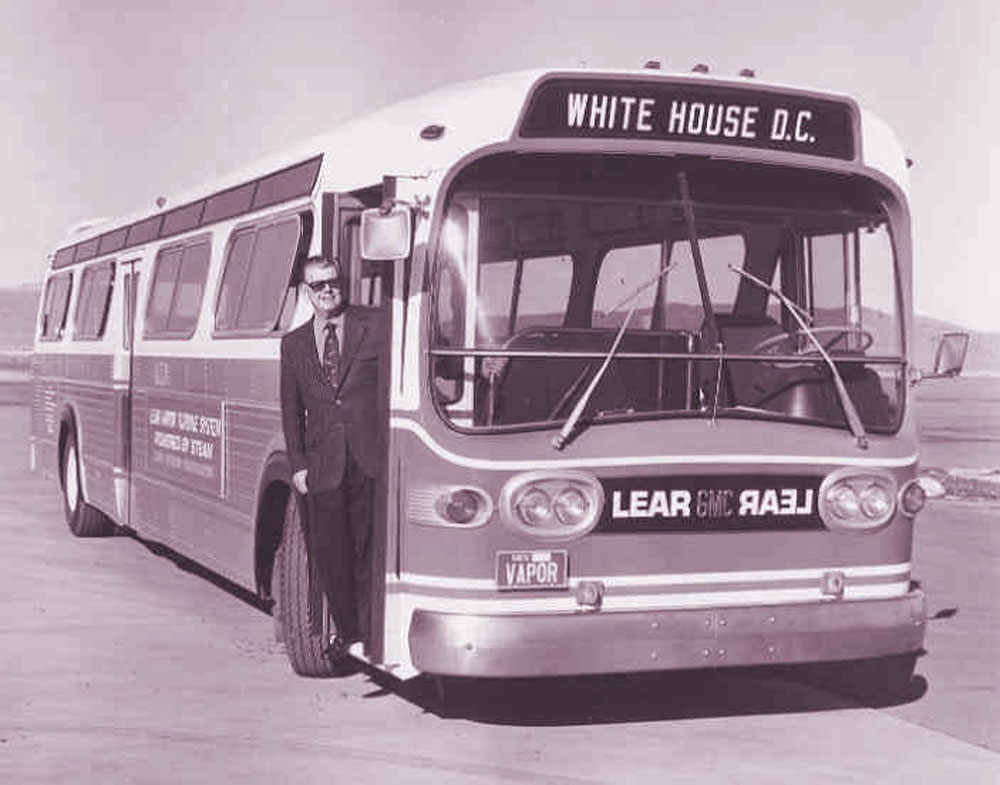
Renner is technically incorrect with the assertion that the Lear turbine bus was the first vehicle in history to be successfully propelled by a steam turbine. There were steam turbine locomotives as far back as the 1930s.
Apparently, this wasn’t Bill Lear’s only steam project, either, as he would power a Chevrolet Monte Carlo using a steam turbine and built a steam turbine-powered racecar that entered into the 1969 Indianapolis 500.
The Buses Were Promising
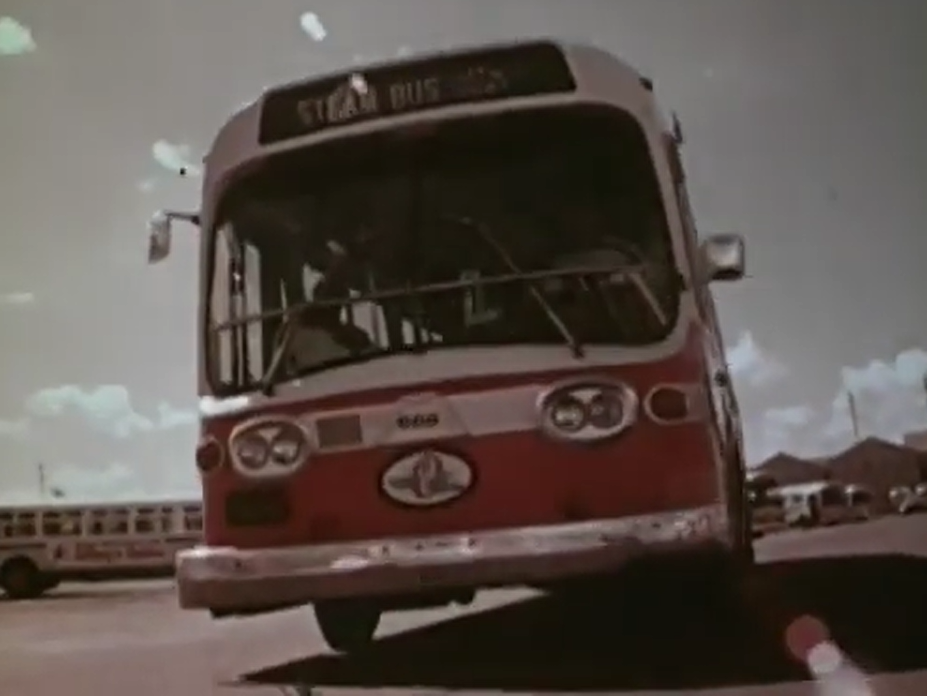
William M. Brobeck and Associates was the first to finish its bus, delivering a functional vehicle to AC Transit in fall 1971. Lear was next, and his bus was finished in January 1972. Finally, in March of that year, Steam Power Systems finished its bus. All three contractors had to work under tight parameters. No flammable, explosive, or toxic fluid could be used. The steam generators had to be designed to be inherently non-explosive, a variety of temperature and pressure safety switches and valves had to be installed, the turbines had to have overspeed governors, and driver controls had to be as similar to a diesel as possible. The contractors weren’t even able to use large pressure vessels out of safety concerns.
The results were promising. The steam buses made between 180 HP and 225 HP overall and were shown to have performance characteristics on par with diesels. The steam buses had slightly lower top speeds and took longer to accelerate, but were also much quieter and smoother than the Cummins and Detroit Diesel-powered buses they were compared with. The fastest steam bus, for example, came from SPS, and achieved a top speed of 58 mph. It took 71 seconds to reach 50 mph, or 14 seconds longer than a bus with a Detroit 6V-71. Overall, it was found that the steam buses were roughly comparable in performance to a bus with a six-cylinder diesel, but much slower than a bus with a V8 diesel.
Check out this promotional video:
In testing, it was found that the steam buses were 2.5 to 10 decibels quieter than the diesels when sitting still and up to 14 decibels quieter when on the move. Sadly, the quietness was largely limited to the exterior, as the steam buses were found to be as loud or even louder inside than diesel buses.
What really looked good was emissions performance.
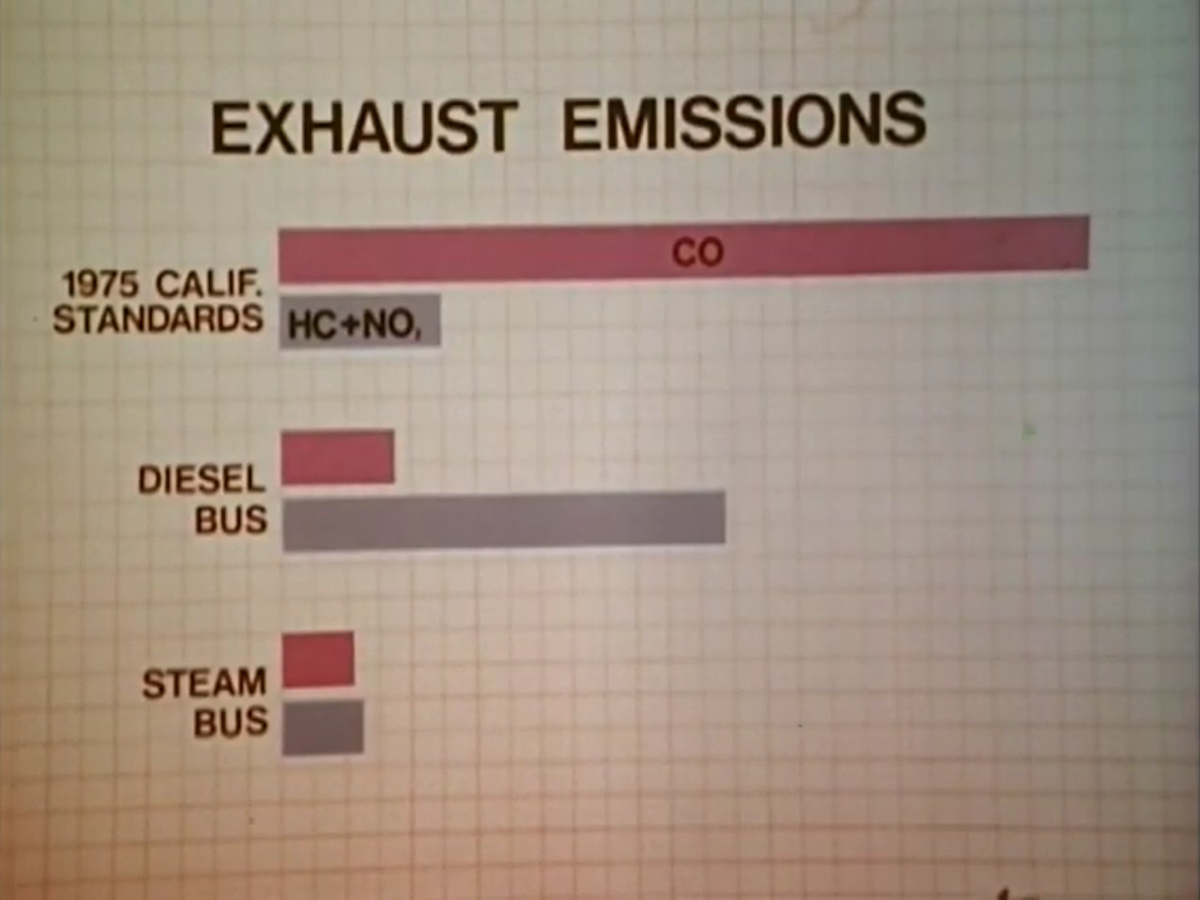
Analysis had shown that the cleanest steam bus produced 30.5 percent less CO and 86 percent less HC and NO2 than the cleanest diesel bus. In other words, the program produced the result it was hoping for. Collectively, the buses would drive a total of 8,372 miles on public roads, with around 800 of those miles in passenger service. Each contractor even managed to ensure that the buses had regular diesel-like controls and that the steam engines were able to be fired up and ready to roll in six minutes or less. The bus drivers even started them up entirely from their seats like they would diesels.
So, what went wrong? If the worst trade-off is that the inside was a little louder, why aren’t there steam buses out there today?
Running Out Of Steam
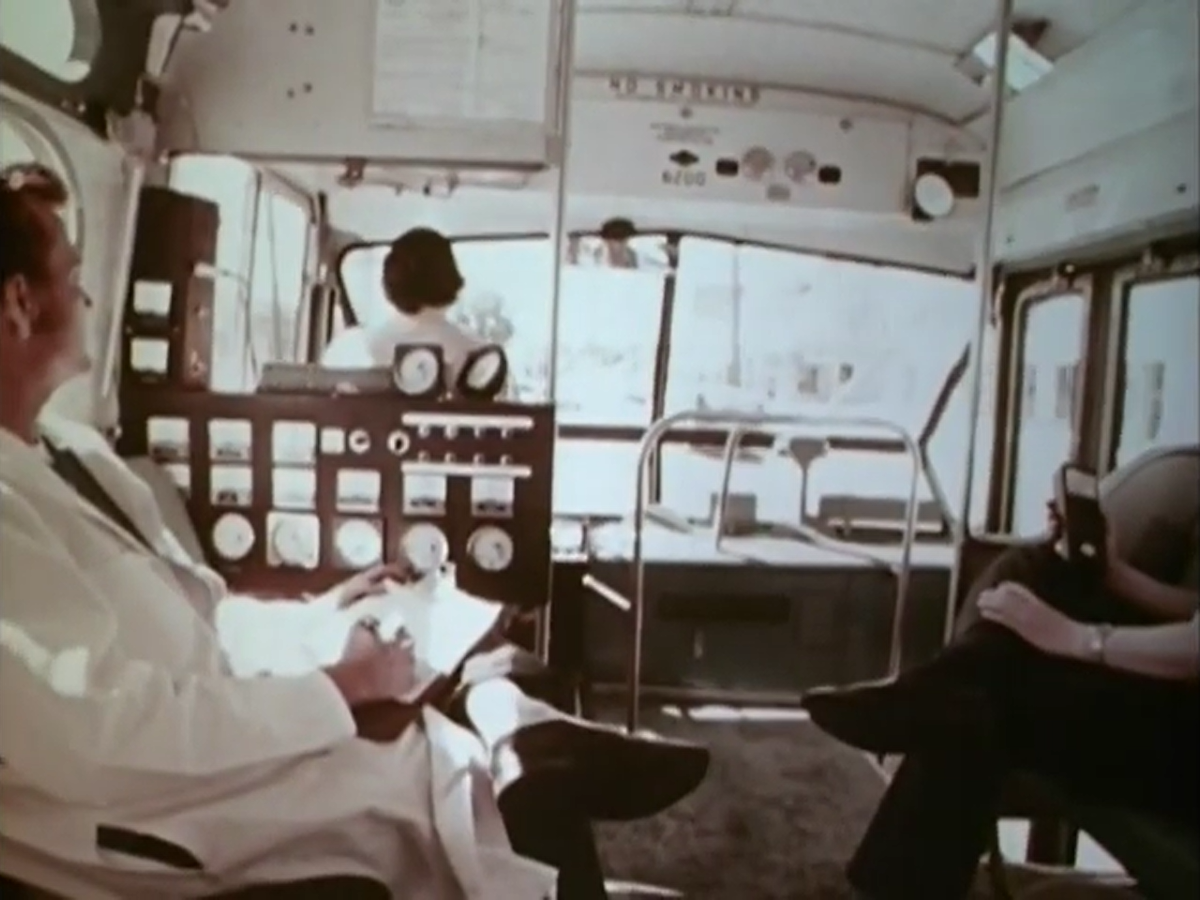
As it turned out, the experimental steam buses were great on paper, but still needed a lot of work.
The first problem was fuel economy, or lack thereof. In testing, it was found that diesels got two to three times better fuel economy than the steam buses did. At 20 mph, the diesels did between 4.7 mpg and 7.7 mpg while the steamers did no higher than 2.2 mpg at the same speed. At 30 mph, the disparity grew, as the diesels got between 7.1 mpg and 11.8 mpg while the steam buses got no higher than 3.5 mpg. In fact, 3.5 mpg was the highest average reported by the steam buses, and most of the time, they got in the mid-2 mpg range, regardless of driving speed.
Idling was even worse. At idle, the steam buses consumed 4.7 gallons of fuel per hour compared to only 0.65 gallons per hour for the thirstiest diesel. The data also showed that Bill Lear’s novel steam turbine bus struggled pretty hard. His bus tended to be slower, louder, and thirstier than the other steam buses in the test.
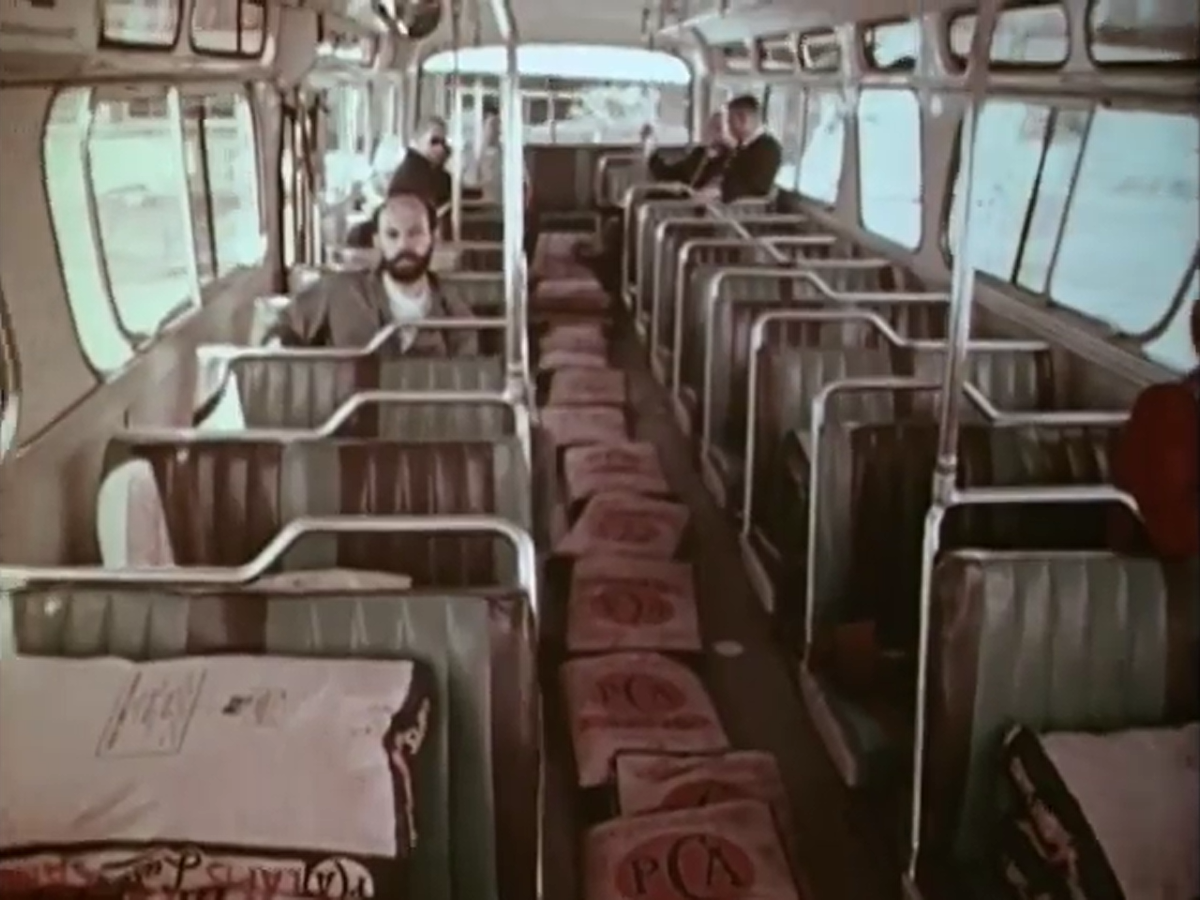
If all of that wasn’t bad enough, two of the buses were also quite unreliable. The Alameda-Contra Costa Transit District bus suffered an engine failure on its very first day of service. Repairs took five months, then the bus was put back on the road in May, 1972. This time, the bus survived eight days of use, but generated complaints about control instability, a blower motor failure, a feedwater pump failure, a relief valve bellow failure, and unexpectedly high water consumption.
The bus went back to the shop for more improvements and returned to public service in September, 1972. It then ran for nine days without any mechanical failures. This bus traveled a total of 3,465 miles during the testing program.
The San Francisco Muni Railway steam bus was a beast, and enjoyed 11 days in revenue operation. During this time, the bus climbed 19 percent grades, ran down the highway in traffic, and carried loads of 98 passengers. The only operational issues with this bus were a boiler modification to reduce smoke and a fan belt that came off. This bus was even driven 230 miles across the Sierra Nevada to Reno without issue. Overall, it traveled 3,900 miles. As it turned out, Bill Lear’s bus was the slowest, thirstiest, and loudest, but it was by far the most reliable of the three.
Then there was the SCRTD unit, and this one was a disaster. It couldn’t even complete its first two attempted days of service due to an oil pump failure and a bolt shearing off the combustor fan. It finally completed only one successful trip of 7.3 miles in September 1972, just to get sidelined because a fan in the boiler failed. Just a day later, the SCRTD team discovered a boiler leak. They decided to use the bus for performance tests for a few more days before the leak got worse. The bus managed to get only one more day of revenue operation before the steam bus testing period ended on September 30, 1972.
They Needed More Time To Cook
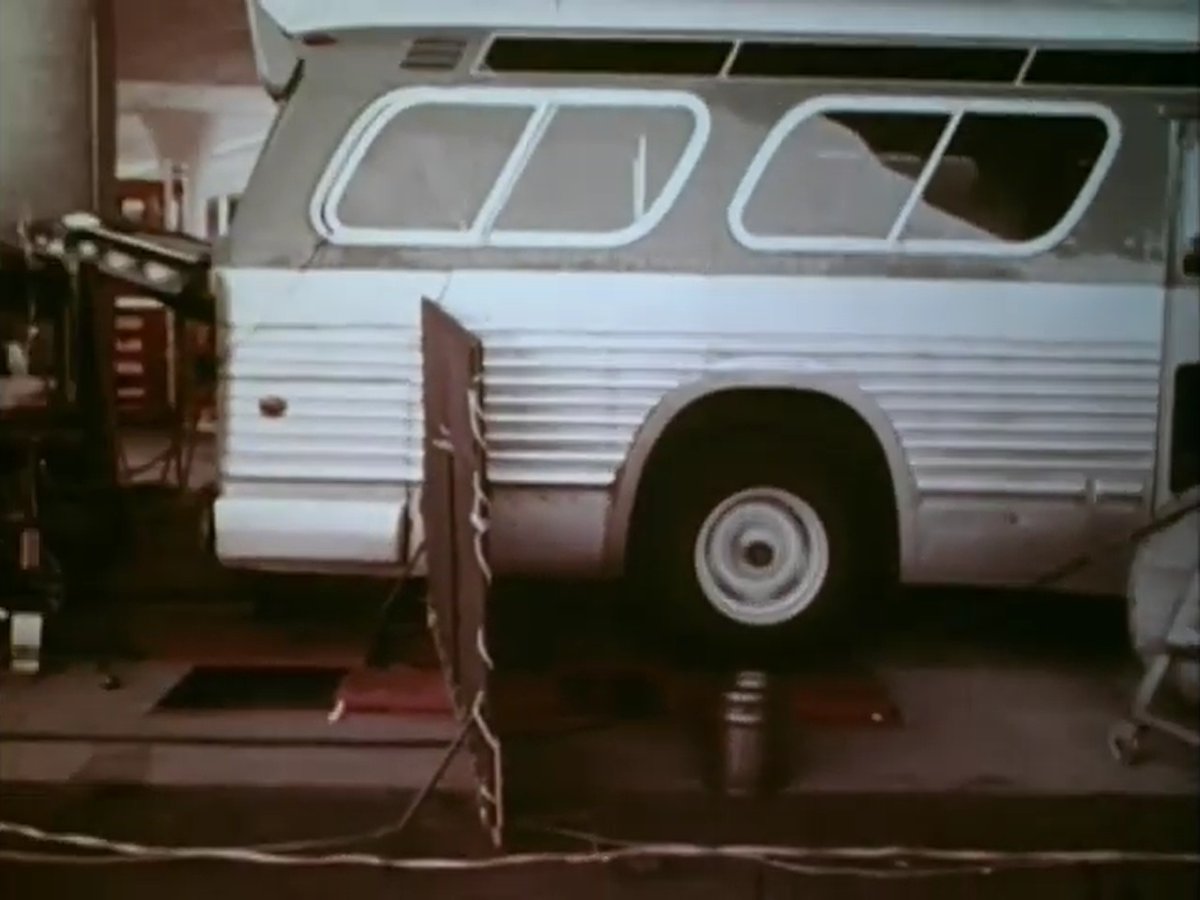
It wasn’t all bad. When surveyed by researchers, most riders, fleet managers, and drivers all preferred the steam buses over diesels. Drivers and riders in particular loved the smoothness and quietness of the steam buses.
The Assembly Office of Research concluded that the $8 million experiment ($65,002,822 in 2026) was a success. The contractors really did make steam buses that drove like diesels, but were far cleaner. The researchers believed that, with more investment, the contractors could work out the kinks to get better reliability, better fuel economy, and better performance out of their steam buses. It was believed at least another $20 million ($159,785,645 today) was needed for further research over four years.
Ultimately, this did not happen, and the Steam Bus Project concluded on September 30, 1972. The oil shock of 1973 was the final nail in the coffin, as getting 2 mpg was now untenable in a world of fuel shortages, even if steam engines could run on a cheaper fuel. Bill Lear had grand ideas for a futuristic AWD steam-powered bus of his own, but even his research came to a halt in the aftermath of the oil crisis.
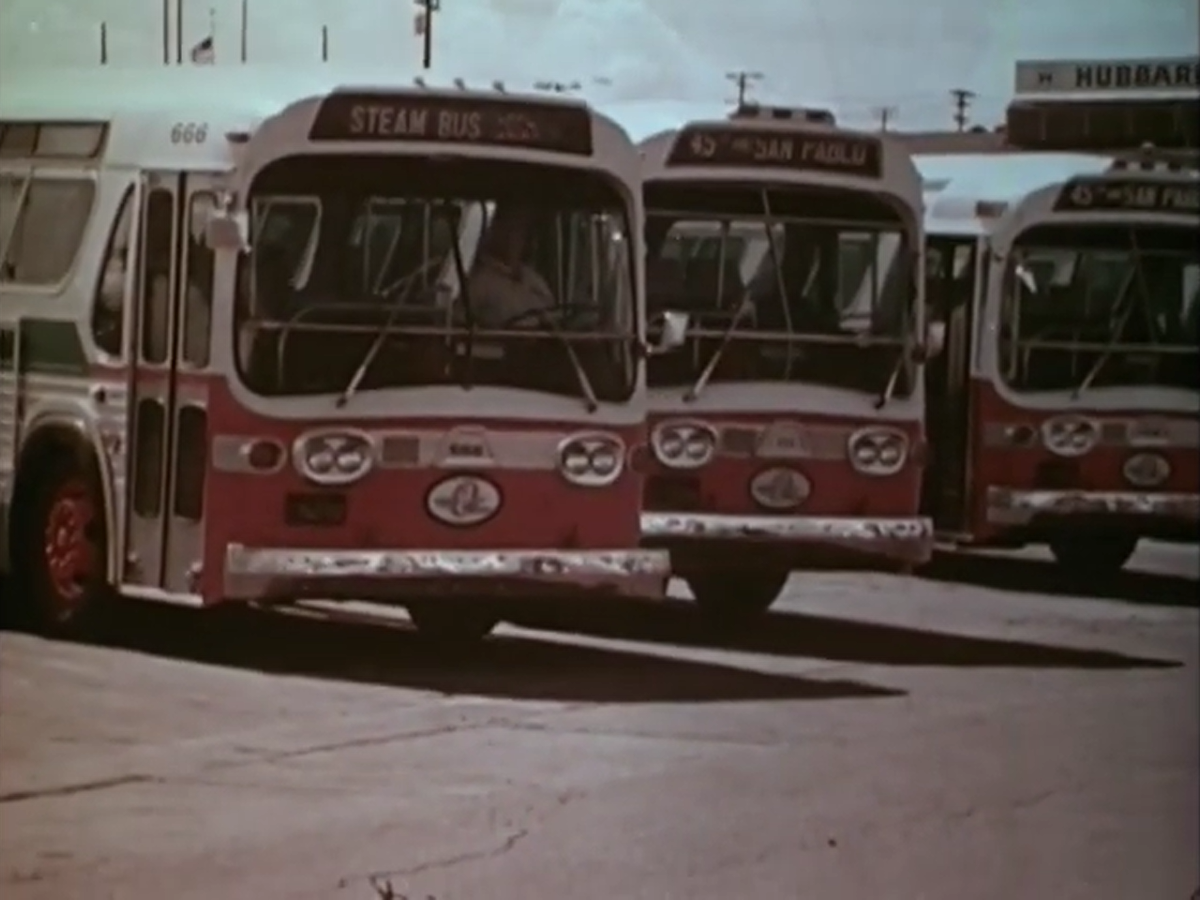
While the Steam Bus Project was ultimately a dead end, the San Francisco Municipal Transportation Agency says that it was one of the catalysts for the movement to improve diesel engine cleanliness and fuel economy. The program had proven that Californians desperately wanted better air and were willing to invest in clean air projects.
Honestly, it’s amazing that this project even happened in the first place. Three contractors took regular buses, tossed out their diesel engines, and then strapped steam engines to them. Steam engines were a bit of an anachronism even in the 1970s, so to see compact steam engines living in the back of sleek transit buses must have been a shocker to the few people who got to witness it back then.
But the project also made sense. The mission was to reduce emissions, and that part was a smashing success. A part of me wonders what things could have been like had the fuel economy issue been figured out. Would steam have had a comeback?
Top graphic image: ACT268; Creative Commons Attribution 2.0 Generic




.jpg)
Whoa, I had no idea they converted these diesel buses to steam…very interesting…amazing article!
Smog? Reminds me of the “smog strangler”:
Kramer: Hey, how are you doing? Jerry! George!
Jerry: We’re doing fine. How are you?
Kramer: What me? Fabulous, just fabulous. I’ve got a lot of auditions, a lot of call backs and I’ve got a lot of interest for my movie treatment. I’m in development, I’m in developed vehicles. And there’s a lot of energy here, man. You know, the vibe, it’s powerful. I’m just swept up at it. Yeah, I’m a player.
George: A player?
Kramer: Yeah, a player…
Jerry: Kramer, do you realize what’s going on here? Do you know why you’re here?
Kramer: What? What this? I’ll be out of here in couple of hours. Hey, guess who I met today? Rick Savage, oh nice kid, really good kid. You know, we’re talking about doing a project together.
Jerry: Kramer, you’ve been arrested as a serial killer!
Kramer: So? I’m innocent! I mean you guys believe that I’m innocent, don’t you? Jerry? George?
Jerry: Well, yeah…sure.
Police: Kramer, let’s go. The Lieutenant wants to see you.
Kramer: Ok, yeah. All right look, I’ll be out of here by noon. Maybe we’ll have lunch together, huh?
KRAMER GOES WITH THE POLICE OFFICER, BUT ASKS IF HE COULD SAY JUST ONE MORE THING
Kramer: Help me!! Help me!
Ha ha! Also Jerry’s stand up bit:
“The thing about L.A. to me, that kind of threw me, was when they have these smog alerts out there and they actually recommend that people stay indoors during the smog alert. Now, maybe I’m way off, but don’t you think, wouldn’t you assume, that the air in the house pretty much comes from the air in the city where the house is? I mean what do they think, that we live in a jar with couple of holes punched in the top? What the hell is going on out there? It’s very strange, do you realize that it’s now possible for parents to say to their children “All right kids, I want you in the house and get some fresh air! Summer vacation, everybody indoors.”
The California Assembly Office of Research must have a different definition of success than most people. Spending $65,000,000 to get a couple of broken busses…
I have my doubts that direct-drive turbines of any kind will work for a street vehicle, they just don’t like running at variable speeds. I daresay a steam piston engine would actually have been better. The old Stanley Steamers were known for their ferocious torque, perfect for a bus. And “chugga chugga” is way more fun than screaming turbines.
One of my mentors as a young engineer was from Switzerland. His town was one that used Gyrobuses for a bit.
The Gyrobus was an EV. But it didn’t have batteries. It used a multi-ton flywheel it would spin up to 3,000 rpm when it was connected to the electrical grid via three booms that came out when it stopped. With the flywheel at top speed, it could go as far as 10km at up to 50 kpm before the flywheel ran out of energy.
It was built by a Swiss company, I don’t know if my mentor knew about it because he was an engineer on the project or a passenger. Long story short, it was not a success.
Gyrobus – Wikipedia
It seems fitting that a country renowned for its mechanical clock & watch movements would field buses powered by flywheels.
It’s still quite silly, but fitting.
I’m loving these “weird engine deep dives”, Mercedes.
Fascinating insights into engineering history and engineering. Amazing stuff.
Any chance you could do an article on the Orbital 2-stroke engine that was “the future” in the late 80s and early 90s?
I recall lots of manufacturers signing agreements and running prototype engines – Ford UK had a load of Fiestas on test, some used by the Police – and then it all died off. I believe due to emissions not being good enough
https://en.wikipedia.org/wiki/Sarich_orbital_engine
No engine braking and a much shorter service life was the result…
Born and bred in Pittsburgh (mid ’70s), possibly THE poster child for urban air and water pollution. My grandparents (and parents) told tales of streetlights on at noon. It required the death of an entire industry (and the subsequent economic upheaval and distress) to clean up this city. Now the many of the old mill sites are multiuse economic development sites with residential and business centers. Pittsburgh now hosts national fishing tournaments on the once dead rivers. The buildings downtown are no longer black with soot. At least our rivers never caught fire…unlike Cleveland.
Use of steam engines for public transportation. An occurrence I knew nothing about. I do note that they were so desperate to solve the pollution issue that they were willing to innovate by looking at every possibility to alleviate it. I think we’ve lost that drive today, and are steered solely by legacy companies and technologies that don’t want to lose market share.
The AC Transit logo and the bus number 666 are not to be overlooked. I am truing to sort out the background of the picture, only a few places that line the bay, thinking this is Emeryville
AC Transit has a history of transportation mods to make the buses better and pollution less
Given the advancements in turbine designs, I wonder if someone will try a steam engine in a series hybrid vehicle at some point.
Considering power generation is just various ways of boiling water to spin steam turbines. With the exception of dams, which skip the boiling step.
Nah, just remove the steam generator on the turbine powered bus, replacing it with spent Uranium fuel rods rightly packed in a very irresponsibly dense configuration in a high pressure water tank that is coated in lead and friable asbestos.
This way the Lear Turbine Steam Bus 666 is fueled for a million miles, but it can’t be parked for more than a few hours or the high pressure tank will explode…
Since the era of steam busses was in the 60s, I’m really rather surprised that no one tried to make a nuclear-powered bus.
Could you imagine getting on a nuke bus only to later find out that there were a dozen recalls that weren’t performed on it yet?
You’ll be fine if you’re wearing your Power Armor.
Remove the steam generator on the turbine powered bus, replacing it with spent Uranium fuel rods rightly packed in a very irresponsibly dense configuration in a high pressure water tank that is coated in lead and friable asbestos.
This way the Lear Turbine Steam Bus 666 is fueled for a million miles, but it can’t be parked for more than a few hours or the high pressure tank will explode…
Mercedes I have to say please check out the AACA musuem in Hershey PA. They have an excellent bus collection
I think the steam turbine statement is technically incorrect because of steam turbine ships, not because of the locomotives. Those were all massive failures, just like these buses, and should not be chalked up as remotely successful vehicles.
I assumed he meant land vehicles because yeah, if you include ships, it’s even more wrong!
The steam turbine electrics were failures, but the Pennsylvania Railroad’s S2, which was purely mechanical drive was not. PRR just didn’t build/order any more with the decision to move to diesels.
Didn’t forget about the S2, just didn’t think it was a great success given the massive fuel consumption at partial throttle; turbine was only efficient at high speed. I wonder if some kind of transmission might have been possible for it to keep it in a good operating range. Perhaps if diesels hadn’t been available that might have been worked out?
That is true, which is why it mostly handled express passenger trains like the Broadway Limited west of Pittsburgh, where it regularly ran in excess of 100 mph. It couldn’t run east of there due to a sharp curve it the Pittsburgh station.
Turbine powered ships were very successful, especially if you include turbo-electric setups. They’re still in use in nuclear powered ships and submarines.
(I also love the story about how the very first steam-turbine powered ship, Turbinia, was advertised by showing up uninvited to the Royal Navy review, in front of Queen Victoria, and literally running rings around the navy vessels, none of which were quick enough to stop her.)
Reminds me of the later interest in Stirling Cycle engines in cars.
In Pierce County, WA, where I live (Tacoma… about 30 miles S of Seattle), the transit system started converting to CNG back in the 80s. I think they no longer have any pure diesel buses in their fleet of nearly 200 vehicles. They have some hybrid-electric buses and are slowly phasing in battery-electric buses. A significant portion of their fuel is harvested from landfills and livestock lots instead of venting to the atmosphere.
My local buses are mostly diesel, with a few hybrid electrics, I think one battery electric, and four or five hydrogen fuel cell.
I guess they generally like all of them, but the non-diesel ones have been higher maintenance than suspected (which was already higher than diesel). But government grants covered most of the up front expense. Who knows how it’ll work out. I think it’s kinda cool.
While they have shortcomings, I like our EV buses. The shop is slowly becoming more quiet.
By Q4 of next year, our garage (we have 4 in the city) will be 100% EV transit buses.
Rode an electric bus in LA and the smooth, quiet ride really was fantastic.
Hang on, the main issue with steam turbine buses is MPG? I’m super curious how efficient some mechanical/electrical enginerd could get a system that utilized electric heaters to generate steam. I have zero knowledge, affinity, or ability to perform the complex computations necessary to see if it would be remotely feasible.. but dang, I want a reality where busses and mass transit are steam engines powered by sunshine!
Terribly inefficient, I’m afraid. Also no reason to do it as electric motors are great for road vehicles; it’s the batteries that are the problem.
Remove the steam generator on the turbine powered bus, replacing it with spent Uranium fuel rods rightly packed in a highly dense & irresponsible configuration in a high pressure water tank that is coated in lead and friable asbestos.
This way the Lear Turbine Steam Bus 666 is fueled for a million miles, but it can’t be parked for more than a few hours or the high pressure tank will explode…
This probably wouldn’t have been as large of a problem had the trolley buses been phased out in the 60s, at least in LA. This was a proven system and stayed in use in SF.
Really interesting, well-written. You are carving out a niche with these types of cool articles on random technical things. More please.
Aww, thank you! I discovered this one by accident while digging through the Internet Archive researching about four other things (like the two-stroke Dodge Shadow) at the same time.
“While the Steam Bus Project was ultimately a dead end, the San Francisco Municipal Transportation Agency says that it was one of the catalysts for the movement to improve diesel engine cleanliness and fuel economy. The program had proven that Californians desperately wanted better air and were willing to invest in clean air projects”
They should have invested in platinum, palladium, and rhodium instead.
“The researchers believed that, with more investment, the contractors could work out the kinks to get better reliability, better fuel economy, and better performance out of their steam buses. It was believed at least another $20 million ($159,785,645 today) was needed for further research over four years.”
Strange they would think that when locomotives gave up on steam for exactly the same reasons.
Something else, steam engines tend to need a long warm-up before they can go to work. For ships and locomotives that can be 24 hours which is one reason warships also gave up on steam for gas turbines. How about this bus? Was it mentioned and I missed it?
They said the lear bus had a 6 minute warm up time. Automotive steam engines didn’t have super long times. I believe the Stanley Steamer was around 20 minutes
Probably not a deal breaker for a bus but I doubt that would fly with consumers used to just getting in and going.
Maybe, but those in the far north do that pretty routinely in winter
CARB was testing catalytic converters by 1970. I remember looking at a prototype converter on a Pontiac around that year. It was mounted transversely at the rear of the car, tucked up beneath the bumper, surrounded by an impressive finned heat sink.
At that time, catalysts were seen as the best next stage in automotive pollution control with one obstacle being availability of required unleaded gasoline, which was not generally sold at gas pumps. When catalytic converters debuted in production cars, there was no shortage of public outrage that unleaded gas was selling for 10¢/gallon more than the leaded stuff.
The Doble car from the ’20s was advertised as under a minute. Probably not quite that fast, but not that far off. They used efficient burners and flash boilers with the water inside small tubes for better heat transfer.
Another problem with steam engines was water:
“As an example Southern Railway 2-8-2, # 4501 in excursion service averaged about 13 miles to the ton of coal and approximately 100 gallons of water to the mile. Larger engines such as N&W 611 were probably in the 150-200 gallon range. 1218 was hungrier, and thirstier, 11miles/ton and 130 gallons.”
https://www.citizendailypost.com/faq/how-much-water-does-a-steam-locomotive-use-per-mile
100-130 gallons per MILE, ouch!
It was mentioned at least one of these busses showed unexpectedly high water consumption. I imagine that could be a deal breaker if the water tank was big enough to affect passenger capacity.
That’s why most, if not all, steam cars from the 1910s and these buses used condensers. Trains are very different.
“Renner is technically incorrect with the assertion that the Lear turbine bus was the first vehicle in history to be successfully propelled by a steam turbine. There were steam turbine locomotives as far back as the 1930s.”
And if one includes ships as vehicles back to the 1890s:
https://en.wikipedia.org/wiki/Turbinia
Not surprised by the turbine results as this was a bad application for one and some issues should be expected with what were one-off prototypes. What I was surprised by was just how bad the fuel consumption was. I expected it to suck, but that’s really bad. The Doble Steam car was advertised getting about 10 mpg of fuel, 60 water (the latter of which I believe Jay Leno reports as highly optimistic in regards to his own). Having to run all those auxiliaries on the buses must have been a big contributor to consumption, but the issue is always keeping enough heat in (without blowing up). Insulation can only do so much. The one thing I wonder about is the reheating between expansion cylinders. As I understand it, the point is to use residual pressure post high pressure piston exhaust to get more work out of the steam before it goes to the condenser, as well as reducing the temperature the condenser needed to drop. Adding more heat at that point seems like it would use more fuel and negate the point of the expansion cylinders.
What were they burning to heat the boilers?
Assuming it was diesel, it’s a bit hard to believe they could consume twice as much (or 5 times as much at idle) and still make less hydrocarbon and nitrogen oxide emissions.
I certainly hope it wasn’t CNG. Put a pressurized fuel tank next to a high pressure steam boiler in California traffic and you get some delicious kaboomzies.
“In each case, the main expander (engine or turbine) drives auxiliaries and accessories at idle. While a variety of liquid fuels may be used, most testing was conducted with No. 1 diesel.“
Hah! I knew it was just my crap reading comprehension. I even did a ctrl-f for ‘fuel’ and still missed that.
Amazingly, it was No.1 diesel!
Okay, so I guess burning diesel specifically to make heat is a far more controlled and complete burn, resulting in less HC and NO than an ICE engine that throws a lot of combustible material out the back door. Better keep those fuel nozzles in tip-top shape, though.
Exactly. In an ICE engine, you can only burn fuel in the cylinder for however long the piston stroke takes, before it vents out into the exhaust manifold. Once that happens, the stoichiometry changes and the reaction tapers off and stops.