


I’ve been trying to crack to code for the last four years here at The Autopian. What could Cadillac have done in the early eighties to make an affordable and sensibly-sized car to bring in new buyers but still have a car with the qualities that made a Cadillac and Cadillac?
I’ve proposed a number of solutions, but I know now that the answer was a best-selling GM product that was right under our noses the whole time. No, it wouldn’t have been sophisticated or world-beating, but it would have pleased buyers and bean counters alike. Let’s try once more to make a better Cimarron.


Imagine if Toyota had made a Lexus based on something like a Corolla, Tercel, or even a Yaris. How do you think that would have gone for them? Thankfully, they made an entry-level car out of a Toyota Camry (and later the RX crossover that shared a lot with the Highlander) which turned out to be their best-selling products and money makers by far.

On the other hand, General Motors really did make a Cadillac Corolla in the early eighties: the much-lambasted Cimarron-version of the J-Body Chevy Cavalier. What were they thinking?

How could they not have taken a product that would have been far better suited to wearing the crest-and-wreath logo and, more importantly, justify a Cadillac-level increase in price? Something smaller than a big Fleetwood but not as expensive and less sophisticated than the crowned-jewel FWD Eldorado and their other big eighties flub-up, the bustleback Seville?
I think I have just the car that would have been like printing money for Cadillac around 1980: the much-loved G-Body.
This Is What The Word “Hubris” Means
The big question many might have is how the hell the Cimmaron ever saw the light of day in the first place. The impetus for this embarrassment was almost certainly the success of the 1976-79 Seville. Based on the proletarian X-Body (Nova), this “international sized” car was aimed at Mercedes-Benz, Rolls Royce and other understated-looking European rivals. With its crisp lines and minimalistic detailing, it attracted the well-to-do despite the fact that under the skin it wasn’t nearly as sophisticated as the rivals from Stuttgart.

The Seville was by far the smallest product you could buy from Cadillac at the time, yet they stickered it as their second most expensive car, just below the massive factory Fleetwood 75 limousine.

Despite the absurd price, Cadillac seemingly couldn’t build enough of these dressed-up-and-polished Chevy Novas. This, naturally, sent the absolute wrong message to GM’s top brass who now thought they could do the same thing with any old compact or subcompact sedan and have a Euro-fighting winner. Enter the Cimarron:

We’ve beaten this dead horse a lot, but the Cliffs Notes of the story is that nobody wanted to pay twice the price of a Chevy Cavalier for one with a Cadillac grille, different taillights, ever-so-slightly changed interior, and literally nothing else.
As I’ve explored before, there were plenty of other competitive options GM had from their overseas divisions to convert into worthy “international” Cadillacs. I’ve already shown the Cadillac Cantata–a Bitter SC-style Opel Senator sedan to be made in Russelsheim and imported to America:

The Opel interior would have been lightly modified Cadillac style but kept most of the German bits.

I even made a second-generation Cantata with Pininfarina Allante styling on a later German Opel Senator chassis as a sedan, hardtop coupe, and four seat convertible:

There was also a station wagon edition…

..as well as a V8-powered M-style sport sedan:

If GM had wanted to go more traditional with a smaller but still rather sizeable car in the early eighties, they could have gone Down Under and brought a V8-powered Holden-built Statesman luxury sedan over here, as shown in the alternate universe 1980 Seville below:

Naturally, General Motors did none of these things, and I can guess why. As much as these imports would have given them far better and highly credible small Cadillacs, the shipping and exchange rates combined with federalization cost would have made them not nearly profitable enough for GM (as proved by the insane 747 “air bridge” production of the failed Allante). No, they needed to use a domestic (or Canadian) built platform to work with; one that was smaller than a “standard” Cadillac but not clown-car sized. Enter GM’s best mid-sized rear-drive car ever.
Nuthin’ But A G Thang Baby
A lot of Autopians (like our Jason Torchinsky) don’t understand the worship of the “Tri Five” 1955-1957 Chevrolets; to many of us under the age of boomers the real GM car to put on that pedestal is the 1977-91 B-Body full-sizers or the car that followed that one into the “downsizing” program in 1978: the GM A/G-Body. The A/G drove deceptively well for what amounted to a rather spacious “mid sizer”, providing a comfortable “big car” ride and easier maneuverability (it’s actually half a foot shorter than the current Charger and the same size as a Genesis G80). It was a little bigger and heavier than its archrivals from Dearborn- the Fox Platform sedans- that were somehow more European feeling than old school American.

The only real issue, as we’ve stated many times before and will continue to bitch about, is that the rear windows did not roll down.
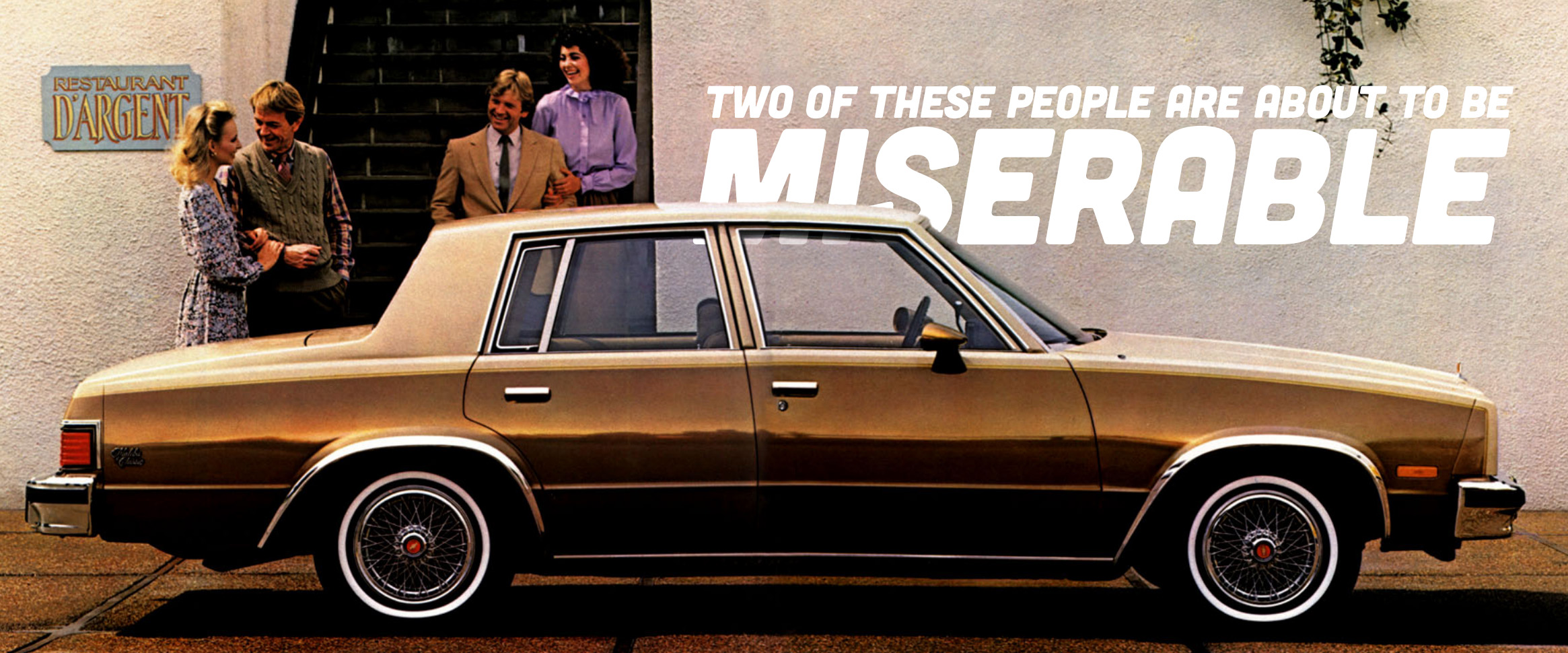
Offered as the Chevy Malibu, Pontiac LeMans, Buick Regal/Century and in endless versions of Olds Cutlass, the top-20 best-selling cars list in America was often made up of at least five of these A Bodies, later called “G” after the new FWD Celebrity/6000 cars essentially replaced them and became the “A”. Well, they were all successful except for the early “fastback” ones that tanked in the sales department:

A variety of V-6 and V-8 motors were available, all of them with rather pitiful malaise performance figures. None, of course, were as pitiful as the infamous diesel V8; however, look at those whopping fuel economy figures it got when it when the head bolts still held the heads in place (they didn’t for long).

Say what you want about malaise-era General Motors cars, but these things were almost as indestructible as the larger B-Body cars, if not more so. Our own BMW-and-Porsche-driving Thomas Hundal’s first car in 2014 was a three-decade old Cutlass (gasoline, thank God).

He no longer owns it and probably wrote it off for dead but, sure enough, a few years ago he saw his old ride daily driving the salt-covered Ontario strerets that it had been since the early eighties.

I could give you many more stories like this, including the vaunted Chicago Cutlass:

The durability and quality (well, quality relative to some other GM products) is great, but best part about using the A/G-Body as a Cadillac might be the size. Take a look below at the “full sized” C-Body the silly J-Body Cimarron. What were they thinking? The A/G is exactly the length and width of what a “near” buyer would have been looking for in the era of high gas prices, higher interest rates and a recession economy.

Also, the “J car” was a rather underpowered (even for the time) and subpar econobox while the A/G-Body had essentially all of the qualities of a “real” rear drive Caddy but in a more efficient size. Let’s give it a try; it’s not like would could do worse, rught?
This Cutlass Went To Finishing School
We’ll start with the notchbacked formal-rear-window version of the A/G Body four door for our Cadillac Centaur; essentially, it’s the 1980 Cutlass or Buick sedan. The size is really fine as-is ,but I’d like to pull the wheelbase a few inches longer and put all of that extra length in the rear doors and back seat. Slightly more overhang in front and a Cadillac grille tapers back into the hood bump that fades outwards into the beltline of the car. No vinyl roof on this example below, and you’ll note that the “opera” lights are just subtle things buried in the B pillar. I know wire wheel covers would be the primary choice but I added aluminum wheels from a Holden.

Here’s an animation of a G-Body Pontiac (called the Bonneville here and the Grand LeMans in Canada) transforming into a Caddy Centaur. Note the wheelbase change and nose extension to make the owner feel like they were piloting something more than a Malibu:
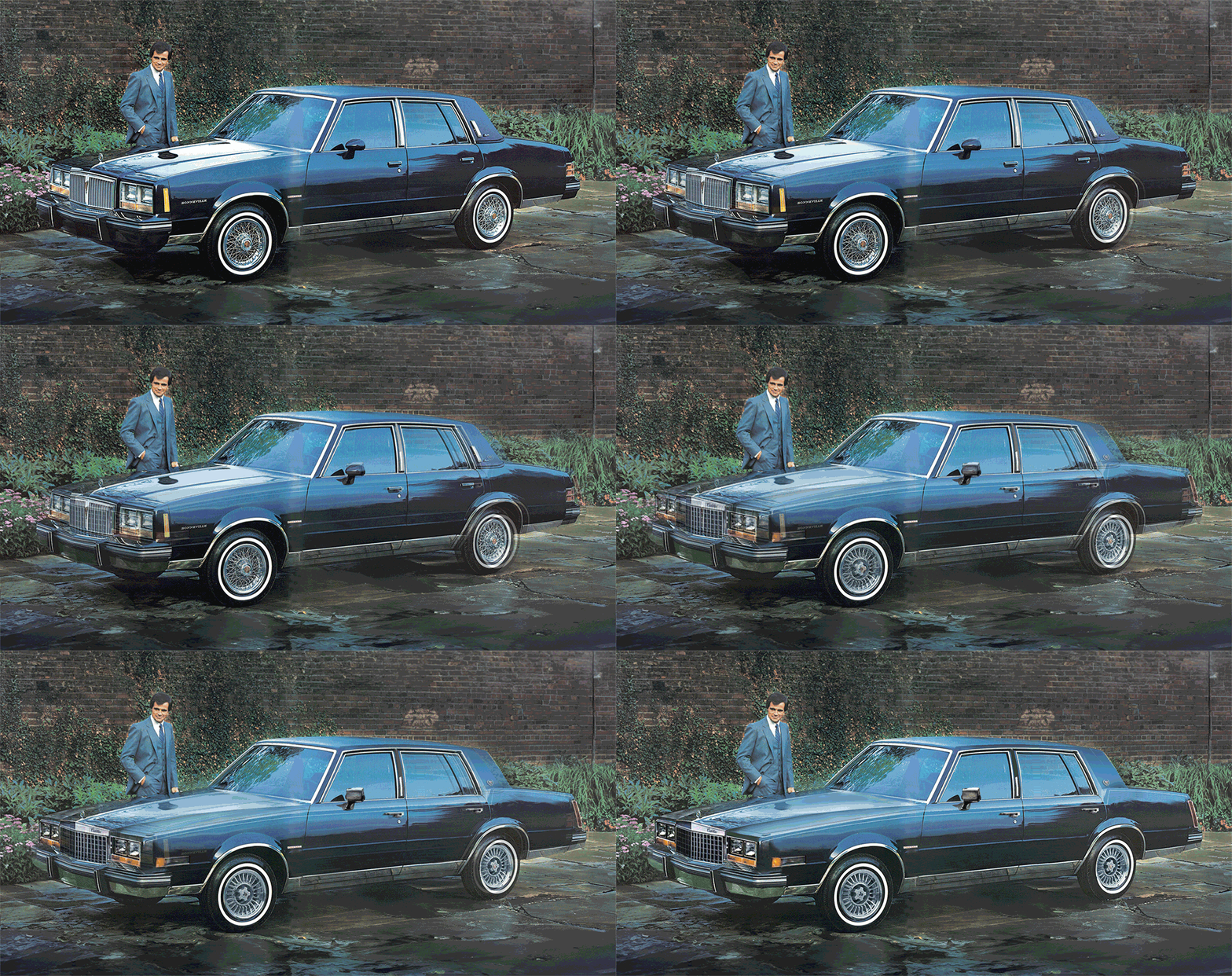
The rear window is slightly more upright, and I’ve added raised quarter panel “shoulders” similar to what’s on the concurrent Eldorado coupe. Vertical Cadillac-style taillights finish off the back.
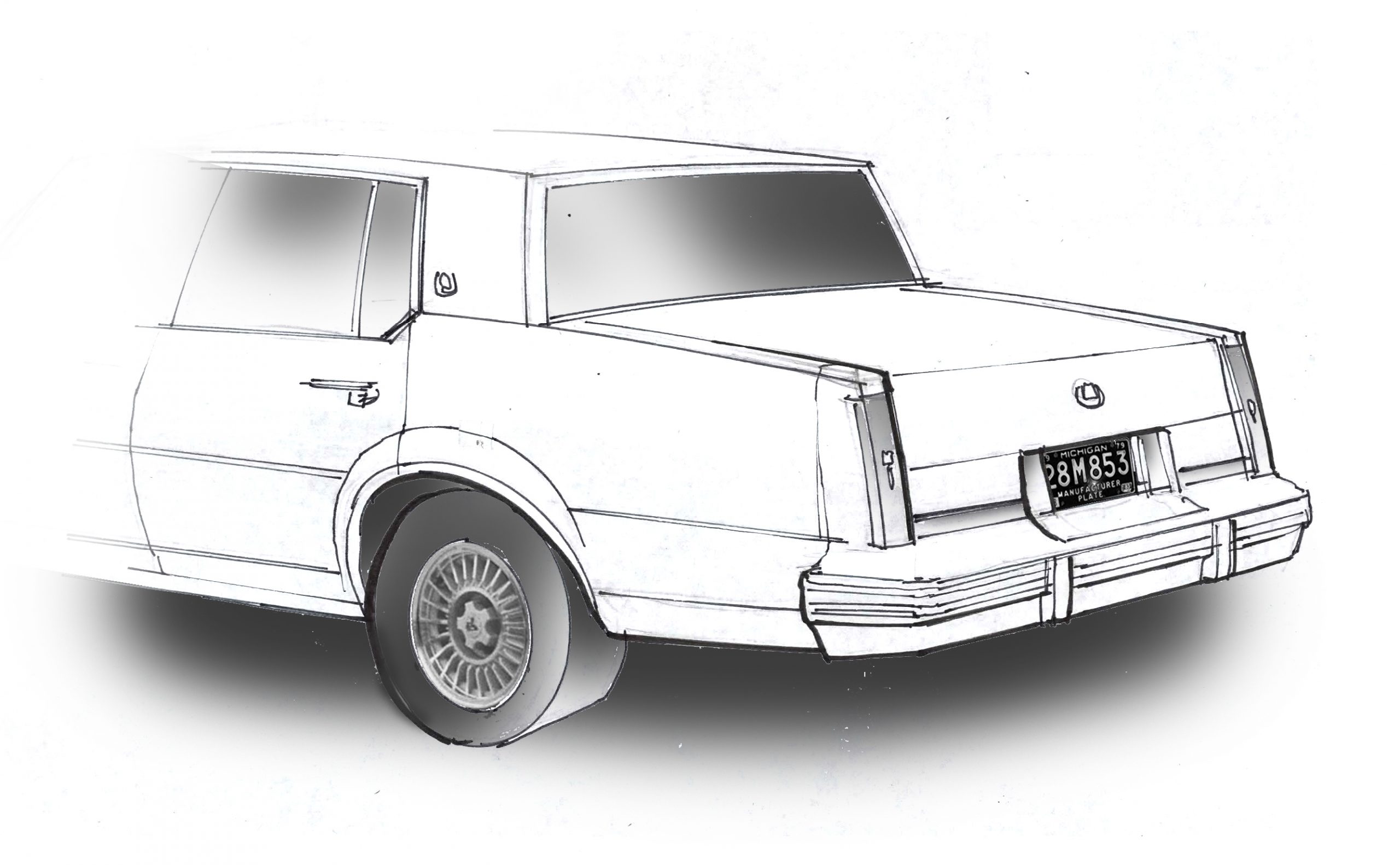
It obviously looks similar to other GM products, but then that was part of their whole modus operandi of the time. Also, such a car would not step on the toes of the upper-level Caddys so there would still be incentive to make more seasoned and monied buyers move up to a DeVille or a Seville. That would have been those buyer’s loss: the Centaur would have offered almost all of the ride comfort and space of the bigger, more expensive cars but be much better to drive. Yes, a V6 would likely have been standard, but most Centaurs would have come with the five-liter (305 cubic inch) Chevy V8 under the hood. The EPA standards would likely have deemed the gas 350 too thirsty, but do know what the third optional engine would be? Yes, you already zoomed on the logo stuck behind the front wheel, but you don’t want to say it: the 5.7 liter Olds diesel! Hey, these later diesels weren’t nearly as bad as the first ones, and it wasn’t like a Mercedes 240D was any kind of rocket ship. I’d hope that four-wheel disc brakes could have found their way onto this thing.
Still too much of a barge for your tastes? Fine. It’s a G-Body, so you know that means any of the bits from a Monte Carlo SS or even a Buick Regal T-Type (cough, Grand National, cough) would bolt right on. Apparently, that’s why our own Thomas Hundal bought one since the possibilities of creating a latter-day muscle machine were endless. Hey, Cadillac could even have offered a version with an F41-style suspension, trim blackout, no whitewalls, bucket seats and a floor shifter. Oh, and a Buick 3.8 liter intercooled Turbo under the hood. I wish. Anyway, here’s the Centaur “Touring Sedan” before you commenters badger me for it:

Inside, I’ve used the Pontiac LeMans/Bonneville G dashboard and modified the area inside the padded frame with a Cadillac-like instrument setup featuring digital gauges with a trip computer. Base model Centaurs would probably get a similar looking panel but with analog gauges and your standard GM three-slider climate controls instead. Just the thing for wafting down the road with a Yacht Rock cassette playing through the four Delco speakers.
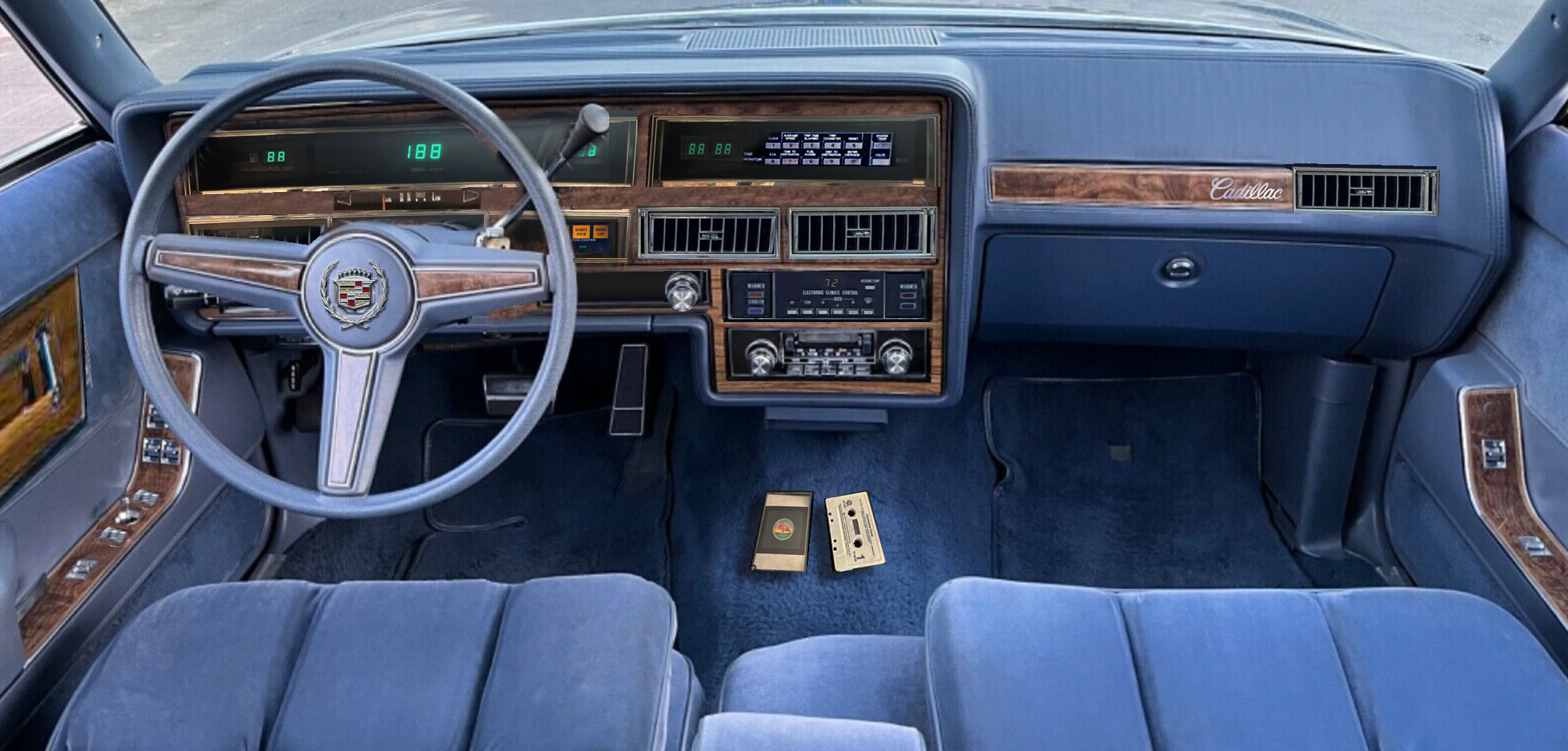
Seat controls move to the door panel, and yes there are four window switches on the driver’s door! The need to make new, stretched rear doors would be an opportunity to make the rear windows roll down like on, I don’t know, every other four door car on the market?
Knick Knack Paddywack, Still Ridin’ Cadillacs
Make no mistake: the 1980 Centaur wouldn’t have been a brilliant all-conquering sport sedan to make the BMW 5-Series irrelevant, but neither is the Lexus ES series. However, nobody that owns an ES350 has to convince their friends and neighbors that they’re driving a Lexus; Cimarron drivers even needed to work hard to convince themselves. The Centaur wouldn’t have had that problem.
As a fellow former big American iron owner like Thomas, I can see the strange appeal of this kind of machine. If you have a Real Job and walk out to your car from the office in the dark past seven o’clock after a crappy day, there’s nothing quite like seeing that big chrome-covered box, opening the door to about six dozen courtesy lights and knowing that this big cushy velour-lined ride is essentially going to waft you home over potholed suburban streets while you sort of give it a suggested direction with one finger. A Cimarron didn’t provide that, but the G-Body absolutely could have in a relatively affordable, medium sized package that ran forever.
Best of all, it would have been a Cadillac.
Topshot source: General Motors


The taillights on the Cantata look a little low for optimal visibility and I wonder how long that white steering wheel would stay white.
It’s odd that the horizontal taillight lenses on the Cimarron and the Cantata have little details that remind me a Thunderbird of all things!
Yeah this would have worked pretty well at the time. My in-laws had an olds diesel for 1 year, and never owned another GM product. My folks had a few gas A/G-body Malibus that pretty much got them through the 80s to the mid nineties, and brought me and my brother home from the hospital. I can just barely remember the red velour.
As someone else already pointed out, and i want to second this, I think that the “downsized” Caddy should have been based on the FWD A-body. It wouldn’t have been as small as the Cimarron, and closer in size to this G-body based car. But, it would have been more modern with FWD, which GM was moving towards.
However, it would have made that Fortune magazine cover even better with 5 different A-body sedans (instead of 4).
Not to defend the Cimarron (though my parents briefly had an ’84), but the Cavalier was originally well upmarket from the Corolla. It was designed to compete with the Accord and Camry.
Also, a better option for the small Cadillac would’ve been the A-car. I don’t think anyone would have minded a fancier 6000STE with more power.
Also, not to defend how the Cimarron drove, but I thought it was a pretty decent looking car.
From what I’ve read, the later ones with the V6 were pretty decent.
The first year of the Cimmaron was 1982, a couple of years before the Camry appeared, and also a few before GM really understood how much of a market threat the Japanese makes would be. The Cimmaron was directed at the European premium offerings, most likely Audi, BMW, Saab, and Volvo.
“Imagine if Toyota had made a Lexus based on something like a Corolla, Tercel, or even a Yaris.”
Now I want to see all of those. I love a tiny luxury car.
It happened – but in reverse. The 1992 7th Gen Corolla AE100 is also known as ‘baby Lexus’ due to it’s trickledown of Lexus styling and (for the time) refinement.
I think the closest equivalent would have been an Acura EL – a tarted-up Civic.
I see no difference.
Like wise, I too have been exploring what ifs pertaining to the 80’s Caddy miscues. Whilst I find your article and illustration’s fascinating and quite plausible, I wonder if this would have appeased the Caddy dealers that where crying for a new smaller than Seville car? I have given a lot of thought to an X-body (FWD) sourced car, what I think should have been the new Seville all along. Yes the new X-bodies had issues but I believe had Cadillac been involved with the development from the onset of the project it would have been a much better car all across the board. Like you said, it would have been a Cadillac. “The Standard of the World”.
There are enough photos of cars near small airplanes in old brochures to make a full-length film.
That would be a killer project. Find and scan every promotional picture of a car near an aircraft aimed at projecting a sense of wealth and importance.
The Cantata would have done well. GM missed out on a very good thing.
In the ’80s it would have been a two door.
What if…hear me out…you added a bustle trunk.
What if… I show you out. I hated the Seville’s bustle trunk. OTOH, I admired how funky it looked on my ’71 Peugeot 504.
Oh, sweet keeper of the weather NO. I had a Malibu on this platform assigned to me as a company car. It was only a couple months old. It was the greatest POS I have ever experienced. Totally put me off GM products and even experiencing some modern ones as rentals hasn’t changed my mind. That crap can had so many issues and was constantly breaking down and falling apart. This was before lemon laws, so the company asset manager told the dealer to take it back and refund it with only abut 10,000 KM on it, threatening to never do business with them again. The company had a fleet of about 20 cars from said Chevy dealer, so they acquiesced..
I was slated to get a hand me down Monte Carlo from a more senior employee and he was going to get something new. He warned me about every similar thing wrong with his car.
My boss took pity on me and arranged for me to get the first of the new fleet deliveries, a just released Ford Taurus. (not from that same dealer, who never saw any business again, despite being owned by the cousin of the owner of our business – LOL).
The Taurus was a spaceship compared to that coal cart.
I really liked how every time I turned the key in the ignition it started.
I could drive over speed bumps and slam a door without fear of something falling off.
It didn’t randomly overheat.
I could use any parking spot in the lot instead of being relegated to the one where it was OK to have a giant puddle of oil in it.
I wasn’t constantly being pulled over because the turn signals refused to work in the presence of the constabulary, but worked fine when being diagnosed by the ‘tech’.
And, it didn’t constantly smell like fuel vapours and off gassing plastics inside.
Even by the low standards of the Cadillac customers of the day, this would have destroyed the brand, especially when following the Cimarron.
> I really liked how every time I turned the key in the ignition it started.
Some car enthusiast you are!!!
(Jk)
That first gen Seville is such a great looking car. My uncle had a seafoam green one rotting away in a field when I was a kid. Still remember playing in it for hours with a dark green interior and thick pile carpet. Sad day when he finally pulled the drivetrain and sent the rest to the crusher.
Actually, Lexus sells a version of the Yaris Cross in Europe called the LBX, which is not too far off from a Lexus Yaris…
“The LBX ticks some but not all of the boxes we hoped it would.”
Tested: 2026 Lexus LBX – Full review, price & features | Autocar
and before that the HS
Was that the fancy corolla one that looked like a decepticon’s shoe?