

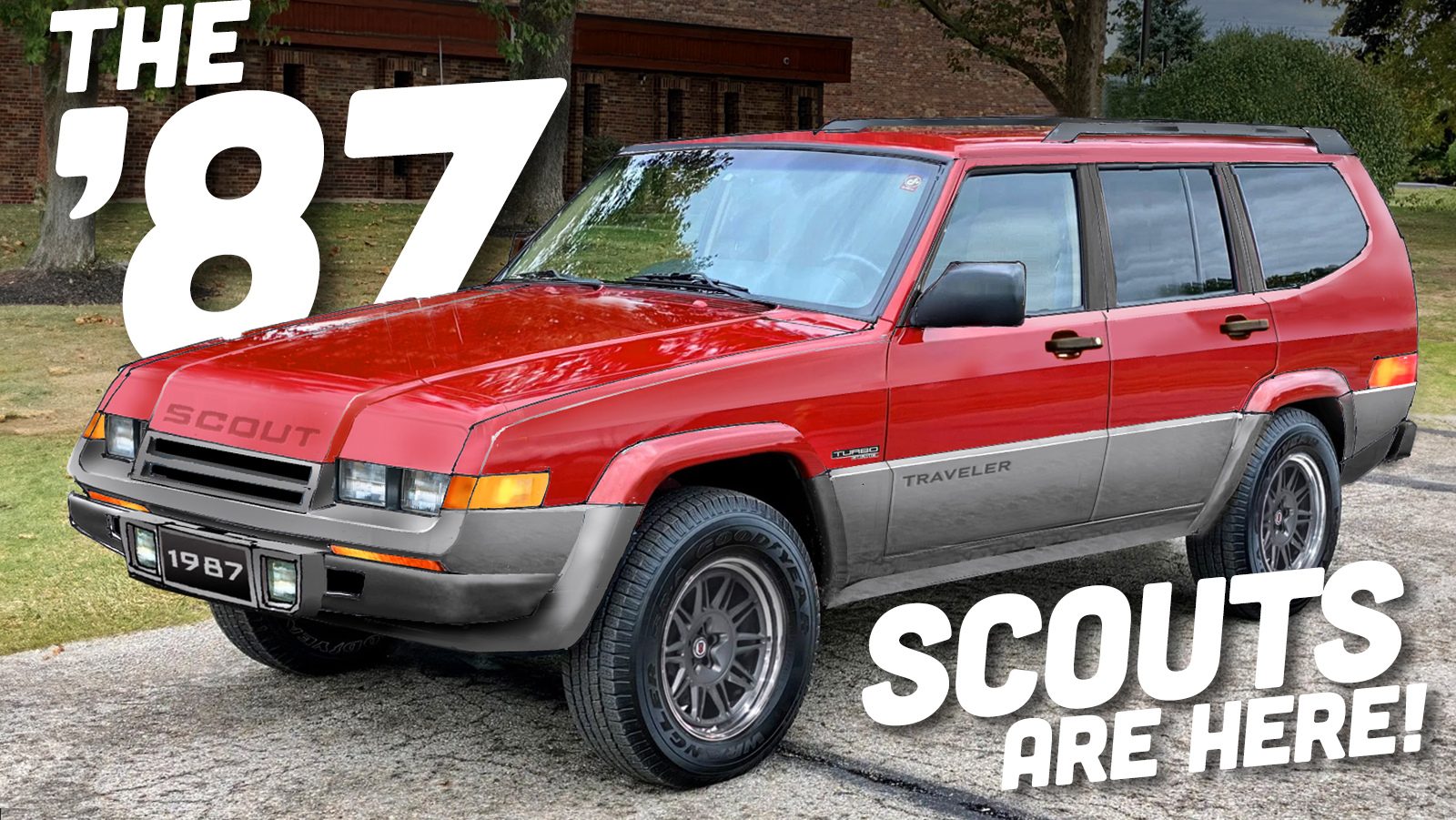
If there is such a thing as an SUV historian, that person would say that 1980 was a year of bad timing for the then-emerging genre. American Motors launched its all-wheel-drive Eagle, which became a niche player, but it was way too early to market to become a 1965 Mustang-level success. Who the hell wanted a lifted half-car/half-truck thing? Yeah, I know. Meanwhile, International Harvester chose that year to give up on its once-pioneering Scout SUV program due to limited sales and even more limited profits; International simply didn’t see it as a market that was going anywhere. Again, go ahead and laugh.
In hindsight, if the Scout had lived on in a more modern, smaller, and efficient package, it likely would have ridden the SUV wave that was starting to rise. I’ve explored this alternate reality before, and I’d like to revisit and expand on it a bit. Let’s go back to the mid-eighties and give Jeep and the Bronco II some sleepless nights, or at the very least a little competition.


As the name would suggest, International Harvester was one of America’s largest makers of tractors and other farm equipment. From the brand’s very beginnings in the early 1900s, International also produced road vehicles, including two- and four-wheel-drive pickup trucks and a Chevy Suburban-like utility called the Travelall. Despite a loyal cult following, International played a distant fourth- or fifth-banana to the Big Three’s offerings. Naturally, the company needed to expand again and noticed that the famous Jeep had no real competition. Ultimately, the product was to bridge that gap between the utilitarian Jeep and the more car-like Wagoneer (or Jeepster). Starting from a rather abstract design brief for a “replacement for the horse,” the initial project of a flat-sided concept sort of stalled at IH, as recounted by Ted Ornas, designer of the original back in 1960:
One night while sitting at our kitchen table (full of frustration and desperation), I dashed off this rough sketch on a piece of scrap mat board. It had contoured sides and was designed for plastic tooling. The next morning it was shown to a committee member. He reviewed it with controlled enthusiasm, but revived interest in the program. We were off and running.
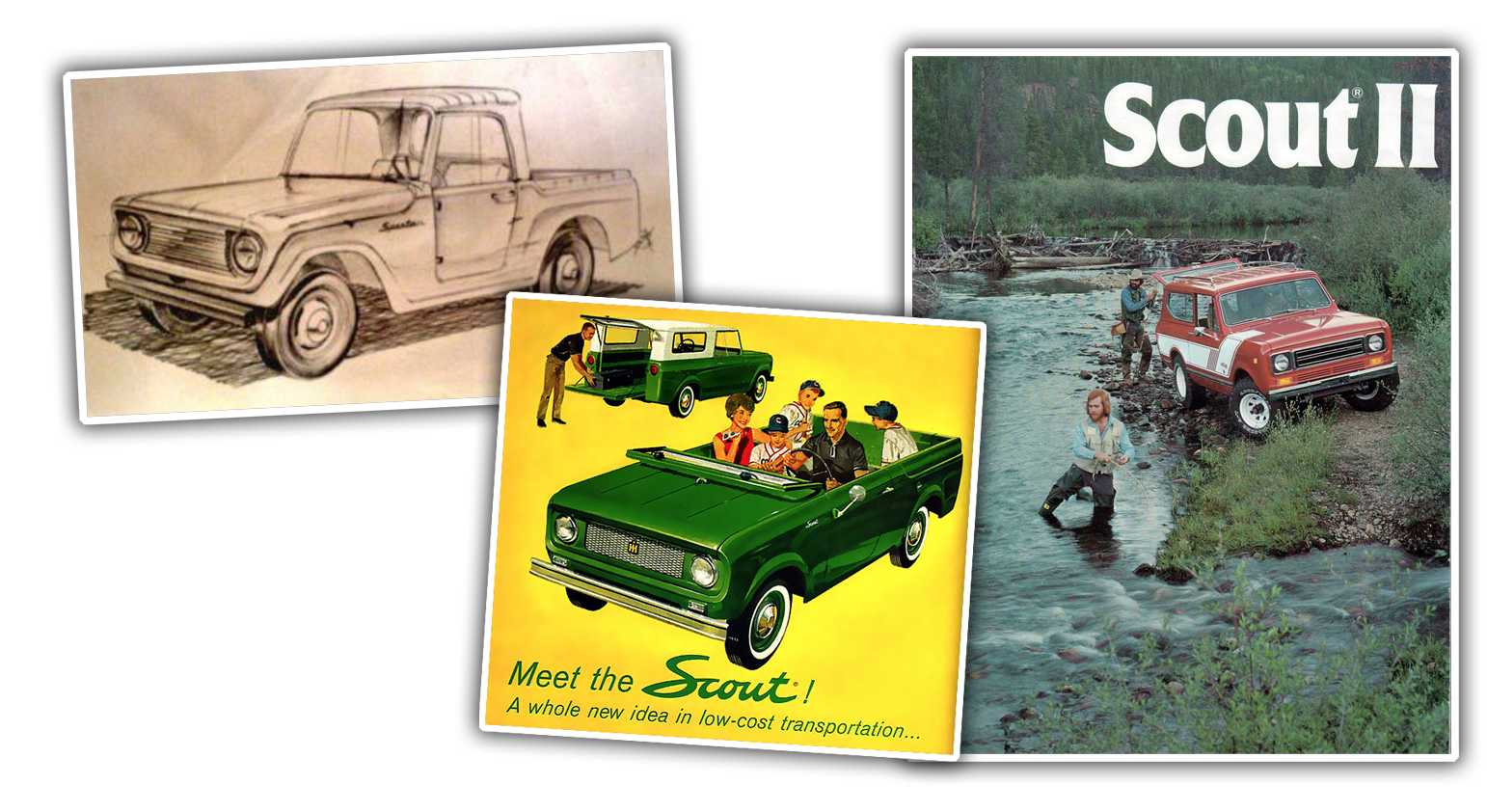
After the idea was approved, development proceeded on what was eventually called the Scout. Launched in 1961, it didn’t have the planned plastic body but instead was made from pre-rusted sheet metal (it’s a long story, but supposedly IH didn’t purchase Big 3-quality material). The Scout was successful; a less-agricultural second-gen version, the Scout II, arrived in 1971 and was a precursor of the SUV boom of the eighties, which it unfortunately would not live to see.

Due to poor management at International, a protracted strike, and a decision to focus on what they projected to be more profitable markets, the last Scout was built in 1980. International missed the market explosion by only a few years. What if it had continued making SUVs, or at the very least came back after a very short hiatus? Let’s play Monday morning quarterback, automobile-style.
The Real Scouts That Weren’t
A sad fact is that International did have plans in place during the late seventies for new models before the rug got pulled from underneath them. One plan involved updating the looks of the now-rather-dated Scout II, which they attempted at first to “modernize” with over-the-top graphics and trim like below:

We know from uncovered sketches that a facelifted “Scout III” was in the works with a new nose and tail.
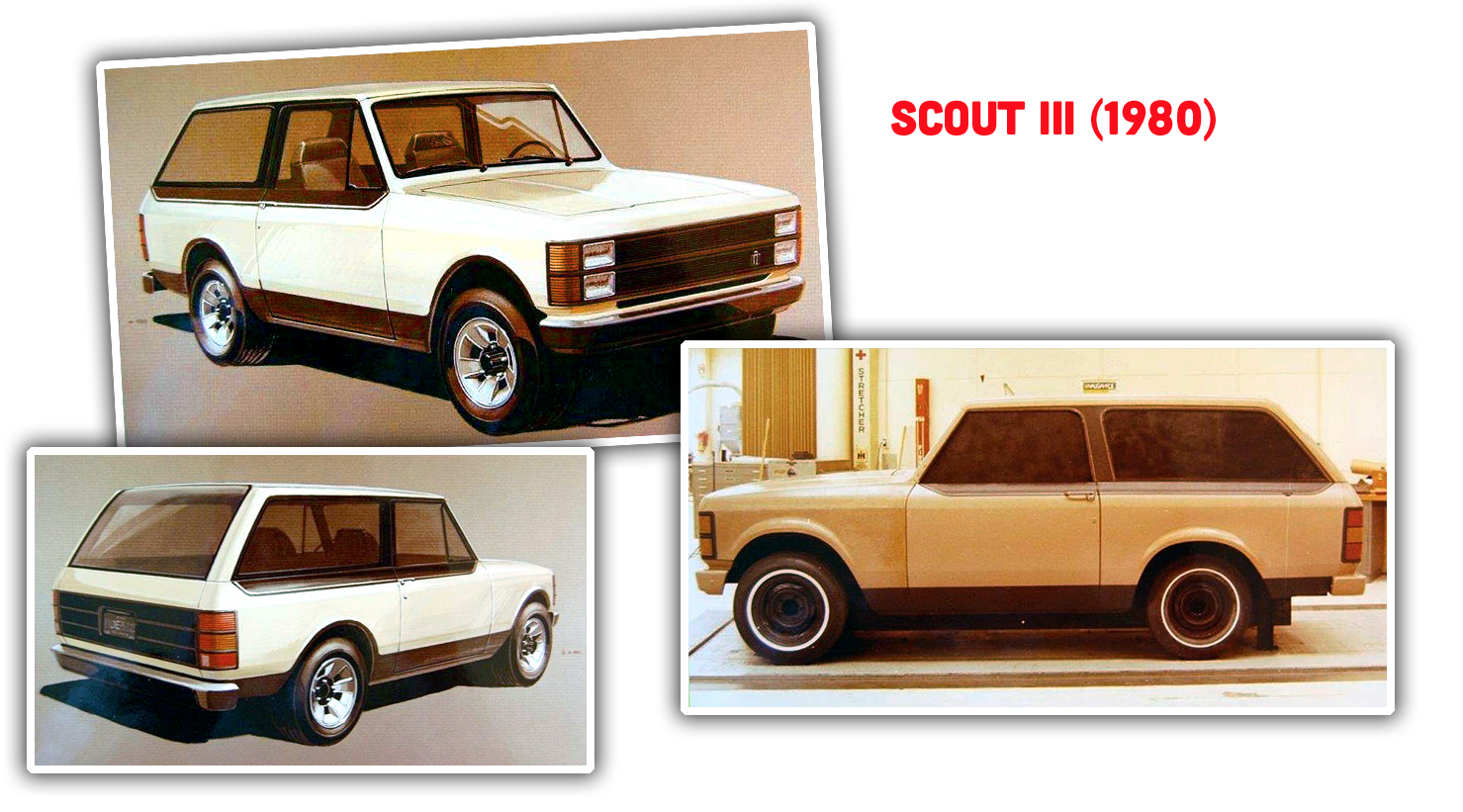
This revised model looked almost Range Rover-like from some angles, but I think that in the teeth of the early eighties energy crisis, that clunky old chassis under the new skin would have fared poorly against the new 1980 “Bullnose” Bronco and Box Body Blazer.
No, to survive, the Scout would have needed to come up with something all-new as they did back in 1961, namely a smaller and more efficient product to combat the emerging new breed of compact SUVs like Bronco II, S-10 Blazer, and especially the XJ Jeep Cherokee. One rather promising concept that International was well into developing at the time of their demise was the Supplemental Scout Vehicle or “SSV” with a smaller wheelbase and more sporting pretense.

It’s this direction that I would have used as the inspiration for the revived Scout line, and I think it could have been part of the restructured International of the mid-eighties that actually did happen. What would that have looked like?
The New International
In the early eighties, after dropping the Scout, the International Harvester company took major steps to improve profitability, mainly selling off many of its divisions such as construction equipment, Cub Cadet lawn equipment, and even the entire agriculture division. Remember Farm Aid and John Mellencamp’s Scarecrow? Yeah, farm equipment was not a hot market in the American Midwest back then. On February 20, 1986, IH officially became Navistar International – a new era for the company to focus on building trucks and engines.
That is what actually happened, but in my alternate reality, this new International would also relaunch the Scout brand. Way back when the Autopian began in 2022, I envisioned a new 1987 Scout based on the SSV concept. That vision of the future from Scout’s actual design team, with its low grille and headlamps plus an aggressive off-road presence, is what inspired my thinking for a revived model (I ditched the six-bar grille since it, you know, looks a lot like something else). I started with a small Wrangler-sized two-door short-wheelbase “Sport” version with an openable top that you see below, appropriately parked in a Hoosier quarry where you might film a Mellencamp video:
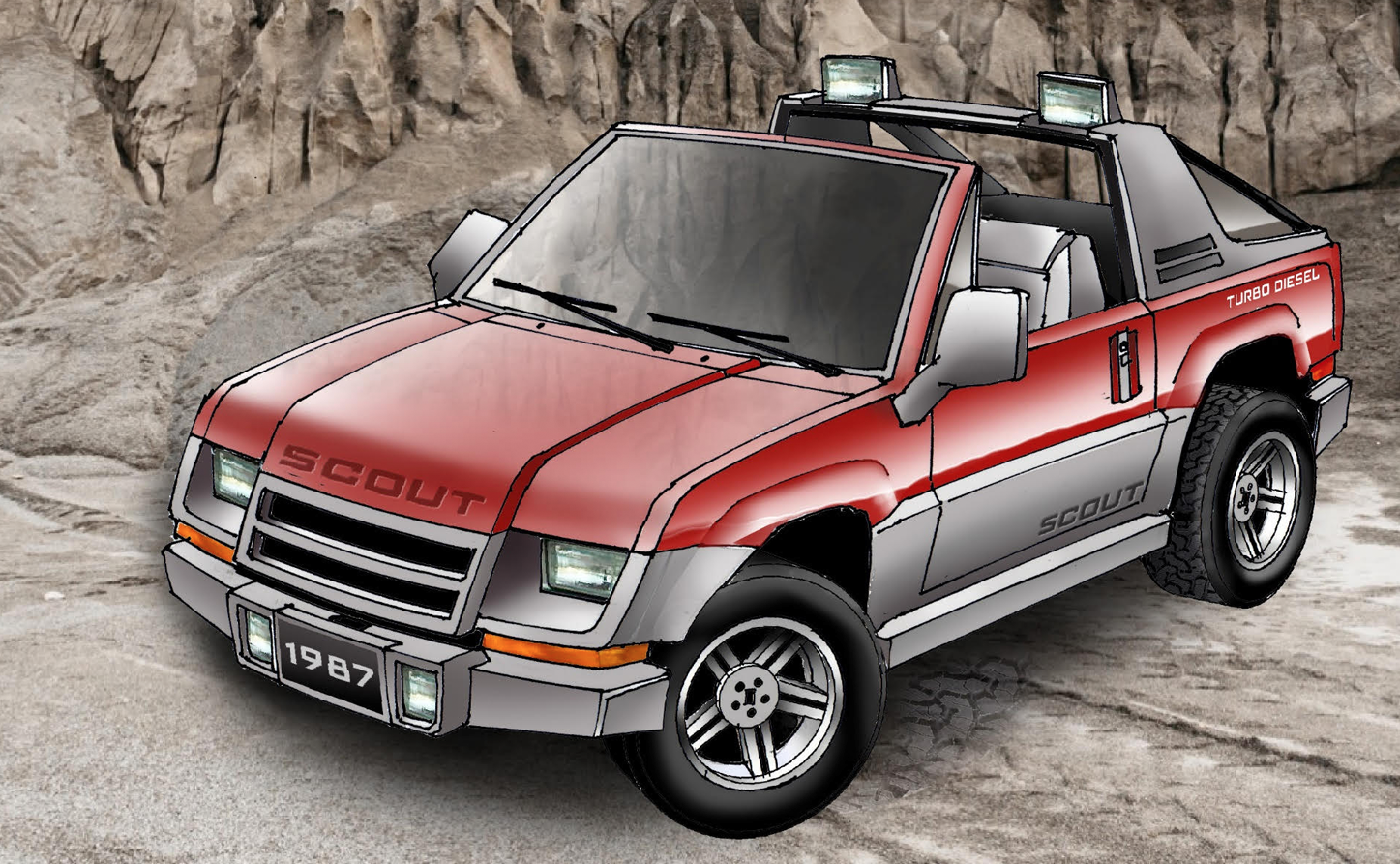
As a hard-core four-by-four from a company known for vehicles so rust-prone that they made seventies Fiats seem aluminum, I covered essentially everything below the height of the wheel arches in plastic where stone chips and scratches could buff out easily. There’s also angular steel bumpers with matching ‘running boards’, vertical door handles, the winch behind the fold-down license plate cover, and manually retractable fog lights on the ‘sport bar’ to fit into garages.
At the rear, I think a giant tire (on the off-road models) would not fit behind the axle in its entirety, so it would have to poke out the back between ‘bumperettes’, with the one on the left for the license plate and the one on the right housing a fold-down step.

Note that the Hoffmeister kink from the last Scout II is incorporated into the quarter window on the hard top rear module. With the soft top rear module, the fabric top lifts up like a hatch for cargo or a full 90 degrees to be open like a Lancia Zagato but backwards (the section over the front seats removes targa-style).
On the inside, I have not idea what I was hopped up on at the time but my thesis was that many Scout Sport owners would want to add their own radios, rally gear, and upgrade to new technology over the years (plus there will be RHD Postal version) which will turn the dashboard into swiss cheese, so the solution I had here was to have no dashboard at all. Steel cross tubes would allow you to mount instrument pods and snap-on accessories like ashtrays and cup holders. Note the Fiat Panda style cargo hammock at the bottom, and if you order A/C there are vents that snap onto one of the tubes to tap off of the cold air pumped into the tube. The steering column (not shown) fits between the bottom two tubes.
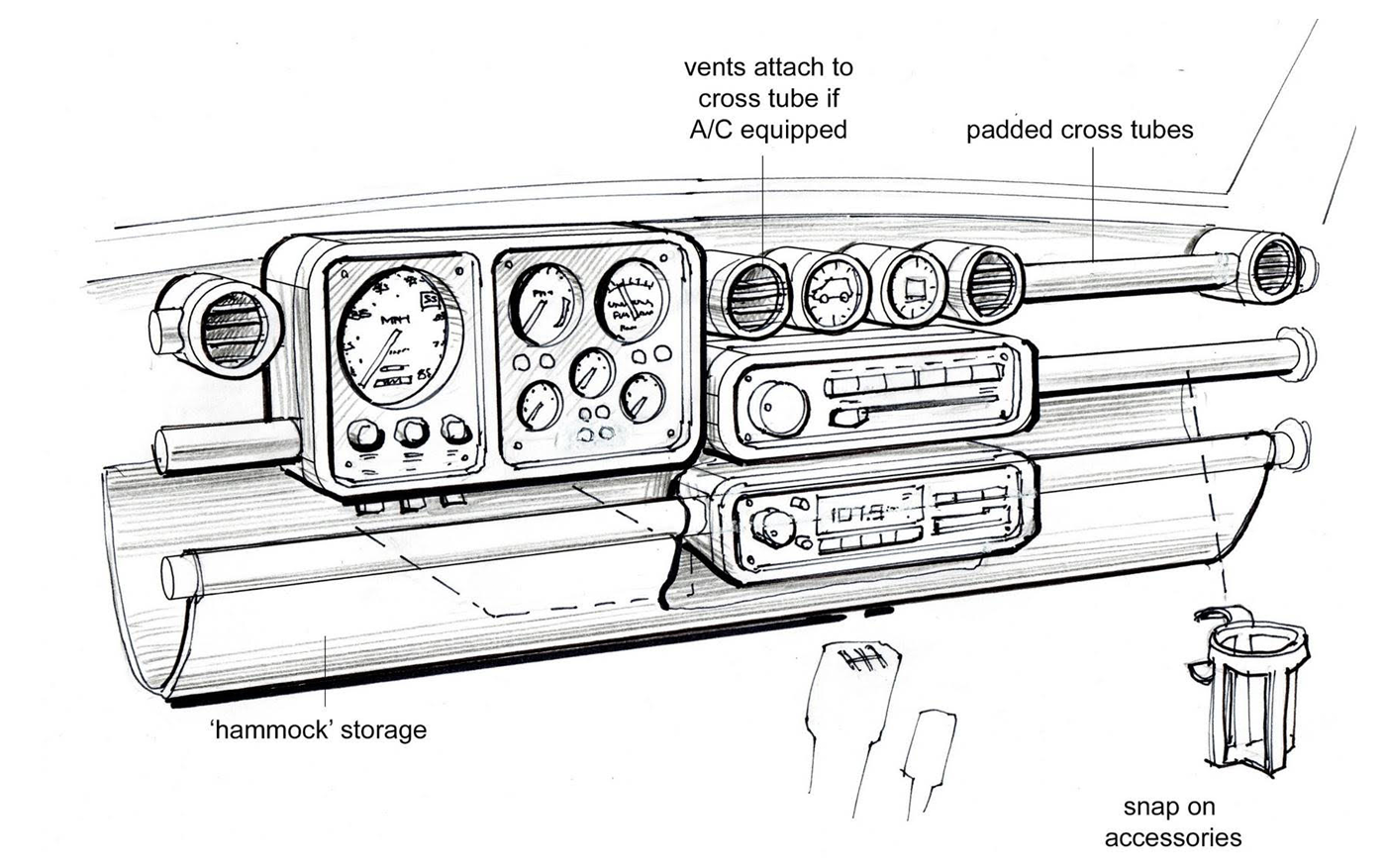
As Jason pointed out, that hammock storage is sort of like the Fiat Panda’s:

No fold-down windshield on this Scout Sport, but the doors can easily be removed. Scout Sport would have had quick-release knobs, so you aren’t fumbling in the rain to put your Scout back together. Slide onto the hinges and turn the lock screws. That’s it. The vent/front quarter window removes to allow the door to fit easily in the trunk area. You’ll also note that the mirrors do not attach to the doors.
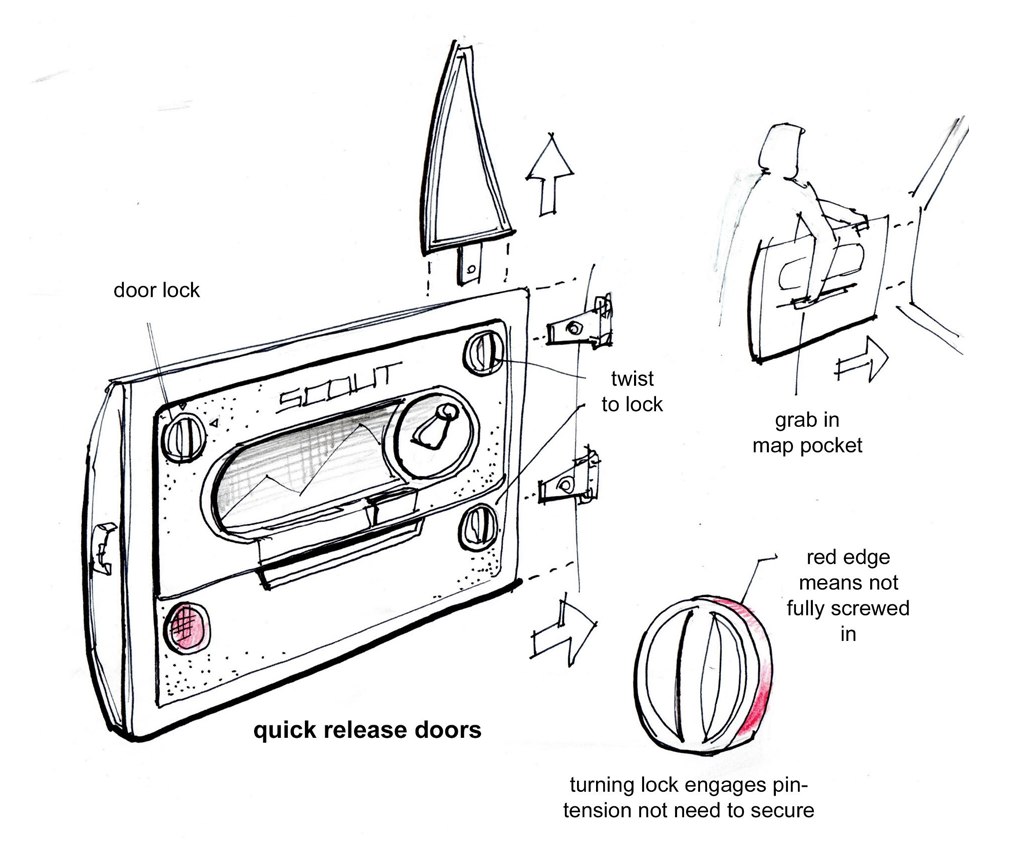
The rubber-floored cargo area also features flip-up seats, which could also be locking storage compartments if you remove the cushions (the seat upholstery features the New Scout logo of an autobahn going into the mountains).

This is all fine if you’re a young, hard-core mud bog runner, but what about the meat-and-potatoes family market? I didn’t get into that too far in my original story, so we can fix that now.
The Scout For the Scoutmaster
Scouts were offered in a variety of flavors, particularly after International Harvester dropped its line of larger trucks in 1975. The imaginary 1987 model would follow suit with the short wheelbase convertible and hardtop Sport models that I’ve just detailed above, but they’d obviously offer a longer wheelbase version as a new generation of Traveler (can’t decide on one or two Ls) in two and four-door versions or the pickup Terra version (which is similar to what the New Scout line is to include).

The longer, larger Scouts would be around six inches longer than the benchmark XJ Cherokee; that seems to be an ideal size for maximum usefulness without getting Suburban-big. Most of the styling cues of the Sport model would remain, including the low nose (now with four headlights) and plastic lower flanks in either a grey or khaki tan, depending on color choice (I’d go deep green metal with khaki plastic). Yes, I kept sealed beams since Jason always wants easy replaceability of parts on vehicles subject to abuse. Actually, any vehicle.

I can see plastic-covered automobile-style bumpers as one choice, but this one in the illustration has the “off road” style steel ones with the winch behind the front plate from the Scout Sport. You could get those bumpers with the spoked alloys I’m showing as part of the Stone Cutter package that also has the MADE IN INDIANA graphics on it.
In back, you can see that the bold side marker lights (again, just for you, Jason) wrap into the rear light clusters, which extend up to the roof almost Volvo-style. They’d actually be split in two by the high-mounted cabin exhaust vents; I don’t want them mounted low in a vehicle that could go through deep waters. The upper section of the light clusters would be smoked-out high-mounted turn signals, almost like a Citroen DS; safe and cool looking. We’d still do the offset license plate from the Sport with the fold-down step on the side, but allow for a trailer hitch dead center. I’m seeing a fold-up glass section and a fold-down tailgate for camping and outdoor fun

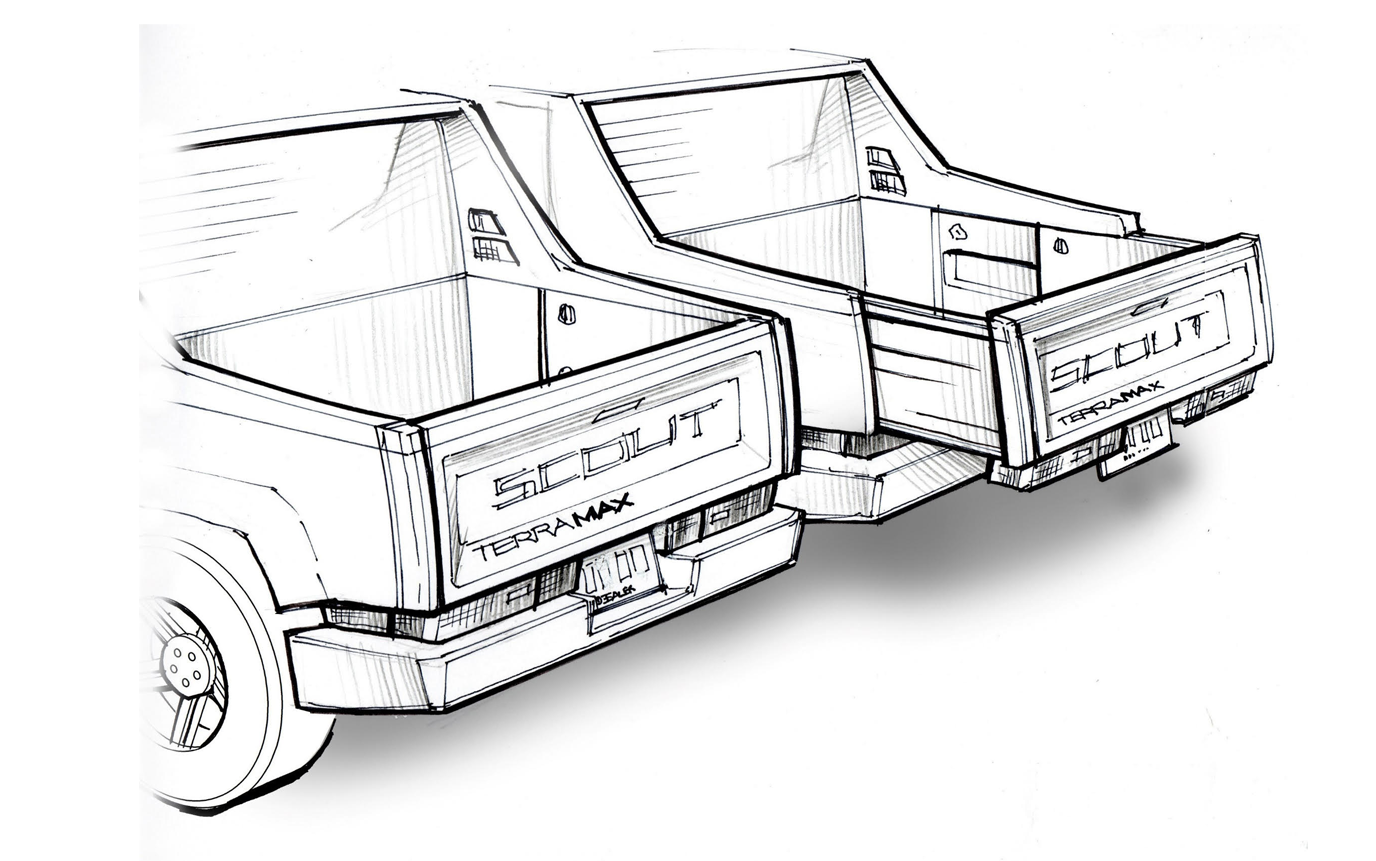
The Terra models would obviously have a short bed since they’d be four-door pickups on the Traveler wheelbase, but I proposed a strange pull-out extendable bed as an option called the “TerraMax”. Jason had suggested a bed floor that would fold out to fill the gap, and I’d have “phone cord” style stretching “pigtail” wiring in back to keep continuity to the rear lights when extended. Another stupid blue-sky idea that some people might really like.
 .
.
Inside, I’ve taken inspiration from those bizarre ideas I had for the Scout Sport above and toned it down a bit for the Traveler and Terra. I’d still go with a modular-looking layout with exposed hardware, but it would be a bit more conventional. You’d still get the tubing and the ability to add accessories, not to mention making it easier for the factory to change out components like digital gauges versus analog or radios.
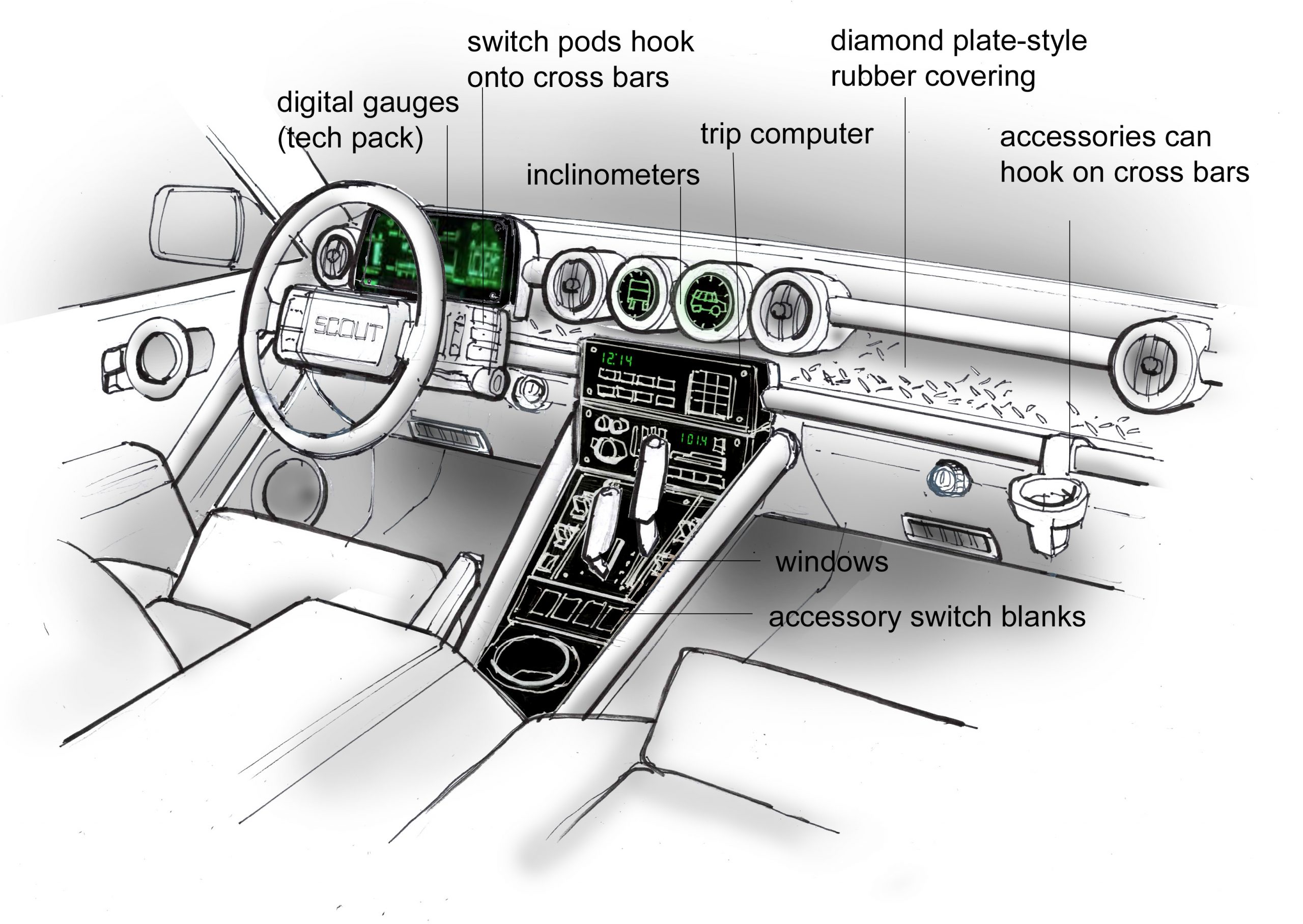
There are also switch pods that mount to the crossbars as well, and might also be adjustable. With the Tech Package, you get electronic climate controls and a trip computer, and if you skip that option, you get analog gauges, more manual climate controls, and a simple digital clock and outside temp gauge on the right pod.

The interior might be large enough for a small third row, or we’d need to make an extended wheelbase for that (or just offer rear-facing small seats).
A Hoosier With An Asian Heart
In my alternate reality, they’d build the new Scout models in a refurbished version of the old plant in Fort Wayne, Indiana, which spit out Scouts for decades before the bitter end in 1980. It’s still there today in good shape and was once occupied by over 10,000 Jack and Dianes working to pay the mortgage on their little pink house. What a great-looking factory building.

One would think that Navistar International might eventually make its own engines for these new small SUVs, but to start out with, I would have them go back to the company that provided them with turbo diesel engines for the last Scout II models in 1979: Nissan. One great engine from that late-eighties era was their TB42 and TD42 straight six that was used in the indestructible Land Cruiser-like Patrol that never got in America. Well, this would be Nissan’s chance to put it into a U.S. market product that wouldn’t necessarily steal sales from them.

I could see both the 173-horsepower gas and 145-horsepower turbo diesel versions of the 4.2-liter motor used in the Scout Traveler and Terra; the smaller Sport model might get it as an option over a Nissan 240SX or pickup four that would be standard. Again, Nissan did not (and never would) offer a Wrangler-style product, so this would just be a chance to sell more motors.
Either that, or I’d have Nissan dredge up the old OHC inline six in 2.8 liter form; that’s a great engine and still running well when our S30 280Z was so rusted that we thought it would fold in half.
Is It Forty Years Too Late?
I’d be lying if I said that I wasn’t excited about the return of Scout, but we know with revivals that sometimes the audience just isn’t there for something that’s been off the radar for nearly half a century. It’s even worse when we get teased with this revival for over half a decade before anything comes of it.
No, the Scout deserved to have never died or at least been resurrected much earlier with products as innovative as the ones that IH designer scribbled out in desperation on his kitchen table. We might be happy that Scout is coming back, but it would have been better had it never gone away.
Top graphic base image: Bring A Trailer


Bishop, this continues to look like a slightly modified 1983-86 Ford LTD front end.
I can’t unsee it!
https://www.classic.com/veh/1986-ford-ltd-station-wagon-1fabp4031gg161776-nXODD74
truthfully, for an ’87 it really should have composite lights
Subaru Forester + Jeep Cherokee + Toyota Tercel = quirky excellence.
Somebody knows how to reverse engineer there. Spot on.
A french Subaru? All I see is late 90s early 2000s Subaru Forester, outback with some 80’s Frenchness. Maybe abit of 80s Toyota Tercel wagon. Could be some 80s Nissian in there as well.
It looks like a Jeep ZJ and a 1990 Camry Wagon had a baby lol
This is weird: what if the Ssangyong Musso had debuted in the 80’s? There is something in this design that reminds me of the 90’s Musso, but done in the 80’s style. As if the real 90’s design had taken some styling ques from the “predecessor”. Note: the original Musso was drawn by some real designer, no offense meant…
It was the Scout II that was rust prone. The 80/800 models are surprisingly durable.
I parked a 1961 IH Scout 300 yards from Casco Bay, Maine for 4 years and didn’t notice any appreciable rust on when I went to get it running again.
My 1963 Scout lived outdoors in San Francisco’s Sunset district for decades before moving across town 1998; I last saw it in 2010 and it still hadn’t rusted (or been washed in 15 years.)
Meanwhile, I watched my friends 1977 Traveler bloom into a decrepit pile of rust within 5 years of being brought to San Francisco from whatever garage in the Central Valley it must have lived in for the first 30 years.
International’s high build quality standards just weren’t viable against the crapola the Big Three were fobbing off on the market in the Malaise. Coupled that with a dealership group that was still basically farm equipment and the headache of keeping the ‘Light Line’ going just seemed like too much work.
No one wanted to pay high prices for high quality, and even if they did they had to go through a hard to access dealership experience.
I’d be more worried about that plastic cladding hiding a bunch of rust.
Maybe it’s just plastic with no steel underneath? Same weight and goes back to the original plastic panel idea for the II?
That fastback jeep like concept truck was on display in the Auburn Cord Duesenburg museum back in 1988 (+/- a summer) when my parents and I stopped by to see the museum. Awesome museum at that time and it’s been restored and improved since. Anyway, my 14 or 15 year old self was really into it and I was disappointed it never made it to production. I would not be surprised if it was prototyped on a Jeep chassis. It has aged well.
The SSV pictured above was basically a reskinned composite body Scout II (you can see the SII windshield pretty clearly) sitting on a SII frame; they were doing the AMC do-more-with-less thing here before the plug was pulled.
I’ve heard a lot of the “IH used substandard metal” stories passed around as fact, but having talked to a couple of ex-employees who worked on the line, from what I understand their steel was the same as the rest of the US auto industry. Jeeps and Broncos rusted at the same speed, but the Big Three started putting effort into rustproofing a lot earlier. And 1980 IH used galvanized steel for a number of exterior part, which lasted about 5 minutes longer than the regular stuff on salted roads.
I love the idea of the spare tire poking out of the bumper, perhaps as a workaround for 5-mph bumpers, but it would make fitting a tow hitch complicated.
kind of looks like a first-gen Forester
Stop threatening me with a good time, The Bishop!
Can you just go ahead and call up GM, Ford, Subaru or whomever and send them this? Because its around 200% more interesting than what they and everyone else is churning out which has zero personality, no risks in their designs, nothing remarkable, nothing that stands out.
100% would drive this
Glad you like it!
This would provide maximum privacy at the Tastee Freeze to do whatever you wanted to Chili Dogs.
I’m not shaving my legs for the Cutter edition, though. (DT will be confused.)
yes, a 1979 movie is absolutely out of his scope. Great film though, and I love Bloomington
I like this, and especially appreciate the clever touches that are able to be added in with retrospective/hindsight but knowing about current vehicles, e.g. Bronco doors coming off but mirrors stay behind, flexible storage, etc.
I’d like to see the Scout III fleshed out more. It looks so good it’s saddening that it didn’t see the light of day.
I’d also want a green body and khaki panels. The taillights are quite a nice idea, but how do the high-mounted Amber’s work on the truck-like configurations? Especially since they can’t be on movable panels.
You can see that the Terra has different taillights below the tailgate (like 1970s Datsun pickup style)
Right, that’s what came to mind when I saw them in the image. However, I noticed that the lamp assemblies move with the extendable bed section (brake lamps can’t be on movable panels, CFR Title 49, Part 571, Section 108 “FMVSS”, subsection S6 1.3.1) in the drawing showing the extendable bed “in action”. Yeah, this is a fun concept idea, but I also appreciate how thorough you are with these, so I was surprised this was included.
I also noticed here’s no provision for high-mounted ambers in that image, which makes sense for the configuration. I’m guessing the amber section is now the corner light, and noticed the small rectangle for the reverse light in the same assemblies.
I’m honestly not sure! How does it work with those cargo boxes that fit into trailer hitch adapters? I’ve seen those with aux taillights that plug into the outlets next to the hitch?
I think those fall under some sort of supplemental allowance for either trailers or accessories, though I’m not certain of their widespread legality.
This hits right in the feels. I live just a few miles away from the Harvester plant on the east side of Fort Wayne and drive by that place frequently. It’s wild to me to envision a future where IH (which is now International Motors) still built these in town. The old plant still exists and has been divided out to multiple current tenants. The area surrounding the plant is actually called the Harvester Neighborhood.
Unfortunately, their proving grounds were sold off a few years back and repurposed for other uses. It wasn’t uncommon to find semis and school busses running around there with gaggles of engineers in tow.
On another tangent, I used to work in the building that International Motors currently uses as their North American HQ in Lisle, Illinois when it was previously occupied by Lucent Technologies.
That proving ground was insane! I saw those concrete ruts at the end of the test track.
What the HECK?! That Scout III mockup is a dead ringer for the Gavril D-Series from BeamNG!
https://beamng.fandom.com/wiki/Gavril_D-Series
(The Bishop’s concept might use some cues from the CaseIH tractors of the time. But definitely looks mostly of the era.)
Hmm, a little too much Subaru Forester in there for my taste.
Sadly, that was part of my whole idea to get sales.