


General Motors has long been a leader in American small-block V8 power. GM V8s are often the default choice of engine swaps, and power millions of hard-working Chevrolet Silverados, Suburbans, and Tahoes, as well as their GMC and Cadillac equivalents. But there’s one GM V8 that seems to be a bit of a problem child, and it’s the 6.2-liter L87. Offered in current-generation GM trucks and SUVs, more than 28,000 L87 V8s failed before GM issued a recall for a fix. Now, over 6,000 fixed engines have failed, and the U.S. National Highway Traffic Safety Administration is launching a probe to figure out just what is going on here.
In 2019, General Motors launched an update to its Generation V small-block V8 architecture. The L87 succeeded the L86 that was in production since 2014. Power numbers between the engines are similar, but while the L86 used GM’s Active Fuel Management, which switched running cylinders between V4 and V8, the L87 uses Dynamic Fuel Management, which can choose from 17 cylinder deactivation configurations to save fuel. This naturally aspirated, overhead-valve V8, which is a part of the second-generation EcoTec3 family, features a cast aluminum block, a forged steel crank, forged powdered metal rods, and billet steel cams.


On paper, the L87 is a great engine. It’s the largest light-duty truck engine on the market, and with 420 horsepower and 460 pound-feet of torque on tap, it can practically pull a house. For many buyers, the 6.2 V8 sounds like the perfect option for their Silverado, Sierra, Tahoe, Yukon, Suburban, Yukon XL, or Escalade. Besides, General Motors has been slinging LS-derived V8s for around three decades now, and the platform has, for the most part, proven itself.

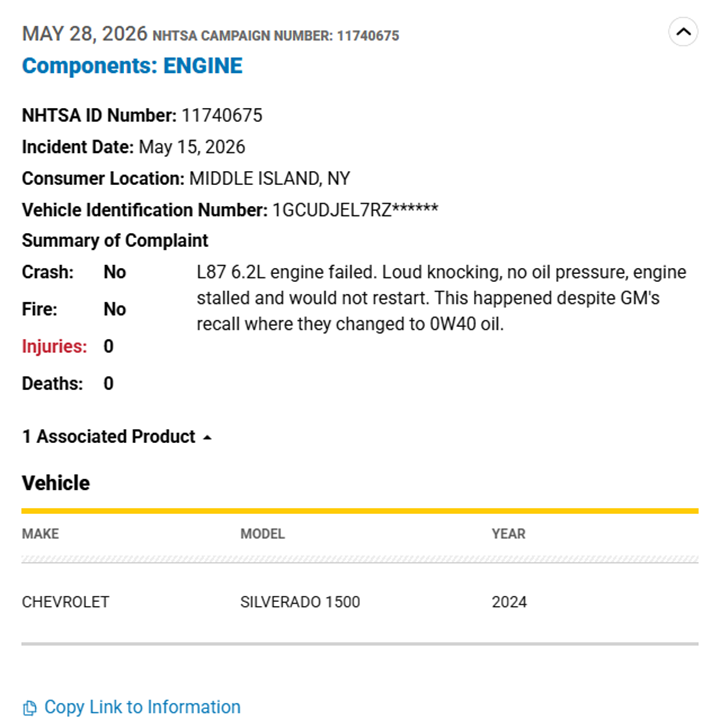
But the same seemingly cannot be said for the L87. Back in January 2025, we reported that the National Highway Traffic Safety Administration (NHTSA) opened an investigation into over 877,000 GM vehicles equipped with L87 engines after receiving a flood of reports about engine failures. Then, in April 2025, after more than 28,000 engines failed, General Motors finally issued a recall for nearly 600,000, citing “crankshaft, connecting rod, or engine bearing failure.” The prescribed fix was to inspect engines and, depending on detected wear, repair or replace affected engines as necessary. Engines that weren’t worn enough to warrant repair or replacement were instead put on a diet of higher-viscosity oil, a new oil cap, and a new oil filter; that’s it.
Normally, that would be the end of a recall, but NHTSA started receiving reports that supposedly fixed engines were failing, too. In January 2026, that resulted in NHTSA launching an investigation into whether the fix didn’t actually fix these poor engines. Now, nearly nine months and a pile of 6,050 allegedly failed engines later, NHTSA is once again investigating L87 failures. This time, the spread is even greater, with a population of 997,743 vehicles affected by the investigation.
Where This Headache Started

It’s been quite the ride to get to where we are today. Let’s go back to where this all began, with the 2025 story written by Zoe Skyforest that was apparently the calm before the storm:
Across all these vehicles, owners have found themselves suddenly facing a total loss of power when driving, only to later find out that major engine damage has occurred. The problem doesn’t seem to be limited to any one model year or model; instead, it seems to affect a range of vehicles with the L87 engine built from 2019 until today. It doesn’t take a genius to know that a sudden engine failure can leave you in a dangerous situation. The agency notes the severity of the problem, and the inherent safety risks—explaining that “Failure or malfunction of the engine results in loss of motive power of the vehicle, which may lead to an increased risk of a crash resulting in injury and/or property damage.” Thankfully, as of yet, no crashes, injuries, or fatalities are known to have occurred.
As it stands, NHTSA has received 39 complaints regarding the matter, with submissions stretching back several years. Submissions to the agency indicate the problems often tend to crop up suddenly, without prior warning. At best, some owners hear strange noises or ticking, or get a warning for low oil pressure as the engine seizes up. In some cases, the issues have occurred in trucks with under 5,000 miles on the clock, with NHTSA recording multiple cases of total engine failure under 20,000 miles. However, some vehicles have approached 100,000 miles before failure.
Interestingly, some owners cite that their problems first became apparent when the vehicle suddenly shifted into neutral, only for them to later find the true issue to be major engine damage. Others have found they are able to restart their vehicles after an initial loss of power, only for the problem to reoccur. Most cases, however, seem to involve a single sudden incident where the engine loses power and totally seizes up. In many cases, the engine has suddenly failed while owners are traveling at highway speeds, leaving them with zero power in a dangerous situation. “While driving on a busy road our vehicle stopped from catastrophic engine failure without warning which put my family and I instantly in danger and nearly got us killed,” stated one shaken owner. “Due to the high traffic where it stopped we were scared to stay in the vehicle and also scared to exit it, so we contacted the police before calling a tow truck.”

General Motors conducted an investigation, which was completed in April of that year. It found a staggering 28,102 complaints or incidents allegedly involving failure of the L87 engine. According to NHTSA, 14,332 of those complaints cited a “loss of propulsion.” GM responded by immediately recalling 597,630 vehicles built from 2021 to 2024. In the recall, GM said that the root cause of the L87’s failures was manufacturing issues regarding the engine’s internals. From the recall:
GM’s updated field data analysis identified a build period from March 1, 2021, to May 31, 2024, with an increased rate of potentially related engine failure claims. GM’s investigator reviewed findings from teardowns of field engines and data from a study of new, unused crankshafts. Supplier manufacturing and quality issues were identified at intermittent periods within the suspect build period, including (1) rod-bearing damage from sediment on connecting rods and crankshaft-oil galleries; and (2) out of specification crankshaft dimensions and surface finish. These issues an cause or contribute to bearing damage that can lead to loss of propulsion and engine failure.
Sadly, not all of those who experienced an engine failure were able to safely pull off the road. Per GM’s investigation, L87 failures could have been a contributing factor in 12 crashes, 12 injuries, and 42 fires.
As I said earlier, the affected engines were ordered to have their internal components inspected and either repaired or replaced. Per the recall, replacement parts for these engines were “produced after the suppliers’ suspect manufacturing window.”
In January 2026, NHTSA opened a new investigation after receiving 36 reports of post-fix engine failures. It wasn’t just those who got new engine internals either; people who received entirely new engines also reported failures. Now, things have seemingly gotten worse.
A New NHTSA Investigation And A Class Action Lawsuit

Today, NHTSA has announced a probe into 997,743 vehicles after having received over 6,000 complaints alleging post-fix engine failures. From NHTSA:
General Motors (GM) issued Recall 25V-274 to address concerns of engine failure in the L87 engines produced between March 1, 2021 and May 31, 2024. GM cited the root cause as a supplier manufacturing and quality issue. GM’s recall remedy for Recall 25V-274 consisted of two different repairs, either an oil viscosity change or an engine replacement, based on the results of the remedy inspection procedure. ODI continues to receive reports of engine failures after the completion of the recall remedy.
To date, ODI has received 499 complaints alleging post-remedy engine failure in vehicles subject to Recall 25V274, 473 of which involved an oil viscosity change and 26 a complete engine replacement. Additionally, ODI has received 191 reports of L87 engine failures in engines produced after the production period cited in Recall 25V-274. GM reported receiving 6,953 complaints of post-remedy engine failure.
The vehicle population in this investigation covers 2021 through 2026 model-year GM models equipped with L87 6.2-liter V8s. Specific models are not mentioned. NHTSA has found overlaps in the complaints it received and the complaints GM received (some people reported an alleged engine failure to both organizations), and thus, the population of allegedly failed fixed engines is 6,050 units.
NHTSA says that this new investigation expands the scope of the aforementioned investigation that it launched in January of this year:
ODI is opening this Engineering Analysis to continue investigating complaints of post-remedy engine failure. ODI is expanding the scope of this Investigation to include engines produced after the production period cited in the recall.

General Motors has also faced multiple class action lawsuits. In February, a federal judge consolidated all of these complaints into one large class action suit. Filed in the United States District Court For The Eastern District of Michigan in February 2026, the 389-page amended complaint from 45 named plaintiffs alleges, among other things:
4. The L87 Engines consistently experience sudden failure, resulting in loss of motive power and propulsion during vehicle operation.
5. The engine failure arises from loss of lubrication between the crankshaft and the bearings (the “Defect” or “L87 Engine Defect”).
6. The sudden loss of power caused by the Defect, often while a vehicle is being driven at high speeds, significantly increases the risk of a dangerous crash and/or injury.[…]
11. As explained herein, the recall is egregiously inadequate.
12. The recall does not cover all Class Vehicles, despite NHTSA identifying all Class Vehicles as being associated with the Defect, and despite numerous reports of engine failure in non-recalled Class Vehicles.
13. The recall, moreover, does not provide for any repair unless vehicles fail certain dealership inspections. As alleged below, there are numerous reports of vehicles “passing” inspection, only to suffer from sudden engine failure shortly thereafter.
14. Additionally, there are reports of post-recall engine failure in vehicles that did receive an engine replacement pursuant to the recall.
15. Indeed, on January 16, 2026, NHTSA opened a new investigation specifically related to post-recall engine failure in the Class Vehicles.
16. Further, the recall mandates a change in oil for Class Vehicles that do not receive an engine repair or replacement. Specifically, the recall mandates that Class Vehicles that were previously instructed to use 0W-20 oil switch to the higher viscosity 0W-40 oil.
17. Not only is this change in oil ineffective in addressing the Defect—as recognized by NHTSA, there have been numerous reports of Class Vehicles suffering engine failure after switching to the 0W-40 oil—but it imposes new costs on vehicle owners and lessees for which they did not bargain.
18. The 0W-40 oil is more expensive than the 0W-20 oil that GM instructed to be used with the Class Vehicles at the time of sale.
19. The 0W-40 oil, moreover, results in decreased fuel efficiency, leading to significantly greater fuel costs over the period of ownership or lease.
20. The Class Members, as defined herein, did not receive the safe, dependable, and fuel-efficient trucks that they paid for; but, instead, received vehicles that impose greater operating costs and that subject them to a significant risk of sudden engine failure. Had Plaintiffs and Class Members known of the Defect at the time of sale, they either would not have purchased these vehicles or would have paid less for them.
Since then, there have only been standard court procedural motions and document filings without much to note. Lawsuits can take years to work their way through the courts, so we may not see a resolution to this class action for some time.
Anecdotally, continued complaints on online forums do seem to back up the reports that these engines might still be having some issues, and that’s sad. The good news is that, for those who are going through this, GM does have a remedy. Previously, GM told us that engines that received the recall work are covered by a “special coverage program” that warranties the engine for 10 years or 150,000 miles from when the engine was first placed in service, whichever comes first. Since all of these engines are younger than ten years old, a bulk of people still dealing with issues will be able to get another engine or repair done for free. That’s great!
I have reached out to General Motors for comment about this new NHTSA investigation, and for comment on if it knows what’s causing this latest spate of issues. Here’s what I got back:
“The safety and satisfaction of our customers are the highest priorities for the entire GM team, and we continue to cooperate with NHTSA’s evaluation of this matter.”
Based on our reporting on this issue over the past year and a half, it’s understandable that some owners have lost confidence in their engine’s ability to go the long haul. The warranty is great, but it is a legitimate concern to wonder what will happen when your truck or SUV is no longer covered by it. So, whatever is going on here, hopefully the cause is found, and there’s a working solution.
Correction (Aug 22, 2026 10 AM ET): We added hedges to the headline since the figures for engine failures are based not only on field “incidents” reported by GM to NHTSA but also on field “complaints.” We can’t be 100% sure that all engine failure complaints are valid, so the number could be lower, though it could also be higher; best to hedge.
Top graphic images: GM





It will certainly be harder to sell one of these used to anyone with access to Google, so the residual value isn’t going to be great.
Is 10 years or 150,000 miles considered a lot of use for a truck? It seems miserably low to me.
That’s above normal for a truck warranty, but lower than normal expected lifespan for a gasser truck. 20yr/200k is what most people I know expect, with farm trucks lasting 20 years with normal repairs (but low mileage), and highway trucks going 200k before severe drivetrain problems (work trucks, rural highway driving).
My father had three Ford V8s replaced under warranty in the same F100 in about two years. Apparently from dust damage. Finally the dealer upgraded it to a 300 six and it lasted for the next 20 years.
My dad put about 50 miles a day on it in the summer but it was mostly dirt roads and lots of towing.
Late reply and all, but that screams manufacturer defect with that specific V8 package rather than an example of normality.
The 6.2 being another example of a defective package.
I have to wonder if a switch to 10W40 oil would solve the problem. These new thin oils (and engine stop-start) is not there to enhance longevity.
Toyota did better by their customers. Just replace EVERY engine that has an issue. More expensive in the short term, but it buys loyalty.
That requires caring about more than just this quarter’s stock performance.
Like I have said in the past here, I have not trusted GM engineering and their management decisions since the Ignition Switch debacle (where they changed the design of said switch without changing the part number, denying there were issues, then saying that they were no longer responsible for those faulty ignition switches because those belong to the OLD GM, before bankruptcy).
Fuck General Motors. Had respect for them for so many years but today so very glad I do not own one of these absolute pieces of junk.
They deserve they get, along with the other domestics who if they can, will pull this exact type of thing, and screw their customers every way from someday.
Their punishment will be the introduction of Chinese vehicles in all of their current market, and at that point SAIC will take over the remnants of Government Motors.
Sadly, our Tahoe is [was] among those 6,000. 2023 High Country made it 50,000 miles before engine #1 quit and was replaced with engine #2. Within 10,000 miles, that one made a horrible noise and back to the dealer it went where they found that the block was cracked on engine #2. We sold it to the dealer before trying engine #3. Funny thing is that the damn thing e-mailed us (it was still connected to our account, I guess) a month ago that it needed to go to the dealer “immediately.”
“ Specifically, the recall mandates that Class Vehicles that were previously instructed to use 0W-20 oil switch to the higher viscosity 0W-40 oil.”
Yeah… that oil viscosity change as a “fix” was completely bullshit and was a lame-assed way for GM to reduce their warranty costs to get remaining ticking-time-bomb engines to last just long enough to get past the warranty.
Fuckers.
You talking about the 10 year/150,000 mile warranty that applies once “fixed”?
It certainly was. The engineers knew that oil viscosity would not fix this issue.
GM’s gotta GM.
Oh, I bet your pardon, gm’s gotta gm.
“In 2019, General Motors launched an update to its Generation V small-block V8 architecture. The L87 succeeded the L86 that was in production since 2014. Power numbers between the engines are similar, but while the L86 used GM’s Active Fuel Management, which switched running cylinders between V4 and V8, the L87 uses Dynamic Fuel Management, which can choose from 17 cylinder deactivation configurations to save fuel. This naturally aspirated, overhead-valve V8, which is a part of the second-generation EcoTec3 family, features a cast aluminum block, a forged steel crank, forged powdered metal rods, and billet steel cams.”
So there’s the correlation, but is it the cause?
Maybe stop using the term ‘small block’, as it only pertains to Americans and really those of a certain age. It’s just a V8 to the rest of the modern world.
Gm considers it the direct descendant of the small block that has been in continuous production since 1955. It has the same 4.4″ bore spacing as the 1955 model.
In fact, GM call it the “generation V small bock” See the title of this webpage: https://poweredsolutions.gm.com/products/engines/l87-engine
“6.2L L87 V-8 Small-block engine”
Perhaps we should stop calling the C8 a “Corvette” because they put the engine behind the passengers and ignore what they call it in the brochures. If gm calls it a small-block in their press releases and website, it’s a small-block.
They should call the L87 the “Mongoloid engine” meaning no offense to any mongoloids out there.
Guess I should put some locks on the hood of my 2006 Silverado, somebody might swap me!
I was getting a part for my ’06 Sierra from a dealership not too long ago, and the parts guy said, “Oh man, those are the ones to keep. If I buy a truck, it’s going to be one of those.”
Shh, don’t let mine here yours got a part or it will want one too… 🙂
GMT800 Supremacy
Clearly another example of production of engines with farctoo many different metals causing failure when warped but unnoticed when metals went back to room temperature
Lolwut?
This does happen more than you think. The car in my avatar is a civic endurance race car, but just about everything under the skin is from a 95 integra type R. We haven’t found any aftermarket or new OEM CV axles that won’t seize after about 30-75 minutes of racing effectively preventing you from being able to steer, however if you can find one in a junkyard that was manufactured in the mid-90’s they never have that problem. The heat from the brakes transfers to the hubs, which transfers to the axle and with every modern CV we’ve had the 3 lobes inside the cup expand at a faster rate than the cup until it seizes in there. We eventually solved the problem via ducting that directs the air towards the vents in the center of the rotor, then a second time by switching to two piece brakes so less heat transfers to the hub so it’ll still keep working if the ducts get ripped off, but we also have a rotation of 5 original axles we’ve found in junkyards that we rebuild and rotate after every race.
Another cool quirk we learned is that every D-series or B-series engine will fail somewhere between the 8 and 12 hour mark due to piston number 3 exiting the block via the front. This is because that’s where the dipstick tube goes so it’s not cooled the same way as the other cylinders. This can be mitigated by retarding the timing 2 degrees from stock.