


You know what I haven’t done in a while? Geeked out about some minor footnote in Volkswagen history! I mean, I guess it hasn’t exactly been a while, but I guess the fact that this time I’m going to be talking about mirrors and weird radios and speedometers is a bit novel, right? Look, I’m just trying to justify to myself that my constant returning to topics that, were they the dead horse noted in the famous idiom, I have by now beaten into what is effectively horse pâté, is somehow just fine.
And you know what? I say it is fine, and I’m going to take that horse pâté and slather it on some mothercrunching crackers and go to town. That’s right, my friends, we’re going to explore two minor artifacts from the vintage Volkswagen accessory world that delight me, and a particular speedometer that confuses me. I’m pretty sure that I’ve noted before that delight and confusion are some of my favorite emotions, and the combination of the two, which I call befuddelightment, is a true joy to feel, so I hope you’re able to join me in this.


The first thing that I encountered that delighted me I saw in this Brazilian Instagram reel:
View this post on Instagram
Okay, so what are we looking at here? It’s a ’60s-era VW Beetle side view mirror, made by an aftermarket company named Hagus. The mirror itself looks pretty much like the factory mirror, at least for the external part, which is significant, as original factory VW mirrors were only an external part.
The box notes that the mirror is only for Beetles made after September 1967 – the start of the 1968 model year, and when the side mirror’s mount point moved from a threaded socket in the door hinge to a special threaded hole in the door itself.

I found a Facebook post from whom I believe is the same person, and that’s where I sourced these photographs. As you can see, this aftermarket side mirror has what appears to be a control arm and knob! That means this is an accessory internally adjustable side view mirror! Holy crap; this is a level of luxury I have never thought possible in a Beetle.
I accepted decades ago that, when driving my Beetle, if I need to adjust the mirror and it’s raining outside, then my arm is going to be wet. The idea that one could be driving a Beetle and adjust the mirror without rolling down the window and shoving your hand outside to physically grab the mirror itself, and instead could just use fingertips to control a small, elegant plastic knob like a king or emperor or sultan would, my lord, that’s a lot to take in.
You’d have to drill a good-sized hole in the inner skin of the door, though? I wish I could see the installation instructions.
I had no idea these existed. I’ve never seen one in person, and I’ve been to innumerable VW shows and the VW Foundation Museum in Wolfsburg. I’m thrilled just knowing this is a thing.

Bur we’re not done! There’s another surprise hidden in these pictures, and it’s not even noted in the post; it’s just hanging out in the background there. I’ve noted it with a little arrow for you, so you know what I’m talking about. See that little box with a dial, knob, and switch? It’s a radio. But not the usual kind of old VW radio!

No, this fascinating little thing is a radio designed to fit into a Beetle’s dashboard ashtray. Yes, it’s an ashtray replacement radio! These seem to be significantly more common than the internally-controlled side mirror, but they’re still not that common, at least as far as I can tell, as I’ve never seen one before. From what I can gather, these were Mexican made, FM only, and that switch on the front let you choose between 6V and 12V operation.
View this post on Instagram
I’m not sure what the big screw is for on the face of the radio, and I’m not clear how you adjust the volume and the tuning with that one knob? Maybe the inner and outer sections of the knob are independent? Maybe that screw does something?
I’m also not clear why you’d choose one of these over having a normal sized radio in the usual slot in the dashboard? Maybe it’s for setups where the normal radio slot is taken up with something like a CB radio? Or a dashboard toaster or something? Maybe you just want two concurrently-operable radios for just that right level of auditory chaos? Whatever the reason, I think it’s really cool, even if it’s a bit confusing.
Okay, since we’re at the confusing part of things, I have a little speedometer-based puzzle to ponder. I saw this Beetle speedometer for sale:

The site says this speedometer is from October of 1969. And the typeface used here fits that. But! There’s something big missing here: the fuel gauge.
You see, ever since 1968, VW inset the fuel gauge into the speedo dial, moving it from the separate location it enjoyed since 1962. As far as I know, no Beetle made in 1969 had a separate fuel gauge! Well, that’s not exactly true; Brazilian Fuscas did, but they didn’t seem to use this type of typography, and besides, the ad notes that this speedometer is from Germany.
Here, let me break it down for you:

Okay, so, Beetle gauges without an inset fuel gauge had that old-style typography with the 10, 20, 80 and 90 numerals upside-down compared to the rest of the dial, and with that almost 1940s-looking typeface. The last year of this style was 1968, and that was the first year of the inset fuel gauge.
In 1969 that narrow san-serif font was used, along with VW finally agreeing to label just what the hell the little warning lights in the gauge cluster were. As far as I know – or thought I knew – there were no (non-Brazilian) speedos without fuel gauges after 1968! Especially not ones that had the 1969-1972 narrow san-serif typography!
So what is this? Was VW still building ultra-low-spec Beetles? Hold on, I need to find out.

Wait wait wait wait. Holy shit. Are you kidding me? Was Volkswagen actually making a low-spec Beetle 1200 in the year of our lord 1969 that did not include a gas gauge? Holy crap were they cheapskates. And I’m not even sure how it makes sense, financially? Because they had to design a completely different instrument cluster with no fuel gauge and – did the Beetle 1200 include a reserve fuel tap, like the pre-fuel gauge Beetles had prior to 1962? If so, that feels like it would all cost more than just putting the damn fuel gauge in the car. If not, well, again, holy crap, VW, really?
Most customers seem to have opted for a fuel gauge, or added one later, as I’ve been trying to find pictures of a 1969 VW 1200 with the no-fuel-gauge instrument cluster, and this picture from one for sale is the closest I think I’ve found, and it’s not even 100% clear here:
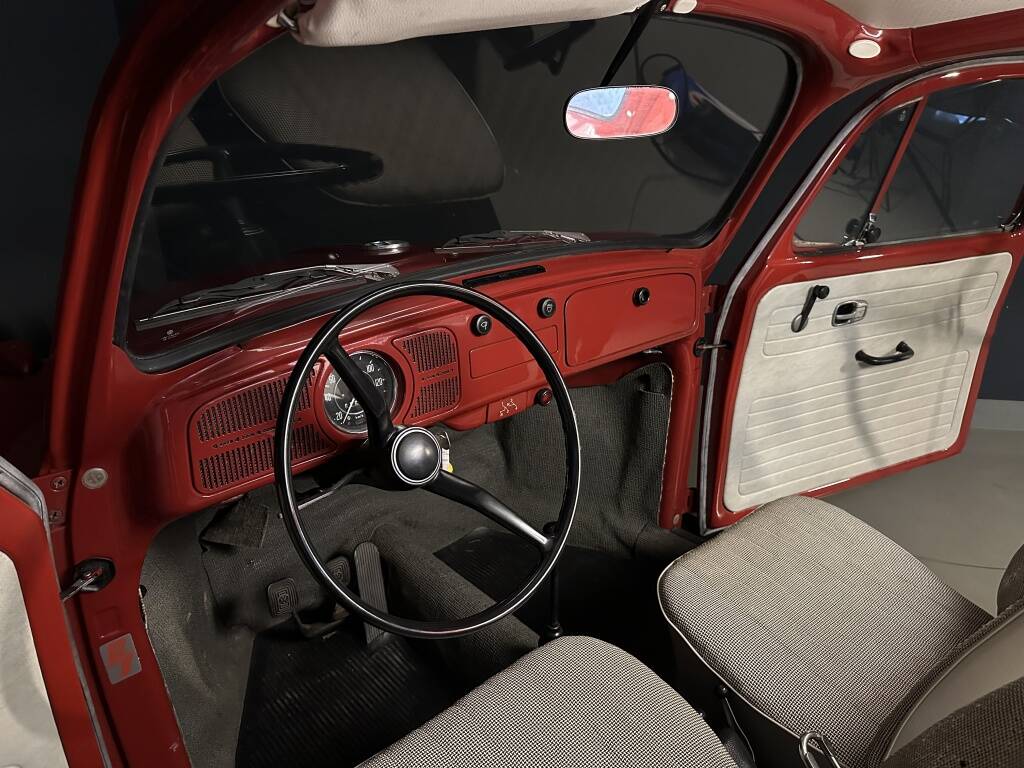
I wish they’d have turned that wheel a bit so I could really see, but maybe they weren’t eager to show that this Beetle comes with no fuel gauge, or, depending on how you think about it, it does come with extra fuel management excitement. It’s definitely a low-spec Beetle, as it only has one sun visor, no dash padding, and the smaller headliner. Who else was selling new cars in 1969 with no fuel gauge? Even the cheapest Citroën 2CVs came with one!
Look at that! Once again, I’m befuddazzled! Befuddelighted, I mean. Confazzled, maybe.


Another befuddlement: are tatami mats and shōji screens a thing in Brazil?
Japanese brazilians are a huge community
I had no idea there were brazilians of Japanese people there.
That is huge!
Famous Doyle Dane Bernback AD copy from 1969:
“The VW Beetle’s engineers are so obsessed with precision that when they discovered that fuel gauges are imperfect instruments, they removed them so as not to mislead drivers and cause them concern.”
Two thoughts: First, all my air-cooled VWs had oil filler caps labeled “OEL” which should be oil (or 710, upside down) in English. Suggests to me that this speedo was made for non-German-speaking markets (since the green light on the speedo is labeled “oil”.
Second, my guess on that ashtray radio is that it’s a down-convertor, re-transmitting the FM megahertz signal tuned in to with the big knob, to an AM signal, on the Kilohertz AM band. Ah, but which AM frequency? I bet the screw setting on the front is to carefully tune the transmitter to an unused freq on the AM band, in your specific market, which is a setting you would want to make from the cabin, but rarely. Hence the inconvenient screw slot. Further, as others have mentioned, putting the input voltage adjustment where it can be reached, is nuts. I think the slider is the power switch.
What I can’t figure is what that ashtray radio would use for a receiving antenna. I would love to see the back of it!
Member for a year, and this article prompted my first comment. Love you guys!
I’m on a Mexican, whoa oh, radio (radio)
I looked at an imported Italian car that had a flush slide in radio that looked very permanent, but a hidden lever released it to pop out like a toaster!
Apparently a design for ultra high theft areas.
Must have been common as it didn’t seem like a particularly high spec unit, but nicely done.
Looked like a factory option.
I remember my mum having one in her VW Polo in the mid-90’s. You just had to lift up a handle, and then you could pull the whole radio out of the dash. So then you’d have to tote around a heavy metal box, with sharp edges, and find somewhere to put it. (eg)
Fortunately manufacturers soon moved to making just the front panel removable. I had one with no actual electronics in the faceplate. There was just a hole to allow you to see the screen, and the buttons would just poke right through and hit the actual switches on the front. You could actually use the stereo without the front, just by bridging two contacts on the front.
I’m not sure what you’re describing is an anti-theft feature, but rather a convenience. In 1958 and 1959 Oldsmobile advertised that “the new Trans-Portable pays a dual role for people going places and doing things in this mobile era. It’s a portable and a car radio all wrapped up in a single lightweight package.” Pontiac had the “Sportable” through 1960, and Buick had the “Transistor Portable.” In that era an often expensive portable radio was appreciated, not the almost disposable item it became later. I think Blaupunkt had a similar OEM unit, and many European radio manufacturers offered removable dual purpose under dash units. The handsome Tandberg TP41 was produced through 1975.
Interesting.
The one I saw was very much an in dash unit and had no speakers.
The release was very concealed too, though if they were common, thieves would know how to find them.
It could have been related to dual purpose types though.
I’m certain it was a European option imported on the car. I’ve never seen similar for sale here.
I used to have an external VHS deck and still have Blaupunkt dvd external decks with remotes!
I bet the Tandberg was nice.
Uher had a car cassette deck I always wanted.
Was Volkswagen actually making a low-spec Beetle 1200 in the year of our lord 1969 that did not include a gas gauge?
Congratulations, you have found a Sparkäfer speedometer. If you search for “Sparkäfer Tacho” you will find lots of pictures of speedometers without fuel gauges, which allegedly cost a whooping DM 35 if you needed one. The petcock (is that the correct word?) works like the one in the pre-1962 models and was kept until 1972 in the Sparkäfer and 1200A.
Unfortunately, I couldn’t find a website about the Sparkäfer in English, but Google Translate is your friend:
https://standardkaefer.de/Modelle/SPARKAeFER-ab-0867/
https://bugfans.de/Forum/viewtopic.php?t=6058
https://www.autobild.de/klassik/artikel/vw-1200-a-862141.html
The Auto Bild article shows the dashboard with a speedometer like the one you found.
The Sparkäfer deserves an article of its own. VW’s desperate attempts to quench each possible Pfennig out of the production costs are hard to believe.
Regarding the ashtray radio, Jason asked, “I’m also not clear why you’d choose one of these over having a normal sized radio in the usual slot in the dashboard?” My guess is that the original radio was only AM. This lets you add FM, just like the add-on FM tuners that were sold here back in the ’70s. — http://www.antiqueradio.com/Aug06_Smith_FM.html — With these, you pushed the little button on the right and that turned off the dashboard AM unit and turned on the FM tuner. These usually mounted under the dash but this one, designed to go on the ashtray spot, is brilliant.
Ahh, that makes sense to me.
You got it. It’s an FM converter, like the ones you could order through your local FM underground rock stations in the 70s.
Ahh, that explains why it doesn’t have a volume knob, the original stereo was doing the actual amplification.
Seems weird to put that switch on the front. I could see it on the back, where you set it before sliding it in. Their warranty department must’ve loved that.
And, unless I’m blind, that speedo doesn’t have the VDO logo on it, which might be a clue that it’s not German-made, but Brazilian.
On the front? In a 12V vehicle I imagine that became an accident- or curiosity-driven “incinerate” switch.
And the higher state you reach once the delight an confusion are permanently internalized: befuddenlightenment.
IMHO the only vehicles that are acceptable without a fuel gauge are ones you can visually see the fuel level with while you use said vehicle.
Like motorcycles with a translucent gas tank and some airplanes.
My gas mower will cut my entire yard on less than a full tank. Good enough.
But how much less?
A few tablespoons at best.
My neighbor had a car with a broken fuel gauge and would hold a match near the uncapped filler pipe to shed some light while he peered into the tank. Does that count?
When did his house burn down
Never happened, thank goodness. Strangely unrelated, he had only one arm.
My high school electronics teacher had only one arm; but he didn’t lose it to anything arc-flash / electricity related.
His arm was lost due to a rather grisly farm tractor incident.
Watching him light a match is interesting to me
Wooden, strike on box held between legs.
H was also a smoker, so I imagine he had some other tricks. Hopefully he didn’t smoke while driving, though.
Lefty? He owes me money!
Nah, this was his brother, Righty.
Could that radio have been an FM converter that worked in conjunction with the factory AM radio like the old Radio Shack converter I had in my first car? That didn’t have a volume knob either because the factory radio controlled the volume. That 6v-12v switch would be what set it apart from other converters. Just wondering.
Ohhh that seems likely!
You mean it’s not the prototype for your ashtray-replacement phone dock?
holy crap, you remember that!
Yes, the switch controls which tuner operates, FM or AM. It is a bypass/power switch.
It is an add on FM receiver for a car equipped with an AM radio only. Knob is for tuning and the original AM radio contains the amplifier and volume control. Just like an old add on 8-track or cassette player.
And that screw to the left, if it’s not a locking mechanism, as suggested below, could be a glass fuse, as it’s about that size.
You are probably correct – servicability was once a thing.
ohhhhhhh yes! Thank you! Jeez, why didn’t I think of that!
Because we both grew up in an era where AM/FM stereo was more or less the default for newer cars. But dad did have 8-tracks, tape decks, CB’s, etc… rigged into various cars from my childhood. Our Fairmont had an aftermarket 8-track and a CB on the tunnel.
My Dad had installed quite a few of those Audiovox FM converters back in the 70s. I remember plenty of our cars were AM only
Dad insisted on AM/FM and AC for all cars once I was born.
But could you install it on a Thing?
An FM-only radio with a switch on the face for selecting 6- or 12-volt. That’s…boy, that’s different.
I wonder if the face switch is the AM/FM one and there’d be a 6/12 volt switch or adjuster screw on the back since it’d only have to be set once for the car it’s being installed in.
I came to post a wondering about that switch also. It seems like something you would not want to toggle that often.
It likely bypasses the FM receiver for the AM one – see my above comment.
That make SO MUCH more sense. thanks!
We did similar shenanigans 25+ years ago adding aftermarket CD changers, etc… to otherwise factory systems.
I remember my $7 dollar Radio Shack radio/tape player bolted to the bottom of my dash wired hot and to surface mount speakers in the back of my 78 VW Rabbit would drain my battery if i did not drive the car every few days. Fun times.
On the speedo – what’s the red cutout section at 50 kph for? Low fuel warning?
It seems like a hash mark for when to change gears, though there only being one is odd. Plus, if you’re not out of first by then, maybe you have bigger problems?
A wink-wink to US fuel economy standards that required a hash mark at 55 mph? With the probably accurate assumption that most US drivers wouldn’t read the km/h marks.
Except 55 mph would be in the 95 km/h range.
They could have changed the gears to make it read mph and just assumed that customs would be sloppy enough to not inspect the part to note the km/h marks. This was the time when we wanted to support West Germany so it wouldn’t have surprised me if such a “mistake” would be overlooked.
A quick search shows the 55 mph was 1974 and the mandate for 85 was started 1979
A sign at the 50 kph mark was common in German cars of the time, as 50 kph is the default speed limit for inner-city traffic in Germany.
MB had an even more striking way of reminding drivers. Don’t go 55 kph! AND DON’T EVEN THINK OF GOING 60! In addition, this speedometer shows very optimistic hash marks for the gear changes at about 40, 70 and 110 kph.
I have thought on the radio: maybe it only needed one dial and the volume is always at max.
It’s been a very long times since I manually tuned an AM radio, but I seem to remember the static between radio stations being fairly quiet, and the radio would get louder the closer you got to tuning to the station’s exact frequency. If you want it a little quieter, you just tune it a little off. Afterall, the Beetle wasn’t a quiet car and I doubt these had a lot of power, so something this simple might have worked.
I see the 1968 speedo is a VDO, my old employer. The rest aren’t marked as far as I can see. Did any other company make their instruments and gauges?
As far as I know, VDO made all the Beetle’s gauges, at least the German-built ones.
Given to understand that Germany has or used to have laws dating from the late 1940s or early 50s, when the country was still dealing with post-war scarcity & recovery, requiring automotive manufacturers to have at least two suppliers for various components in case one supplier ran out of inventory or had problems with production. I’ve seen a *few* Bosch lights on VWs, BMWs, & Mercedeses so I’m guessing Bosch was a backup or at least one of the backups for Hella. However, yeah, haven’t ever seen a non-VDO gauge from the factory in a German-made Beetle…
That screw on the radio might – and we’d need an image from the screw side to confirm – push out a wedge or something to lock the radio in place. That’s my guess anyway.