


555 Horsepower. 1230 lb-ft of torque. 8.3 liters of turbodiesel glory. The new Chevrolet Silverado HD may share its body with the 2026 truck, but this mid-cycle update is a big deal: It brings with it the Mongoose, the biggest diesel engine ever offered in a heavy duty pickup, and one that can tow an outrageous 38,000 pounds. Here’s what it was like to drive.
If there’s one thing that heavy duty pickup truck brands enjoy, it’s oneupmanship. If you look at the last 15 years of torque figures, it’s really been Ford and Ram duking it out. In 2011, the Ford Super Duty’s 6.7-liter Power Stroke was the first HD truck to hit 800 lb-ft of torque — a monumental figure at the time. Ram caught up in 2013 with its 6.7-liter Cummins, while Chevy’s 6.6-liter “LML” Duramax hung out at 765 lb-ft all the way until 2017.


Chevy released the 910 lb-ft L5P Duramax in response, though by then, Ram’s Cummins had jumped to 850 lb-ft, 865 lb-ft, and then 900 lb-ft — just 10 lb-ft short of Chevy. Ford had countered Ram’s 850 lb-ft with a new 860 rating, and then when the Ram jumped to 900 lb-ft and Chevy jumped to 910 lb-ft, Ford went up to 925 lb-ft. So in 2017, Chevy was now no longer dead last; it was second.

But that didn’t last long, because the following year the Ram’s Cummins’ output elevated to 930 lb-ft. That same year, Ford’s Powerstroke’s output went to 935 lb-ft. In 2019 the Ram made 1000 lb-ft; in 2020, Ford’s truck made 1050 lb-ft; and then in 2021, the Ram started making 1,075. All the while, Chevy stayed at 910 lb-ft.
The Bowtie’s L5P got an update in 2024 to bring torque up to 975 lb-ft, but that was still short of Ram’s 1,075, and it was in this year that Ford’s figure jumped all the way up to 1,200 lb-ft.
This is all to say that Chevy has been in third place in torque every year for the past 15 years, except 2017. Which is why 2027 is such a huge deal: Chevy decided to go nuclear.
[Full Disclosure: Chevy flew me to Tucson, Arizona, and fed me lots of steak. It is the diesel of human food, and afterwards I could feel the torque coursing through my veins; I snapped a 1/2-inch bolt using only my fingers. -DT].
A Close Look At The 8.3-Liter Mongoose V8 Diesel
I’m feeling sick tonight, so this won’t be one of my patented 4,000 word deep-dive reviews, but let’s see what I can get cranked out before I pass out.
As I mentioned earlier, the current L5P has been around since 2017, receiving an update in 2024. In reality, that engine’s architecture can be traced all the way back 2001. “We’d stretched that architecture as far as it could go,” Rob Moran, the Assistant Chief Engineer for the heavy duty diesel, told me at the press event in Arizona. It was about four of five years ago that Chevy began planning to bring out the biggest diesel engine ever offered in the heavy duty segment.

Though the engine shares some basic traits with the outgoing V8 — it’s a 90-degree V8, it has aluminum cylinder heads, those heads contain four valves per cylinder, there’s a variable geometry turbo in the valley, etc. — there’s quite a bit new here. For one, the block, Chevy says, is made of a new compacted graphite iron versus the outgoing gray iron. Per Moran, gray iron is the entry point for strength, nodular iron is the strongest (but harder to machine), and compacted graphite iron offers 40-50 percent more strength than gray iron and is more machinable than nodular iron.
I dug into this a bit, learning the following from the Michigan-based Metal Casting Institute, a website that “provides casting information, educational material, training outlines and linkage to technical resources.” From MCI:
Gray cast iron is the simplest, most common and lowest cost form of cast iron in the world. The iron microstructure is characterized by the “Flake Graphite” qualities in the forms of: a.) Type, b.) Size and c.) Martrix.
Gray cast iron has excellent castability and machinability qualities, making it a high value for parts that can be heavy. In addition, gray iron has superior damping and thermal heat transfer, making it excellent for automotive brake systems. While it is strong, it is also brittle.
Compacted Graphite Iron (CGI)is a recent addition to the family of cast irons. As shown by the image to the right, the graphite is characterized as a “vermicular” or worm-like structure. This graphite structure produces an iron with most of the properties being in-between the Gray Iron and Ductile Iron families of properties. Simply stated, CGI has nearly the same castability and wear resistance characteristics as gray iron, but with improved strength. Being able to use CGI for engine cylinder blocks allows thinner wall sections and lighter weight.
MCI goes into detail, discussing the significant advantages MCI has over gray iron, particular in engine applications:
While not quite as strong as ductile iron [which is the same as nodular iron], compared to gray iron properties, CGI is 75 percent stronger and up to 75 percent stiffer. It is also twice as resistant to metal fatigue as gray iron. However, significantly important for use in engine cylinder blocks, the graphite morphology of CGI was [determined] to have similar friction and wear resistance characteristics as found in gray iron.
Engine Applications
With all of the material properties taken into consideration, engine designers found CGI ideally suited for engine cylinder block manufacturing, where lighter and stronger materials are needed which can absorb more power and have similar resistance to bore wear when compared to gray iron. An assembled automotive engine can be made nine percent lighter with CGI. The engine block weight alone can be reduced by 22 percent. This corresponds to a 15 percent reduction in length and a five percent reduction in height and width.This weight savings is made possible by decreasing wall sections less than 4.5 mm thick, where the higher strength and slightly higher stiffness of CGI can be taken advantage of. Similarly, the bore walls and bearing block supports can be reduced in mass without losing the characteristics of gray iron as related to machinability, piston ring wear or noise damping.
Moran told me exactly the same thing: CGI allowed Chevrolet to reduce the block’s wall thickness without compromising strength, resulting in a block about the same weight as the outgoing one despite the new unit being 20 percent larger.
As for the engine’s size, Moran told me the displacement was an intentional way to reduce the specific output (horsepower per liter). This, he told me, lowers exhaust temperatures and pressures, yielding a less-stressed, more durable motor — a quality aided by the fact that the engine makes over 1,200 lb-ft between 1,400 and 2,000 RPM, meaning it can operate at low RPMs almost all the time.

Let’s talk about the new pistons. The outgoing ones were aluminum and the new ones are actually two-pieces of steel laser-welded together under the ring lands (this was done to accommodate a piston cooling gallery). Moran says the new pistons are “appropriately heavier,” though he notes that they’re thinner gauge than the aluminum ones in the outgoing L5P.

“We can run the steel pistons hotter than the aluminum pistons,” he told me. “That gives us improvements from a combustion perspective; it allows us to produce very clean combustion.”
Another change to the new L6P over the the L5P is that there’s now a variable oil pump that can strategically produce oil pressure based on demand, with Moran telling: “It allows us to dial in oil pressure to exactly what the engine needs. We also have electronically controlled piston cooling jets that allows me to cool pistons as needed…When the piston doesn’t need to be cooled, that’s heat that we’re not rejecting to the cooling system that has to go through the oil cooler, etc.”

That oil cooler, by the way, is a giant plate/stack-style heat exchanger now mounted to the side of the motor. The outgoing oil cooler was integrated into the oil filter like this:

Moran says the new heat exchanger has more plates and more cooling capacity than the outgoing one and was “specifically designed for towing 38,000 pounds.”

Moving to the cylinder heads — they’re similar to the outgoing ones in their basic design; they’re aluminum (great for heat dissipation) and they’ve got four valves per cylinder. But the L6P’s heads have integrated intake manifolds.

The outgoing 6.6-liter L5P’s intake manifolds were bolt-ons. Here you can see the intake ports:

And here you can see what the bolt-on manifold looks like (this is a top-view; the intake manifold is at the bottom, and would sit in the vee of the engine with the turbo, just like the current engine):
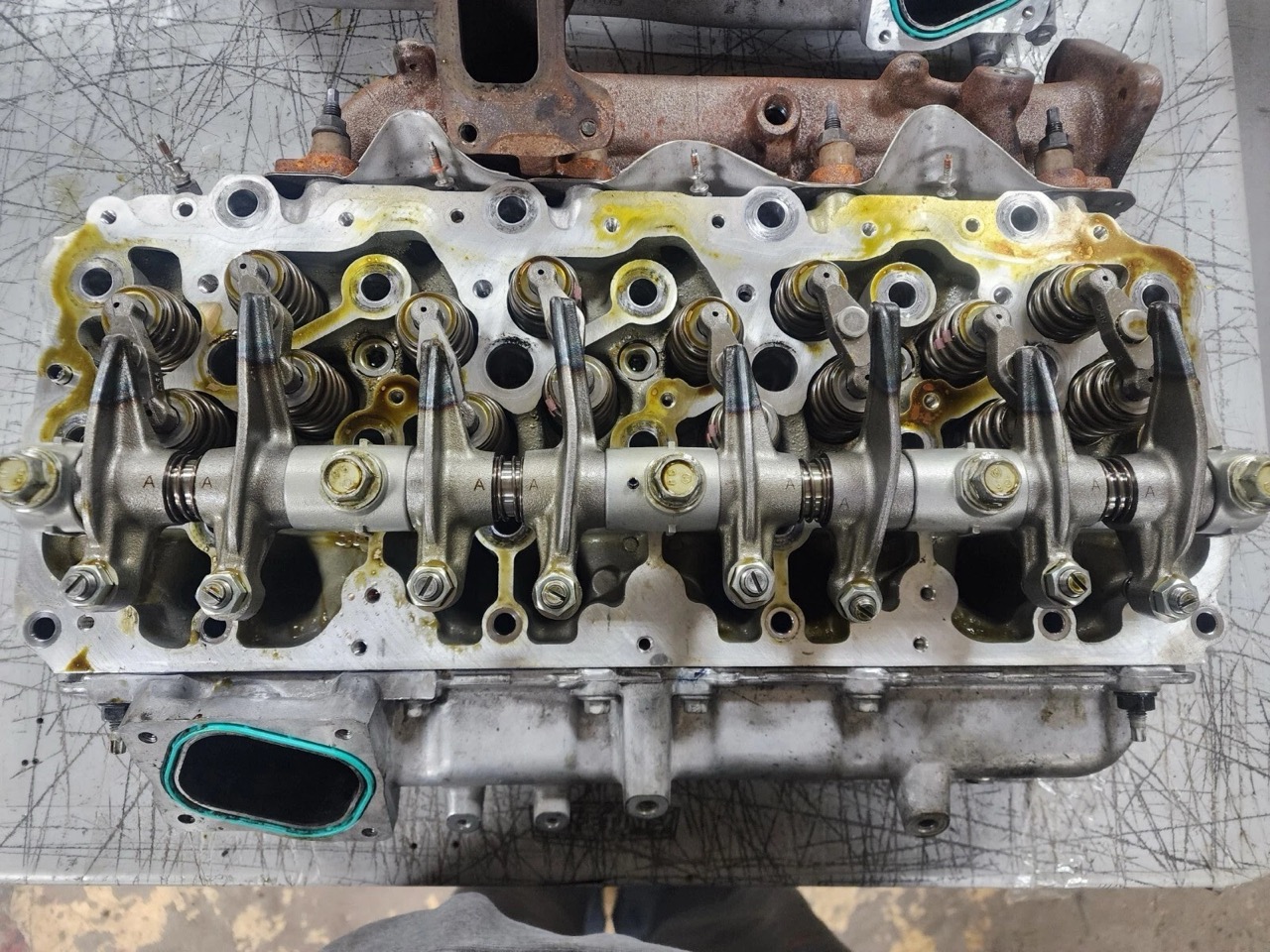
Moran didn’t get into the advantages of the integrated intake manifold, but I’d guess there are complexity, weight, and potentially thermal management/airflow advantages. Bolted to that intake, in the vee, is a huge turbo.

That larger turbo is spun up by the exhaust exiting the engine on the outside of the vee via two cast iron exhaust manifolds. After spinning up the turbo, some of the exhaust goes to an oxidation catalyst before continuing on to the rest of the exhaust aftertreatment system and some of the turbo’s turbine gases go into the EGR cooler.

The clean air that enters through the engine’s airbox is compressed by the turbo and then sent through two coolers — one liquid-to-air “knock down” cooler and one conventional liquid-to-air charge-air cooler.

If you’re curious what the inside of that knockdown cooler looks like, here you can see a bunch of tubes that the intake air travels through and that are surrounded by cold engine coolant. This is a called a “shell-and-tube” cooler, and in this case is made of stainless steel:

Once through the aluminum charge-air cooler, the air enters the intake ports, but not before being mixed with the appropriate amount of EGR to help reduce emissions.

As for the front of the engine, the alternator, engine fan (not shown), and ac compressor appear to be belt-driven. Otherwise, much of the accessory drive is gear-driven — including the oil pump, water pump, and fuel pump:

Here’s a look at the fuel pump, in case you’re interested:

The injectors are shown here on the right:

There’s a lot more to the engine, but I’m getting sicker at this review goes on, so I’ll leave you with Gale Bank’s look at the motor while I move on to the cooling system and exhaust:
There’s A Huge Cooling Module, And An Impressive Exhaust Aftertreatment

Before I get into the chassis, I’ll finish up talking about the engine ancillaries. The cooling module up front, for example, consists of a transmission oil cooler way at the nose, a condenser next in the stack, then the low-temperature radiator for the charge air cooler (and other things), and then there’s the high-temperature radiator for the engine and whatever else is plumbed into that system (I suspect the EGR cooler).

So that’s what’s in front of the engine. Let’s talk about what’s behind it: a sophisticated aftertreatment system. It begins with the oxidation catalyst I mentioned before. “That really cleans up any unburned fuel/any hydrocarbon coming out of the engine,” Moran told me, pointing to the blue and red wires going to a temperature and NOX sensor.

“Based on the data we get there, we come to our first [diesel exhaust fluid] injector,” he continued. “We dose the DEF here, it goes into the downpipe, mixes with the exhaust flow before we come to the first [selective catalytic reduction] brick.”

“The first SCR takes that DEF, combines it with the exhaust system, reacts to clean up the NOx,” he said, mentioning the larger DEF tank on the new truck compared to the outgoing diesel HD (up from 7 gallons to 9 gallons).
“Once we come out of the SCR, we double check the NOx where we are (he pointed to a blue wire) based on what we cleaned up in the first [SCR brick], before we go into the DPF.”
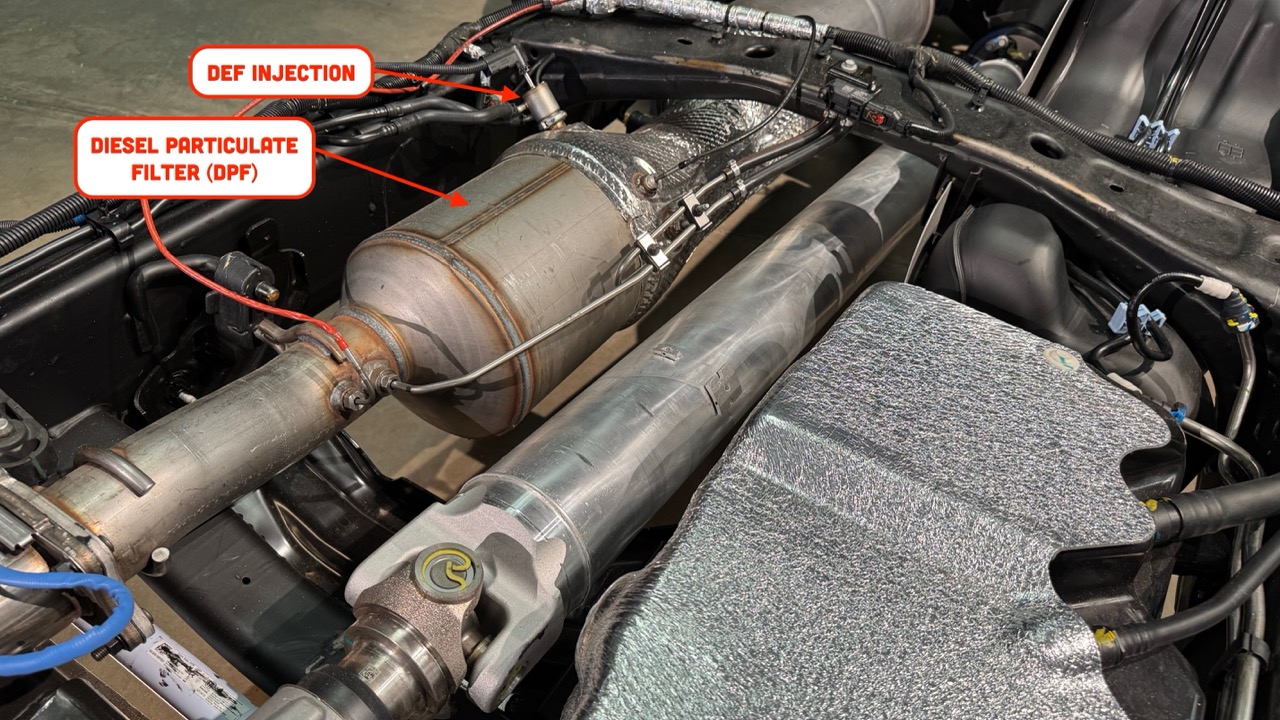
“[The DPF] is the particulate filter that cleans up the soot emissions in the engine…we measure the delta pressure across the DPF and… we regen the system when needed,” Moran, mentioning that the new Silverado HD now lets the driver regen at idle or manually without requiring a dealer to handle it.
“Based on what we see out of the DPF, we then dose the second DEF injector. That will then mix with the exhaust before we go into the second Selective Catalytic Reduction — there are two bricks in there that clean everything up before [the exhaust] goes to the tailpipe.”

The tailpipe, by the way, is quite cool. I’ve seen this on other diesel trucks but never thought too much of it; it turns out those holes in the tailpipe are there to reduce exhaust tip temperatures. The nozzle visible through the holes is acting as a venturi.
“The hot gas going through the center draws in fresh air from underneath the vehicle to control exhaust tip temperature,” Moran told me.

Big Updates To Brakes And Steering, Suspension Remains Largely The Same
On heavy-duty pickup trucks and really anything with a solid front axle, the way steering works is the intermediate shaft that’s spun by the steering column goes into a steering box. That box’s output is a pitman arm that swings in an arc, pulling and pushing a drag link and tie rod that are attached to the front steering knuckles. It’s a simple, but rather imprecise system, in part because these steering gearboxes have so much slop in them.

The new Silverado is the only HD pickup to use independent suspension — a design that is usually joined by a rack and pinion steering system. Chevrolet kept the old-school system going, presumably for durability reasons, but now for 2027 the brand says rack and pinions are ready for primetime in an HD application.
That makes the Silverado the first heavy-duty pickup in the U.S. to use a rack-and-pinion design like what you see in most passenger cars. There’s no gearbox; there’s simply a rack that’s attached to tie rods (which bolt to the steering knuckles), and there’s a pinion that’s attached to the steering intermediate shaft. You turn the wheel, this turns a small pinion gear, this moves a rack back and forth, and this pushes and pulls the steering knuckles to turn the front tires.
In addition to it being more precise than a steering box, a steering rack can more easily incorporate electric assist, which the new Silverado HD has. This assist could enable more ADAS driver-assist features, since the vehicle’s computer can now theoretically steer the truck using the electric motor in the rack. From Chevy:
Our first-in-class advanced, electrically assisted rack-and-pinion steering system helps give Silverado HD a confident, modern steering foundation, designed for reduced maintenance. Nimbly maneuver turns on switchbacks, squeeze through tight fits at the construction site and back into parking spaces with ease.
Tuned for precise and responsive steering
Quiet operation with no hydraulic noise
Reduces steering kickback off-road

Another major change for the new Silverado HD is the brake system. The rotors are bigger — now 14.6 inches — and they’re squeezed by new four-piston fixed calipers.
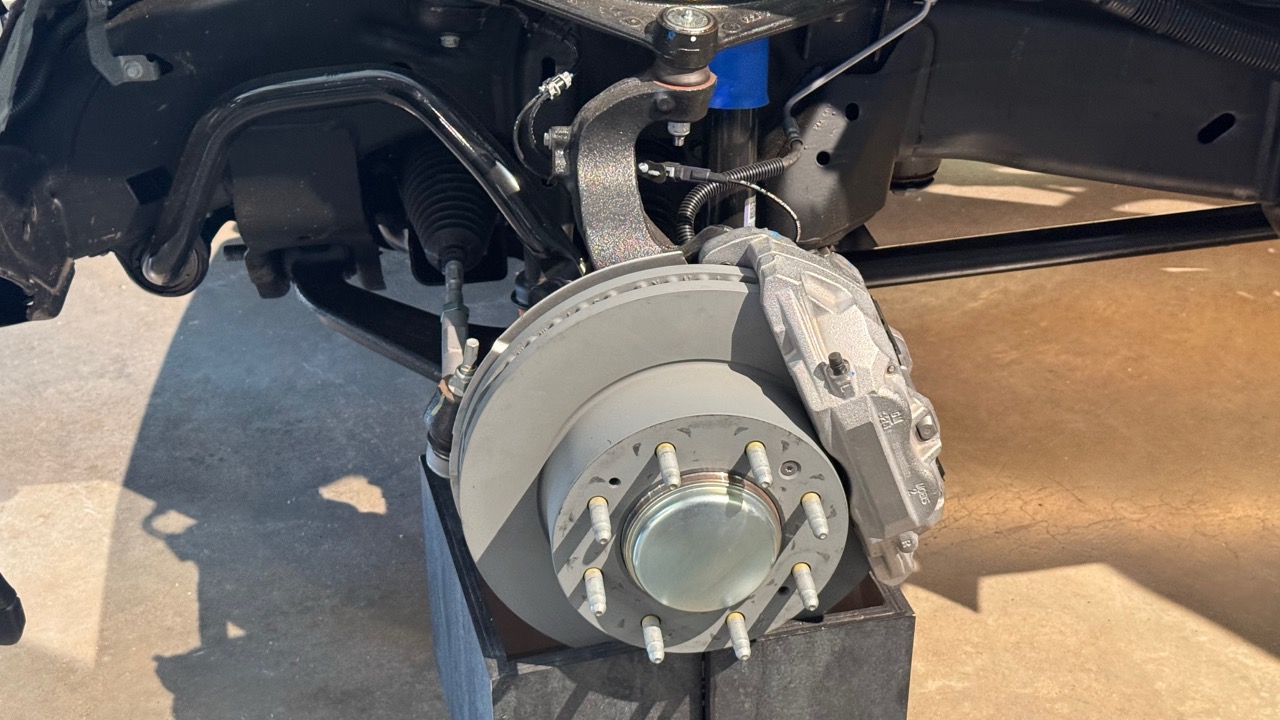
Perhaps even more important than the bigger brake hardware is the new eBoost electronic brake boost system. This replaces a hydroboost system that ran off the power steering pump on the old truck’s accessory drive.
The new electronic brake assist (shown below), Chevy says, is meant to offer “responsive and smooth heavy-duty stopping power, helping to give you added confidence when braking under load, especially on long downhill grades or when making repeated stops while towing.” The brand notes that drivers should notice a “More predictable brake feel; smoother, faster brake response; and improved braking power, cooling and consistency.”

As for the rest of the truck, the basic hardware is similar to the outgoing pickup. Out back is a leaf-sprung solid axle:

And up front is an independent front suspension:

Chevy reckons it’s dialed in leaf springs to the point where a move to coils or airbags doesn’t seem worth it. The brand is also happy with its torsion bar front springs that it’s been rocking or many years:


To see how much of a difference that new electronic brake booster and electronic power steering made on everyday drivability, I hit the road — but not before towing an absurd amount of weight with an absolutely epic truck.
Towing 37,000 Pounds In One Of The Most Impressive Trucks I’ve Ever Driven

What you’re looking at may be one of the greatest trucks I’ve ever driven. Why? Because it’s a nice combination of old and new; this red Silverado 3500 is a regular cab dually with a bench seat, column shifter, and vinyl floors. The screen is small, the dashboard plastics are rock hard (just as many workers prefer), and overall it just feels like a real work truck:

The truck is basic, and yet, it’s also equipped with a huge, modern 8.3-liter monster diesel making 1,230 lb-ft of torque.


Using that truck to tow 37,000 pounds down a drag strip was amazing. The jump off the line was a bit slow, but eventually that turbo spooled, the engine built a few revs, and I was on my way accelerating with a colossal load hooked up to the truck’s gooseneck.

The shifts were a bit firm, as one might expect when towing so much weight (it’s possible there was a little slop in the trailer hookup). But otherwise, that Allison 10-speed did a fine job helping the truck accelerate all the way to 60 mph, confidently.

Obviously, I’d prefer a 4×4, but this two-wheel drive “max tow” truck — with its basic interior and regular cab configuration — charmed me. And so did that surprisingly refined 8.3-liter, which — thanks to that turbo and the sheer amount of air passing through the motor — sounded almost like a jet engine as it stormed along that dragstrip.
Climbing A Mountain At 1,500 RPM
Chevrolet had journalists meet in a parking lot outside the hotel at 8 AM. There, a bunch of Silverados were lined up, and I was assigned the black 8.3-liter Duramax you see in the middle here:

Hopping into the truck, my first impressions were solid. The truck I had used to tow 37,000 pounds was basic, but this black truck was nicer — but not too nice.
The thing I like most about this Silverado HD in comparison to its sibling, the 1500 that I also drove during this press trip, is that there are more physical buttons and there is a truly substantial column shifter.


Seriously, the shifter feels satisfyingly mechanical, and does a lot to give the Silverado HD a “truckish” feel.

Obviously, it’s that tall Duramax diesel that I was most excited to try out on the street, and again I’ll say: It’s felt remarkably refined. Like I noticed at the drag strip, the sound it makes isn’t violent — it’s a loud whooosh that sounds like all the air the engine is sucking in and shooting out the back. The noise isn’t what I noticed when you drive this truck, though; what I noticed was just how low the engine’s revs stayed all the time.
Here I am accelerating quickly as I pull onto a main road; you’ll notice the RPMs are at 1500:

It makes sense. The torque curve for this behemoth engine is total madness — it makes the outgoing engine look downright pedestrian all across the rev range:

But it’s the bottom of the rev range that blows my mind. At only 1,400 RPM, the engine makes 1,230 lb-ft of torque. This means that, if you’re spinning just 1,400 RPM and you’re mashing the pedal, you can make 328 horsepower. That’s a lot of power at an engine speed that would fall into the “cold idle bump” range of a typical gas engine (i.e. that’s what some gas engines idle at when cold in order to warm up).
Experiencing acceleration from a thoroughly relaxed engine on a flat surface is cool enough, but to experience that on a grade is even more impressive. I literally climbed a steep mountain without the engine ever cresting 2,000 revs. I wish I could tell you more about how the Allison transmission behaves, but it did so little shifting that I’m just going to say it was good:

Throw a load on the back, and the 8.3 is in a league of its own when compared to anything else I drove out there — any of the Silverado 1500 half-ton trucks and the Silverado HD equipped with the 6.6-liter gas motor. That motor is more than competent, but the 8.3 shrugs off whatever you hook up to it, and quickly climbs whatever grade needs to be climbed without even the slightest complaint.

Coming down, the exhaust brake, the transmission braking, and the big discs at all corners mean the vehicle slows down as confidently as it speeds up. The brakes are solid; the pedal travel is a bit shorter than I’m used to, but it felt nice, though at idle, I did feel like the truck required a bit more brake pedal effort to stay still (I’ll have more on that later).
The steering, while a rack and pinion setup, doesn’t exactly feel that precise. There’s plenty of play on center, but I don’t mind that on an HD truck; if this thing were as tight as, say, a Cadillac ATS-V steering rack, that would feel out of place. What’s more, the truck’s size and suspension setup means it won’t change directions very fast no matter what you do.

But I’m not criticizing the truck’s handling; it actually slithered through the Arizona mountain roads better than I expected for a large truck. The ride was a little firm, the steering felt very light, and the brakes felt mostly normal. The 2027 Chevy Silverado HD is a shockingly daily-drivable heavy-duty truck that just so happens to have an earth-shattering, torquey 8.3-liter turbodiesel V8.
Off-Roading The Beast

Jumping into the Silverado HD ZR2 almost required a ladder; seriously, the floor height is absolutely bonkers, though I applaud Chevy for putting grab handles on the A-pillars. Every truck should have those.

The Silverado HD gets the job done off-road. It’s got aggressive Goodyear Wrangler tires, a rear locking differential, and skidplates where you need them (though I’d like to have seen protection under the engine and transmission pans, even if I recognize those are tucked up high).


A truck this big isn’t ever going to be a sensational off-roader due to geometry constraints, but the suspension articulated well enough, the tires gripped well (especially with lockers), and I was able to take this thing down a rock trail and have a lot of fun.
Low-end torque offroad is a big deal, as it allows a driver to maintain control over technical obstacles without revving the engine and potentially having to spin up the tires. The Silverado HD idles over rock ledges, and in low range, does require quite a bit of pedal effort to keep stationary. (Not an egregious amount, but more than I’m used to — it’s a lot of torque trying to get the truck moving!).

I’m not feeling great; I’m definitely going to be out of commission tomorrow, so let me wrap this thing up.
If You Like Trucks, The 2027 Chevrolet Silverado HD Is Epic

I’m a huge truck fan, and I love big, brawny engines. In that context, this new Silverado HD seems, to me, like it has the potential to become one of the great trucks of all time. Yes, the competition will eventually catch up, and that’s great. But until then, Ram and Ford are not only down on power and torque, but their engines are 1.6 liters smaller.
The cheapest Duramax Silverado HD will cost you $62,000 (that’s the base price of about $47,000 plus the $11,400 premium for the diesel). That’s not cheap for a Work Truck, but some might find it worth it in order to own the biggest, baddest pickup truck on American roads today. Then again, you could argue that the biggest, baddest pickup out there is the 1,025 horsepower, 1,198 lb-ft Rivian R1T, which would outperform the Silverado HD in many, many ways. But these are two very different machines, and in the category of ICE trucks, we may have to crown a new king.
Crap, I did end up writing 4,000 words. I’m off to bed.
Top Image: David Tracy


Super excited to see ten of these in a Costco parking lot on rubberbands next year.
I’m just going to go ahead and say that consumer pickups this powerful are simply not necessary, and are actually harming pickup truck design. The amount of people that tow consistently with HD trucks is already small. The amount of people towing near 40,000 pounds with these trucks is infinitesimally small. Yet, now we have a whole powertrain, cooling system, frame, etc.. that are designed to handle that. Huge tall front expensive front end to accommodate a huge tall expensive radiator that cools a huge tall expensive engine behind it attached to a huge heavy transmission connected to a huge heavy rear axle. Driving the cost of everything way up.
For what? The 700 people that will tow near 40k with these with any regularity?
Save that capability for the 5500-class trucks.
Lot of great insight on this engine. Though I noticed that electric steering system more than anything. Ford and RAM are nowhere close to competing with that because of their front end setups on their Heavy Duty trucks. Core vehicle architecture updates are necessary to match it, and that is not a small change.
Not really. Electric assist doesn’t require a rack. Look at the first few generations of Toyota Prius – they had a completely manual steering rack, and the electric assist was a motor located in the column.
Current Ford HD trucks have partial electric assist for stability control. There’s an inline electric motor before the traditional hydraulic steering box.
The column systems can’t output nearly enough load to support a full HD truck, but agree, yes, there are electrically-assisted hydraulic systems for big trucks, even for the Class-8s. But there’s still a lot of slop in the system that makes it far too imprecise to do a lot of the more fancy tricks like automatic park and the hands-free SuperCruise.
More futuristic ideas could be the corner steering modules, which would put a steering mechanism at each wheel and control it independently.
Not sure I fully trust the variable pressure oil pumps over time. It is pretty standard these days, but sure seems unnecessary here since Fuel Economy is not really gauged on these.
I understand the lack of multiple machined parts with additional gaskets to fail on the intake, but I wonder how the EGR will fill up the intake runners and how easy it will be to clean those without a full head tear down. I kind of wish the regen system included an intake system cleaner like the cold start runner injection on direct inject motors.
That engine and cooling system looks insanely complicated. I can’t even imagine owning one of these outside of the warranty.
Is the transmission actually Allison, or is it the same 10 speed Ford and GM made together and GM slapped the Allison name on despite Allison having nothing to do with it?
It’s the Ford/GM jointly designed transmission. Not an Allison.
I haven’t driven a modern diesel pickup since the torque war started. But the idea that 1200lbft are available from 1400to 2000rpms is crazy.
Buddy of mine got to drive home a new dodge 2500 2wd Cummins as a work truck in 1999. We were 17 and 18 that summer. It had a snow plow on the front and absolutely no weight on the rear tires.
Watching the tach needle swing up to 1100rpms and the rears would just light up. We could lay two black stripes down any single lane farm road in the county. Usually with a little skip in the middle as it shifted to second. 420lbft was hairy back then.
Unfortunately his boss had security cameras installed one weekend and he lost his grounds keepers apartment and the truck in one hungover bummer of a morning. Without the truck we had to make 16 trips in a Pontiac sunbird convertible to clean the place out.
I should go check one of these out for nostalgia.
In my experience, the highway 3-car haulers running a flatbed 3500 are typically Ram, then Ford. I cant remember seeing a Chevy in that market recently. It’ll be interesting to see if this motor puts Chevy back in play.
Based on the photo of the floor height of the ZR2, is it possible that the Big Three are going for pedestrian safety where you get knocked under the truck and then it just drives over you without touching you?
*slaps hood* The ground clearance on this here Chevrolet Silverado 2500HD ZR4X Mooseknuckle Edition is over four children high!
*jumps as high as possible and still only slaps the side of the quarter panel*
Haha I hope not. Getting hit above center of gravity may knock you down to be cleanly run over, but you also got hit in the chest or face by a 8k lb vehicle…
Edit: and then your head slaps the asphalt first because you were “spun over” from the higher than CoG hit.
Like in movies when you can lie in the center of train tracks when the trail rolls over you.
now tell us how much it costs to change the oil?
Real pickup truck owners don’t measure in puny quarts.
Rotella T6 5w-40 is $34 a gallon right now at the blue big box store. No rebates either. Other diesel oil is similarly expensive. Before Hormuz closed it was often $25 a gallon with a $10 rebate. Shell’s GTL plant in the Middle East getting blown up sure doesn’t help matters.
Diesel F-350 is somewhere around $150 if you DIY. Every 3-4 oil changes also need a few fuel filters— up to $500 at the dealer.
Ouch! DIY for $40 these days for 5 quarts of 0w-20 and a good oil filter for a gas engine is pretty good. I can’t recall the last time I replaced a fuel filter on a car.
Whenever your fuel pump goes out, most gasser fuel filters are attached to the pump.
For truckers who are secure in their manhood or whatever, fortunately GM offers some real trucks by way of Isuzu. GM or reliable Isuzu or Cummins power, easy to tilt cab instead of cab lifts with a hoist within a hoist, and lotsa cargo space so you even if you need a trailer, an under 10K GVW one will do and keep you under the CDL limit. https://www.chevrolet.com/commercial/low-cab-forward-cab-over-truck
Arrived just in time to take scoop up the Cybertruck shoppers.
All 4 of them
Like any of these, they’re a great solution within their performance band, outside of which they’re mostly an ego rub.
I appreciate this a ton, however:
This is a great tool if you have the need for it, and I love that it gives me an instant easy cut line for me to judge you from.
I wonder how the gassers stack up. For all out power this diesel is king but running costs might be a king’s ransom. The gas pickups will still be expensive to run but nowhere near this engine. Diesel, diesel engine oil and DEF all cost a lot at the moment. Gas engines take less oil. The towing fuel economy will be worse but worse enough for the diesel to be cheaper waits to be seen. The gassers are less capable but whether it matters is another question.
Welp, you hit it on the head with this question. I mentioned in my comment above that this truck makes it easy for me to judge you, and by that I mean exactly what you’re asking about.
My use case said to go with a 3/4 ton with a 3k cargo cap, flex fuel capable gasser.
Exactly, it’s all use case and the resulting TCO.
If your use case is 20k trailer regularly then gas is out of the equation.
I think, for the commercial users, it’ll come down to, can the gas truck do the job, or not? If not, then, diesel it is, including the extra running costs. But if its a commercial application, then the costs get passed to the customer anyway. If my use case was teetering on the edge of “needing” the diesel, the $11,400 cost of entry combined with the running costs would be a serious and sobering consideration.
Mine would be if the diesel is necessary or if another way to do the job can be found. Sometimes there’s no way around needing the capability a HD diesel truck offers.
Is that still a cam in block engine? Interesting rocker design sharing lobes like that.
It’s pretty similar to what Cummins has used for decades. One pushrod acts on one rocker, then there’s a ‘crosshead’ to transfer that motion to two valves.
Does the 2500HD ZR2 actually have a front locking differential? If so, that’s new to the HD version of the ZR2.
I got that mixed up with the 1500. Just a rear! I’ll fix that (much appreciated!).
Can someone explain to me the reason for the torque wars between the 3 players? Why do drivers need ever escalating figures and larger and more powerful motors? Did jobsite equipment get exponentially heavier as well? In my Maine town the most these trucks haul is a dog, Monster energy cans and perhaps a trailer with a side-by-side on them. Then they go park at the local bar and the drivers get wasted on Bud Light before driving these hulks home on public roads.
Spec sheets sell trucks.
Having the “most powerful” engine in this segment gets you a marketing advantage.
It is kinda funny imagining an indecisive buyer looking up “What’s the most powerfulest truck I can buy?” even though every option has the torque of a Kenworth at this point
I could ask the same question about why we have 400hp 1/2-ton pickups (glorified cars), sports cars in excess of 1000hp, and electric cars that are even more powerful.
As for jobsite equipment, skid steers weigh 2x to 4x as much as versions from the 80s through 00s. At the same time, excavators have spawned a mini-excavator market that can be moved HD pickups. RVs have become much bigger, all while interstate speed limits have gone way up.
It’s dumb. But people still pay plenty for having a 300hp grocery getter – how else will we merge safely onto the interstate?
I wonder how much range could be gained with lower-output electric cars. Reducing the motor size means everything else can get smaller/thinner/lighter.
The weight savings from the motor would be minimal, couple of pounds at most. Dropping tire size and width would save more weight.
The battery is where the weight is.
It’s not just the motor – basically the whole drivetrain can get lighter with less power, and some parts of the suspension. It probably still ends up <100lbs even in the best case, though. Maybe 200lbs if you’re dropping from powerful AWD to minimal 2WD.
In my corner of Maine most trucks are >20 years old Rams or Chubbys rusted out with the tailgate down, lobster pots falling out, the bed falling off the frame, 3 dozen packs of empty smokes falling out the door when Bub staggers out.
Also I love the place.
I love Maine too. Being northwest of Portland it’s all high school kids with lifted diesels with those silly offset wheels and rubber band tires. Meanwhile I’m driving a 20 year old car to avoid a car loan.
Well. This may be related. The average F250 driver is shorter than the average F150 driver -do your own survey. Glad to help
Maybe this one won’t be the weird split crank design like the 6.6 that they never could really keep from breaking itself in half randomly.
A 9 gallon DEF tank, that’s $100 to fill. And that beast is going to drink a lot of diesel. The exhaust treatment also seems like a lot, thank goodness no one has any stories about those going bad.
I know tow ratings that never get used are the modern pissing match, but a lot of dudebros are going to get sore wallets from this Mongoose. At least the passenger footwell can hold a lot of Naty Ice empties.
Frankly if said dude bro gets put into bankruptcy by this thing,that’ll be the best thing that could happen.
My wife works in the bankruptcy field…the number of high-dollar pickups owned by filers is impressive.
A lot has been written about the “poor timing” on GM’s part– but it’s interesting to think about the knock-on effect on the Hot Shotters and freight haulers working around the fringes from the load boards. With diesel prices staying high, it could still make the Godzilla gas motors the smarter buy.
This would be ideal for the independents pulling flatbed freight, but the economics look ugly
Gas is the way i d go.
We all thought it was weird when Ford (first, with Godzilla) and GM (with the 6.6L DI gasser) did “big” gas motors for HD trucks and light duty commercial— but it was a pretty good read.
At this moment (and as much as I’d love a new Duramax), the math clearly says “Stay Gas”
Those markets are surely decided by running cost, and I’d imagine the close you get to full load the more pronounced the diesel benefit is. Id imagine they stick with the diesel.
I dunno– at some point the LTL carriers start to pick up loads the Hotshotters normally would have gotten.
It’s like 15 years ago when UPS and FedEx started to see the handwriting on the wall and shift the “C2C” package loads from their company trucks onto BNSF and UP rail container lots.
We’ll see– and maybe the decline in diesel starts to equalize it a bit.
F250 s i see on the road are pulling a real load (more than 5000 lbs) less than 2% of the time. IE tool, work sampling, proves this.
“555 Horsepower. 1230 lb-ft of torque. 8.3 liters of turbodiesel glory. ”
… in the hands of consumers WITHOUT commercial truck drivers licenses.
Nah… I’m not excited about this at all.
It’s ridiculous overkill for most of the trucks this will get installed in.
And you just know there will be some lifted bro truck asshole with more money than common sense who will totally go for this and be a menace to all other drivers.
Honestly, the up-coming truck powertrains that excite me far more is stuff like the Ramcharger plug-in-hybrid powertrain that’s coming out on DODGE Ram trucks.
Excited as in you think Dodge can effectively engineer, build, sell, service and reasonable people will buy it? Or excited as in sitting back with popcorn to watch? Im in the second group.
Mostly the former… which I know just MIGHT be wishful thinking because I want Ramcharger/REV to succeed where the 4XE failed because it was half baked.
I’m hoping the Ramcharger/REV powertrain won’t be half baked. And the fact that they are using a low-stressed V6 instead of a turbo 4 this time around gives me hope.
Not that I disagree.. devils advocate.. should extremely high performance vehicles/motorcycles require some form of a “racing license”?
No
I think any vehicle above a certain power-to-weight ratio should require a racing or high powered vehicle license… like anything with a number lower than 10lbs per horsepower. Which is to say on a 4000lb vehicle, if it has more than 400hp, a special license is needed.
So if you have a Dodge Charger, if you have one with the V6 or the regular 5.7L Hemi, you’re fine. But if you have a Hellcat, then you’ll need the special license.
I also think a trailer-towing license-add-on should be a thing where people should have to do a cheap online course where they learn how to tow safely.
Agree. Not sure where to draw the line.
My base and stock C6 (2011) corvette made 450 hp and weighed ~3300 lbs, so well under 10 lbs/hp.
You’ll just have to get rid of it and replace it with a C4 or a malaise-era C3.
:-p
Haha, I’d rather just not have either then! In the wrong hands the C6 is definitely a danger. It’s fairly composed and easy to handle but yeah.. pretty much all the modern EVs are way under the weight to power ratio.