

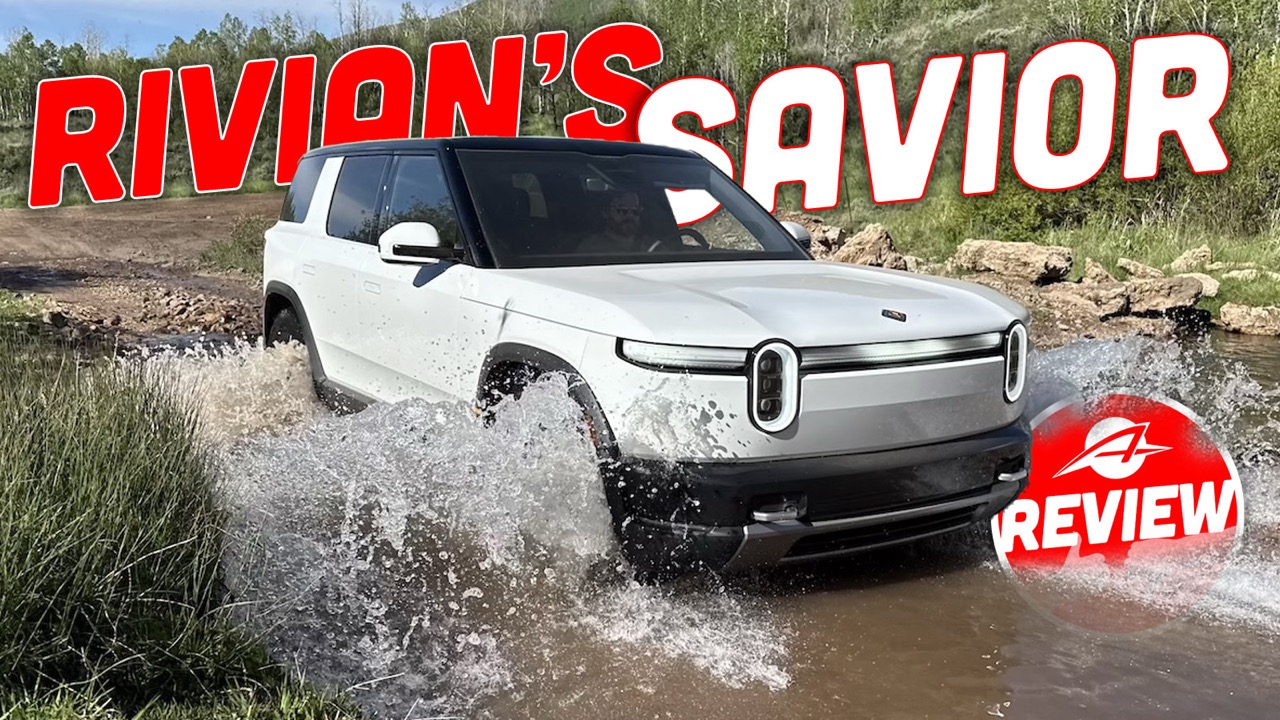
The Rivian R2 isn’t as luxurious as the Rivian R1S, it’s not as capable off-road, it doesn’t ride as well, it’s not as quick, and its styling at launch is nowhere near as fresh. This might lead you to think the R2 is a bit boring — a derivative stuck riding its forebear’s coattails. And, in a way, you’d be right; but I recently drove the R2 and spoke with the company’s CEO and its engineers; what I learned is that, while driving the R2 may not be as exciting compared to driving the R1S, in many ways, the R2 is the more impressive machine.
Engineering is the art of making intelligent compromises. Strength vs weight. Styling vs efficiency. Ride vs handling. And on and on. In the world of engineering, one compromise always has and always will stand highest as the king of all compromises: Performance vs Price. To the customer, this is known as “value,” and it represents one of the strongest driving forces in the automotive marketplace.


When Rivian was developing the R1T and R1S, it, like pretty much every automaker, had to consider cost, but it wasn’t at the forefront of the program. What Rivian was trying to do with the R1 was build a world-beater — an SUV that could sprint from zero to 60 MPH in under 3 seconds, that could drive over 400 miles on a charge, that could use clever quad-motor torque vectoring and an intelligent multi-link suspension to handle corners in ways you wouldn’t believe, and that could use air suspension and traction control to crush off-road trails.
I remember asking a Rivian engineer back around 2021: “Why even bother with the Quad Motor?” A big SUV doesn’t need to handle like a sports car, and I wasn’t convinced that individual motors at each wheel was really helping the vehicle perform off-road, particularly on the rocks where I was noticing lots of wheel “flaring” as each tire saw different traction conditions. Wasn’t the quad motor system just adding unnecessary cost and complexity? The response I heard from Rivian was the right one: We’re a new brand, and we’re launching with the most insane, over-the-top vehicles to show the world what we can do.

And Rivian absolutely pulled that off. I know this because, after I recently told readers that I was about to drive the R2, my inbox exploded. I was a little confused at first, as I find the R3X to be much cooler than the shrunken R1S . Why was everyone so excited? It’s because the Rivian’s R1S and R1T have created an absolute powerhouse of a brand, and the R2 represents the first time many people can take part in that brand at a price approaching “reasonable.”
These emails and all this excitement motivated me to the point where, upon my arrival at the R2 media event in Utah, I took as many notes as humanly possible. Get ready for a long review, starting with discussion about design.
‘We Didn’t Like What We Saw’: Rivian Almost Pulled A Lucid On The R2’s Design
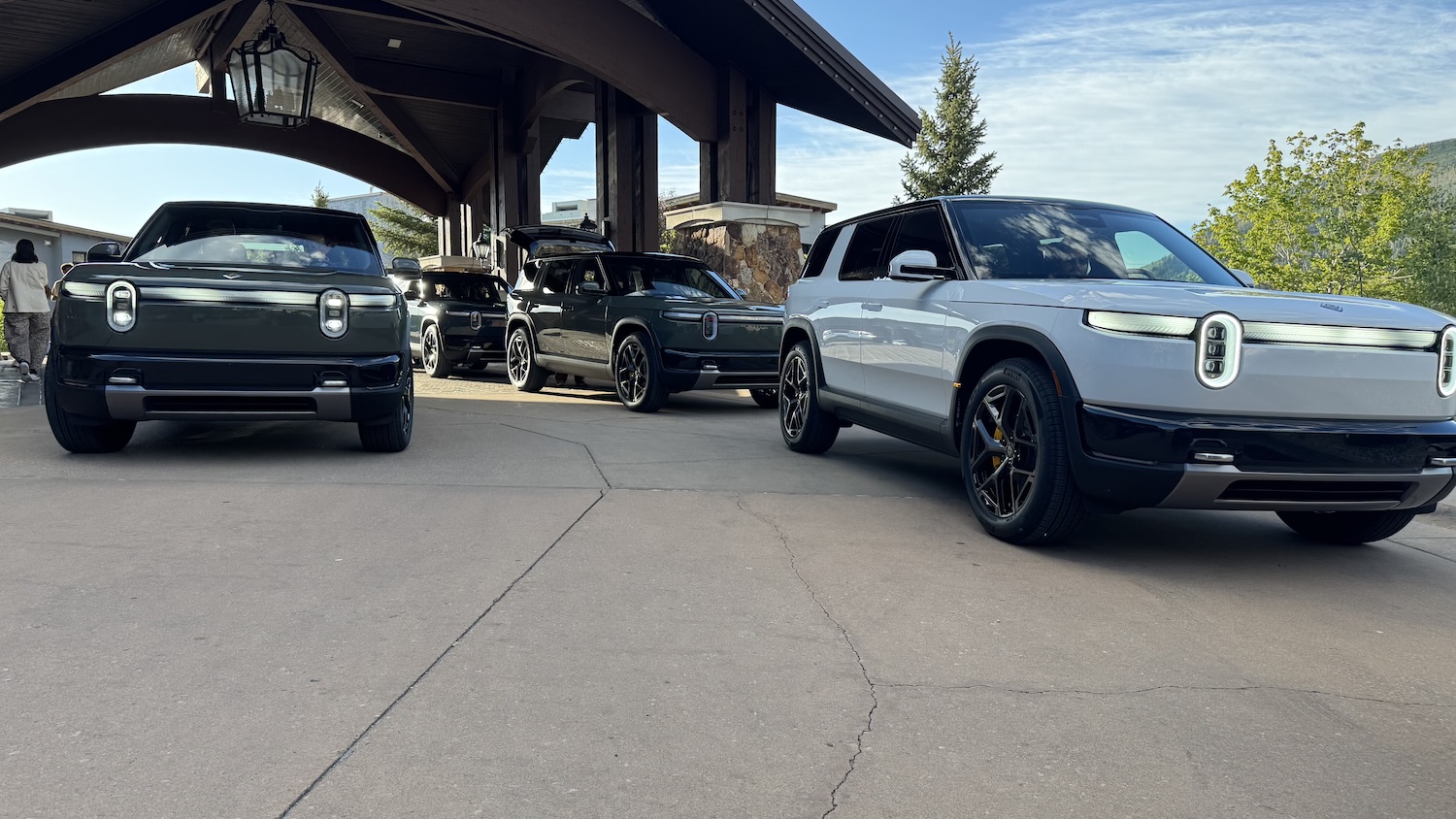
The media first-drive took place at the Waldorf Astoria in Park City, Utah (Full disclosure: Rivian paid for my travel and food), and on the lawn out back the company had set up a cool display that included a body-in-white, an exposed battery pack, front and rear subframes with drive units, various power electronics, and a few complete R2s.
I had seen the R2 from a distance at a Rivian event in Venice, California, and I have to say I’ve always found the design a bit… derivative.

Seeing the car up close didn’t change my mind on that; the car looks like a shrunken R1S, which Rivian debuted way back in 2018. Here’s a look at an R1S I drove a few years ago; the two are hard to distinguish from one another:

If you ask Rivian to point out obvious design differences, the company will mention that the R2’s outboard Daytime Running Light “brows” are a bit more aggressive (they have more of a “scowl,” per Rivian), the entire second-row window rolls up and down without the need for a divider bar, there’s a clever badge/side marker-combo at the rear of the front fenders, the edges of the taillights are a bit more rounded to give more of an “acceleration” vibe, and the headlights are a bit wider and shorter. The two most obvious differences, to me, are 1. the lack of a grille between the “face” and the “bumper” and 2. the hood, which is a clamshell-style in order to meet European pedestrian protection requirements, and whose horizontal edge continues into a character line that runs the entire length of the car.
Since attending this trip, I’ve come around to the R2’s design, especially given the path the car nearly took.

A year ago, I drove the Lucid Gravity, a vehicle that I consider the most impressive “SUV” in the world, on paper. The reason why I predicted the car would flop is that it seemed to me that the brilliant folks at Lucid were too nerdy to compromise aerodynamics in order to make the vehicle look cool (don’t get me wrong — I’m an engineer, so I love the Gravity, but I fear that, to the layperson, it’s a tough sell). The result is an extremely aerodynamic, efficiently-shaped SUV, but the thing looks like a minivan. An $80,000 minivan.
As I learned while chatting with Rivian CEO RJ Scaringe and head designer Jeff Hammoud, Rivian itself nearly traveled down a similar road.
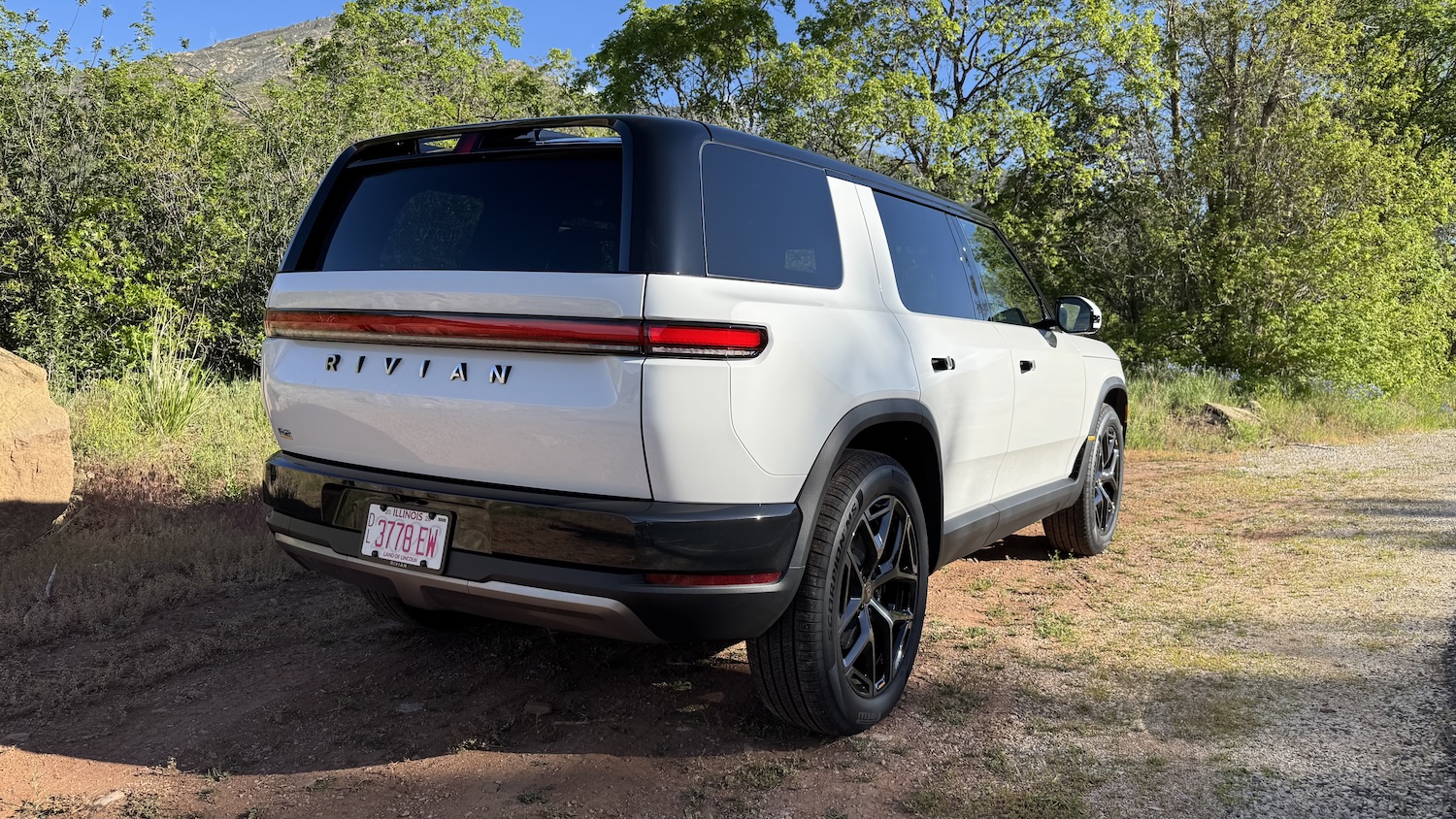
“There’s hundreds of decisions that have very large impacts on things like proportion, packaging, interior comfort — those sorts of things,” Scaringe said at a roundtable with journalists. “A lot of the different objectives when we set out to run the program have a lot of competition to push in completely different directions.”
Rivian’s CEO gave an example. “From an aerodynamic point of view, you want to create more of a taper [at the rear of the roof] — something that looks more like an egg — to move through the air as efficiently as possible…this is particularly important at high speeds.” He went on: “So there you have a tradeoff of making something that’s very aerodynamic but maybe looks proportionally a little bit goofy to something that proportionally looks right, also has a lot of functionality embedded in a two-box shape…We were flexing between a lot of these types of tradeoffs.”
“In each of [the hundreds of] tradeoffs we made decisions that ultimately compounded…[and] got to a place in the R2 program that we didn’t like what we saw. We said ‘Boy, the sum of this isn’t working.'”
Rivian had to shred its design.
[Writer’s aside: I noticed something similar when I was on the Jeep Wrangler JL engineering team. Each engineer was trying to optimize their own system/subsystem, and this was threatening to water down the overall product. At Chrysler, this became known as “death by a thousand cuts.” I remember watching in horror as a vehicle dynamics engineer who was unable to meet his handling targets recommended changing the Wrangler to independent front suspension. Luckily, Jim Repp, a Jeep old-timer who would later become my friend, shut that down. At Rivian, it’s the chief engineer Max Koff and the head designer Jeff Hammoud who collaborate on these big decisions, with CEO RJ often acting as the tie-breaker. -DT]
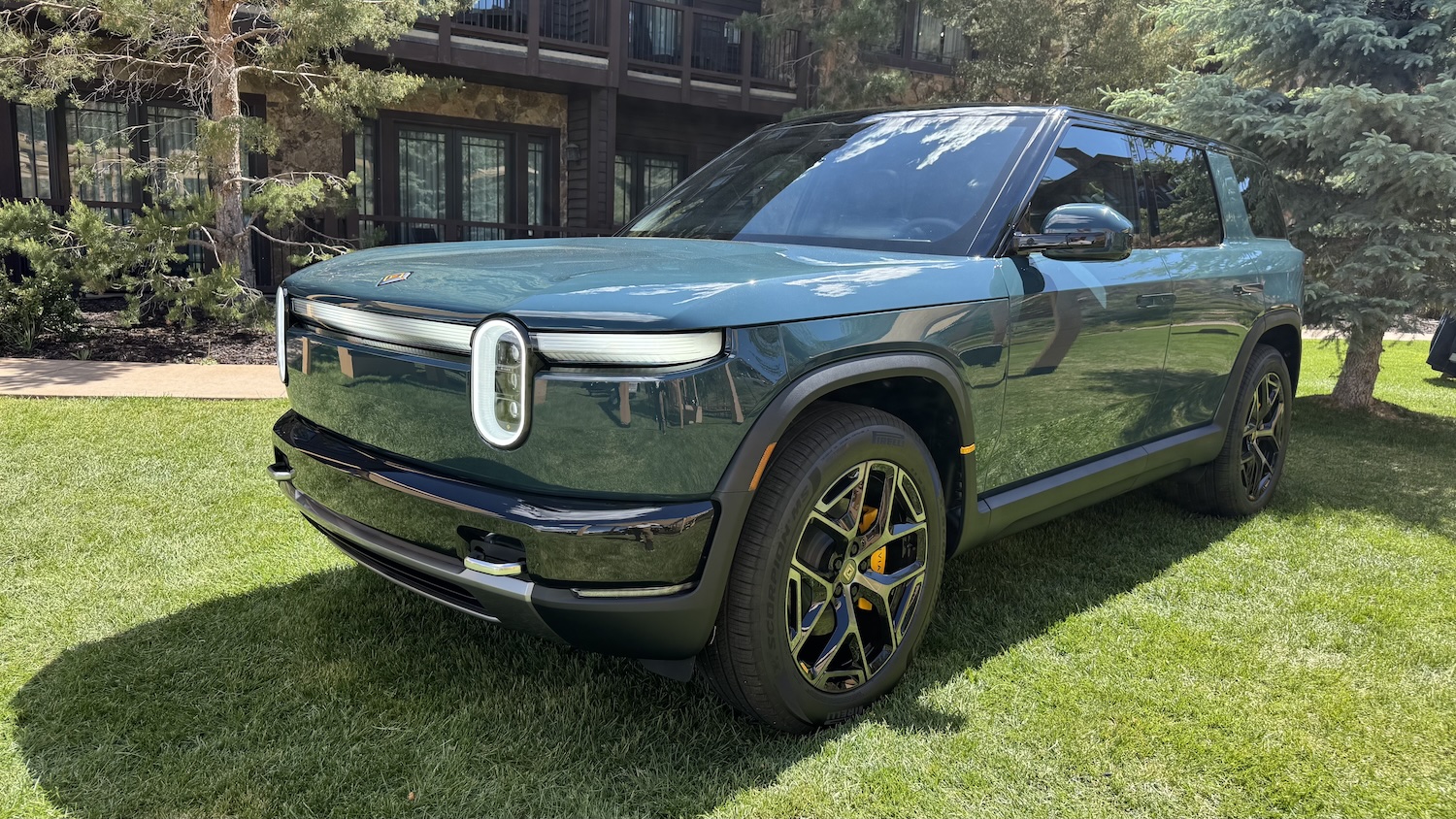
“We actually went through two pretty meaningful resets to the program in terms of vehicle packaging and the overall design approach..and arriving at this [realization that this isn’t working] actually is where we said we had to reject some of these tradeoffs and… try harder.”
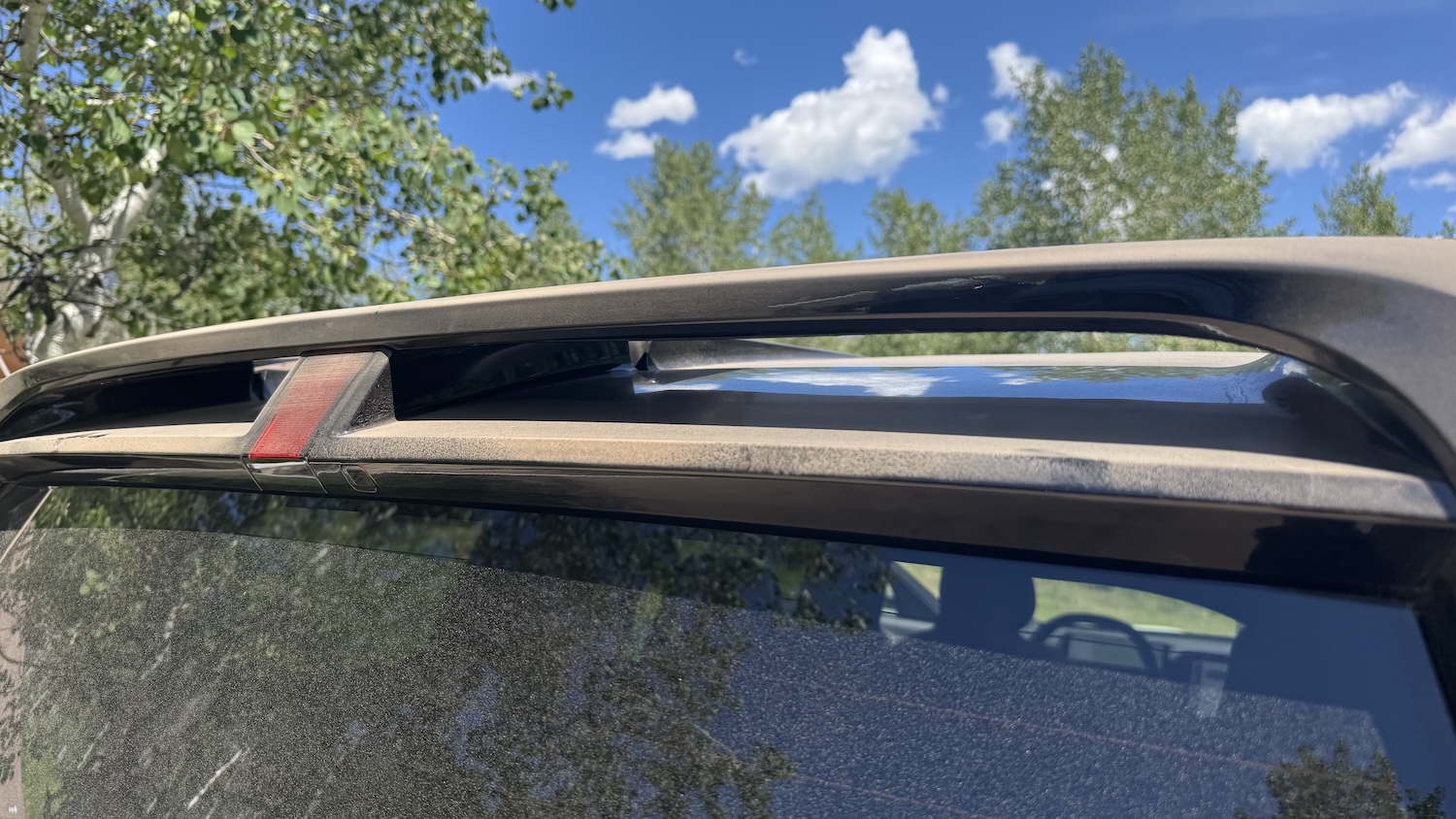
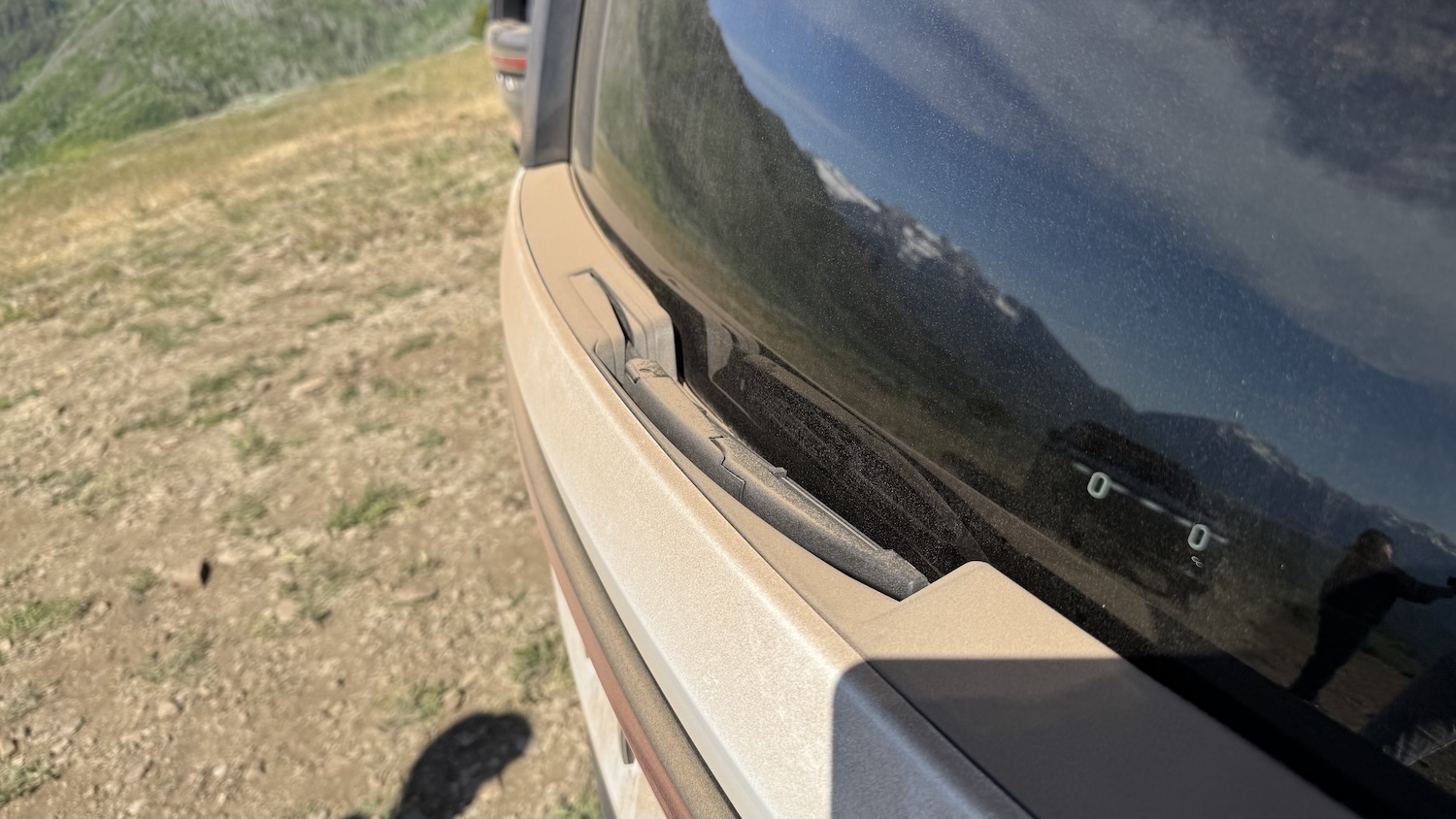
So the team decided what was important, and came to grips with the fact that it was going to have to sacrifice aerodynamic performance (I was told the sacrifice was roughly 8-ish miles of range). “We really wanna have this functionality that comes with a two-box, but we need to get to a certain level of aerodynamic performance,” Scaringe went on. “We’re not going to have the same performance of a pure, more egg-shaped vehicle, but that led to the innovation around that aero pass-through in the back. But then, suddenly, where do you put the wiper if you have a drop-glass?”
Here’s the rear aero pass-through:
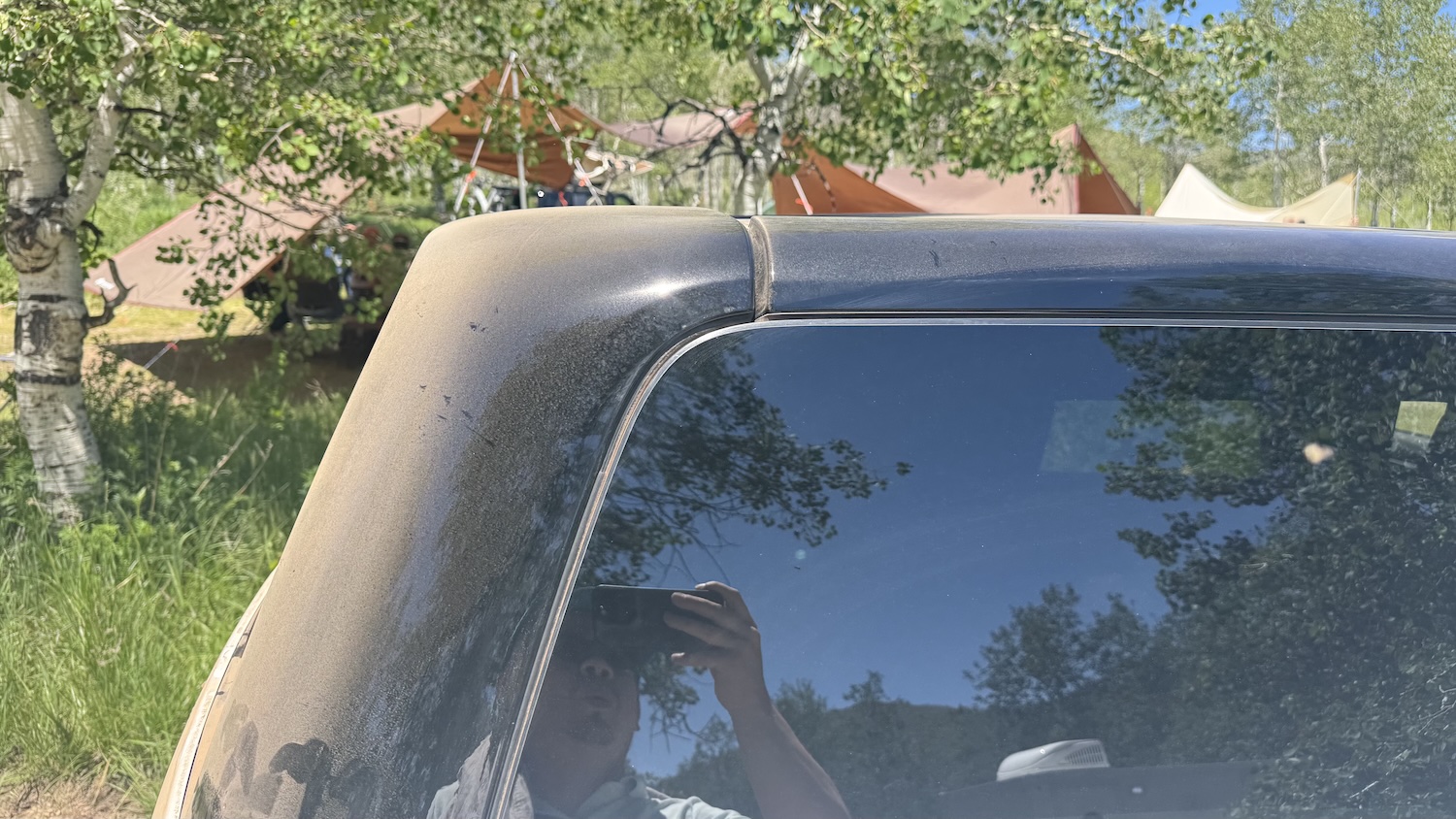
Here you can see that, from the side, the profile still looks nice and upright:
And here’s the wiper, which had to be relocated into the rear hatch:
“I’d say it was like the third iteration that allowed us to converge on making all of these tradeoffs in the most thoughtful way that led to what you see here….We went on a long, long journey with lots of iteration and landed in a place that has lots of DNA from R1, for sure.”
Rivian made it clear that it sees value in the similarities. “We thought it was appropriate, because there was a lot of positivity with R1,” Hammoud told journalists. “And R2, for a lot of people, is gonna be their first experience with a Rivian, so we wanted to build off of that…” He went on to say that the Rivian R3 was shown at the same time as the R2 in order to show that the Rivian team is capable of stretching the brand: “When we did R3, it was really showing that we can take the Rivian form-vocabulary and completely change it into a different segment, a different form-factor, but it still feels distinctly Rivian.”
Not As Capable As The Rivian R1S, But More Intelligently Engineered
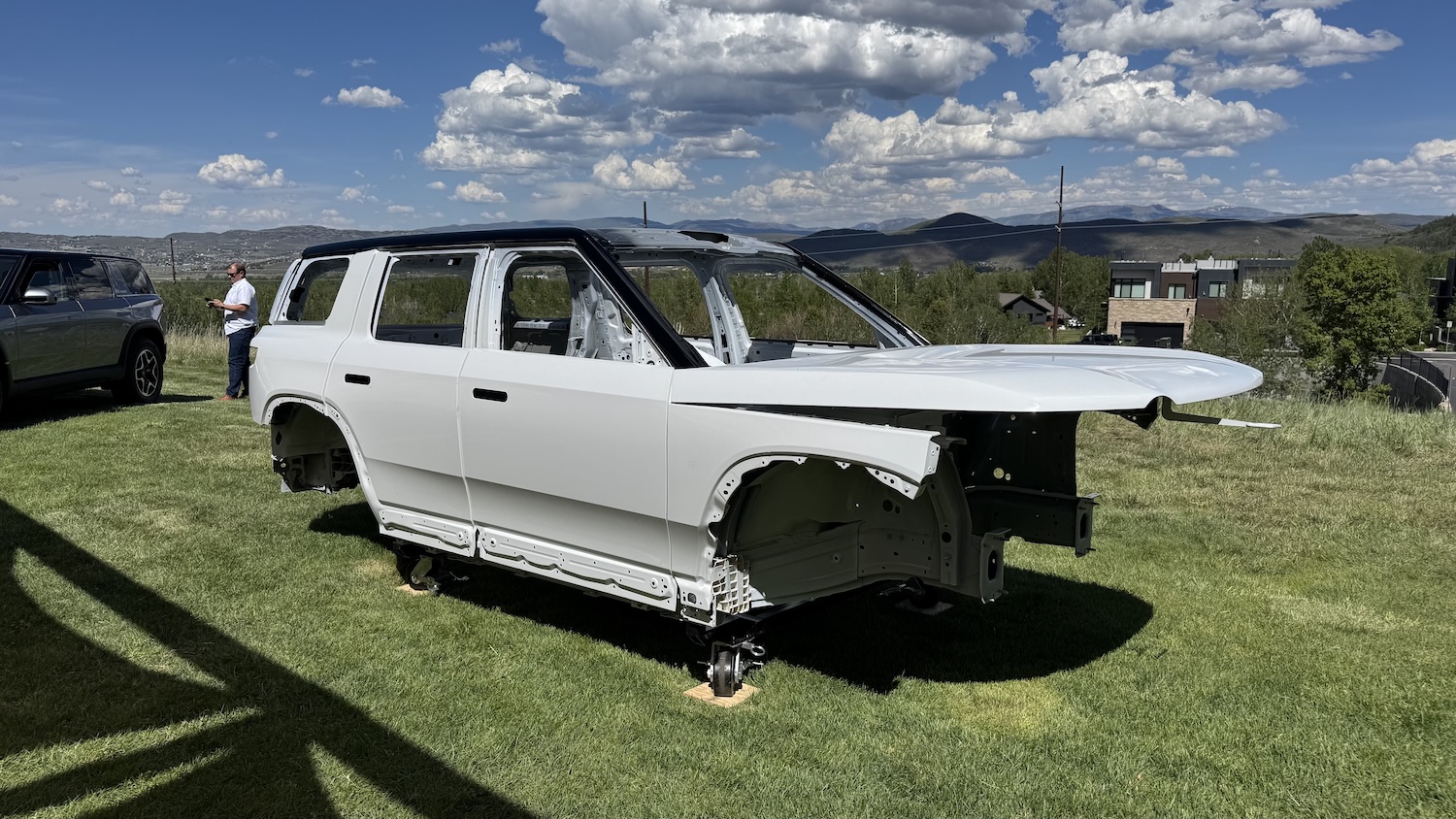
Even though the Rivian R2 looks a lot like the R1, and even though its performance figures like acceleration and range and off-road capability pale in comparison to its bigger sibling, when you look at the engineering behind the R2 it becomes clear that in some ways it’s the more impressive of the two machines.
The R1 was the company’s first vehicle — a “white space” car, as Rivian puts it. It was a halo product meant to “offer a massive spectrum of performance both on-road and on.” And while developing such a world beater was difficult, Rivian says developing the R2 was just as challenging. “How do we bring that Rivian experience to many more customers by making it more attainable?” was the brief.
With the R2, cost was at the forefront of design, with certain departments saying the goal was 50 percent Bill of Material costs when compared to the R1S. And a key to achieving such targets was clever engineering, particularly consolidating parts and bringing them in-house. Beyond that, the R2 had the luxury of being the brand’s “second album,” meaning it could take some of the learnings from the R1.
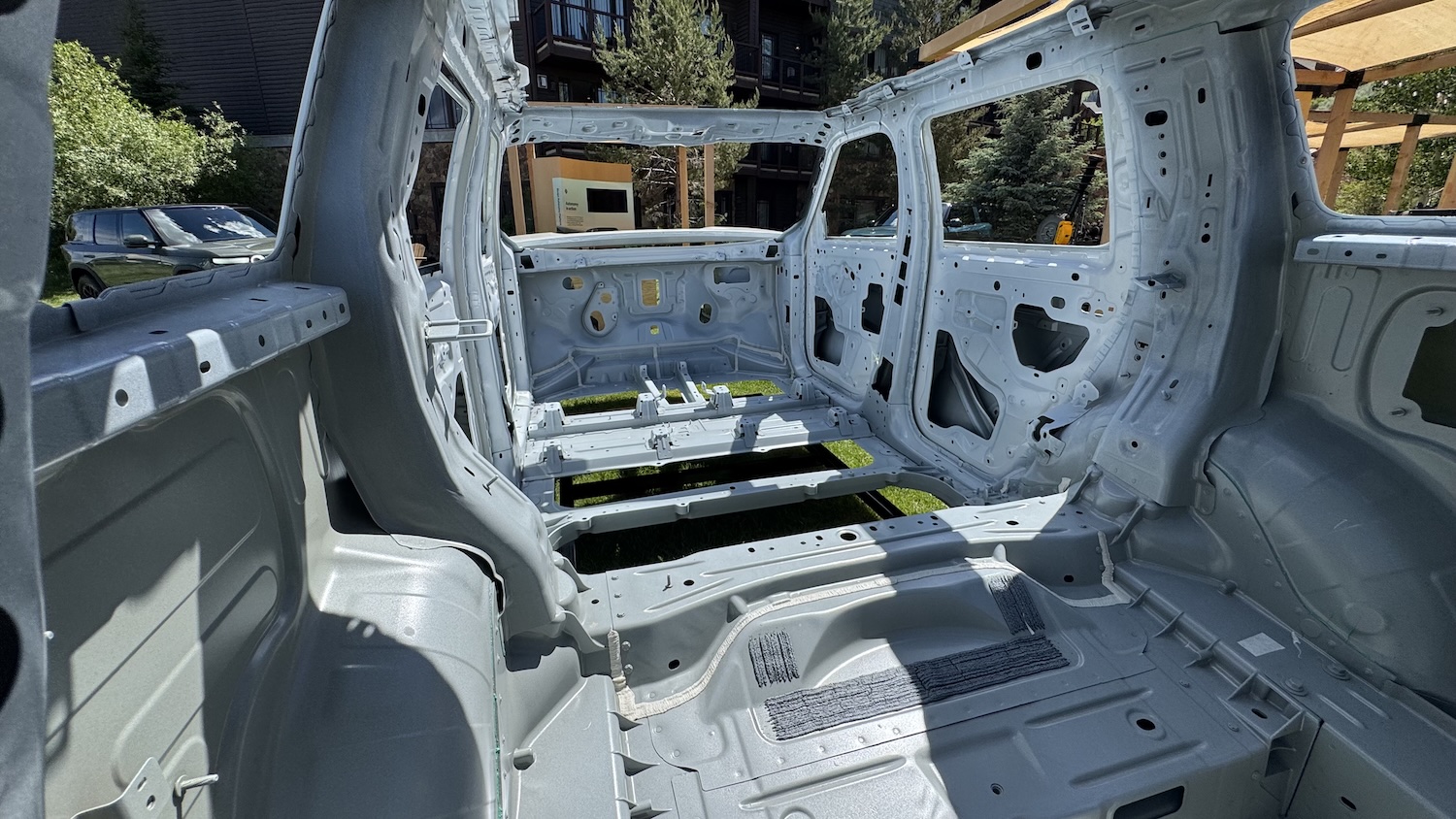
Take the body, for example. It’s roughly a ton lighter than the R1S’s, and while it’s obviously smaller, it’s also just more efficient. There are two reasons for this. First, the R1S had to be built to handle insane on and off-road loads, so it’s just downright overbuilt (Just check out this video from my friends at Munro & Associates. Rivian itself admitted to me that the R1 features lots of redundant body structure). Second, the R1 was the brand’s first iteration; naturally, the R2 is going to build on what the team learned from its own analysis and external critiques of the R1’s body structure.
While the R1 featured a beefy frame to which the battery and body were bolted, the R2 is built on a new unibody platform featuring “advanced structural castings that actually simplify the vehicle’s footprint,” per Rivian. The company continues in its press material, saying that it has “moved toward a much more modular architecture, significantly reducing the total part count compared to the R1. By simplifying the body structure and how the vehicle is assembled, we’ve made specific panels and components far more accessible.”
After a rather controversial situation in which a Rivian owner found themself on the hook for tens of thousands of dollars to repair a light tap to the rear of their truck, Rivian made it clear that the company cares about repair-ability, highlighting to the media: “This modularity is designed to make repairs more straightforward and efficient, ensuring that when service is needed, we can get the vehicle back to the customer as quickly as possible.”
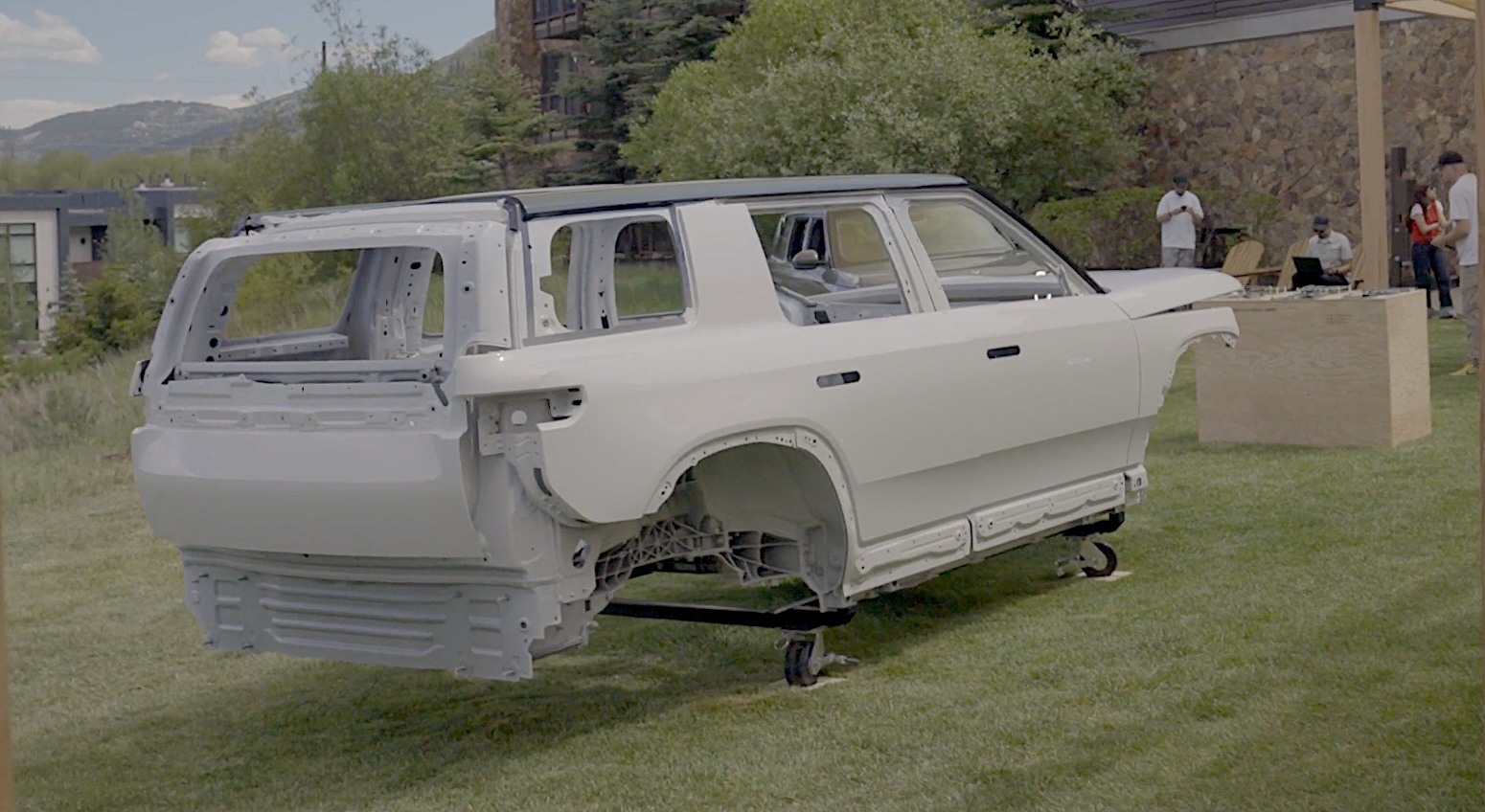
I wish I had more time to chat with Rivian’s body engineer at the event so I could give you more insights into this body-in-white, but for now I’ll just provide you some photos of the beautiful structure. Before I do that, let’s check out the Rivian R1S body structure; as I mentioned before, in addition to the battery, it consists of a humongous, beefy frame:
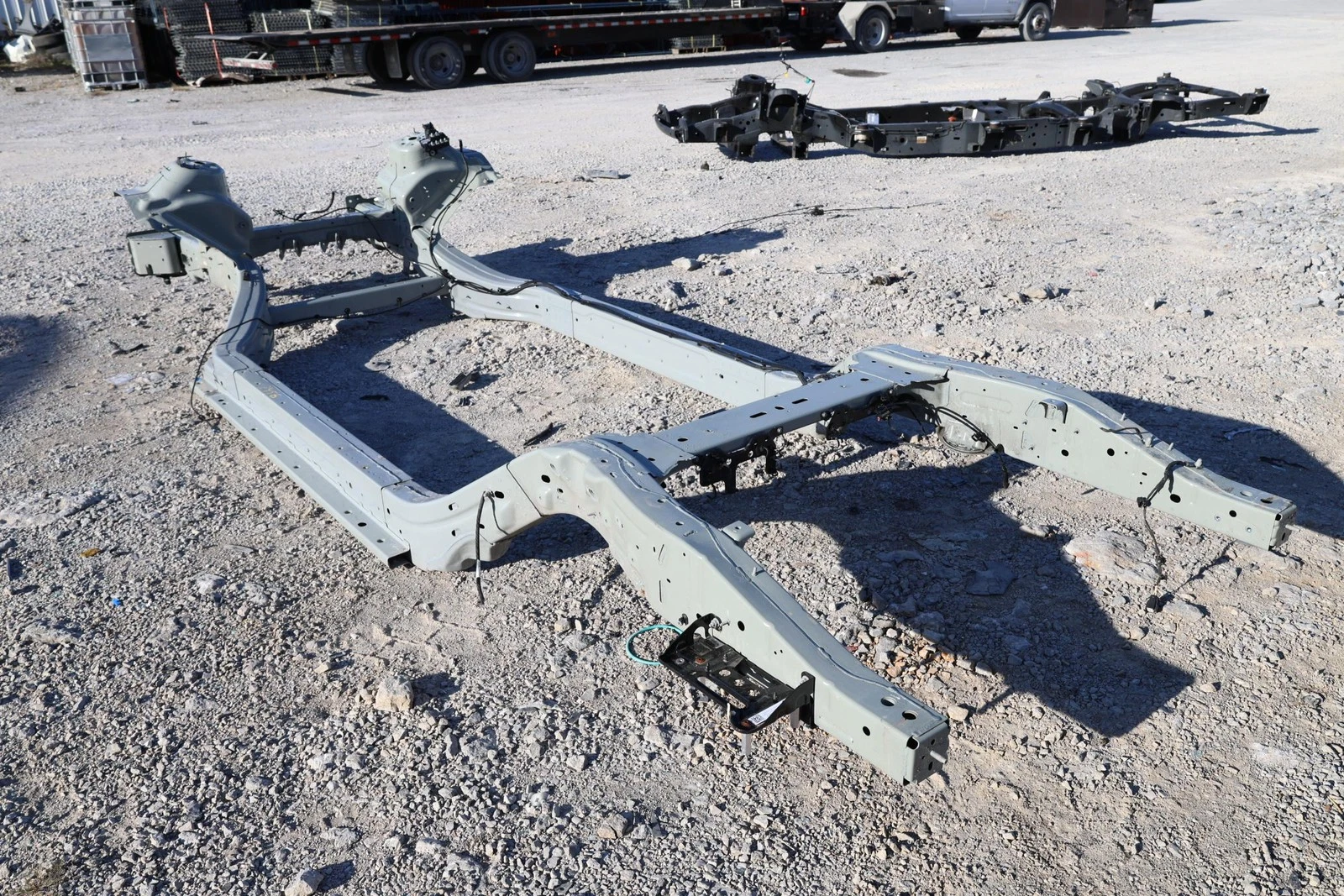
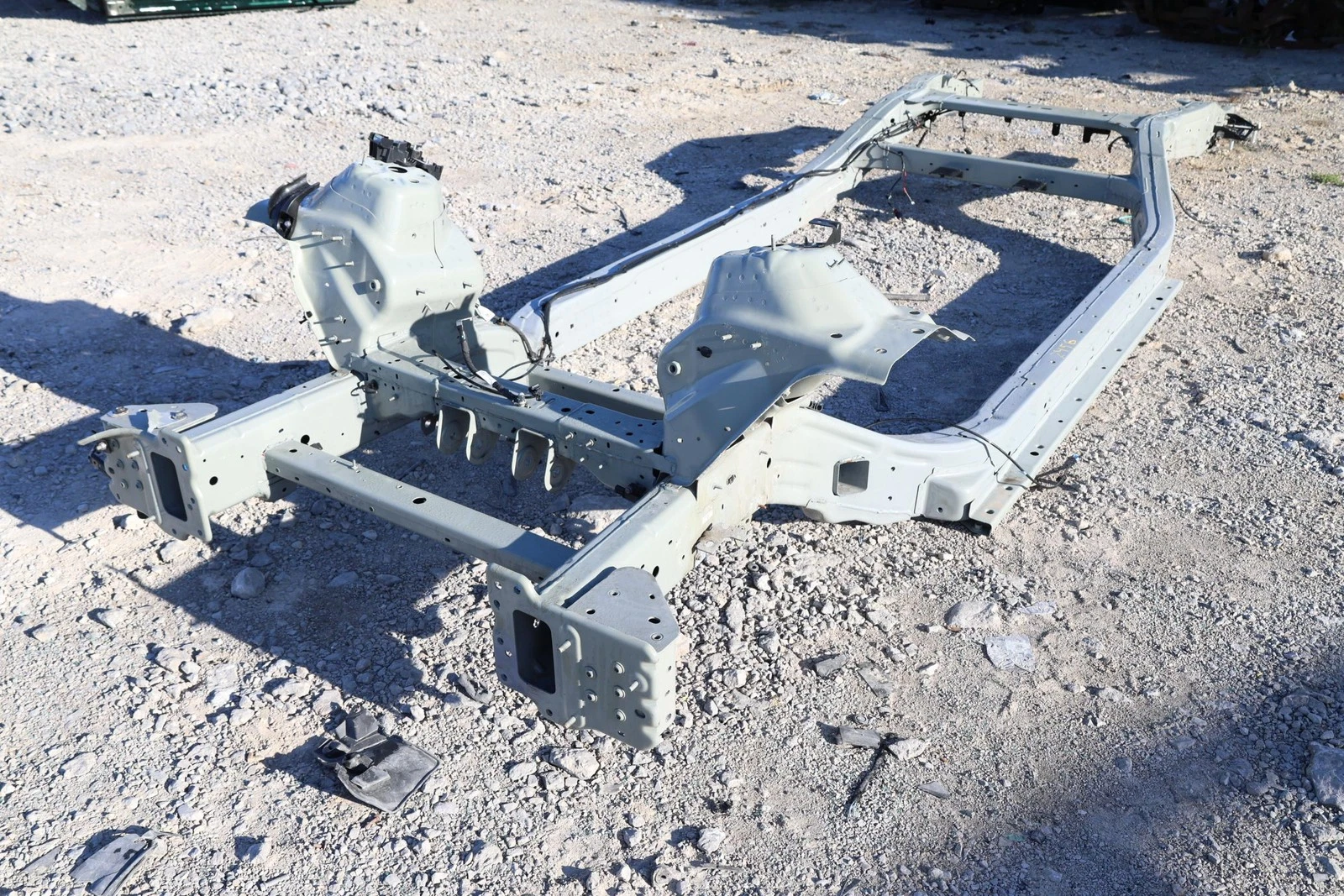
To that frame is attached a body:
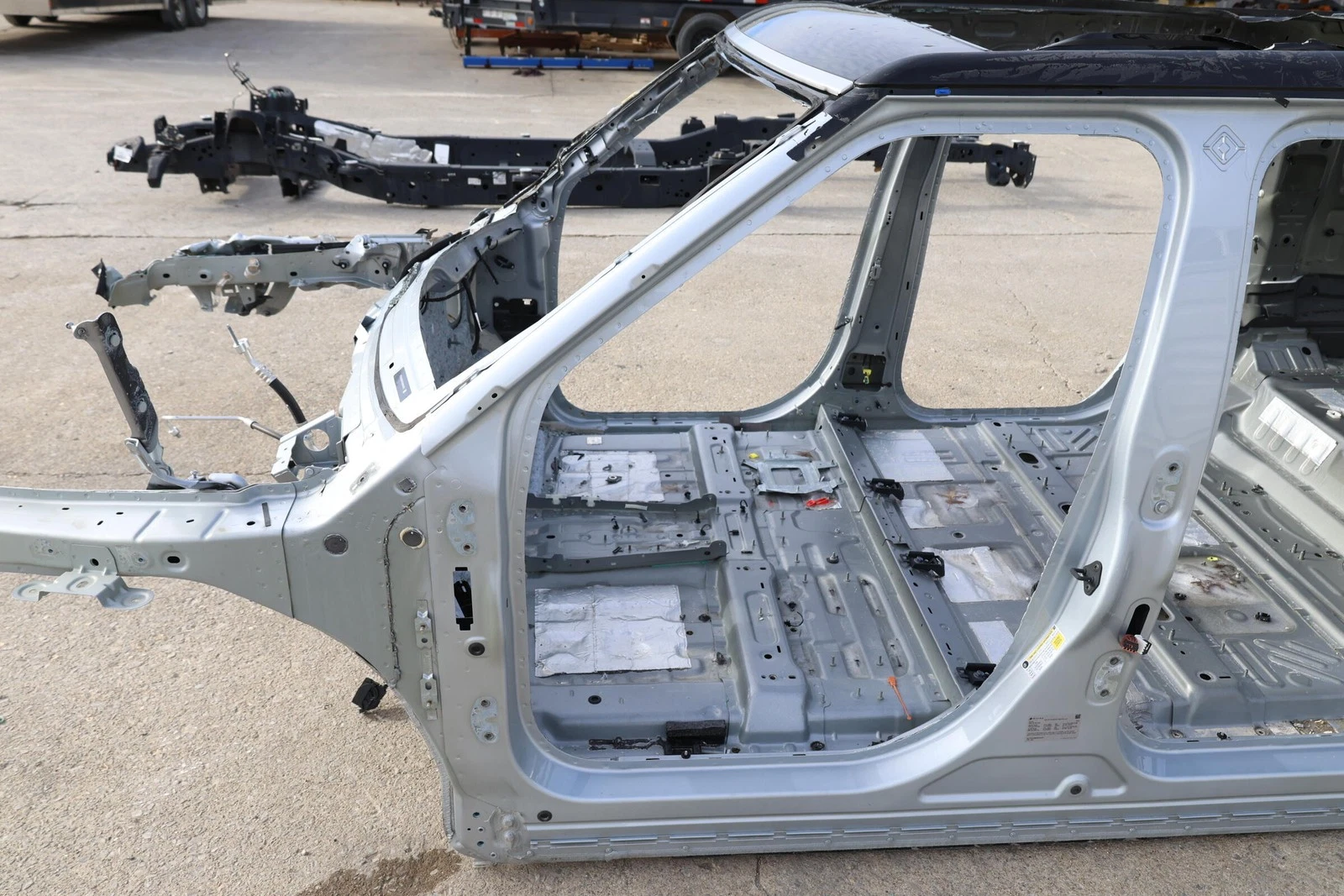
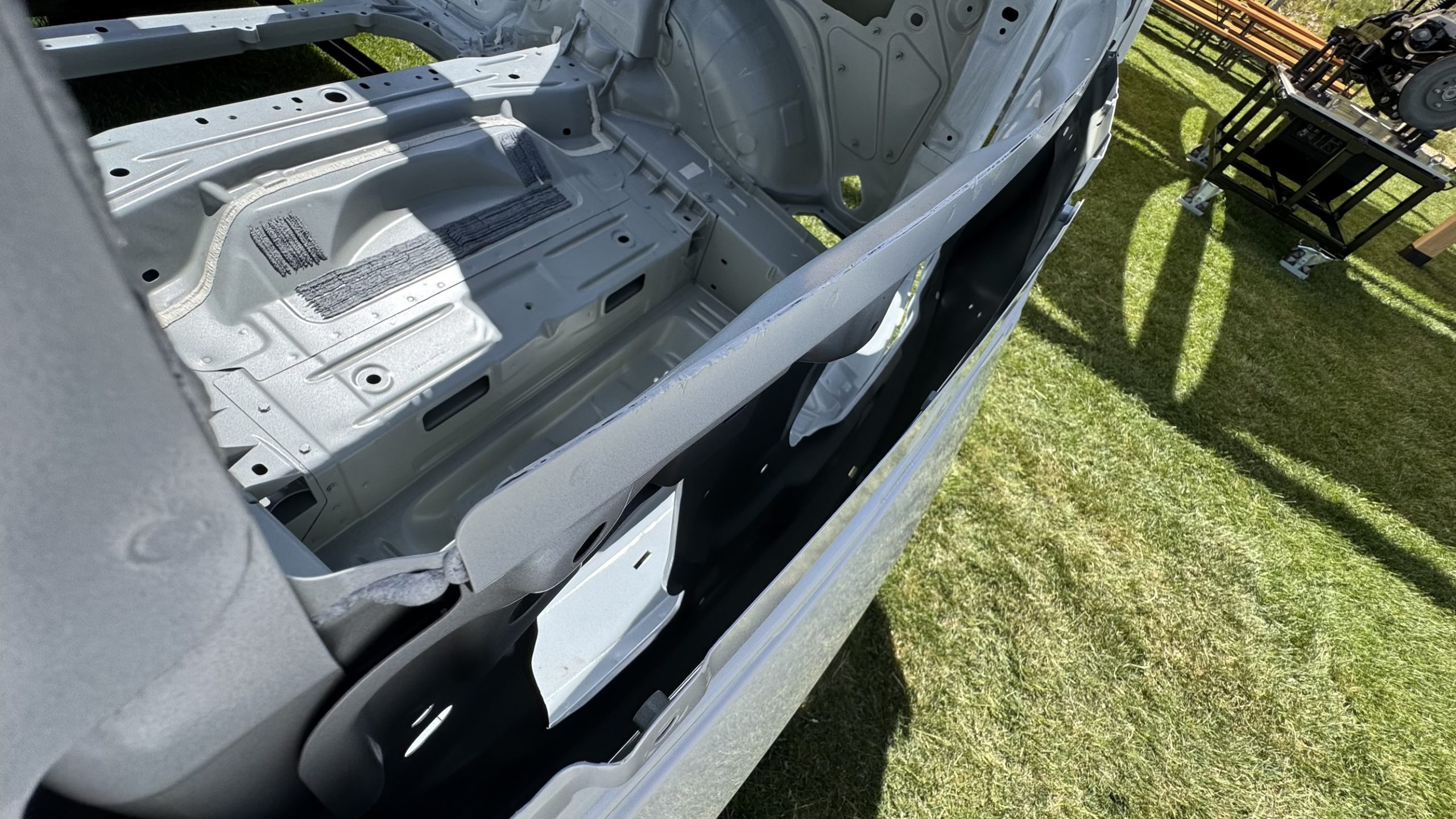
The R2, by contrast, does not feature its own dedicated frame. Its unibody is made primarily of stamped steel with cast aluminum structures throughout. The most obvious of the large aluminum castings is the rear floor; check this out:
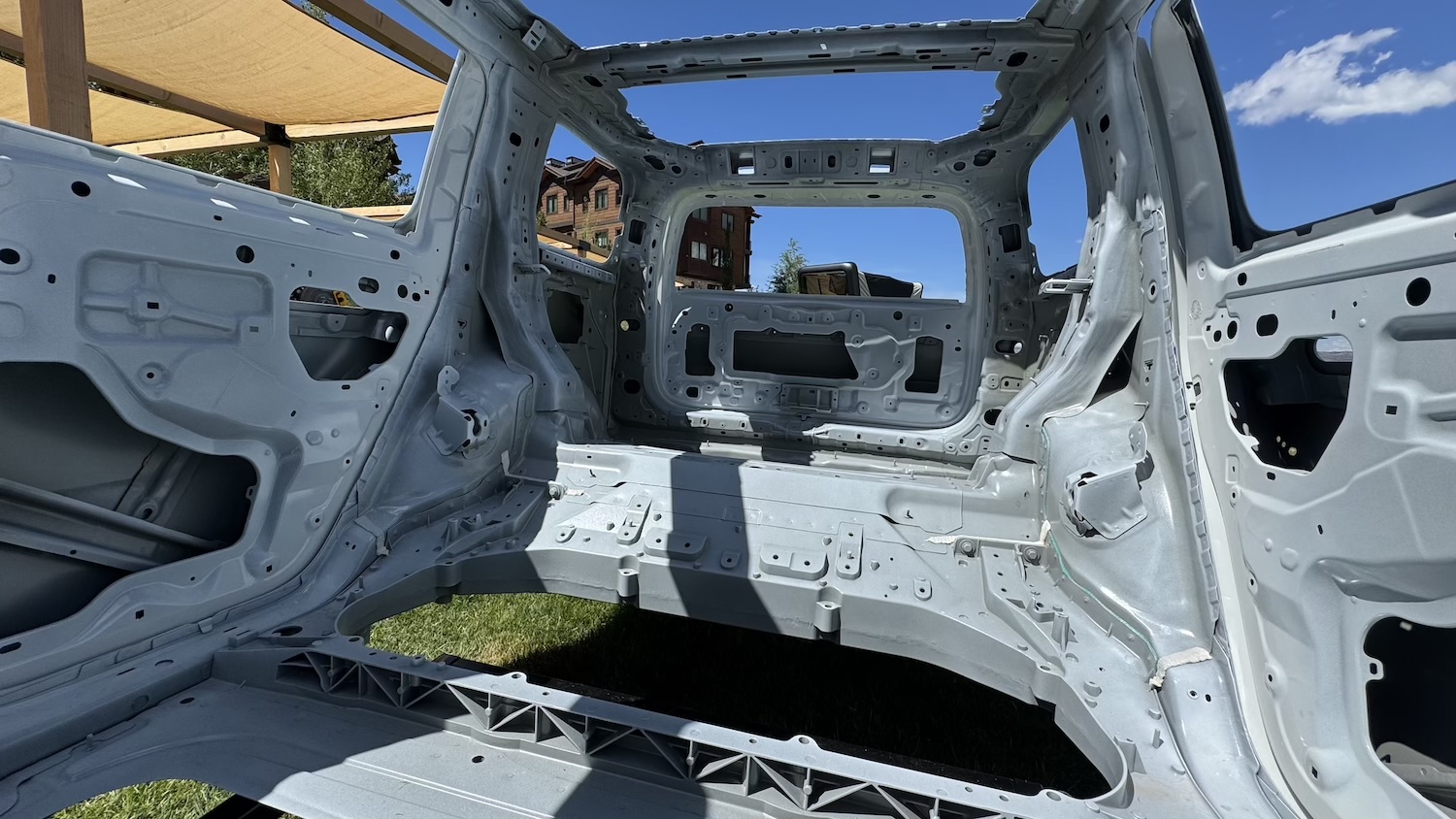
You can see some other castings on the outboard parts of the cargo area:
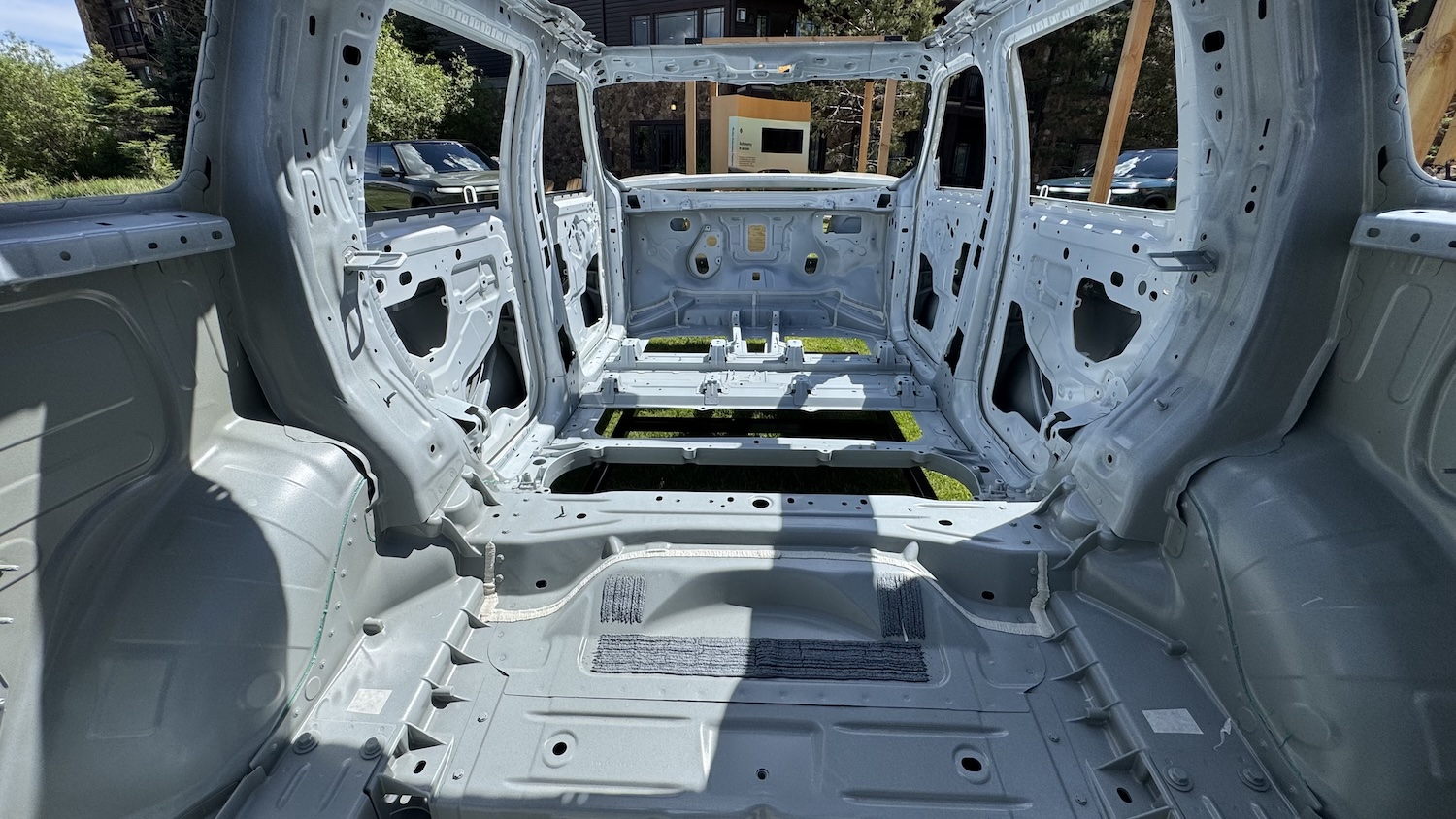
Check out all those welds and bolts and adhesives — a beautiful thing to behold. In the rear wheel wells you get a great look at the giant rear castings:
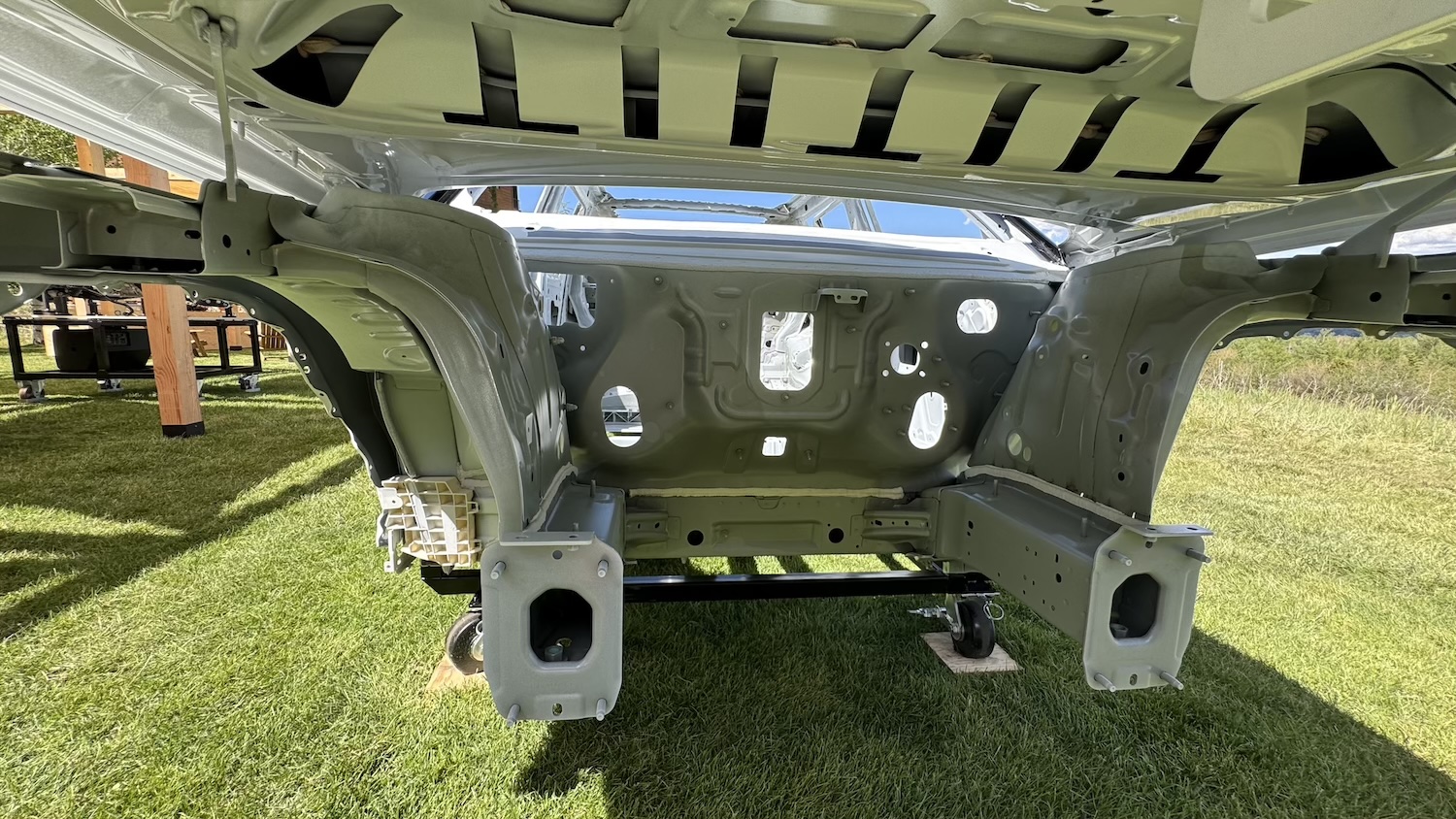
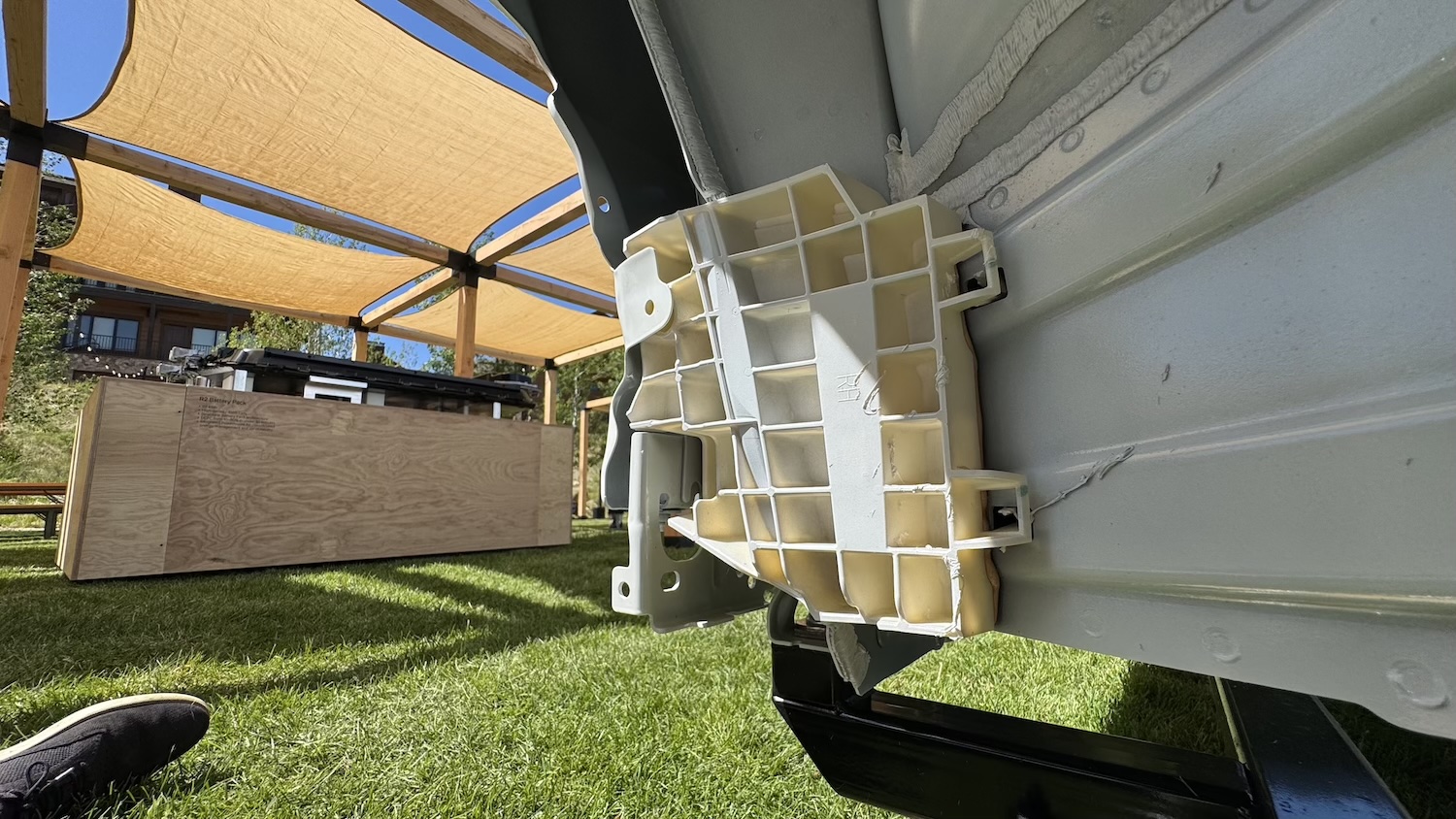
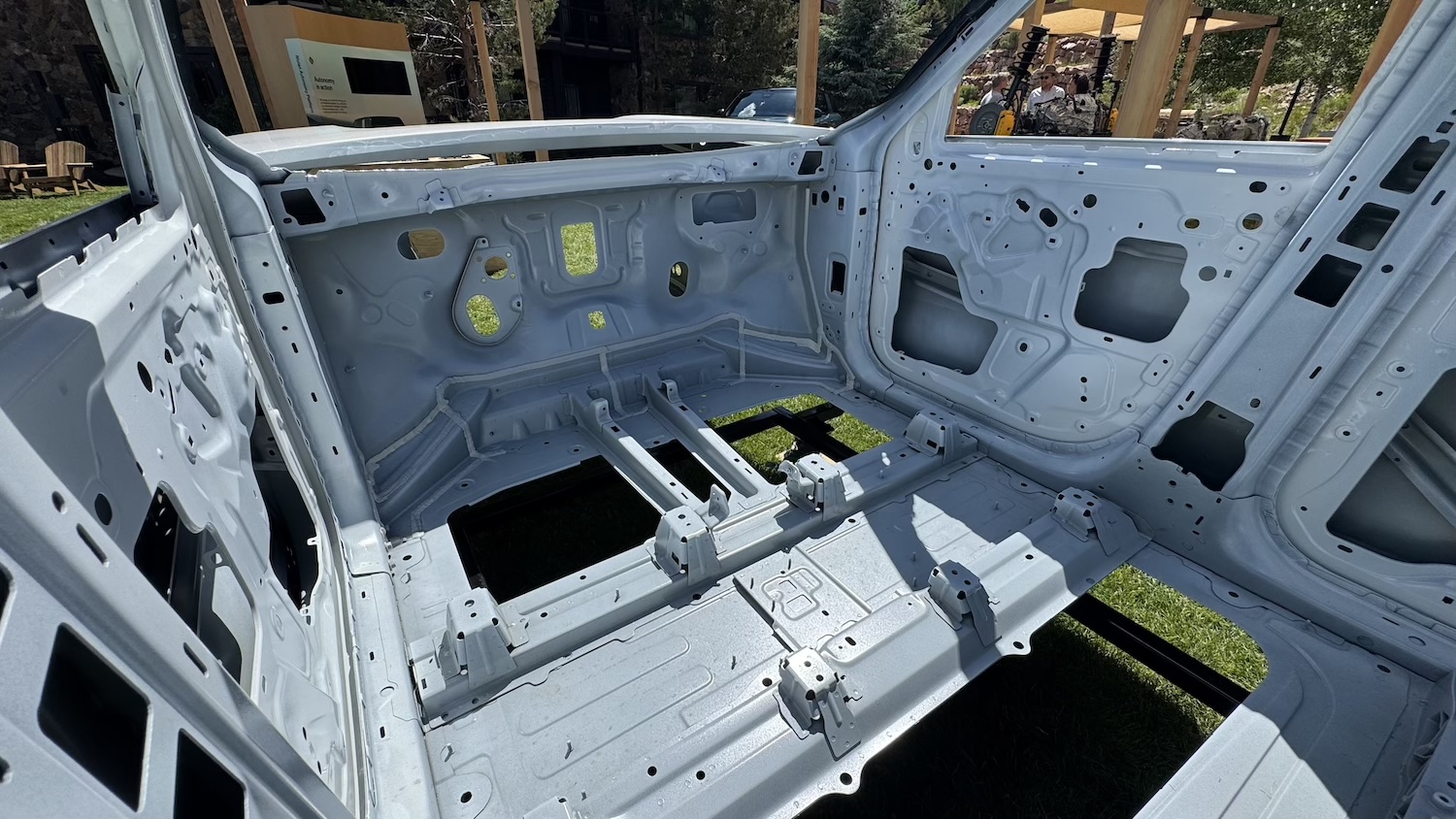
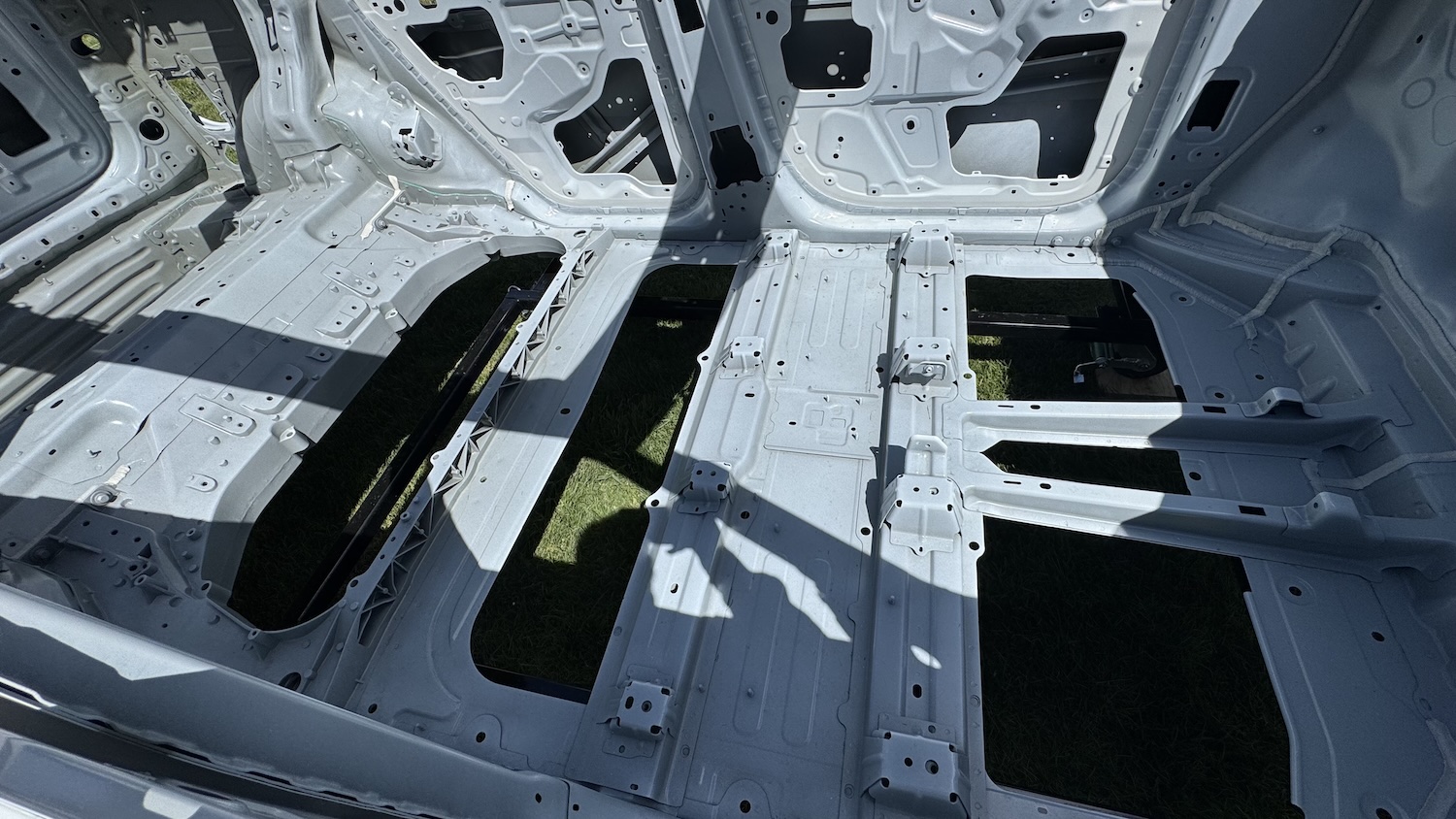
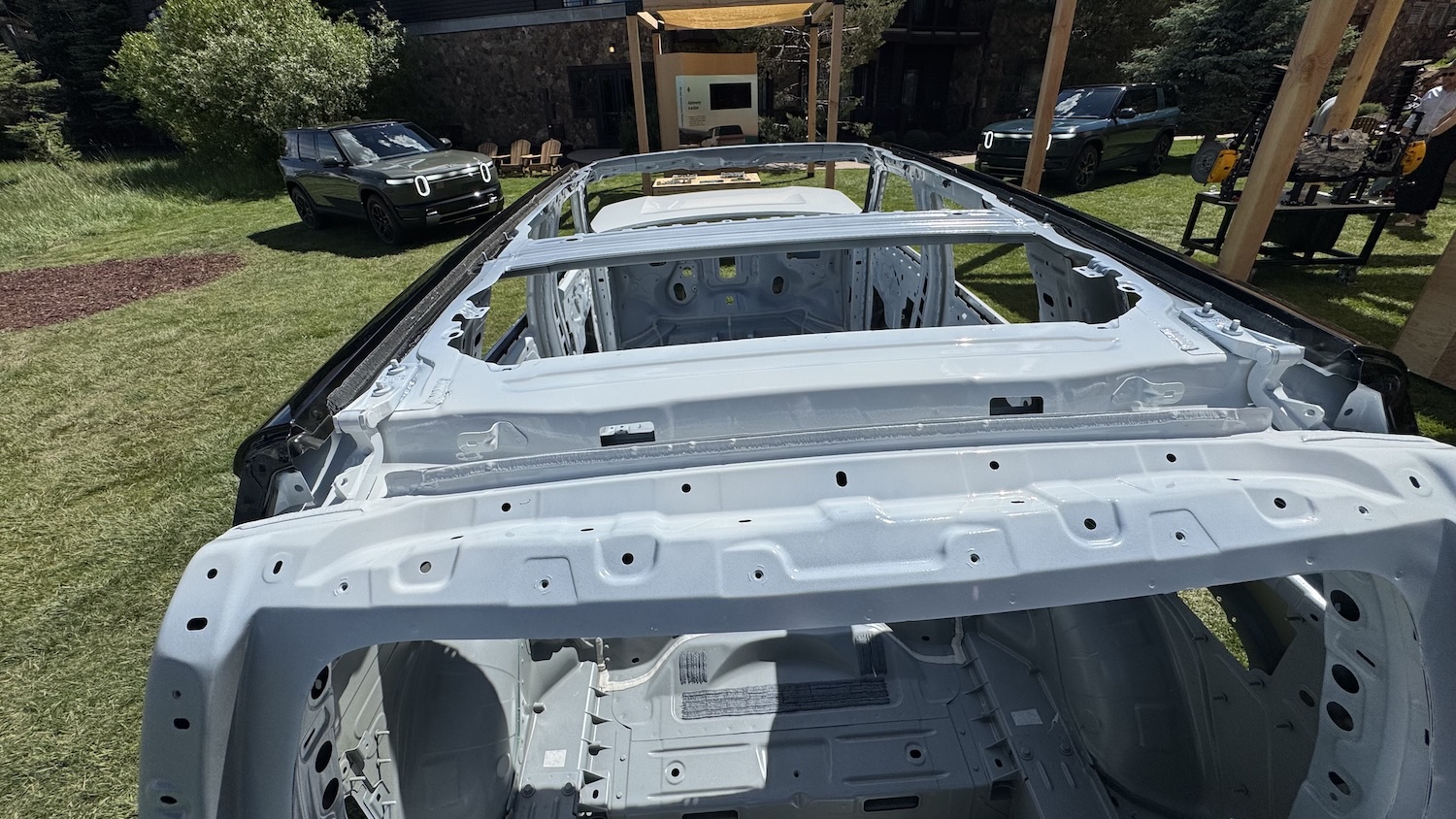
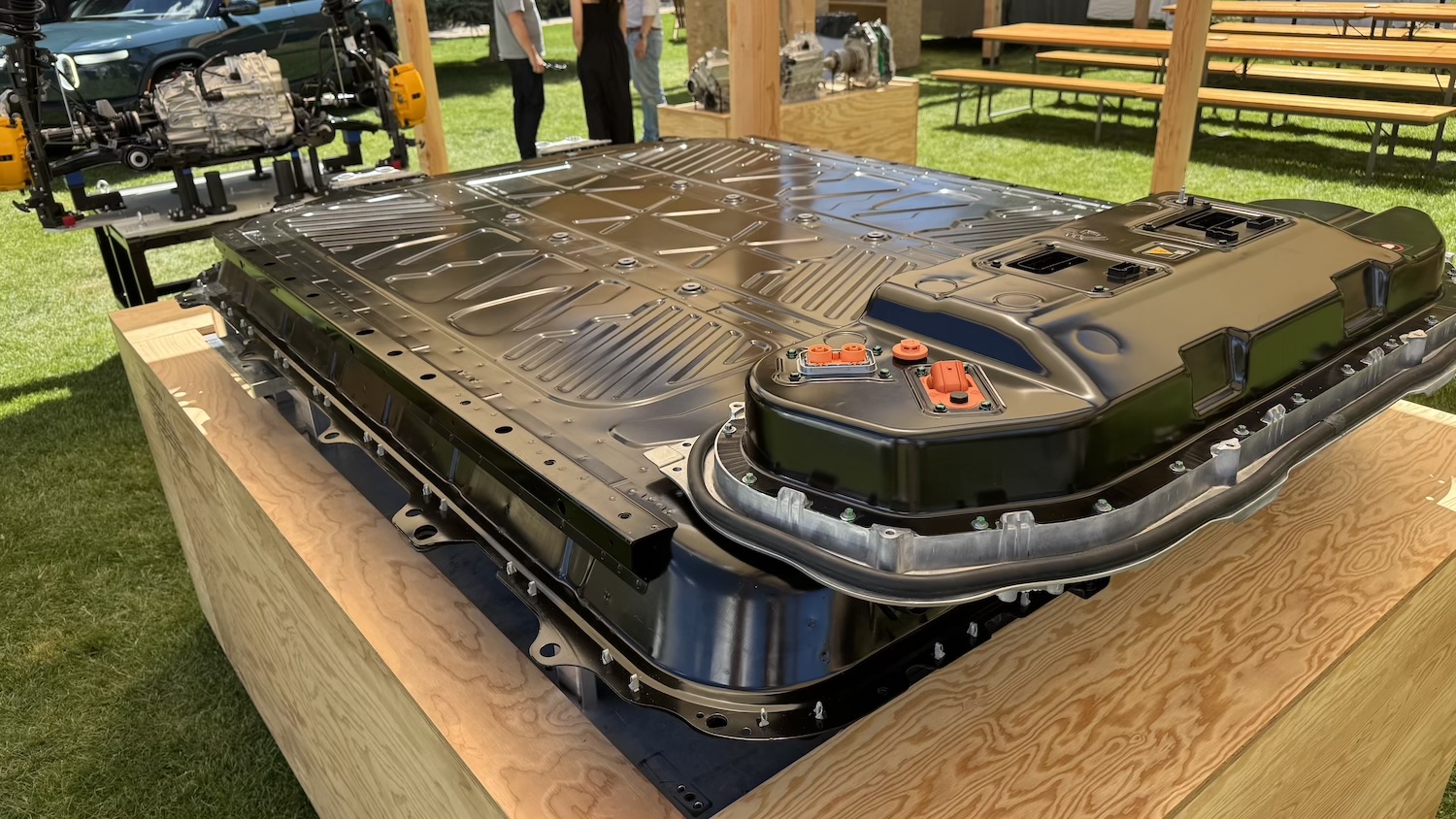
The diagram below shows how the structural battery pack mounts between the axles:

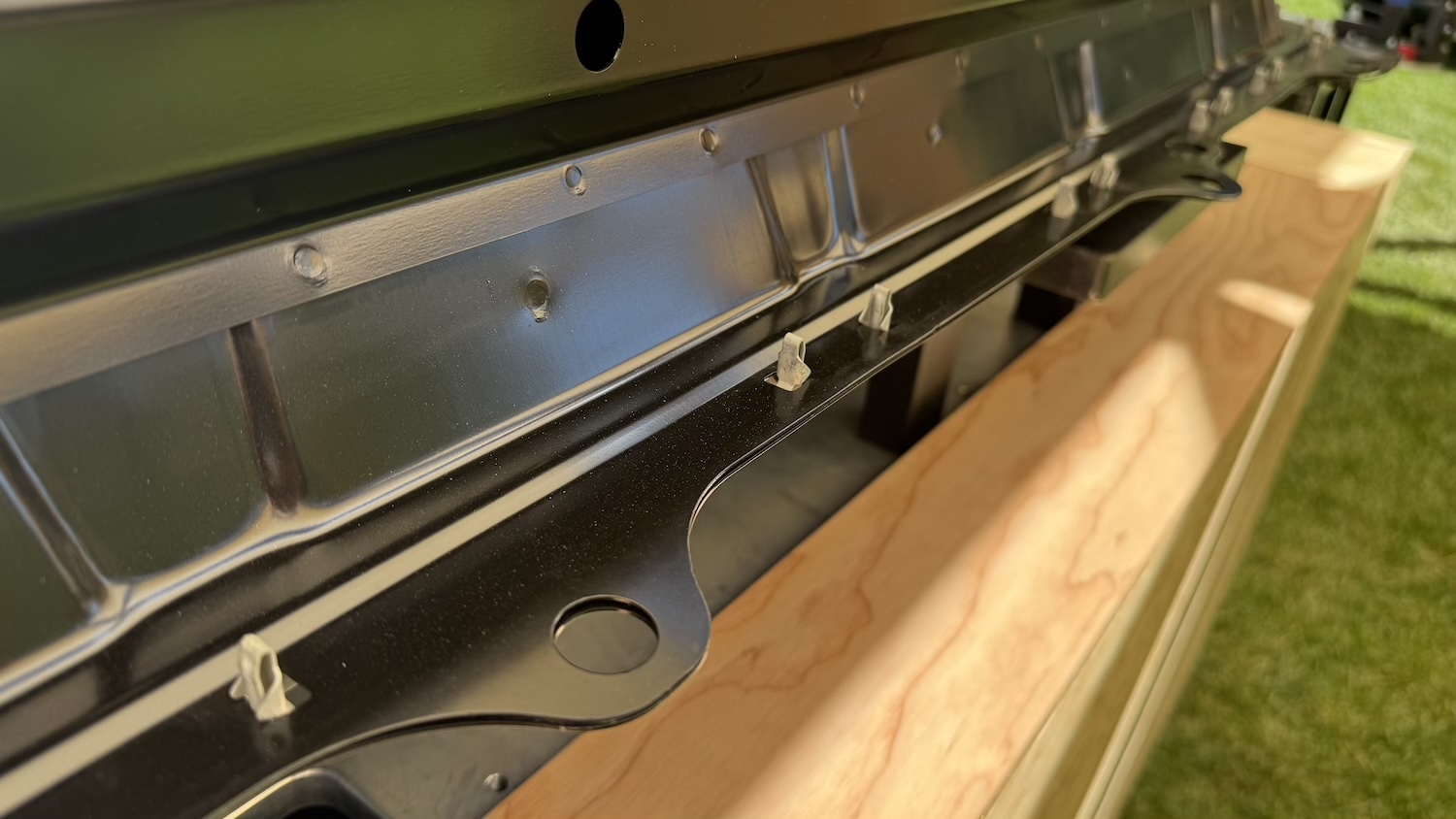
That 87.9kWh pack features a “Powerhouse” sitting on the rear. If you look at the body-in-white images above, you’ll see where the powerhouse mounts to that cast aluminum structure making up the rear floor:
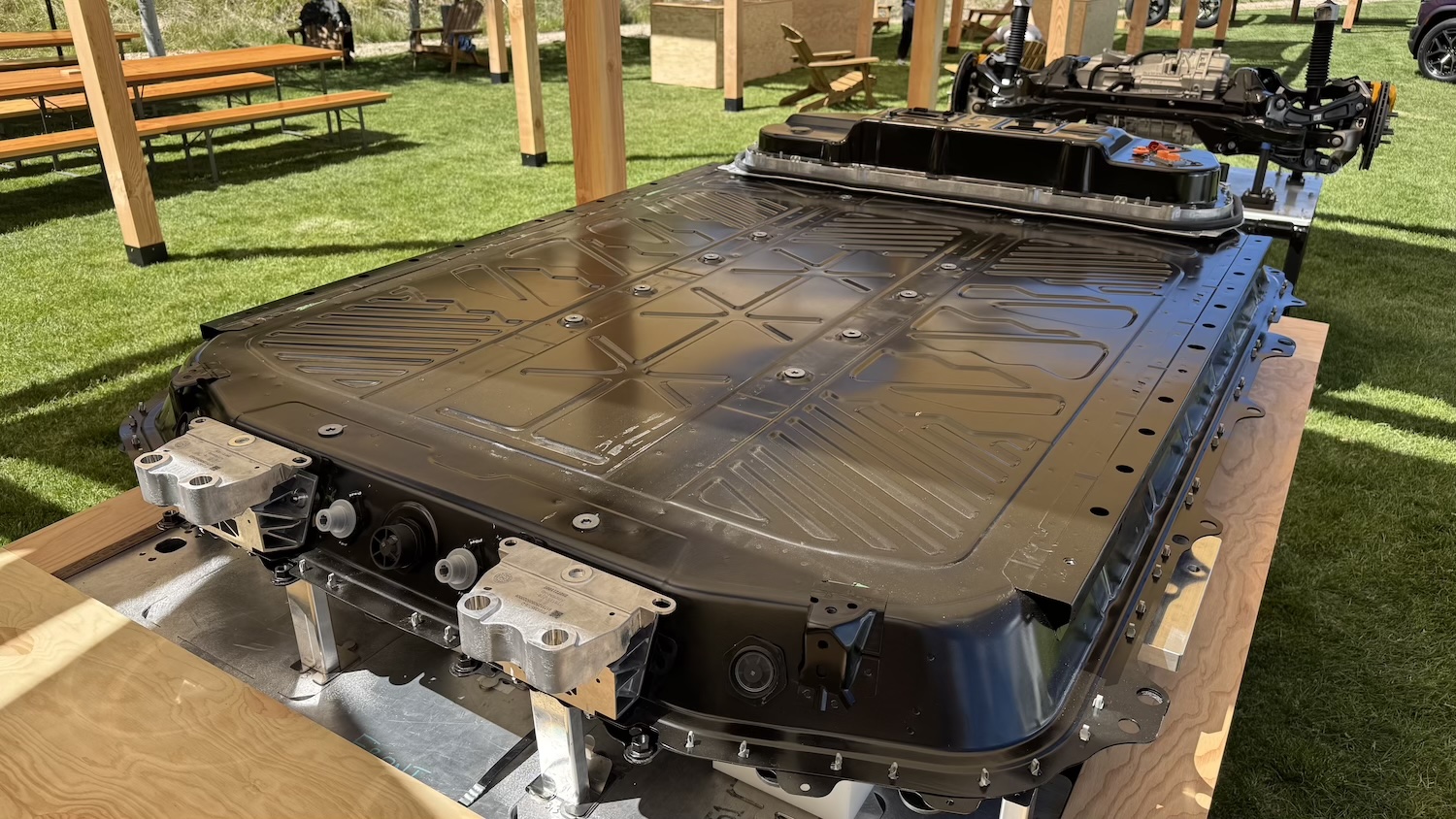
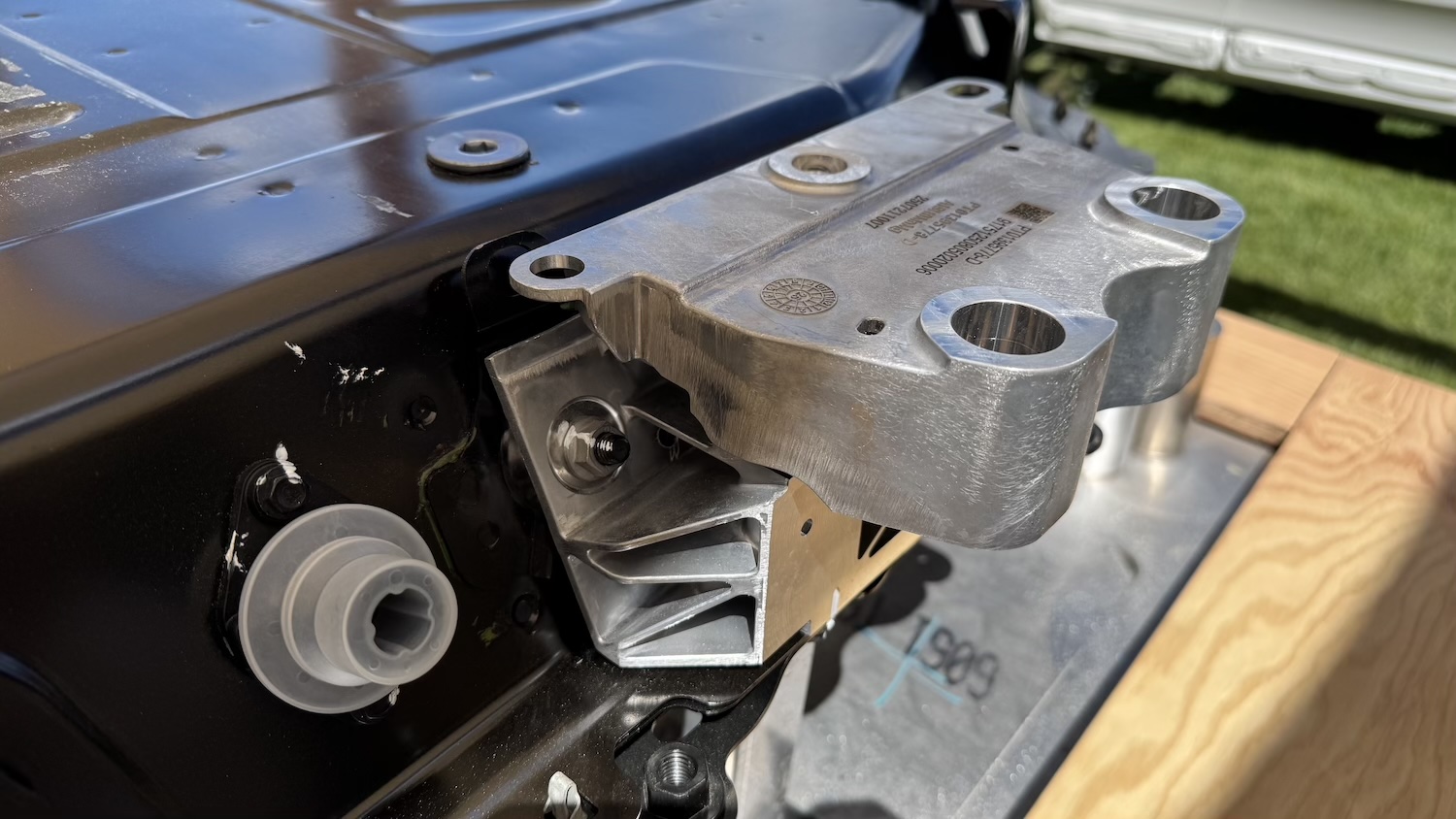
Here you can see some of the battery pack mounting provisions:
Rivian showed us the R2’s 4695 cylindrical cells (NCMA: Nickel Cobalt Manganese Aluminum), which are named for their 46mm diameter, 95mm height form-factor. The design of these cells, Rivian told us, allows for easier manufacture due to there being fewer cells than the 2170 packs in the Rivian R1S. What’s more, the cooling efficiency is increased due to the increased surface area, which is why the new cells are side-cooled.
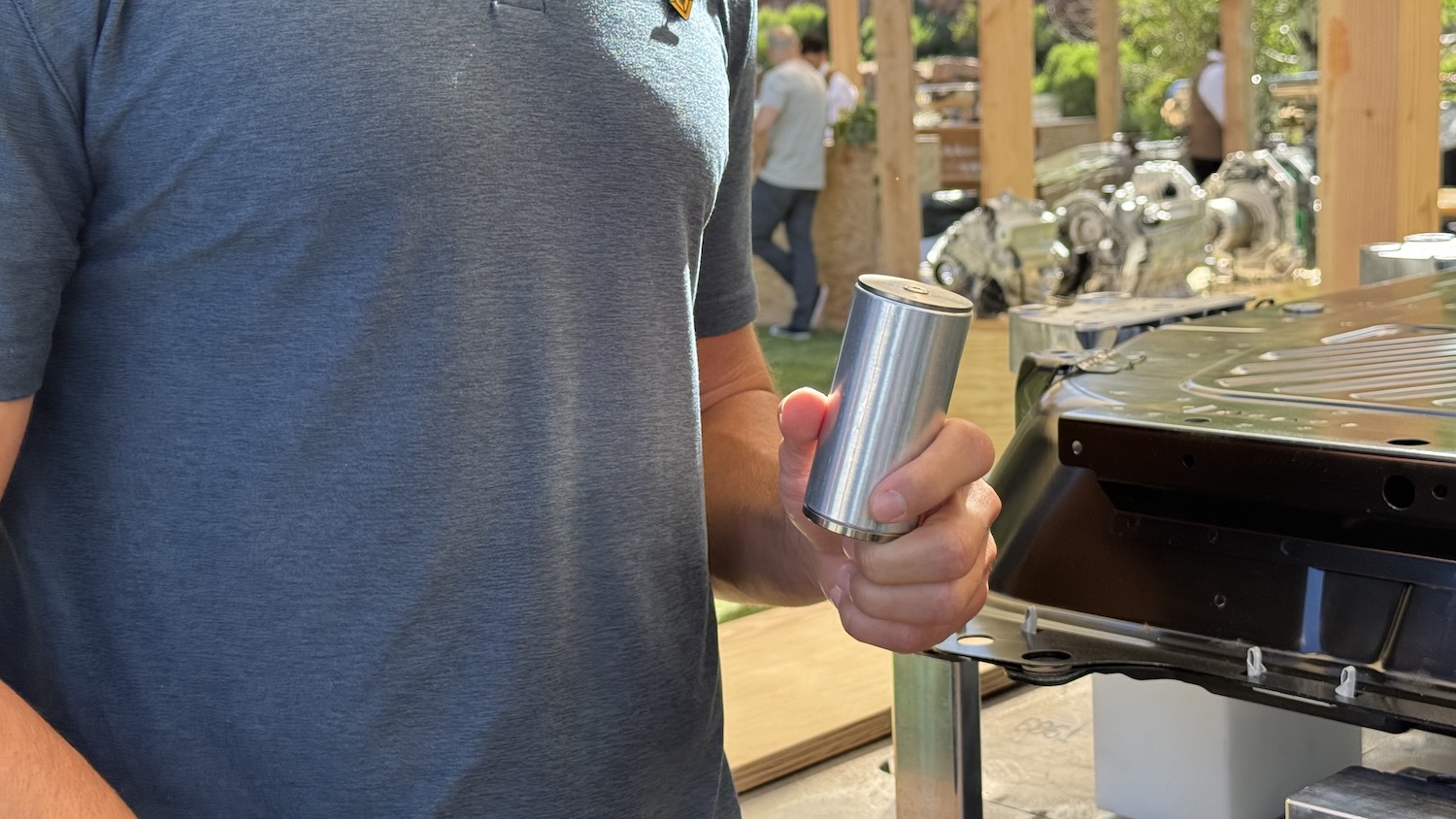
Here you can see the smaller, 2170-style cells in the R1S; they’re end-cooled via cooling plates, whereas the R2’s batteries feature channels that “weave” between the sides of the larger cells.

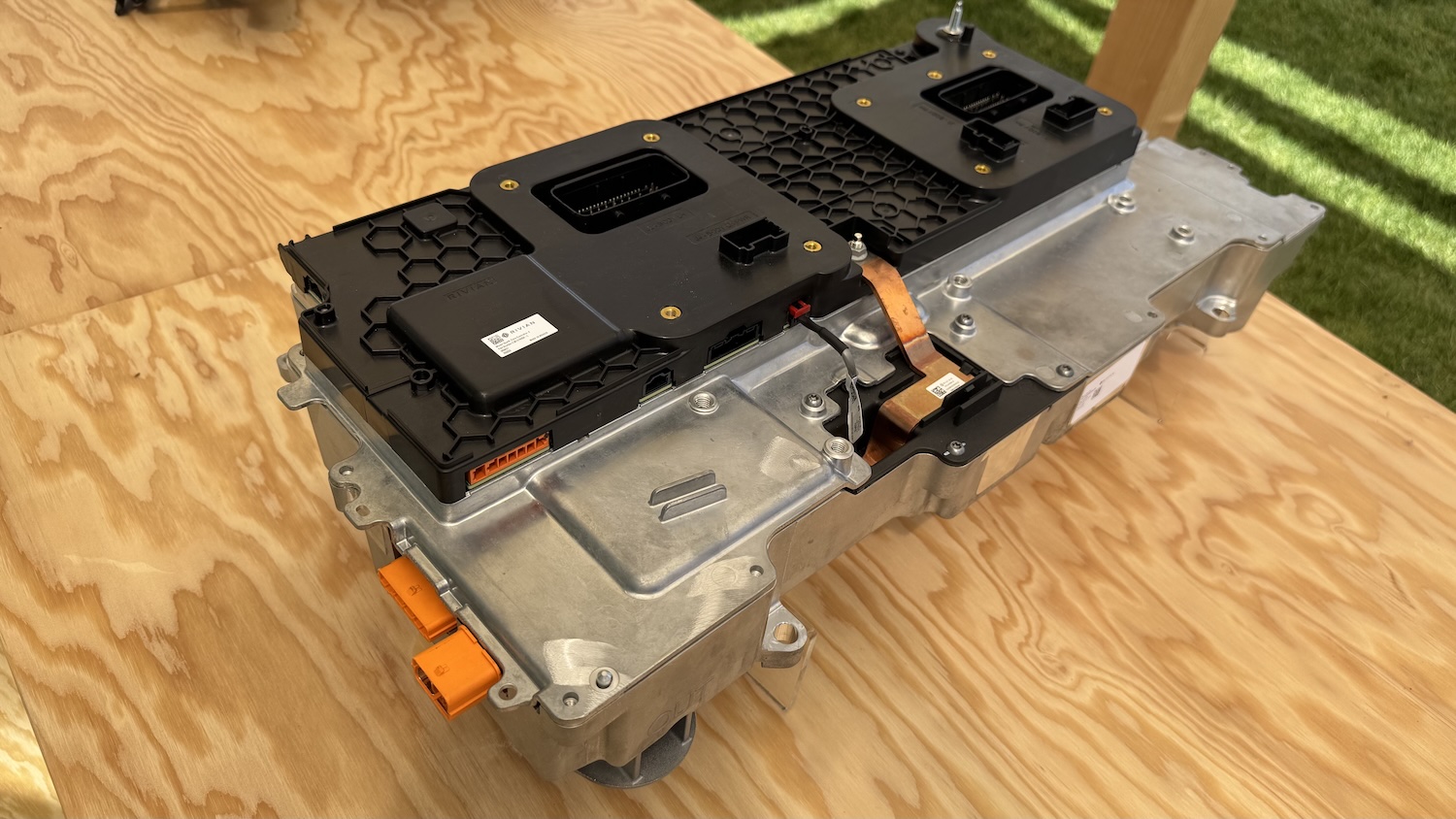
Here’s a look at the guts of that “Powerhouse” sitting atop the rear of the pack:

Rivian showed journalists that what would normally be five components — the south “zonal” (this is the controller for components at the rear of the vehicle), the Battery Management System, the DC-DC converter, the On-Board Charging Module, and the DC-to-AC inverter — has been converted to a single, elegant part.
Here’s a look at that single component located in the Powerhouse box:
The components have all been brought in-house, Rivian says, and instead of features being removed, the R2 actually adds bi-directional charging, so you can actually use the vehicle as a battery to run auxiliary power tools, homes during power outages, etc.

The company also showcased the R2’s wiring harness, which is 2.3 miles (when adding individual wires) shorter than that of the latest R1S.
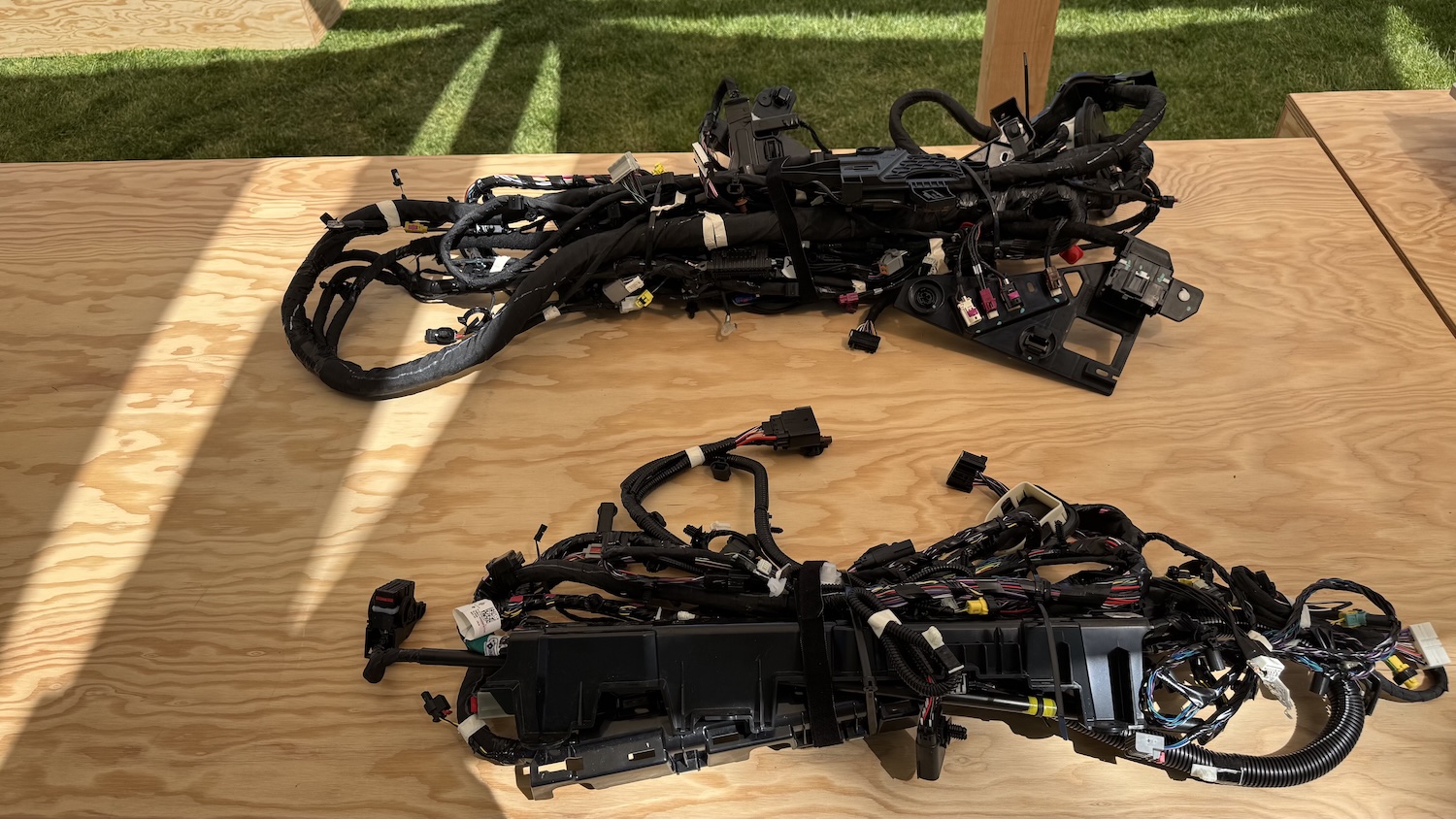
2.3 miles weighs over 44 pounds, which is what one of the copper wire-balls below weighs. It was not easy to lift:
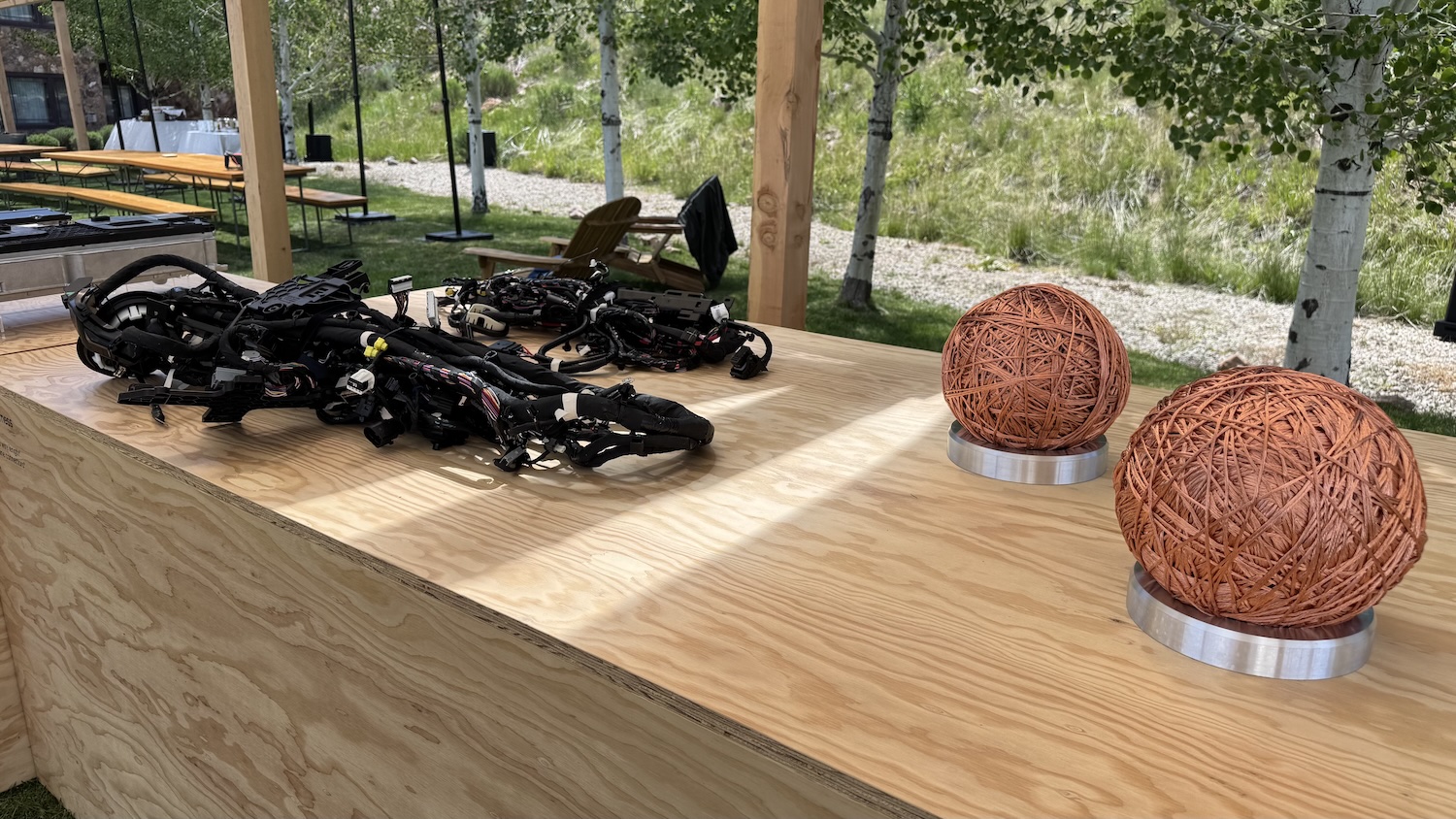
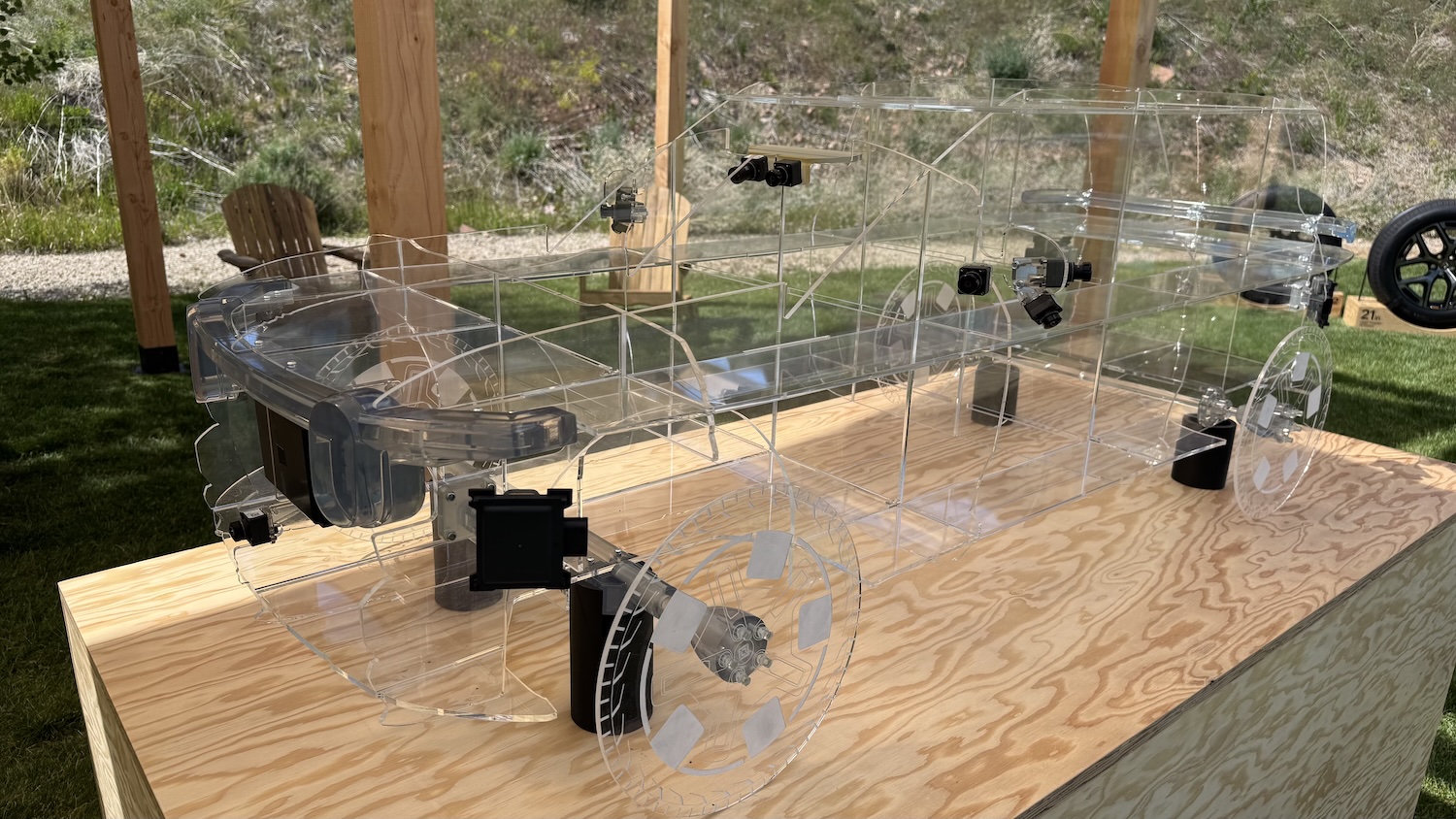
There’s a lot more that Rivian showed journalists. For example, the company showed the cameras (11 in total; 10 outside, one inside) and radar sensors (four corner radars and a long-range in the front) located around the vehicle:
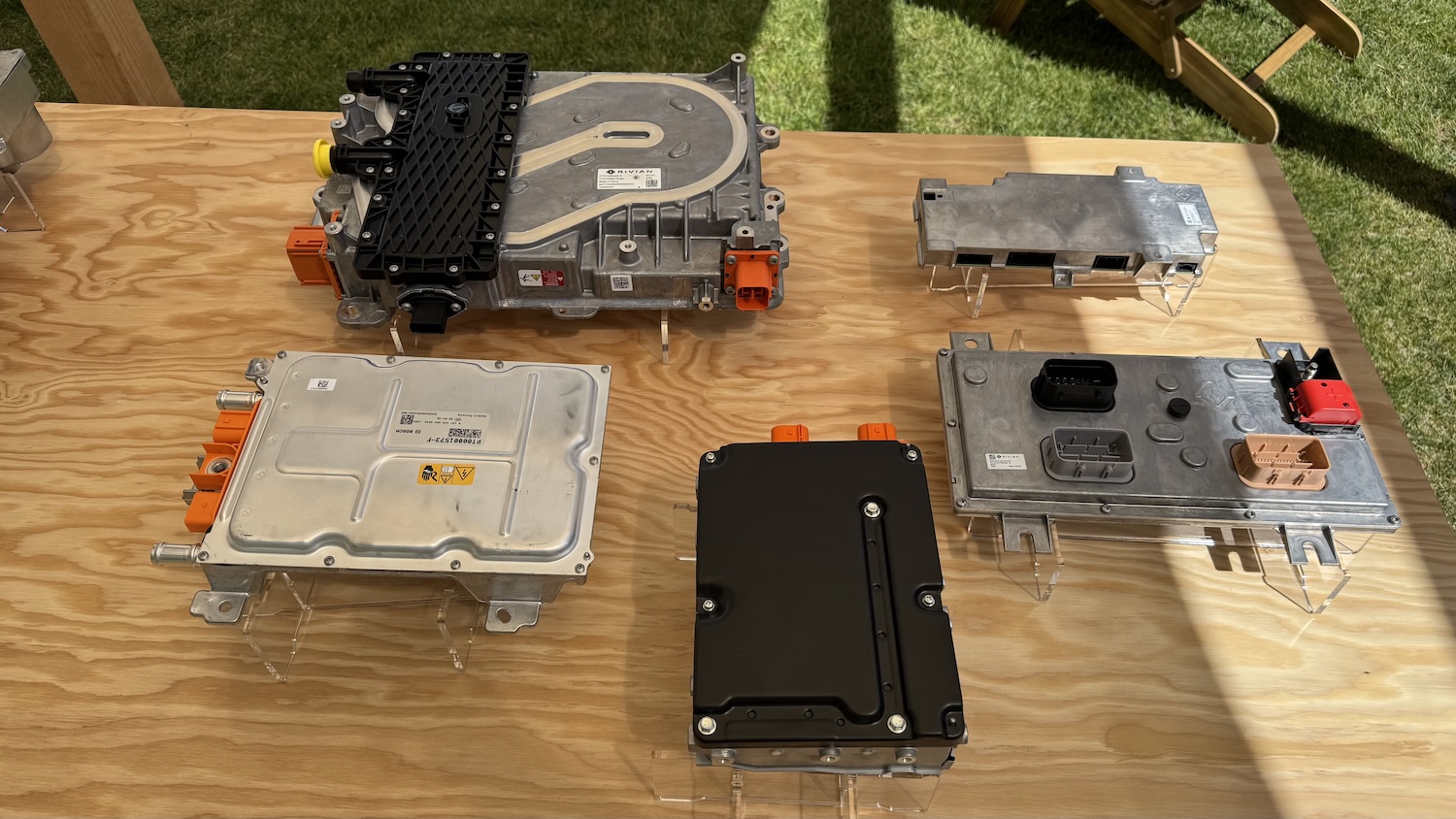
They also showed boards that they’ve made more compact compared to the R1S:
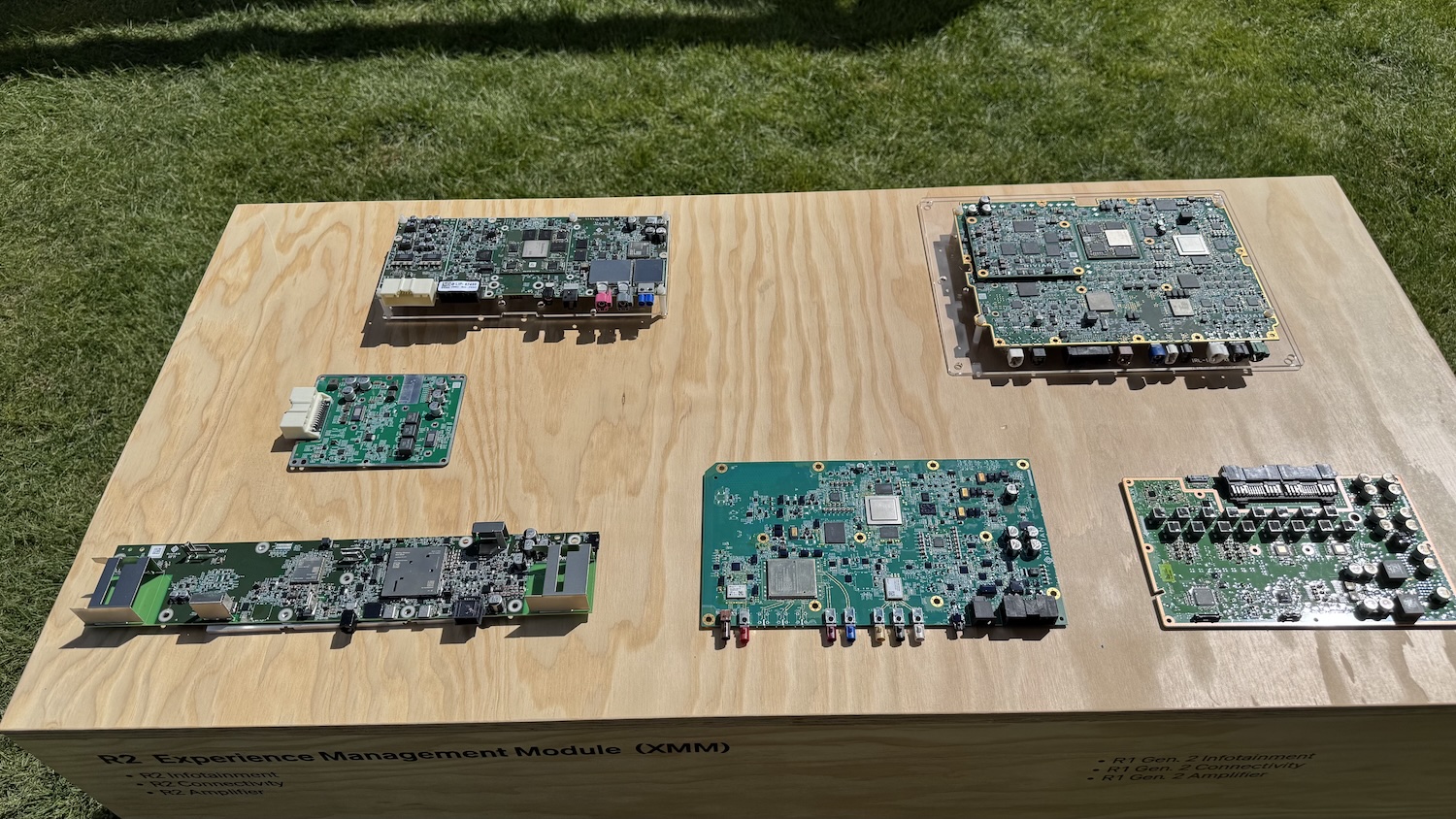
I know there are some electrical engineers furious that I’m glossing over the sensors and boards above (you can see by the text that the R1s are bigger overall) but this review is getting long, so I’ll finish this engineering section with the subframes, since as a mechanical engineer and there’s lots of good hardware on the subframes.
Up front you’ll see a fairly standard stamped steel subframe with a MacPherson strut suspension, a regular steel roll bar, and a fairly typical dual pinion steering rack:
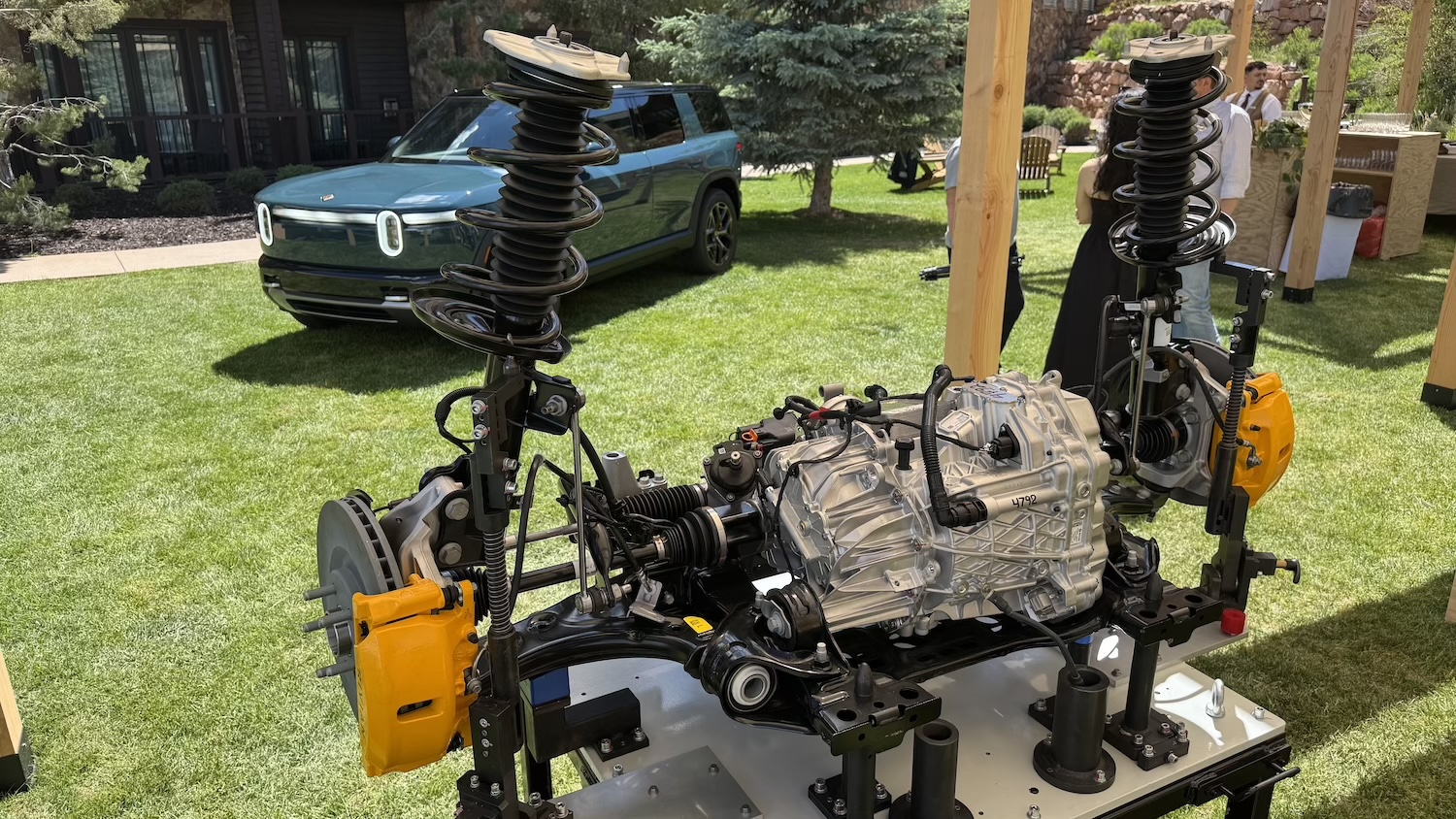
By contrast, the Rivian R1S features air suspension, a fancy hydraulic roll control system, a cast aluminum subframe, a double wishbone front suspension, and a ball screw-style steering system to handle the higher loads. Rivian mentioned that the R2’s braking system is also different than the R1s in that, while pushing the R1’s brake pedal always moves hydraulic fluid, the R2’s brake pedal does not normally move fluid but instead it sends a signal to provide brake pressure (you can press harder to “push through” in the event of a failure); this, Rivian says, allows for better regen performance/variability.
The dynamics engineer mentioned that the Rivian team made him fight for every last feature, and the one he refused to give up on was semi-active dampers, so those are present on the R2 (though simpler than the ones on the R1S) and allow for variable damping performance in different driving conditions (the driver can actually change damping rate via the screen).
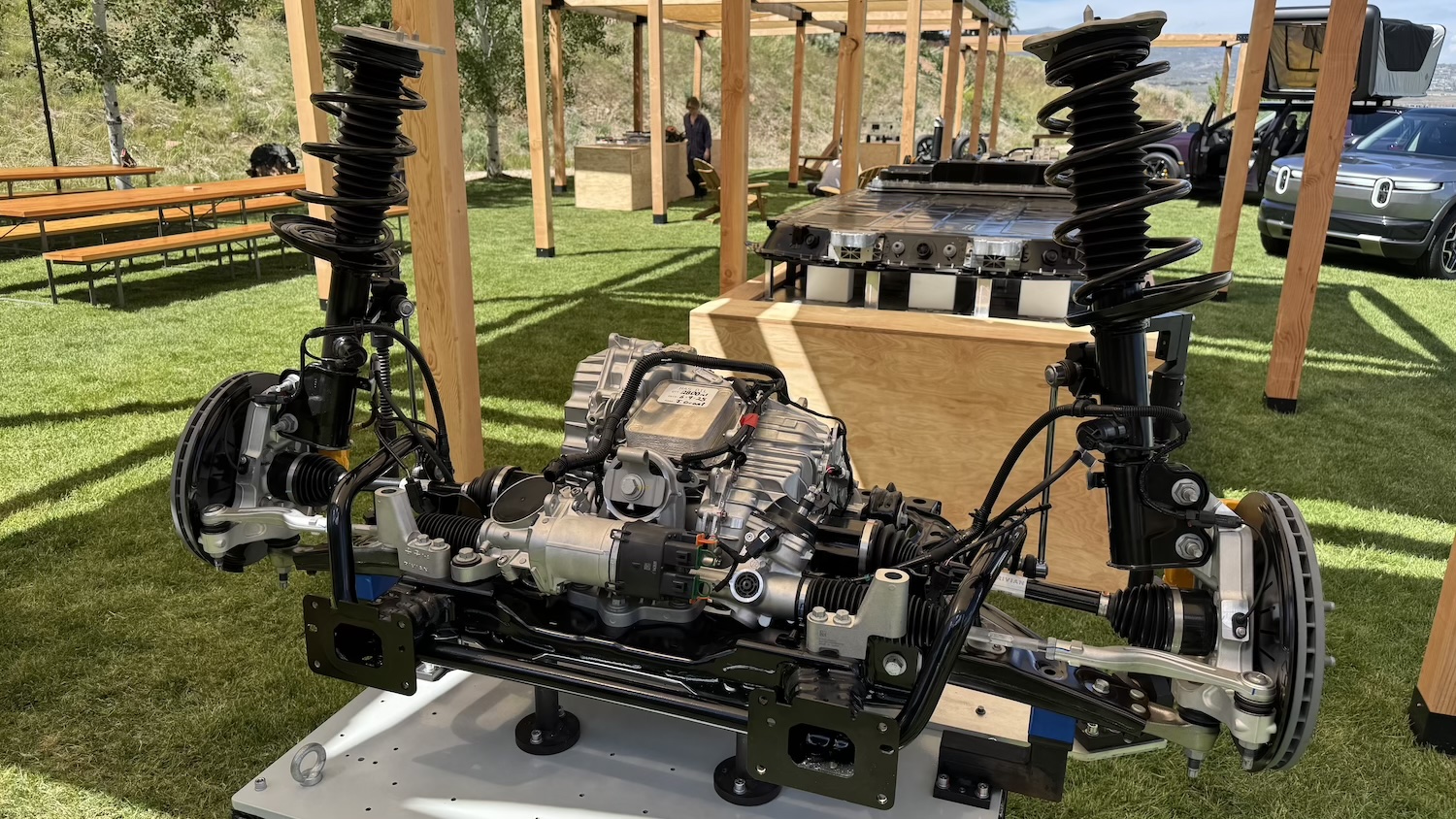
The drive unit is new, and called “Maximus.” A smaller unit than those found on the R1S and specifically designed for mid-size vehicles, it has been set up on the front and rear to offer a 40/60 front-rear torque split. Speaking of the rear, here’s that subframe, which is also stamped steel, which also features a standard steel sway bar, and which also features coil springs instead of air springs.
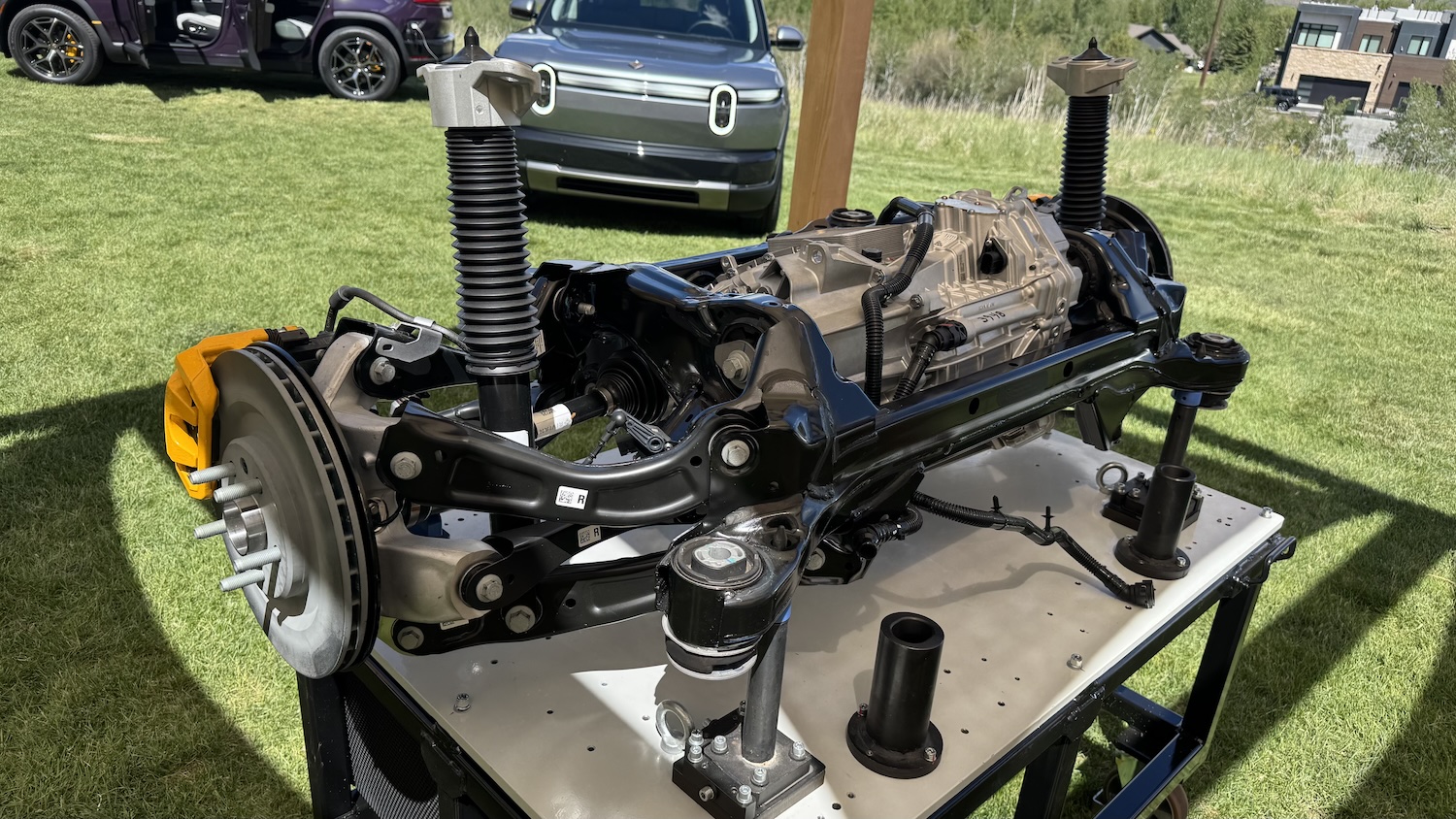
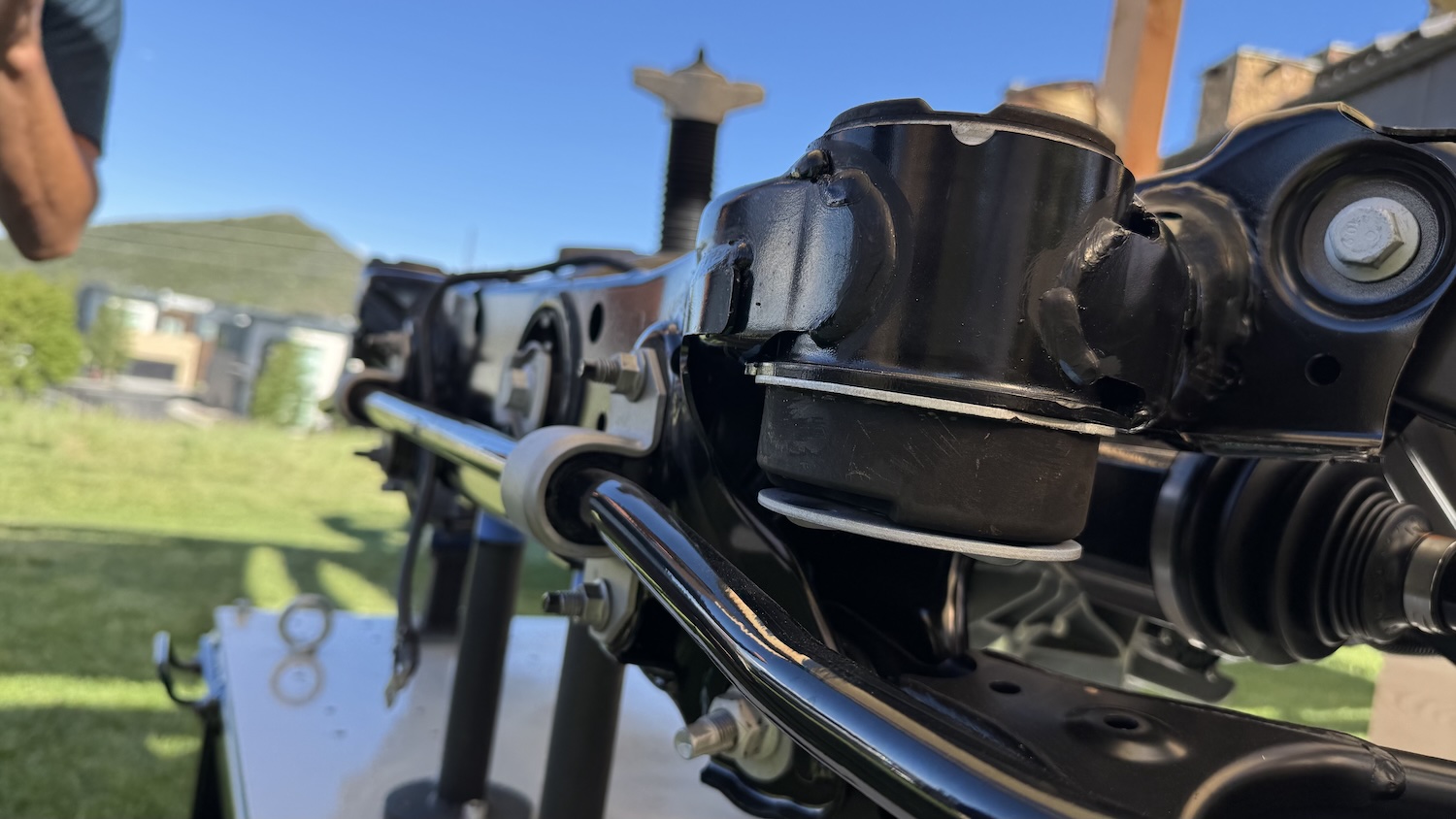
You can see that the suspension is a multi-link setup, and if you look closely, you’ll also notice that this subframe is actually isolated via rubber mounts:
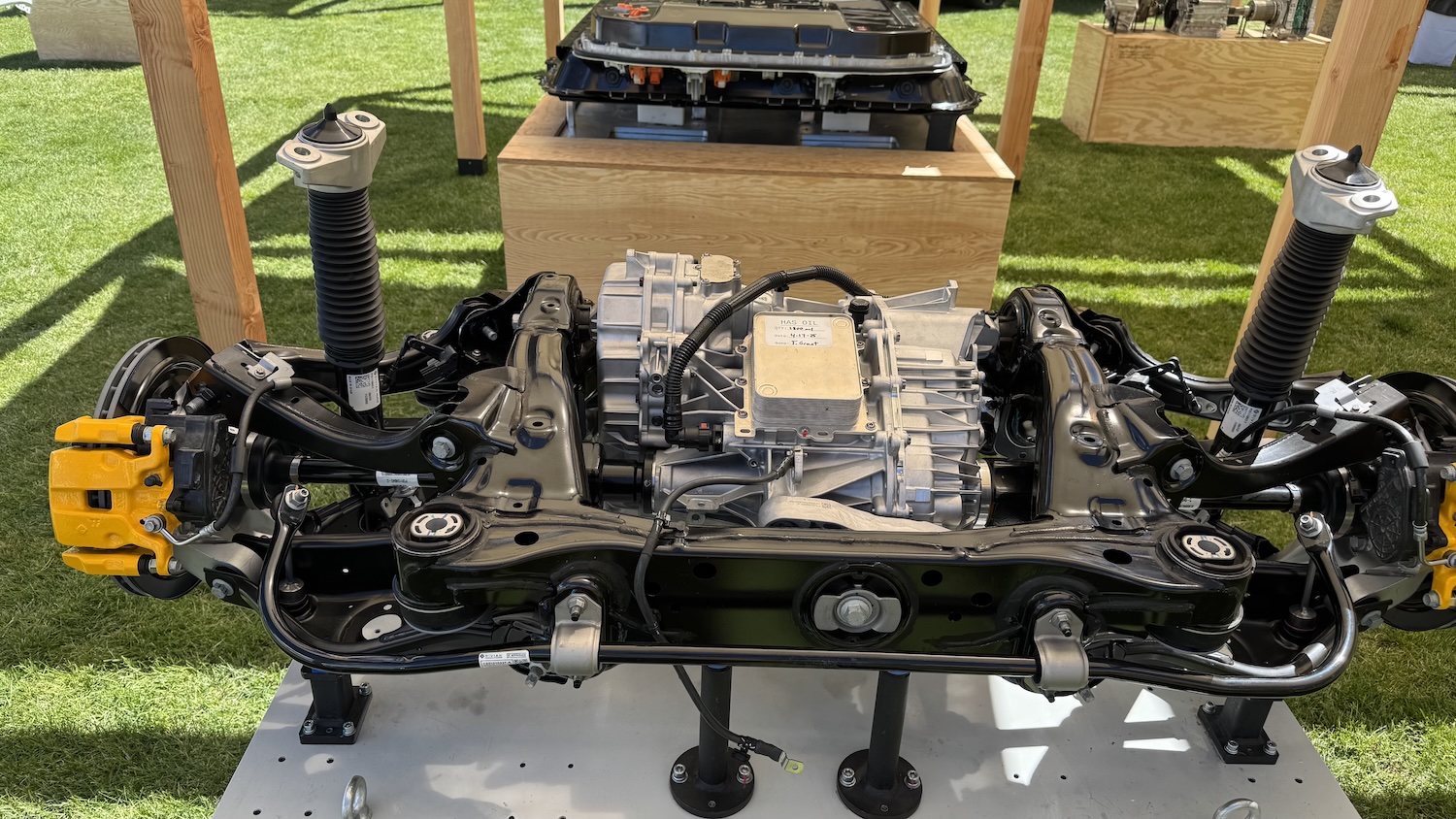
Here’s a closer look:
If you’re curious about the output of these motors, they come in three different combinations (this is also a chance to look at the pricing and range):

For reference, here’s the Rivian R1S’s front subframe:

And here’s the rear: 
You can see the subframes and control arms are cast aluminum, whereas on the R2 they’re stamped steel — a more economical, traditional setup meant for what is meant to be a more economical, traditional electric SUV.
The Interior Is Simple But Nice, And The Storage Is Phenomenal

With the design and engineering discussion out of the way, let’s talk about what it was like actually driving the thing, starting with my assessment of the cabin. The first thing I noticed is that the base car — which is shown above and starts at $44, 995 — is actually quite nice.
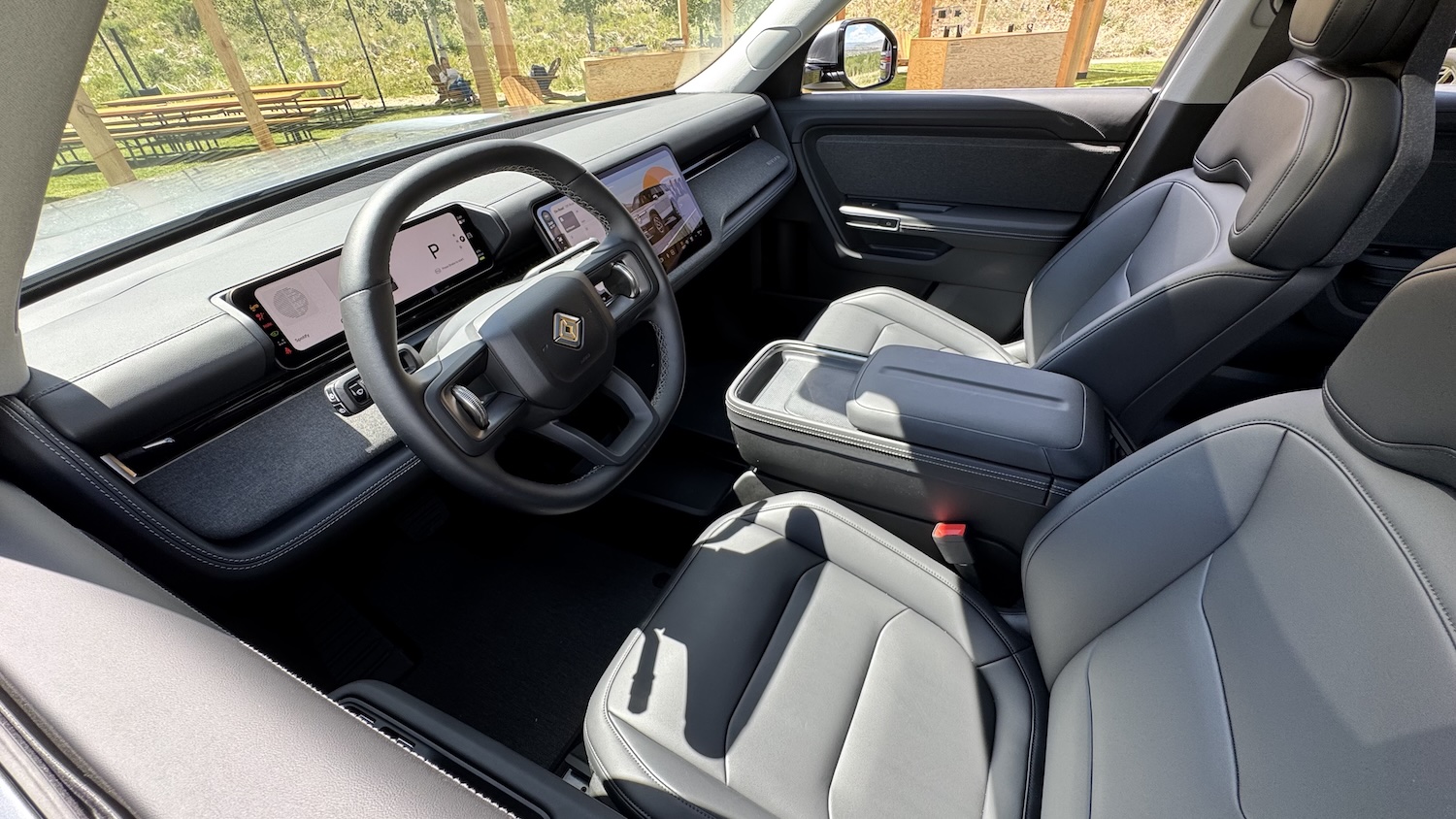
The design is elegant, the “Advantex” faux-leather feels nice and durable, and the whole cabin just feels light and airy and pleasant.
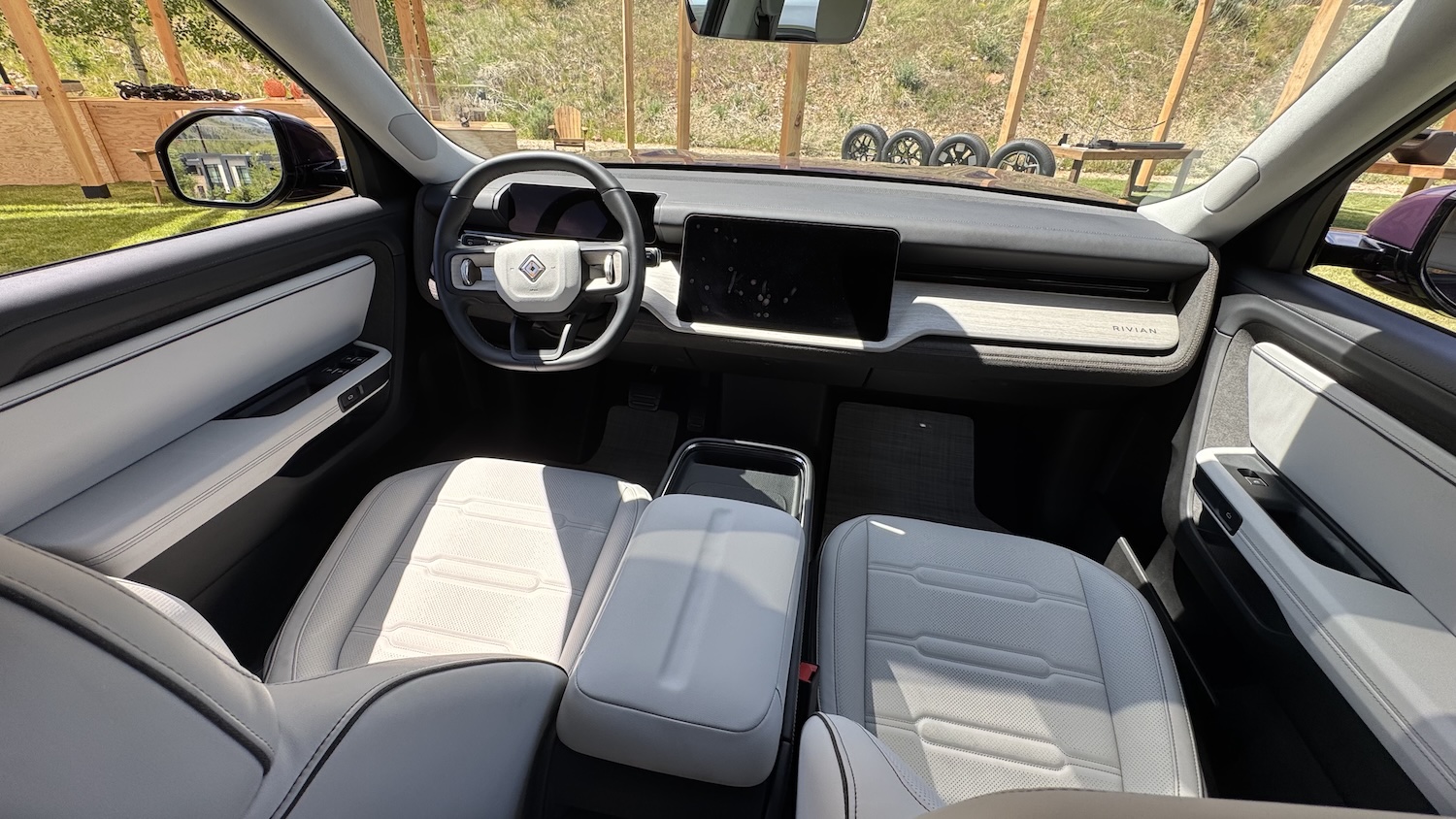
Whether you get the base car or a higher-end trim (like the one shown directly above), the interior is minimalistic and lacks physical controls. The result is that your screen will likely often look like this:
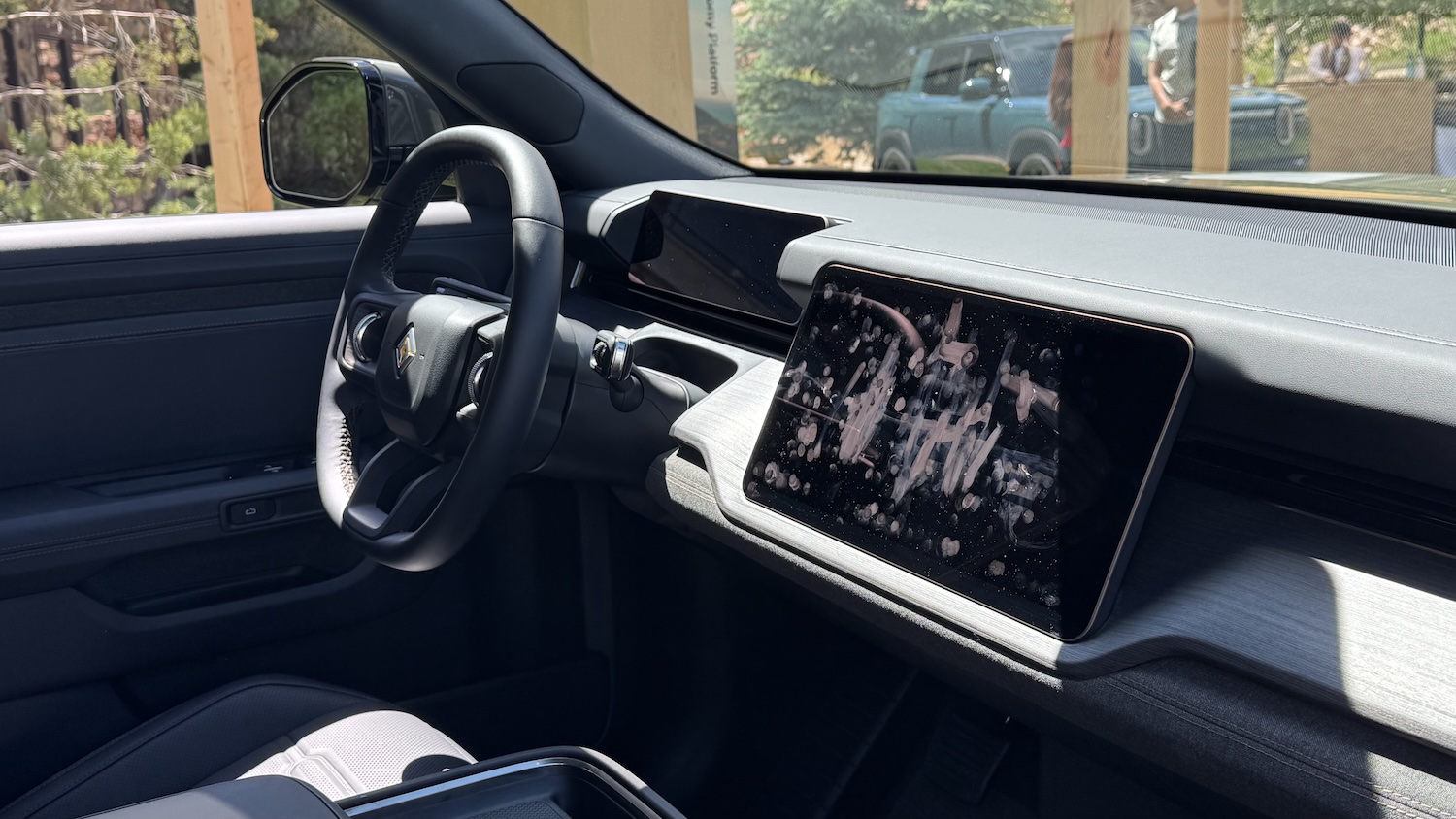
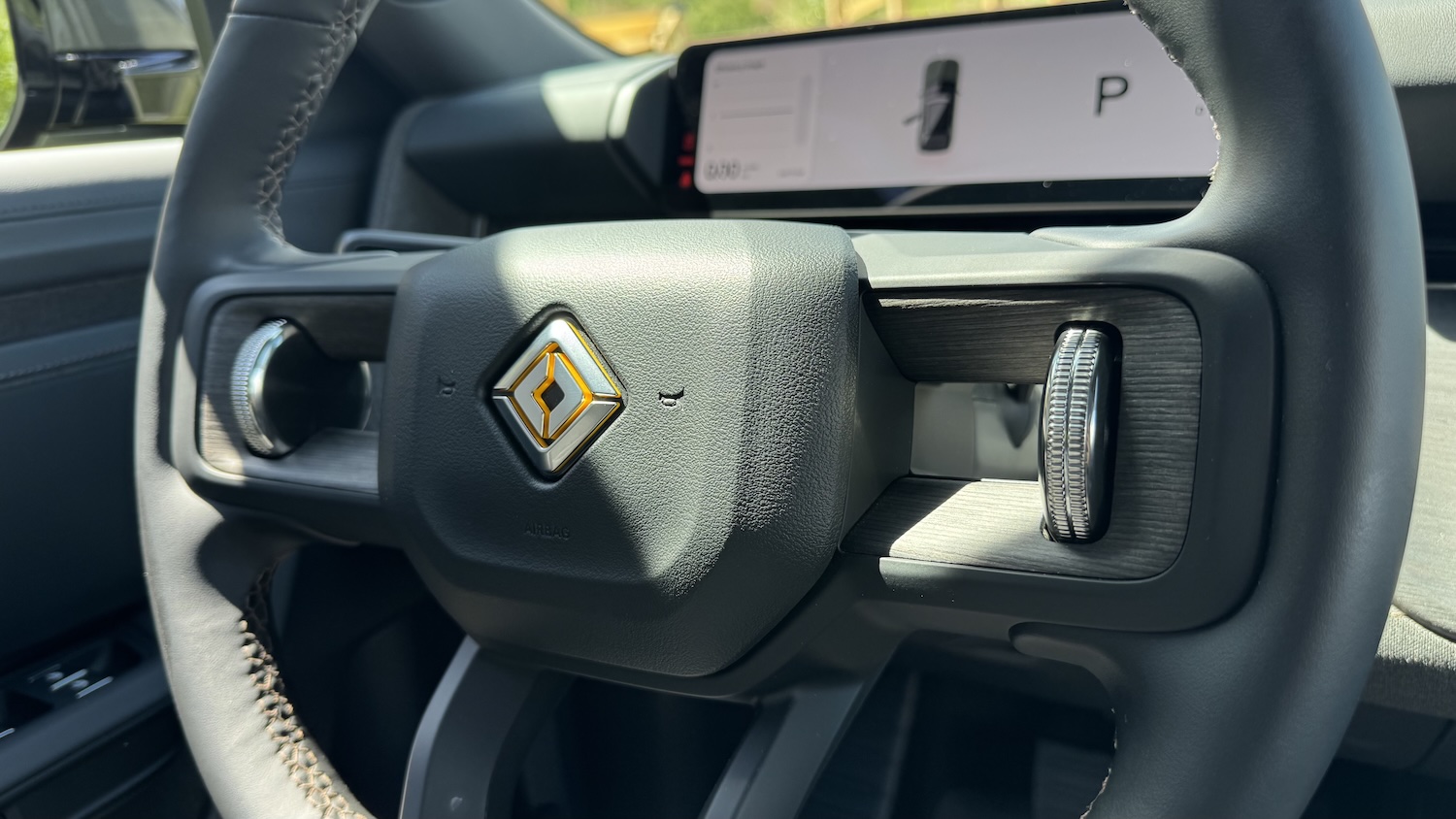
There are two “Haptic Halo Wheels” (see below) on the steering wheel, which can both scroll and press left/right, and there are the stalks, but the infotainment and most other controls must be accessed through the screen. That includes the HVAC vents — something that I find maddening. (Rivian, for its part, says screen-vent control is there to maintain the car’s house-like interior vibe. You don’t see piano black in homes and you don’t see vents in elegant homes, so you shouldn’t see them in a Rivian, design Chief Jeff Hammoud told me).
I’ll get back to the infotainment and the cabin in a second, but for now I want to applaud Rivian for making the R2 an absolute monster in the area of space utilization. The Rivian R2 is 185.9 inches long, 84.7 inches wide, and 66.9 inches tall. For reference, that’s shorter than the Tesla Model Y, it’s about an inch wider, and a couple of inches taller.
Upon sitting in the R2, it quickly became clear to me that, for a vehicle this size, the R2 is massive on the inside; it feels like the Sistine Chapel, not just because there’s tons of headroom (and there is), but because there’s tons of room everywhere. And the way Rivian set up the cargo system on the car is absolutely A+ work.
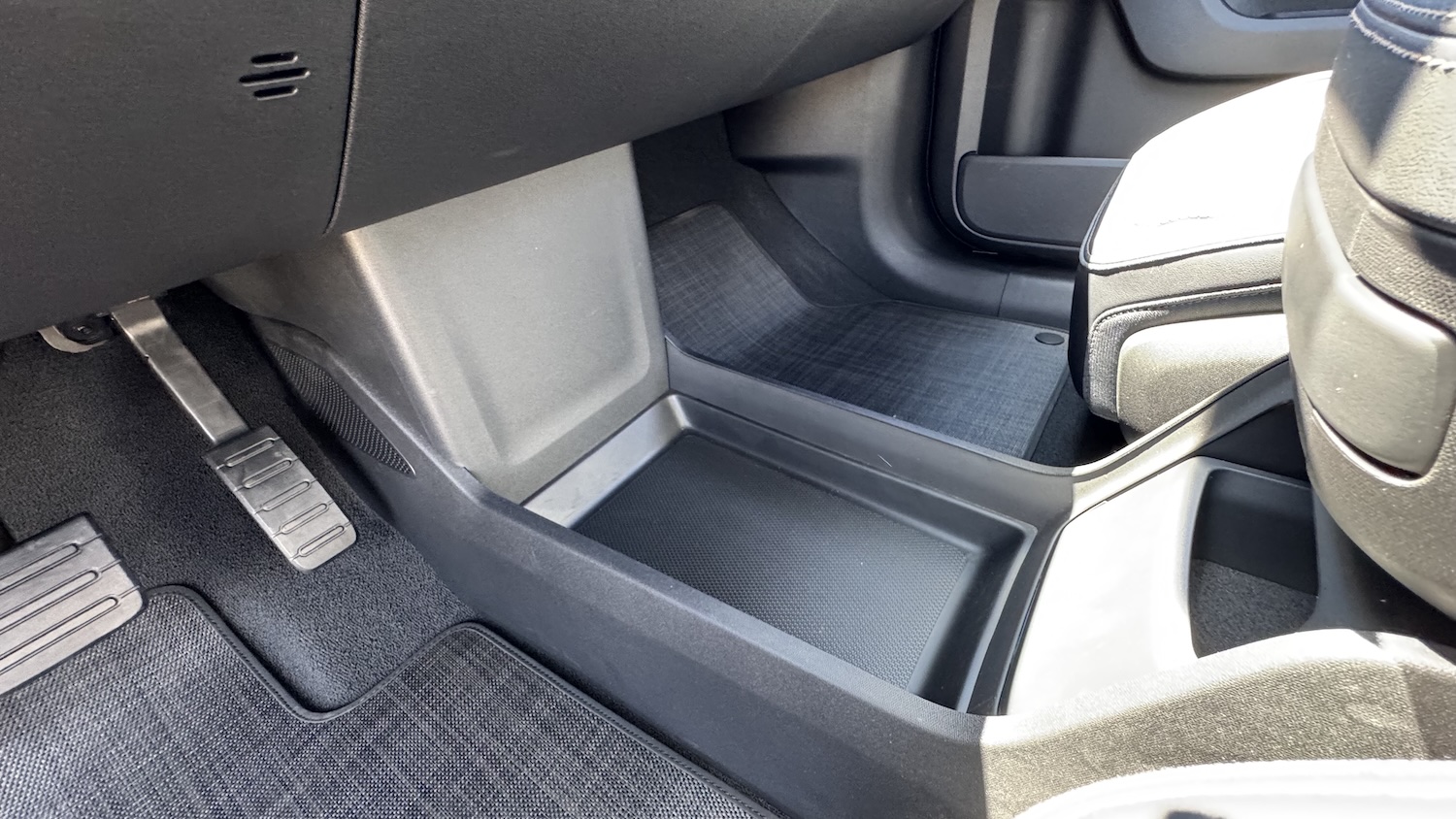
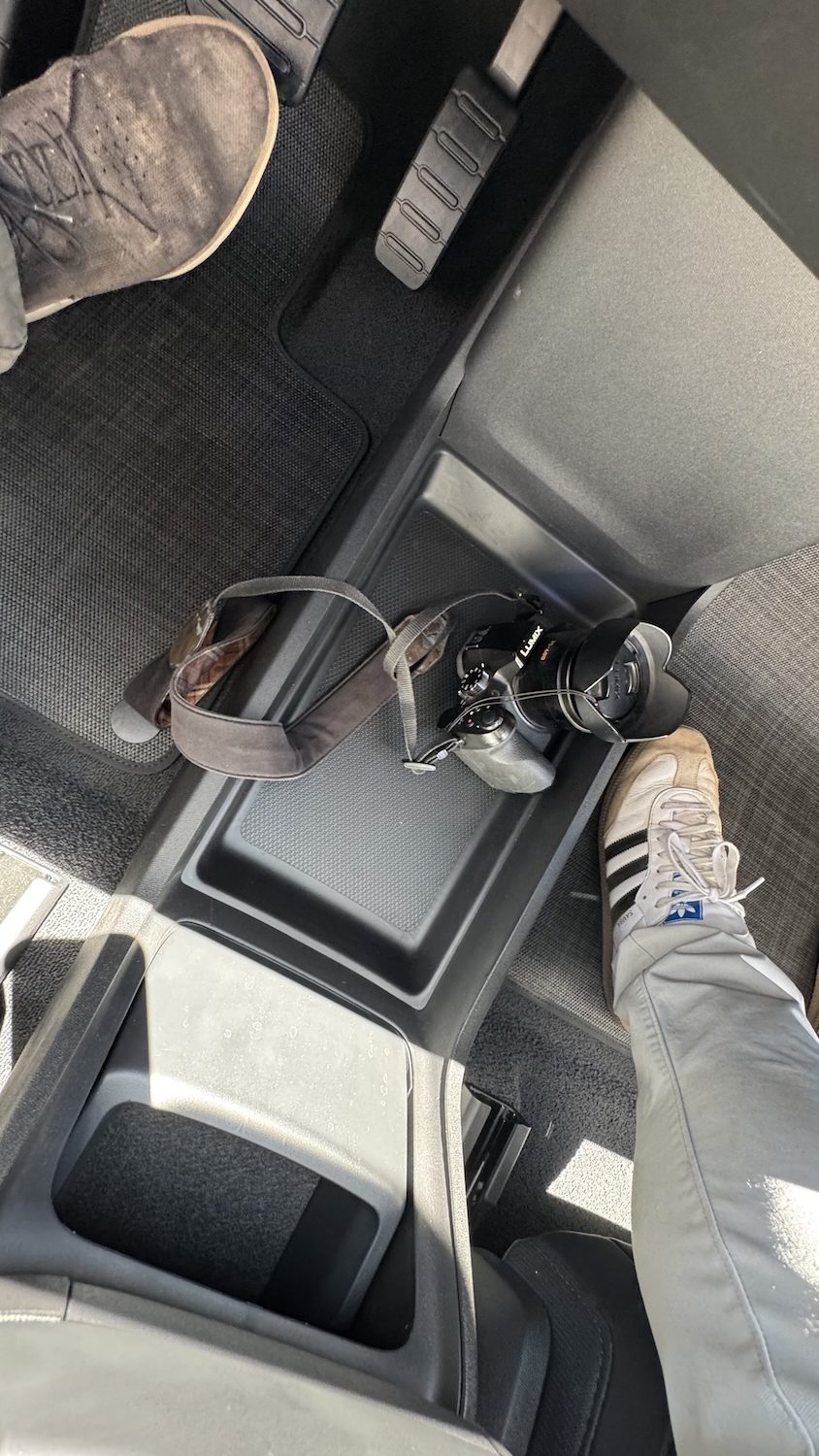
I think every electric car should have a shallow bin on the floor between the driver and passenger. It doesn’t have to be tall and it certainly shouldn’t be a huge center tunnel as is so common — it just needs to prevent stuff from sliding in turns. This space becomes so useful for big items like backpacks, purses, and in my case, a camera:
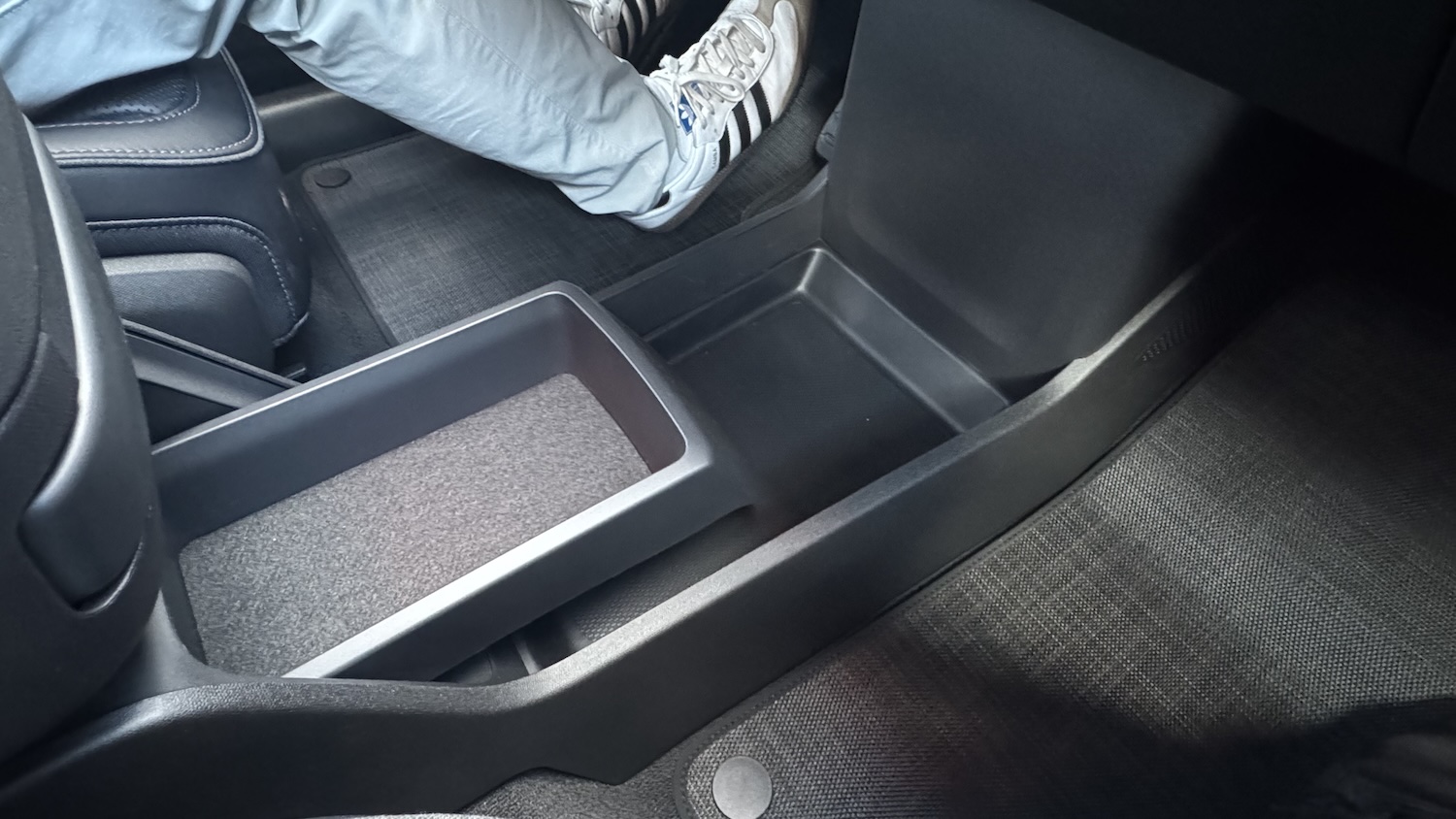
Rivian has a fore-aft sliding drawer in the center console that offers even more storage:
Speaking of the center console, up top it features a wireless charger at the front:

And towards the rear is a deep bin of which I only have this blurry screenshot:

Jutting from the front of the center console is a pair of cupholders:

And ahead of that, built into the dashboard, is the awesome pair of (manually-opened) gloveboxes:
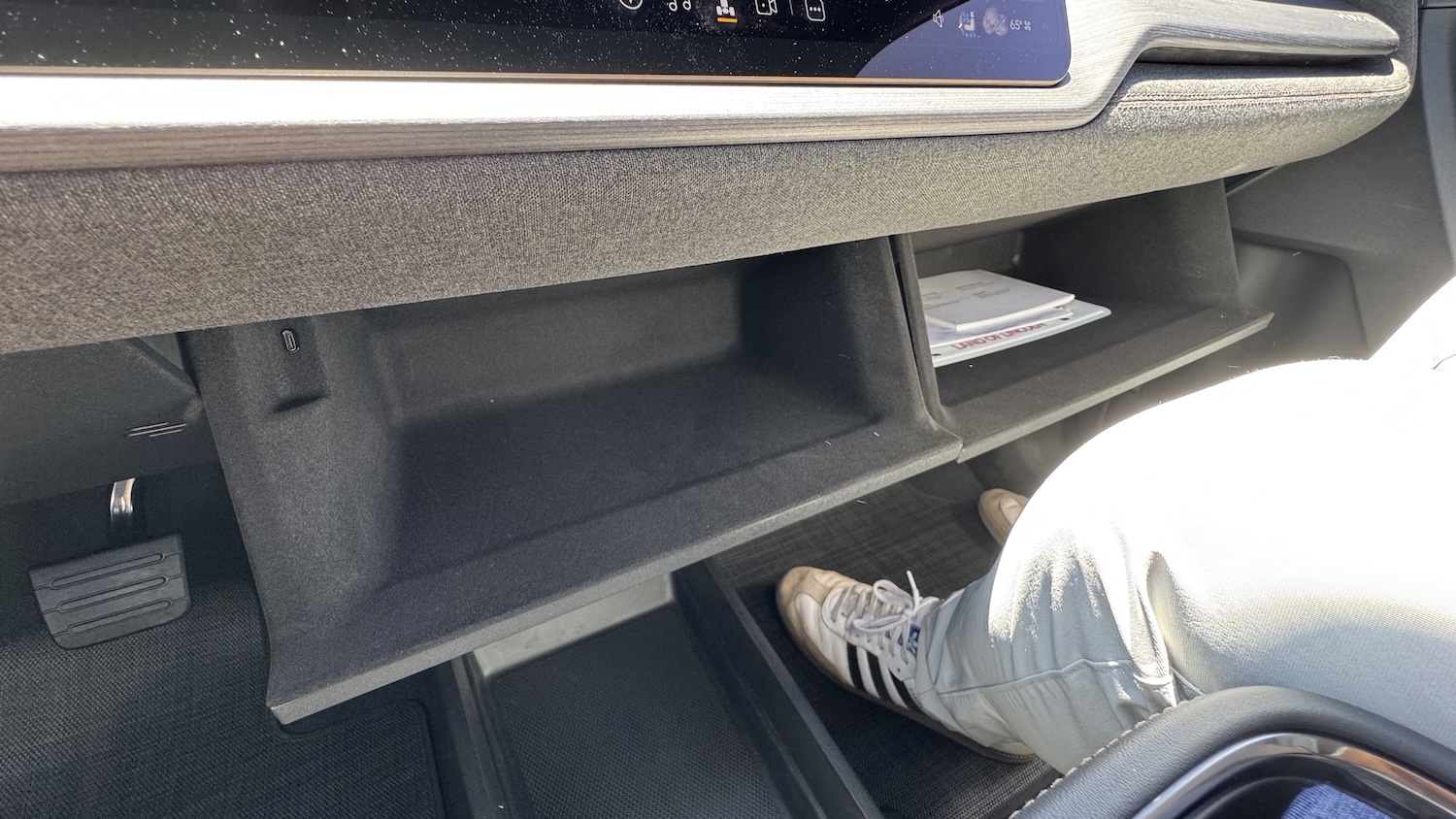
The doors up front have an upper storage area as well as an expandable lower storage area (I think all cars should have expandable door pockets; this is just great design). There’s lots of space there because the front speakers have been relocated to the base of the dash. These are back-to-back “force-balanced” speakers, so they don’t transmit significant vibrations into the structure holding them in place. (Overall, the sound system quality seemed good to me).
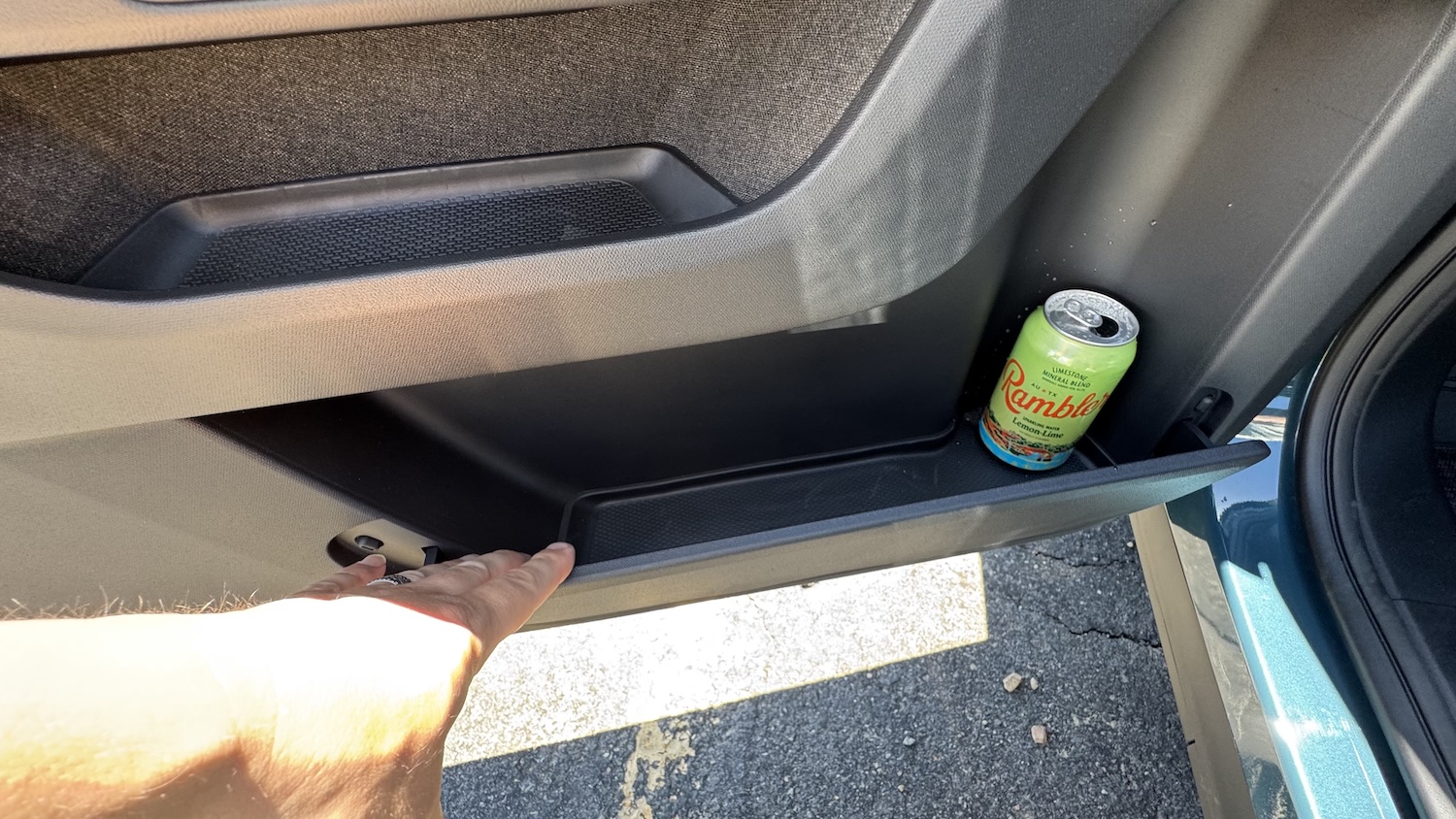
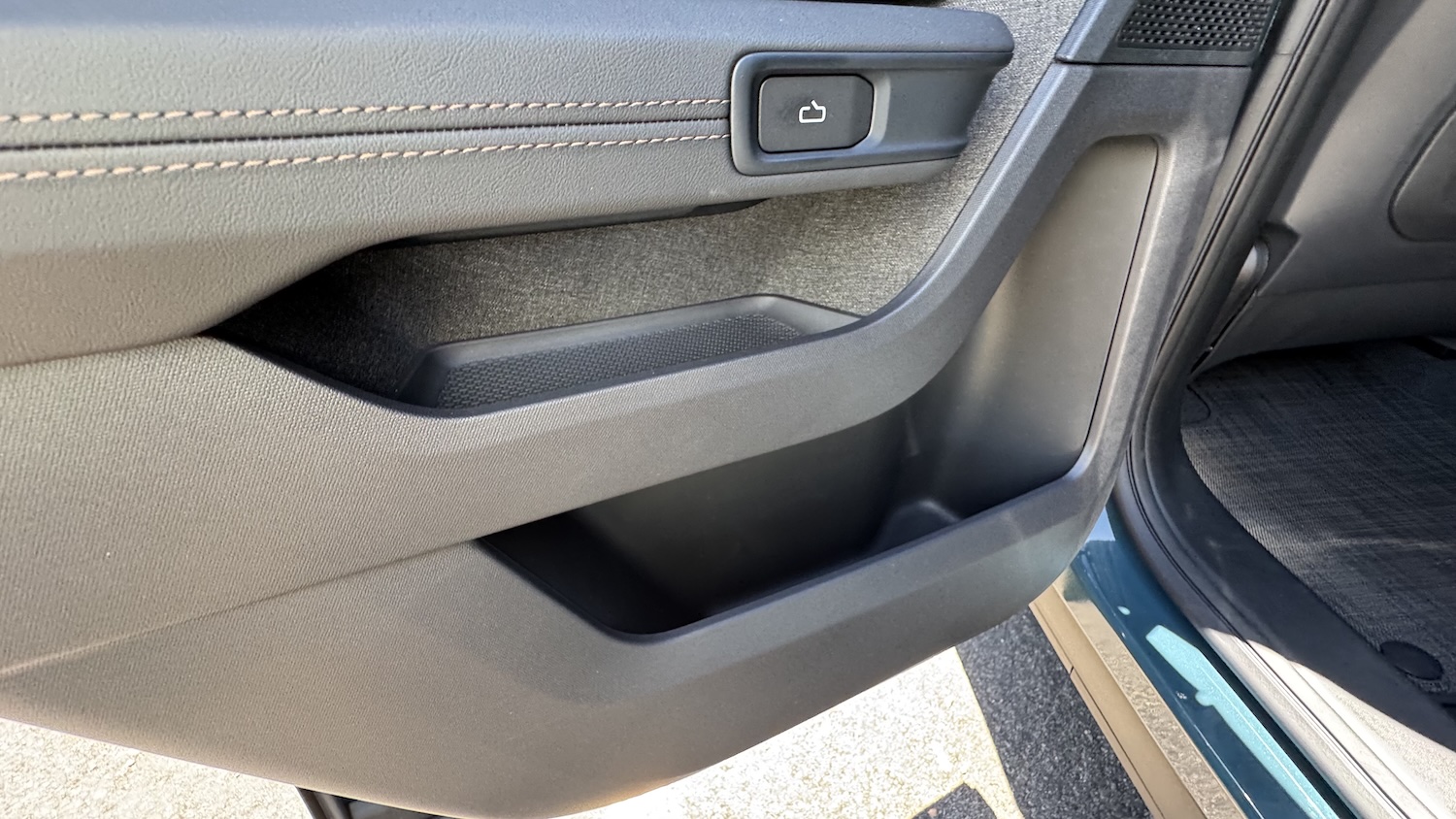
In the rear doors, there’s a smaller upper storage bin and a huge lower one with an area that should fit a tall water bottle:
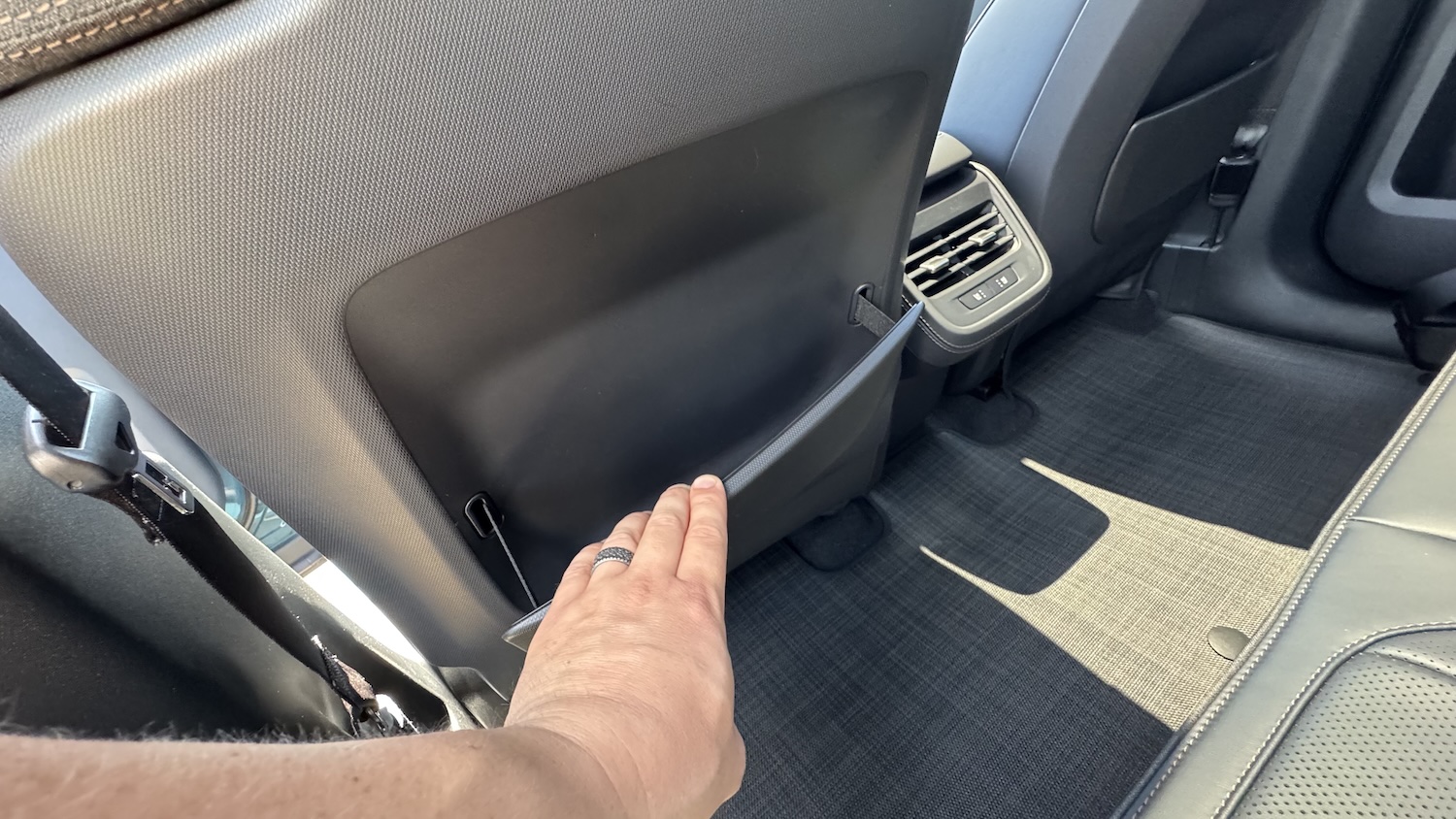
Behind the front seats are expandable storage pockets:
There are some cupholders and a little bin in the center of the rear bench upper cushion:

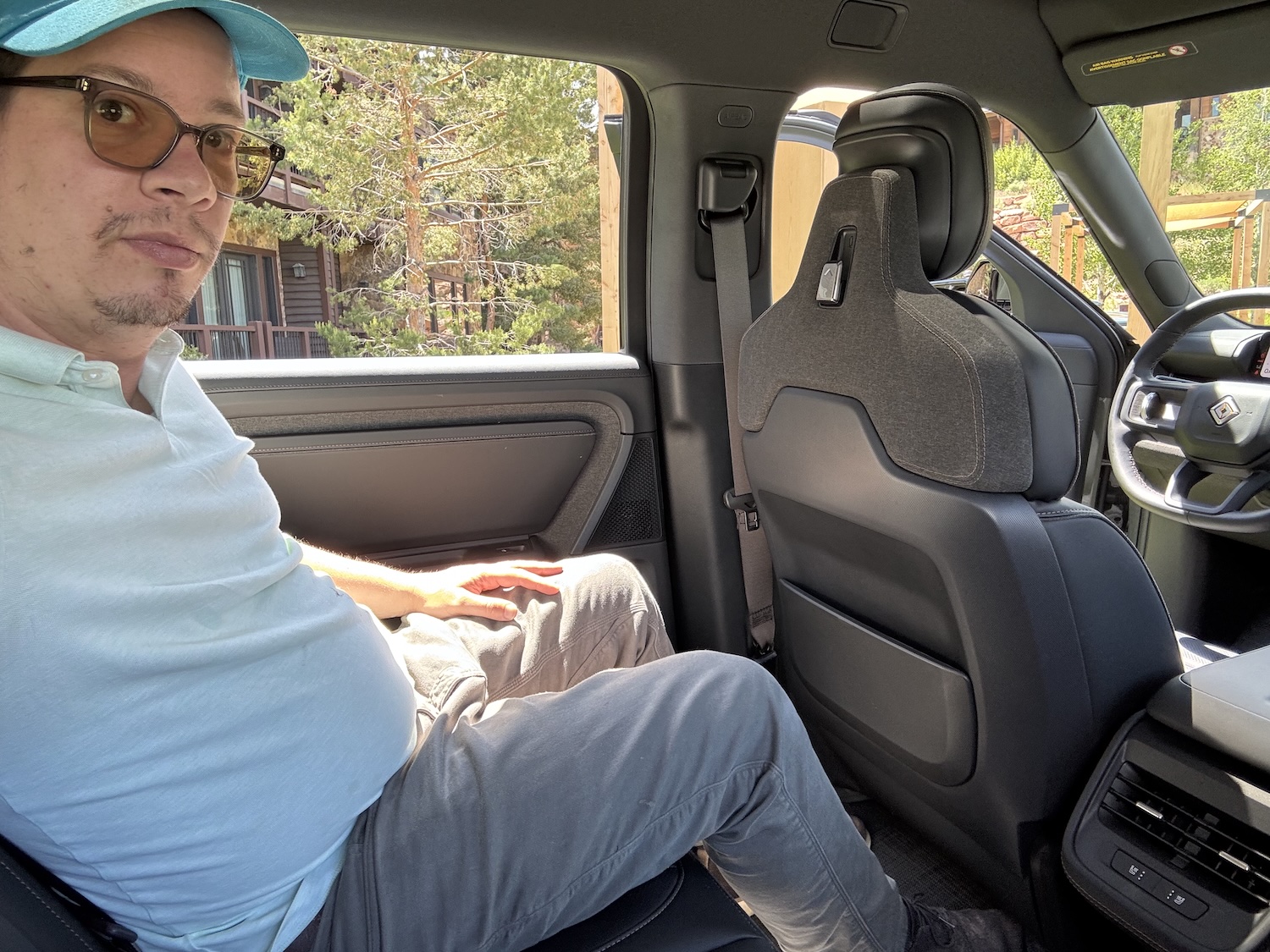
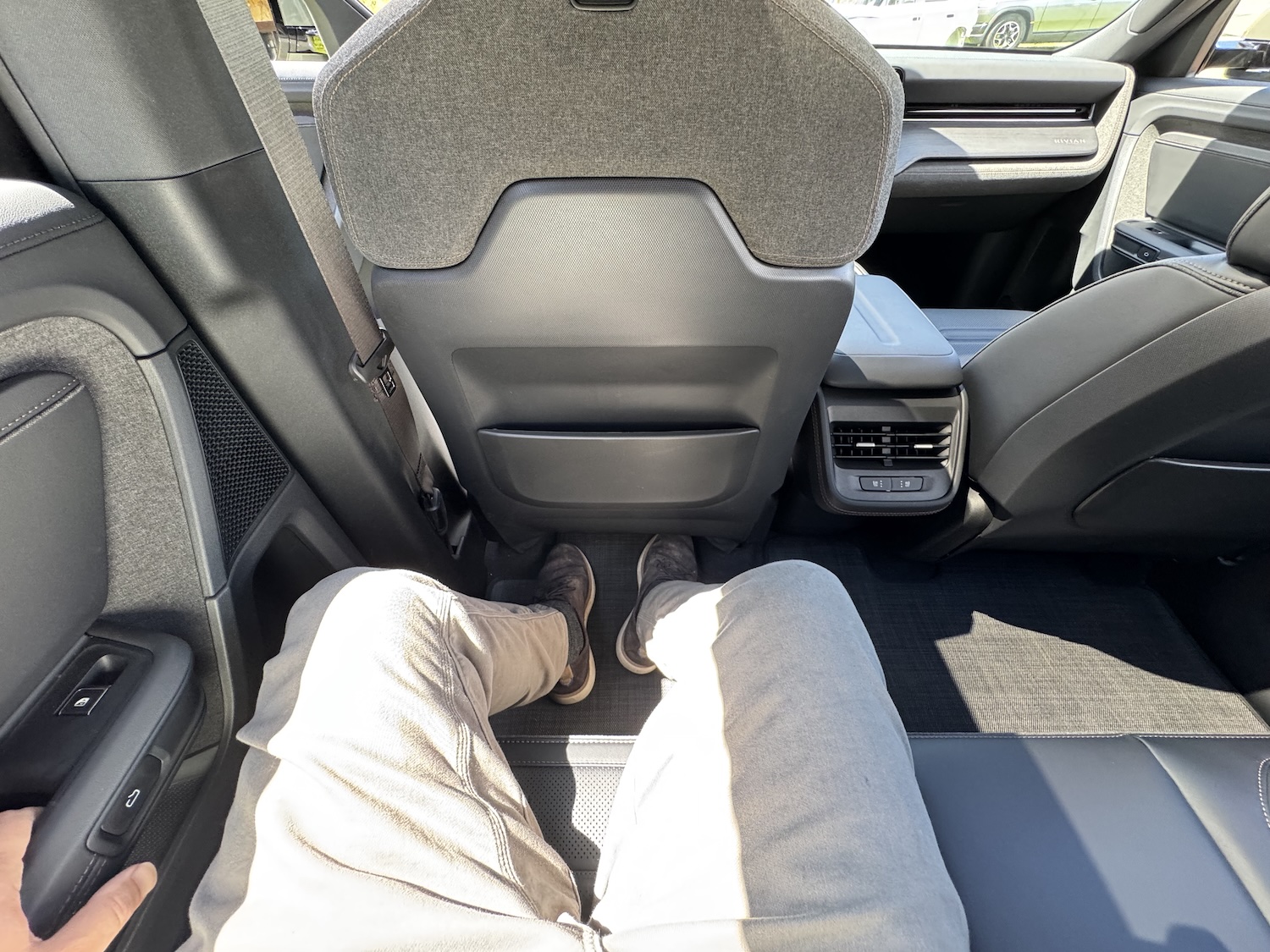
But most importantly, what’s back in that second row is space. Tons and tons of space. How could there possibly be this much space? Look at how much room there is ahead of my knees; it’s even more than the R1s!:

Surely all that legroom came at the price of rear cargo space, right? Not really; it’s huge back there, too:
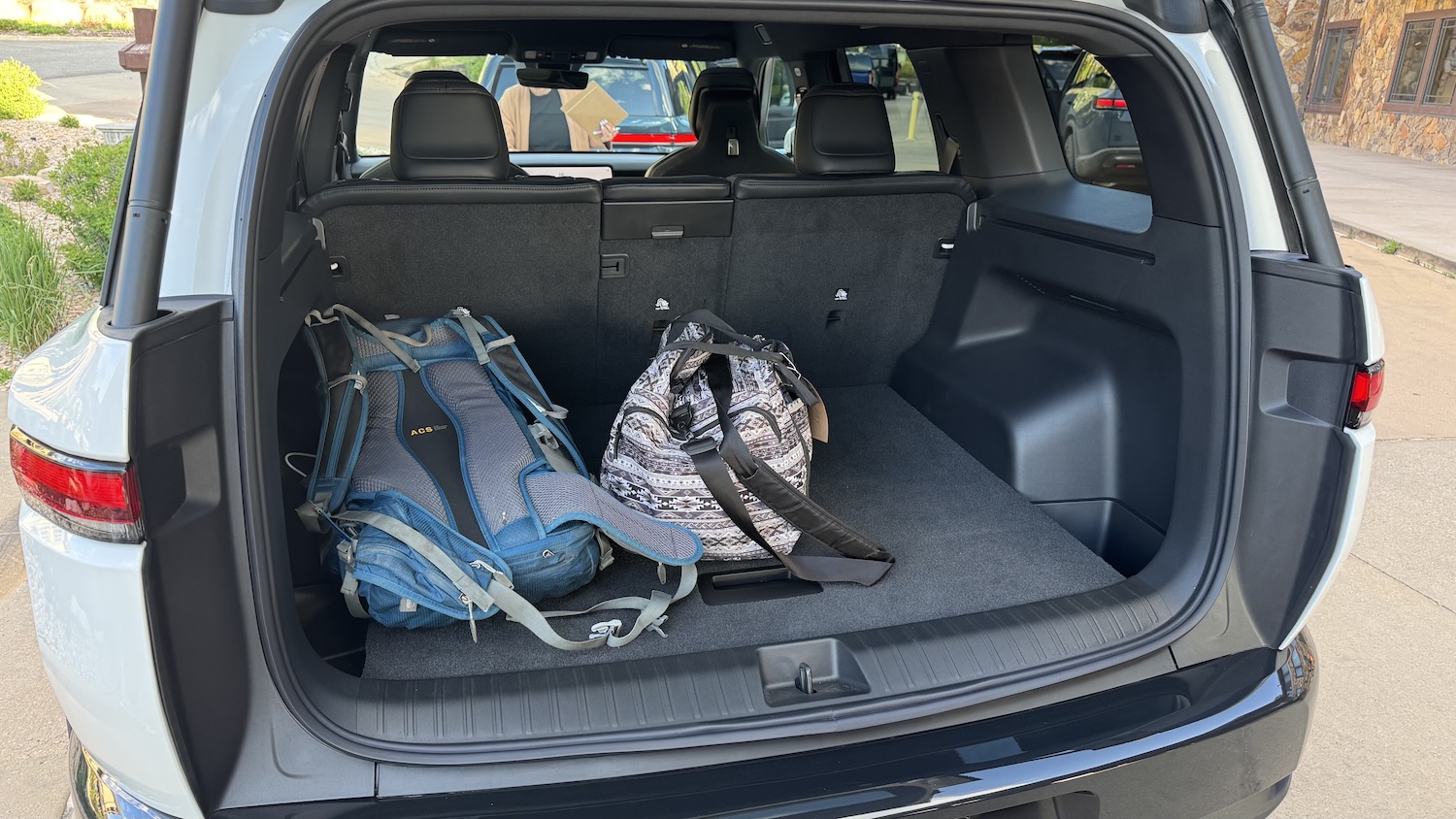
You can see the storage bins aft of the rear wheel housings:
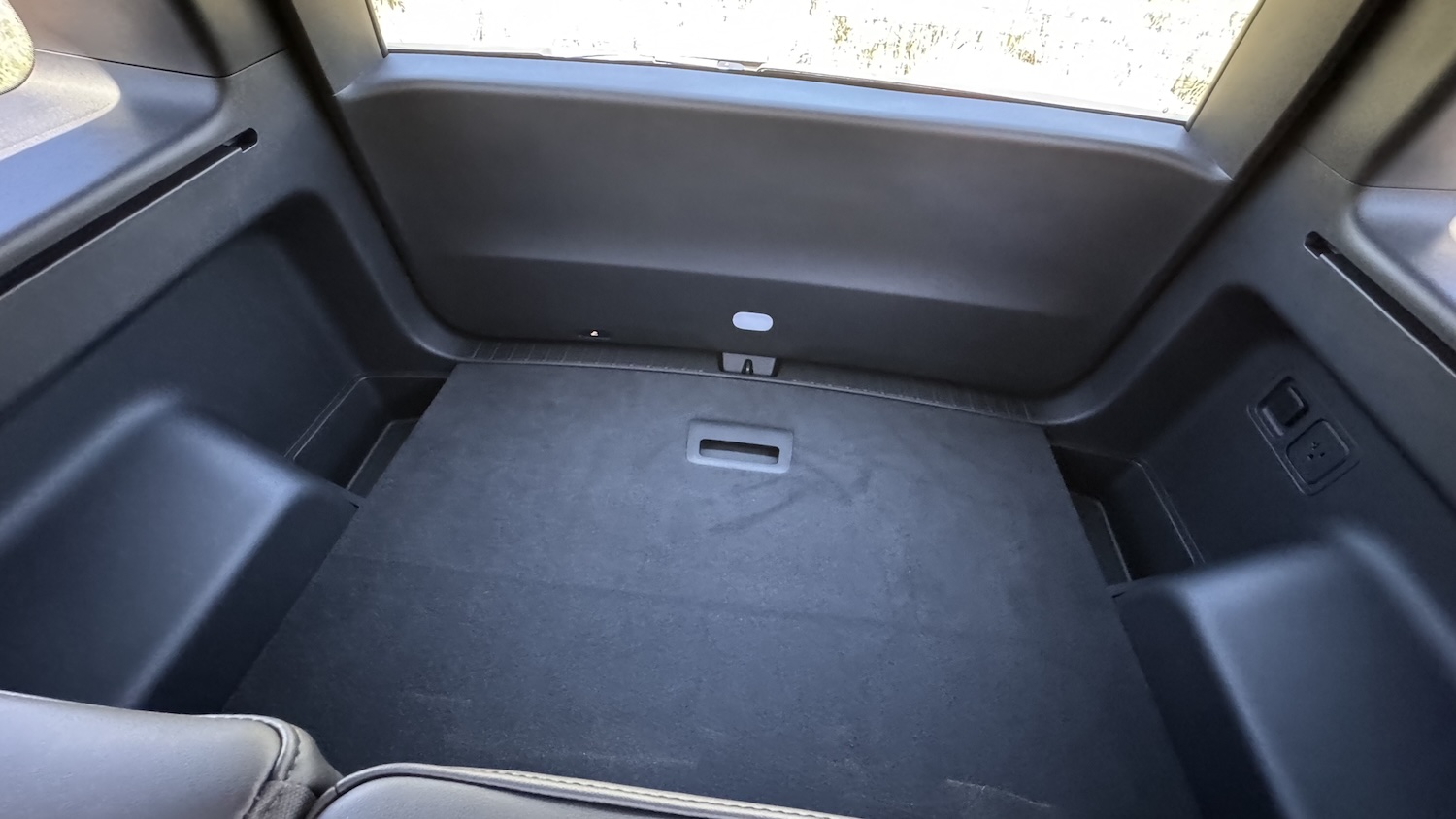
And below the floor is even more room if you forego the spare tire:

That’s really my takeaway on the Rivian R2’s interior. Do I think the quality of materials/overall design is that much better than, say, a $45,000 Blazer EV’s cabin?:

Or a Tesla Model Y’s cabin:

Or a $40,000 Kia EV6’s cabin:

Or a Mustang Mach-E’s interior?:

Maybe. The R2’s interior looks elegant, but its lack of physical switches really takes it down a notch, and I don’t think its simplistic design looks as nice as that of the Lexus RZ. Here’s the base R2 again:

And here’s the RZ, with its stunning standard Palomino and Macadamia NuLuxe fabrics surrounded by Charcoal trim:

But even if the RZ’s cabin looks a bit nicer and those other cars have buttons where the R2 does not, I think I’d still take the R2’s interior overall solely because of the combination of elite-level interior storage and an upright, airy, just downright pleasant atmosphere.
On-Road Capability
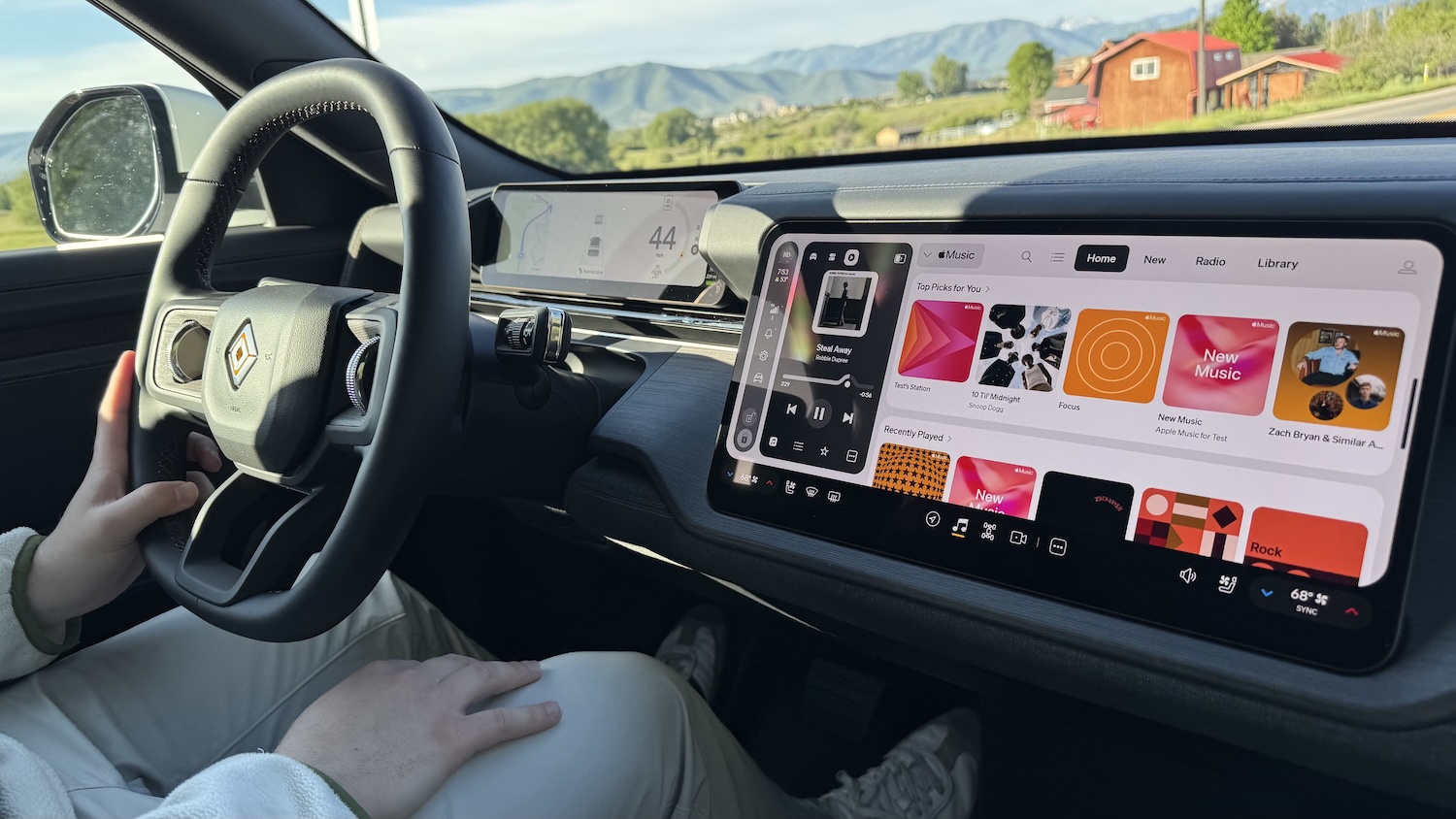
Unfortunately, Rivian didn’t have any base-model R2s for journalists to drive, so I hit the road in a white Performance Dual Motor R2. Right away, I noticed a vibrant screen that seemed to work fine for my needs despite its lack of Apple Carplay/Android Auto:
The cameras were crisp:
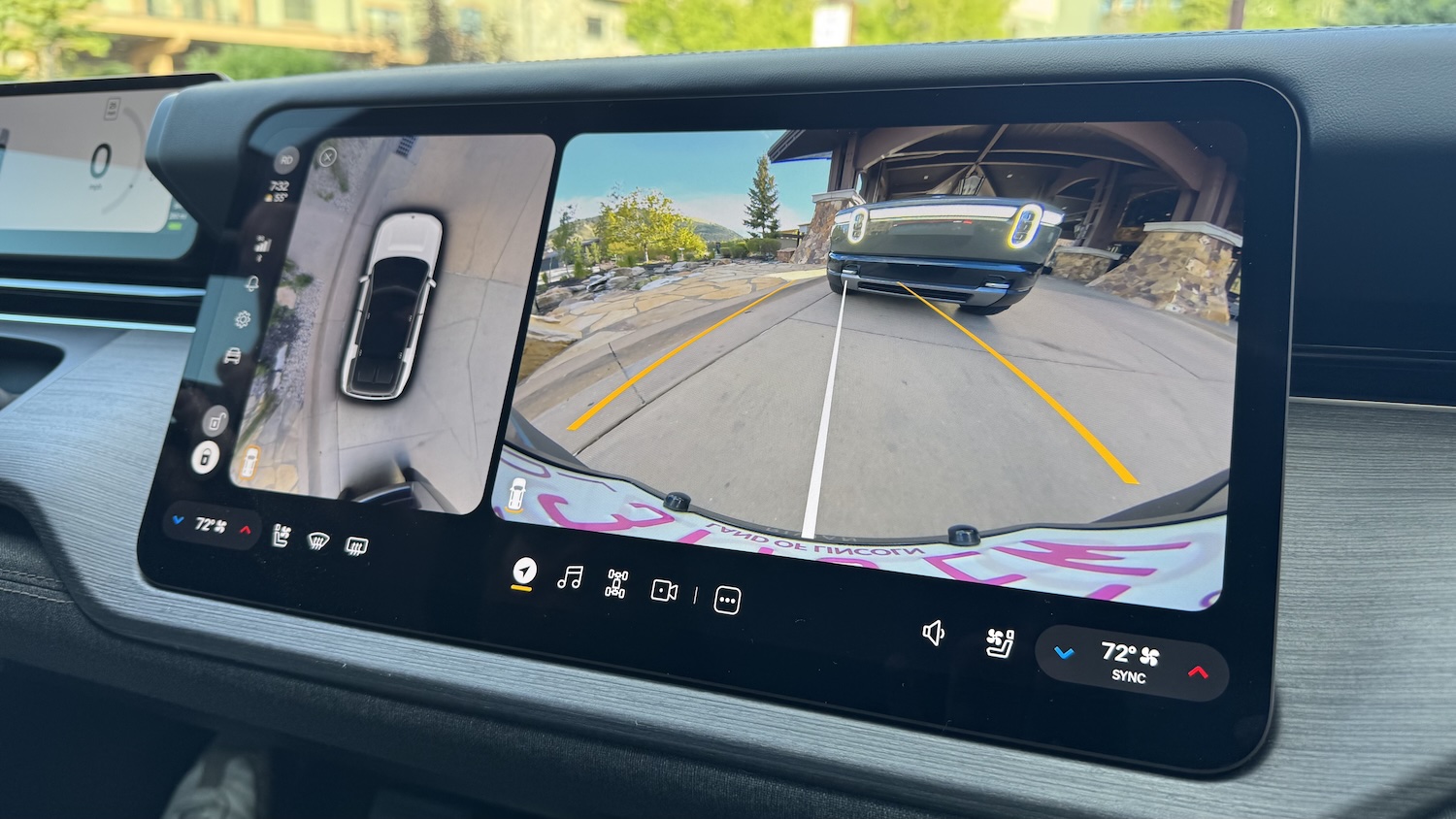
And the shifter — a column-mounted unit — is simply the best in the automotive industry. It’s out of the way and not taking up any storage space; pull it down, and you go into drive, engaging your front camera if you want it on; push it up and the reverse camera engages instantly. If you’re pulling out of a driveway in reverse, you can just let off the accelerator, tap the shifter, and hit the accelerator pedal; far too many cars require brake application and far too many cars have a lag in their cameras when shifting. Rivian understands that we all just want to put the car into drive while rolling backwards, and we all want those cameras right now.
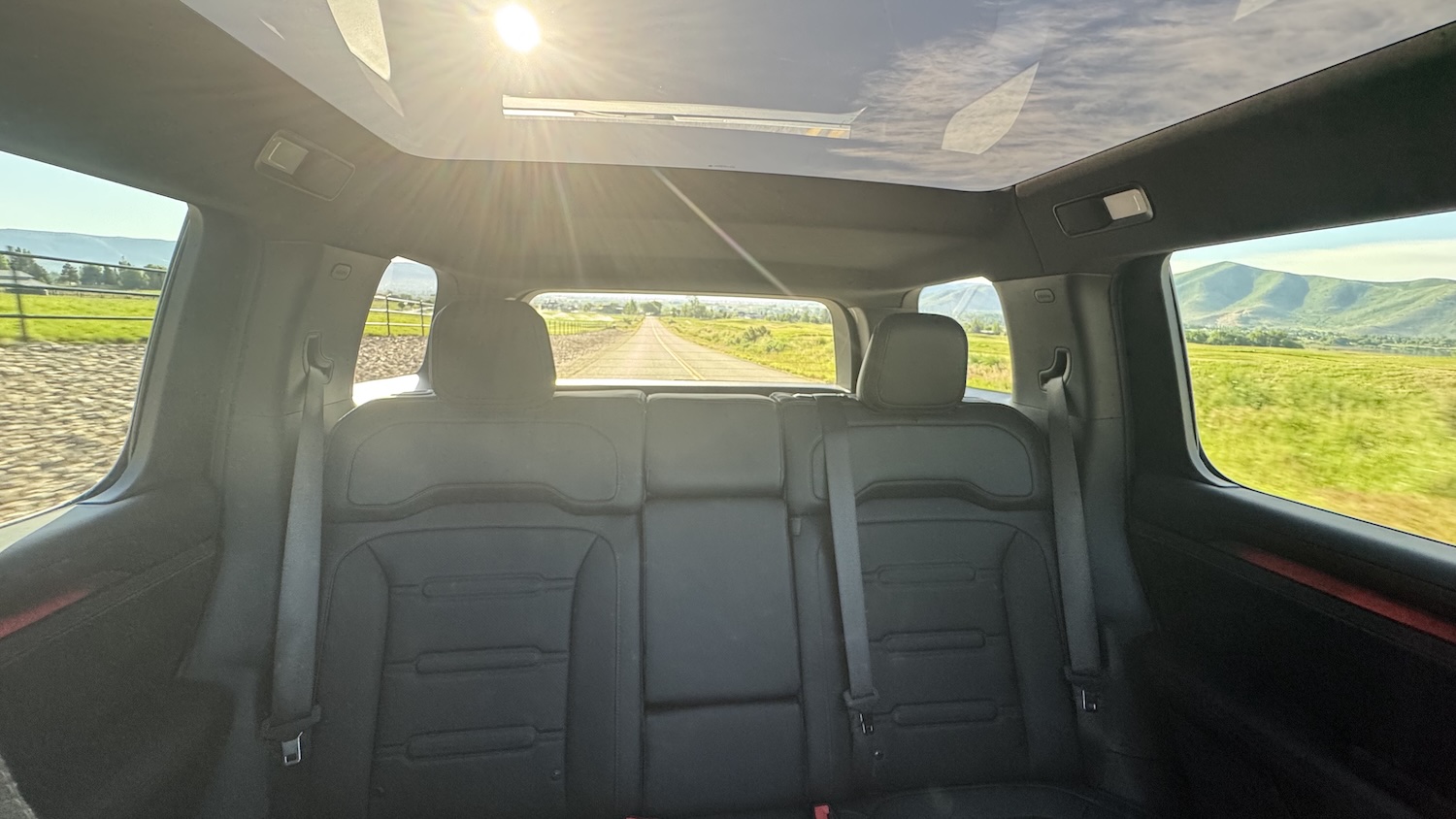
Once my drive partner and I pulled out of the hotel drive we found ourselves on beautiful mountain roads surrounded by Utah’s lush greenery. It was a beautiful, sunny day, and my partner and I could enjoy every bit of it through the R2’s lovely greenhouse. Visibility in the rear and out front is absolutely fantastic for a car made this decade.

On the wide-open valley roads just before the twisties Rivian was sending us to explore, I jotted down a few notes about the ride. First, there was seemingly no wind noise — like zero. This was astonishing. There was some road noise, but it was far from egregious. As for the ride, it was decent. Without instruments on hand, I can’t really quantify how it compared with the R1S, but, to me, it felt like the R2 was allowing more high-frequency imperfections to travel through the chassis and against my spine. Again, it wasn’t anything grievous, but I didn’t feel that it quite glided like a magic carpet, regardless of damper settings.
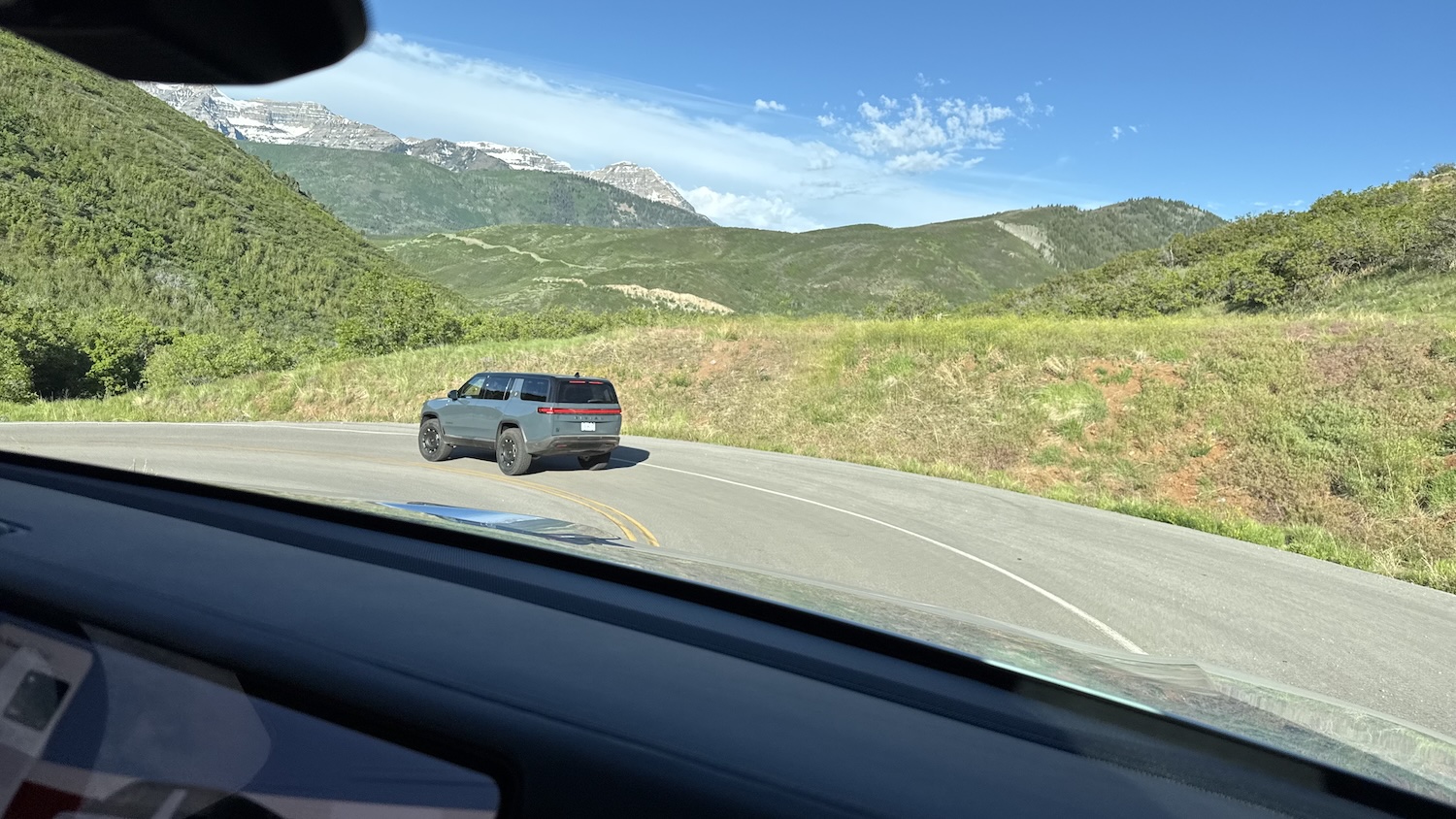
It wasn’t long before we were carving canyon roads and making those 255/55R21 Pirelli Scorpion MS all-seasons howl. If you want an extremely detailed description of the R2’s handling performance, that’s something for the Jason Cammisas of the world, as I’m far from a track driver, but suffice it to say that, with the big sidewalls on the R2 and the lack of a fancy sway bar system like in the R1, turning into a corner was followed by tire noise, a little bit of lean, and eventually understeer. Could you probably use the accelerator pedal to get the tail to swing out? I have no idea; I’m not trying that on public roads.
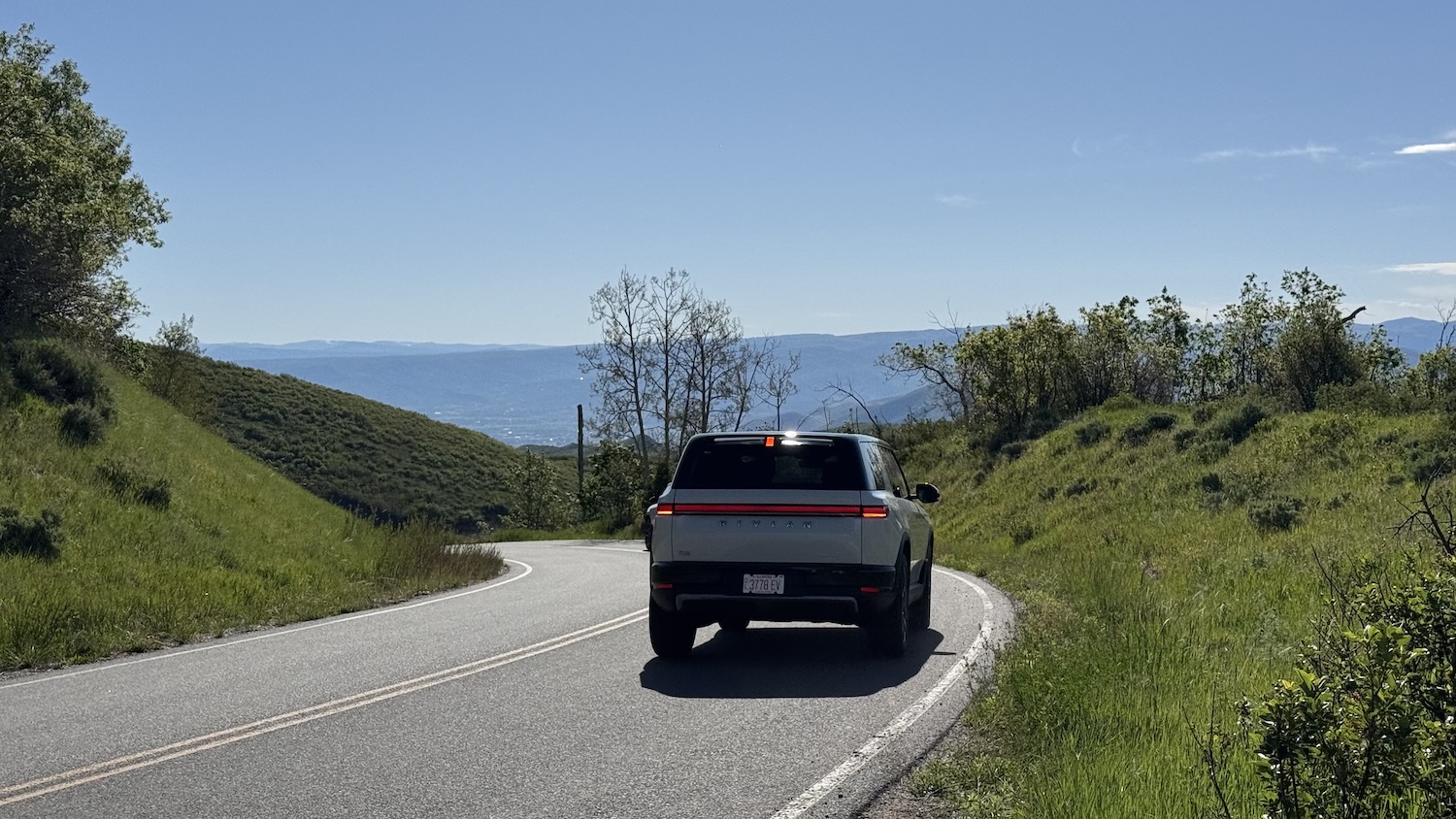
The R2 is lighter than the R1S, but that doesn’t mean it’s a sports car. 5,000 pounds, a MacPherson strut front suspension setup, good ground clearance and big sidewalls is hardly a formula for precision, but I still hustled the SUV through those winding roads and had a fun time. I’m sure the average person buying this thing will be pleased enough with the handling.
Ditto with the acceleration. A 656 horsepower powertrain offering a 0-60 MPH time of 3.6 seconds is still insanely quick, despite the fact that many EVs are quicker. Watch the video above, and you’ll see that the speedometer climbs hilariously quickly without that much indication that I’m accelerating that fast — it’s a drama-free hustle that only an electric vehicle can offer.

I tried Rivian’s Universal Hands Free system, not realizing that it does not stop at traffic lights/signs. Let’s just say: I put those bright yellow brake calipers to the test, and they passed. The system, at least as equipped on my R2, seemed fairly simple, offering the capability of an adaptive cruise control system coupled with a lane keeping system. Apparently the system also does lane changes, and automatic parking is on the docket, and there’s even more in the pipeline. Each Rivian R2 features a provision for a LIDAR unit in the frontmost roof crossmember.
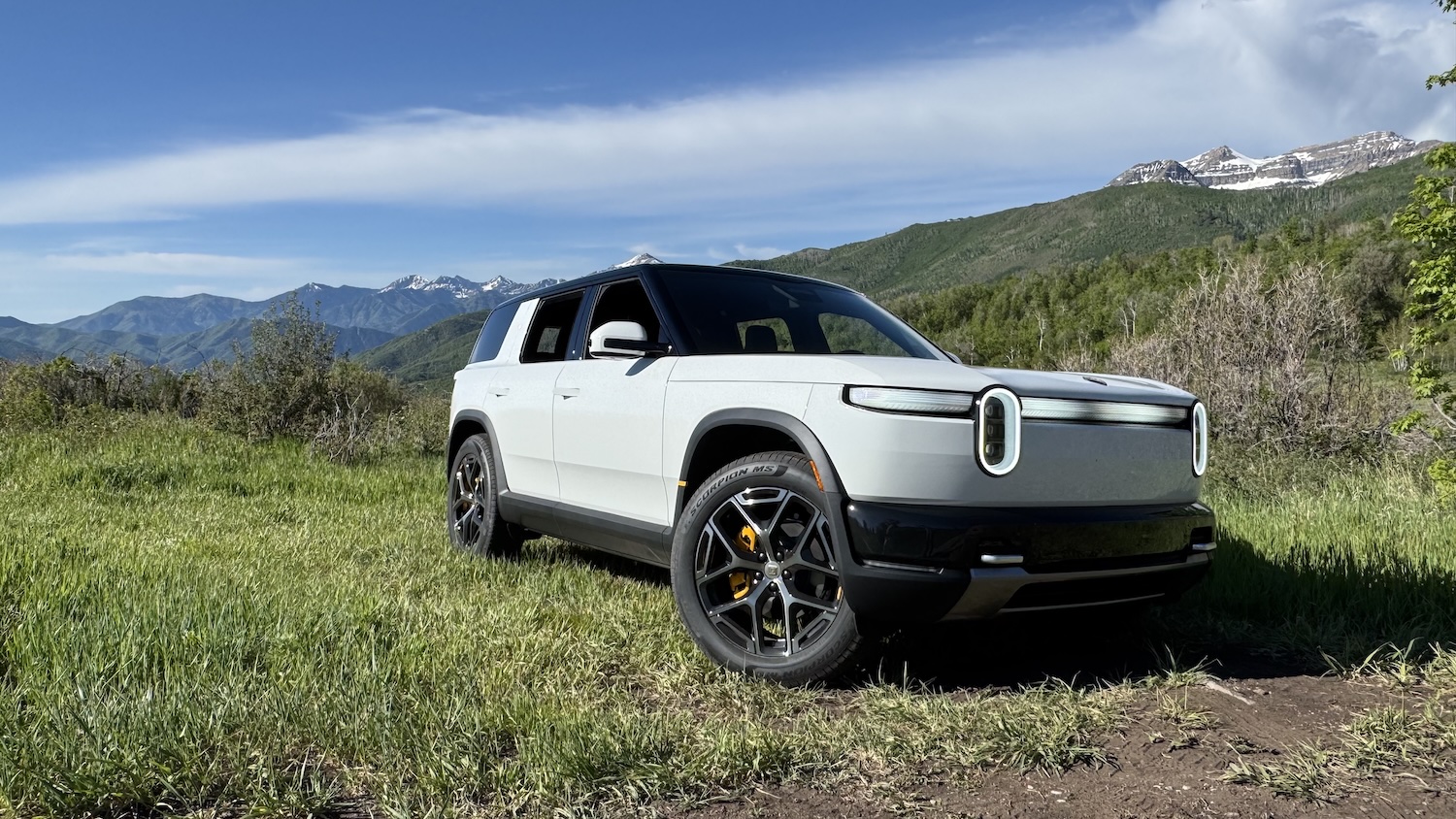
The last two on-road driving notes I see in my book are 1. the steering radius is fantastic and 2. the HVAC very much is not.

The temperature was roughly 85 degrees outside, and my drive partner and I found ourselves sweating. I, generally, am not sensitive to heat, having driven far too many junkers without AC in my day. But it was clear that the R2 we were driving just wasn’t as comfortable as it should have been, so we adjusted the AC controls and turned everything to max cooling. The fan was up, the temperature was down, and yet my head continued to sweat:

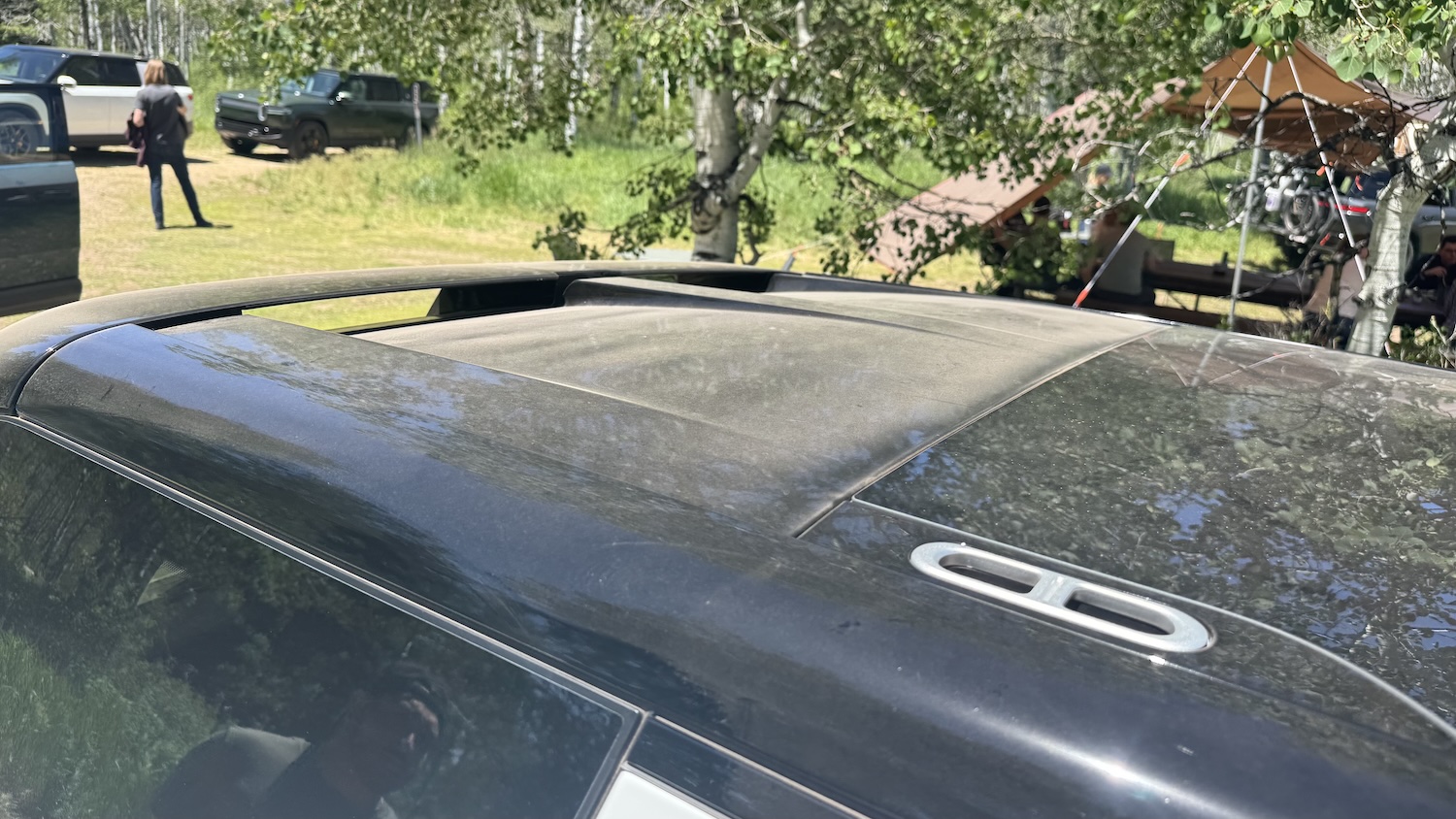
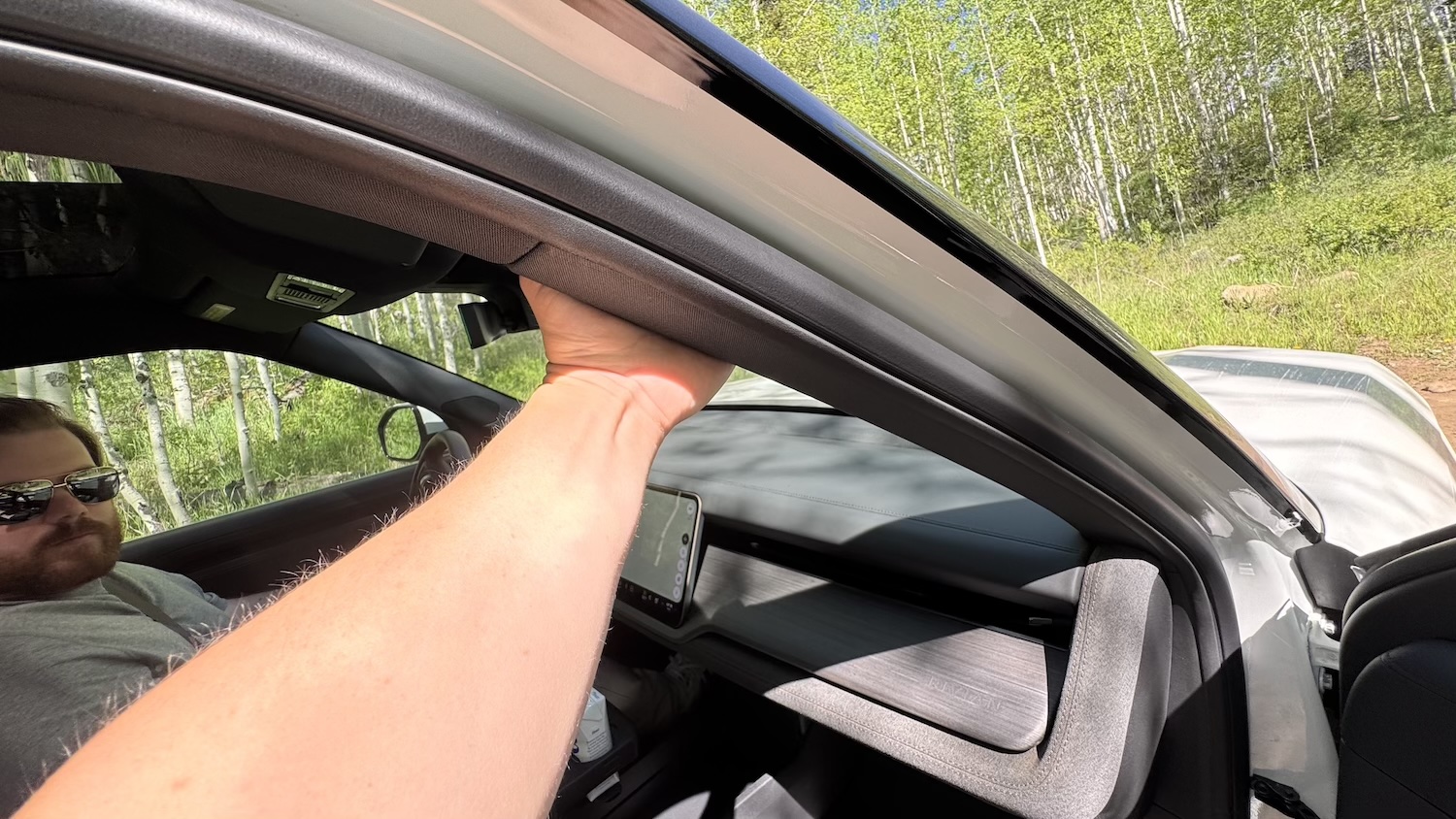
Here I am reaching for the moonroof, curious if the solar load coming through that was the culprit:

I suspect that some ceramic coating on that roof might help, but the bigger issue is that the AC seemingly could not keep up with my cooling request. CEO RJ Scaringe told me the company is planning to increase front-passenger air volume through the vents, so it sounds like they’re aware of the issue.
Let’s get to the off-roading.
Off-Roading
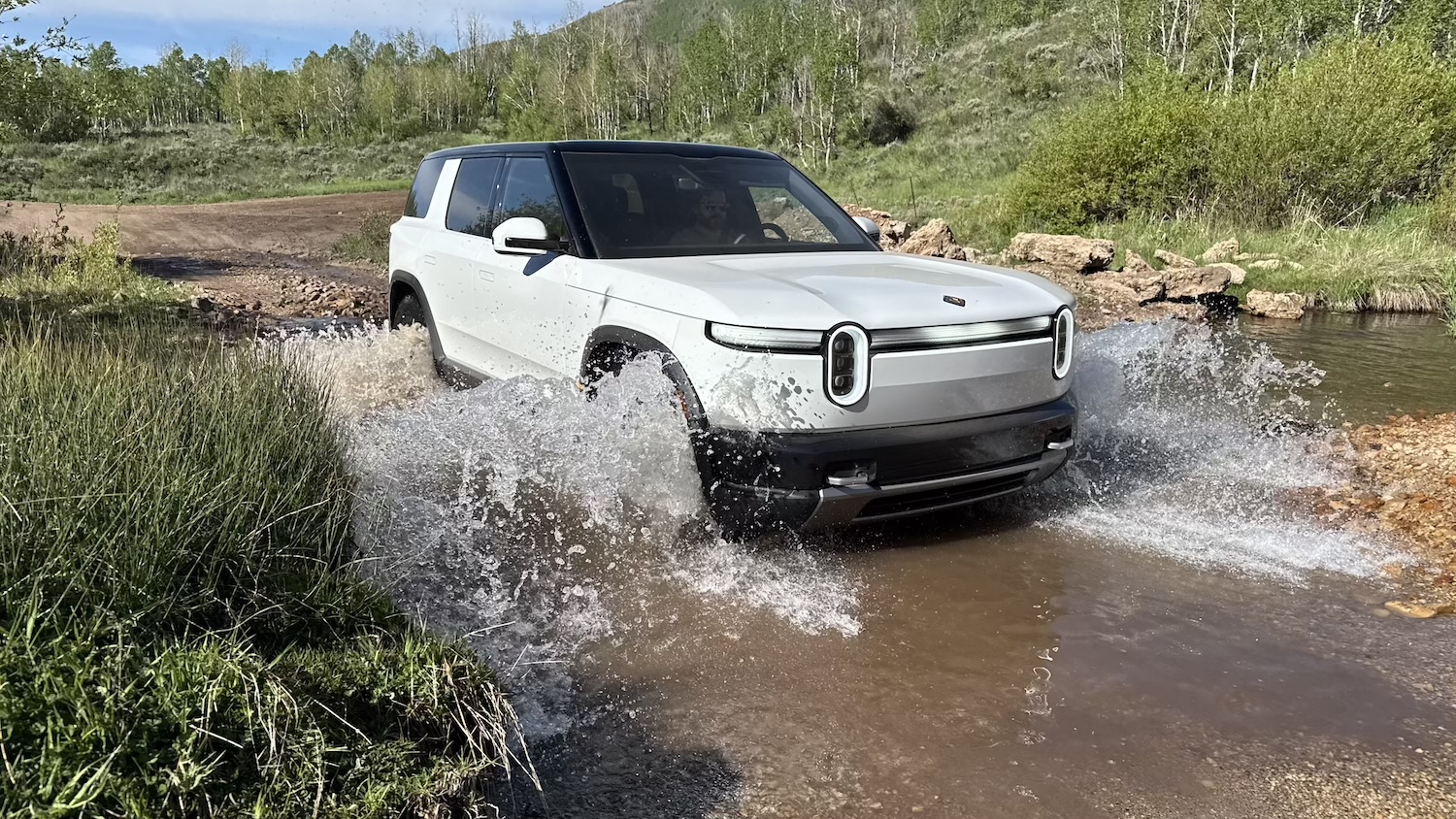
The Rivian R2 isn’t amazing off-road — let’s just get that right out of the way.
The most important attribute of a competent off-road vehicle is favorable geometry. That means good ground clearance to drive over obstacles, short overhangs so the front and rear tires can get up onto grades before the bumpers hit, and a small belly so the vehicle doesn’t get high-centered. And on the geometry front, the R2 is just OK. Its approach angle of 25 degrees is acceptable, as is a 26 degree departure angle and a 20.6 degree breakover angle caused by a rather large 115.6-inch wheelbase.

These are closer to Subaru numbers than they are to Jeep Wrangler/Ford Bronco figures (aside from the breakover numbers, which are bad on all of these four-door vehicles), and they’re certainly not Rivian R1S numbers. The larger Rivian, thanks largely to air suspension, has a roughly 35 degree approach angle, 30-ish degree departure angle, and 26-ish degree breakover angle. What’s more, the R1S has nearly 15 inches of ground clearance compared to the R2’s 9.6 (note that the location of the minimum ground clearance matters as much as the number itself).
The R2’s geometry wasn’t an issue on the rocky mountain trail Rivian sent us on, even if there were a few times that the nose got close to the terra firma:
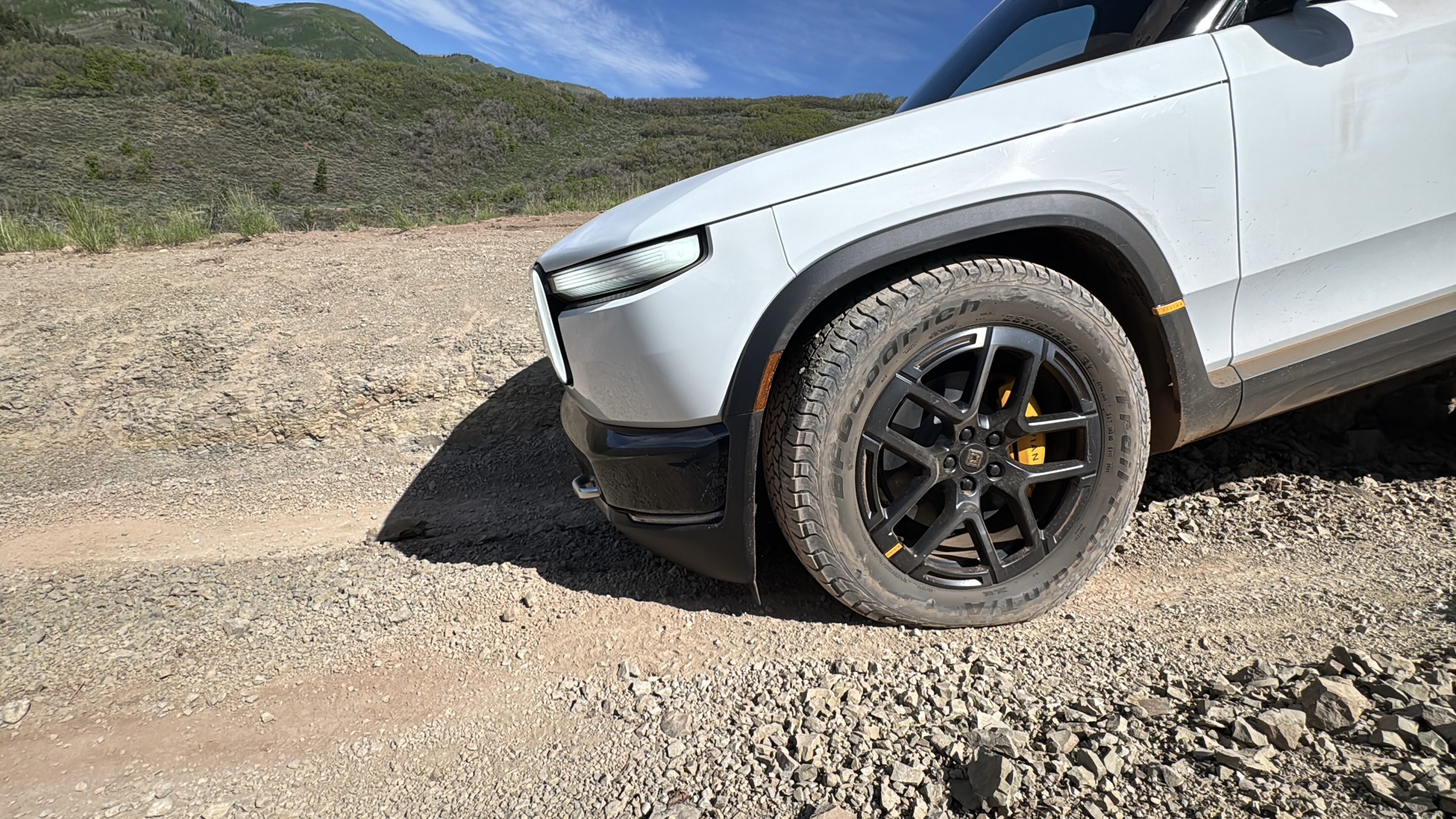
And the belly, too, sometimes managed to get down close to the dirt:

But it really wasn’t the geometry that was a problem on these mild trails. The only areas that seemed to be challenged by the terrain were the suspension and the four-wheel drive/traction control system.
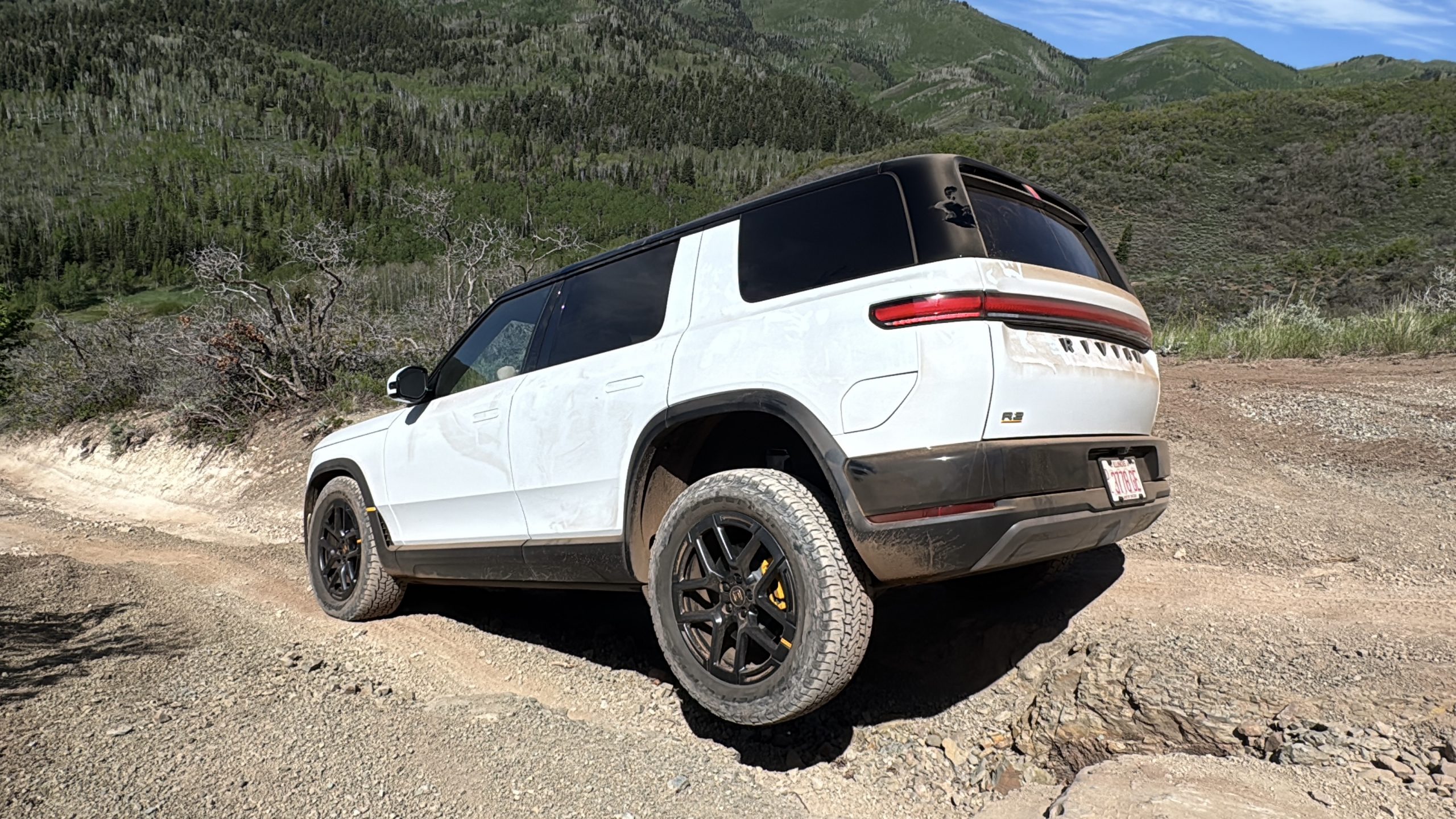
The Rivian R2’s fully independent suspension does not articulate well, and the result of this is that, all too often, those BF Goodrich Trail Terrain T/A tires found themselves trying to grip air instead of rock/dirt. This is a problem because a tire that’s not on the ground cannot assist with propulsion or braking — two things one generally wants to do while off-roading.
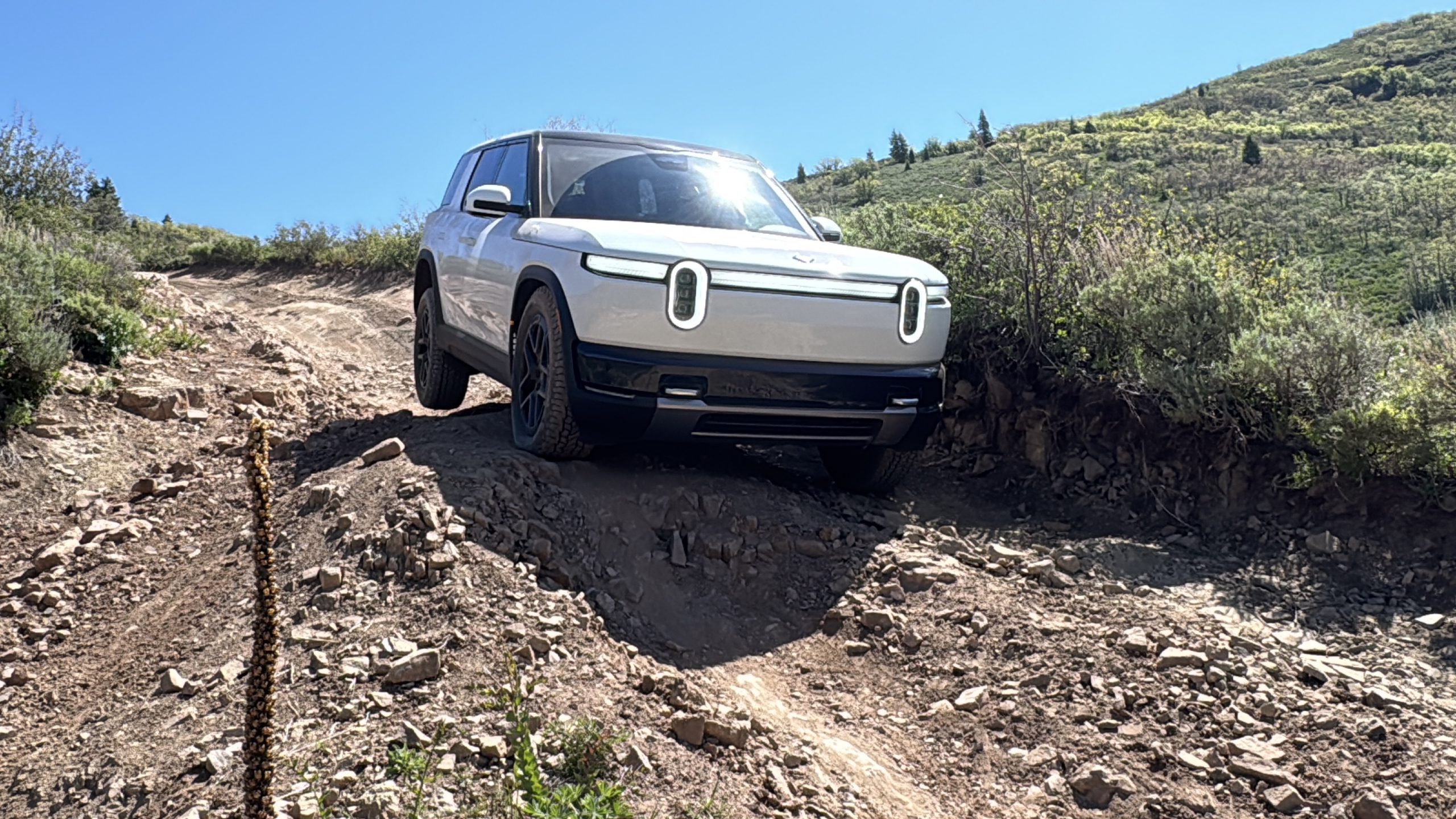
This lack of articulation did not pair particularly well with the R2’s traction control system, which makes do with open differentials front and rear, whereas the R1S can be had with three or four motors — setups that allow for lightning quick torque vectoring on the rear axle. The R2 utilizes what some call a “Brake Lock Differential,” which is basically just strategic application of the brakes to force torque to the wheel on the opposite side of the axle. It’s rudimentary, but usually it works well enough, and has been found on Jeep Wranglers since at least 2007.
The R2’s system isn’t perfect. I noticed something a bit odd when trying to mount the rock you see in the image below:
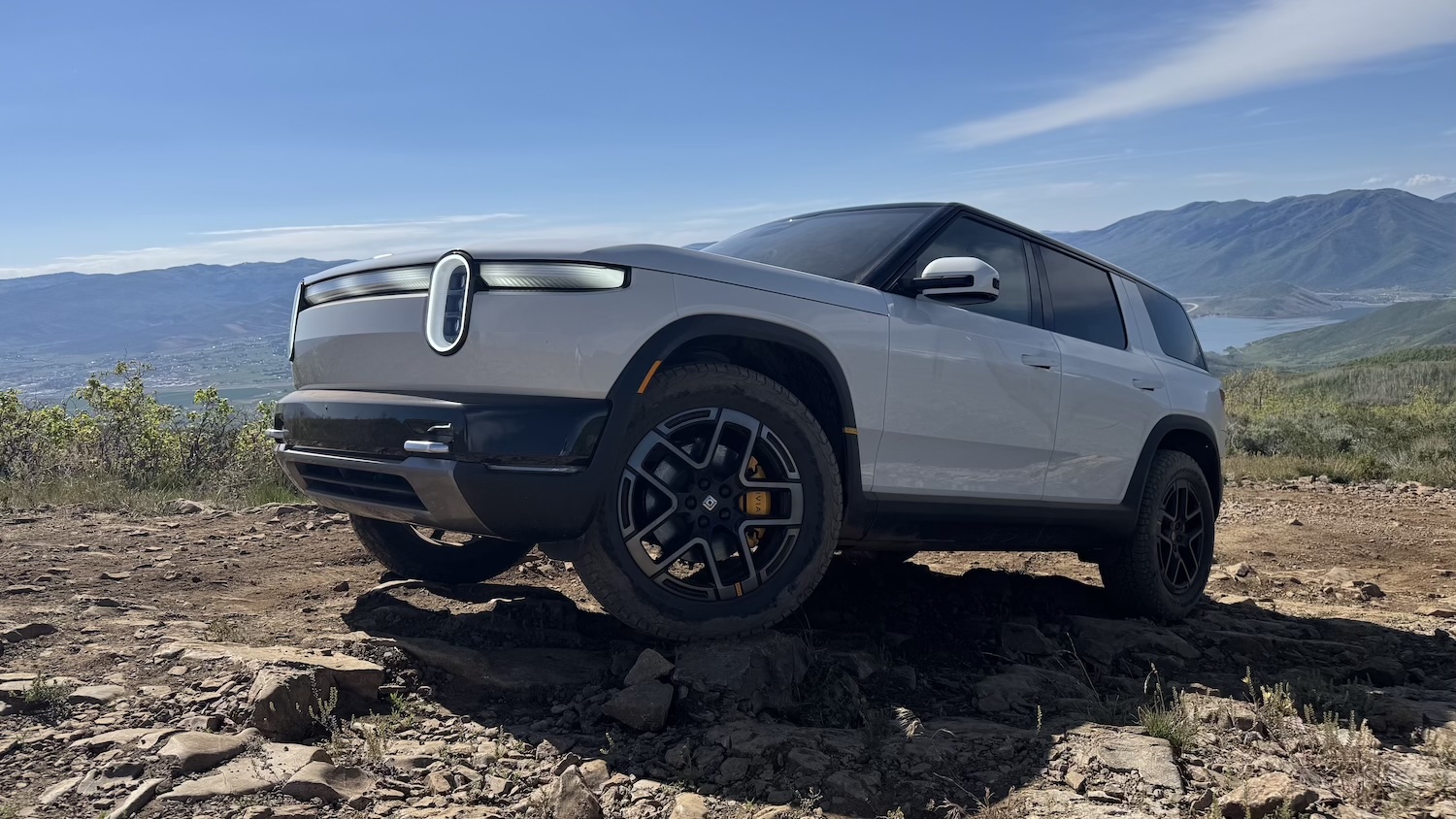
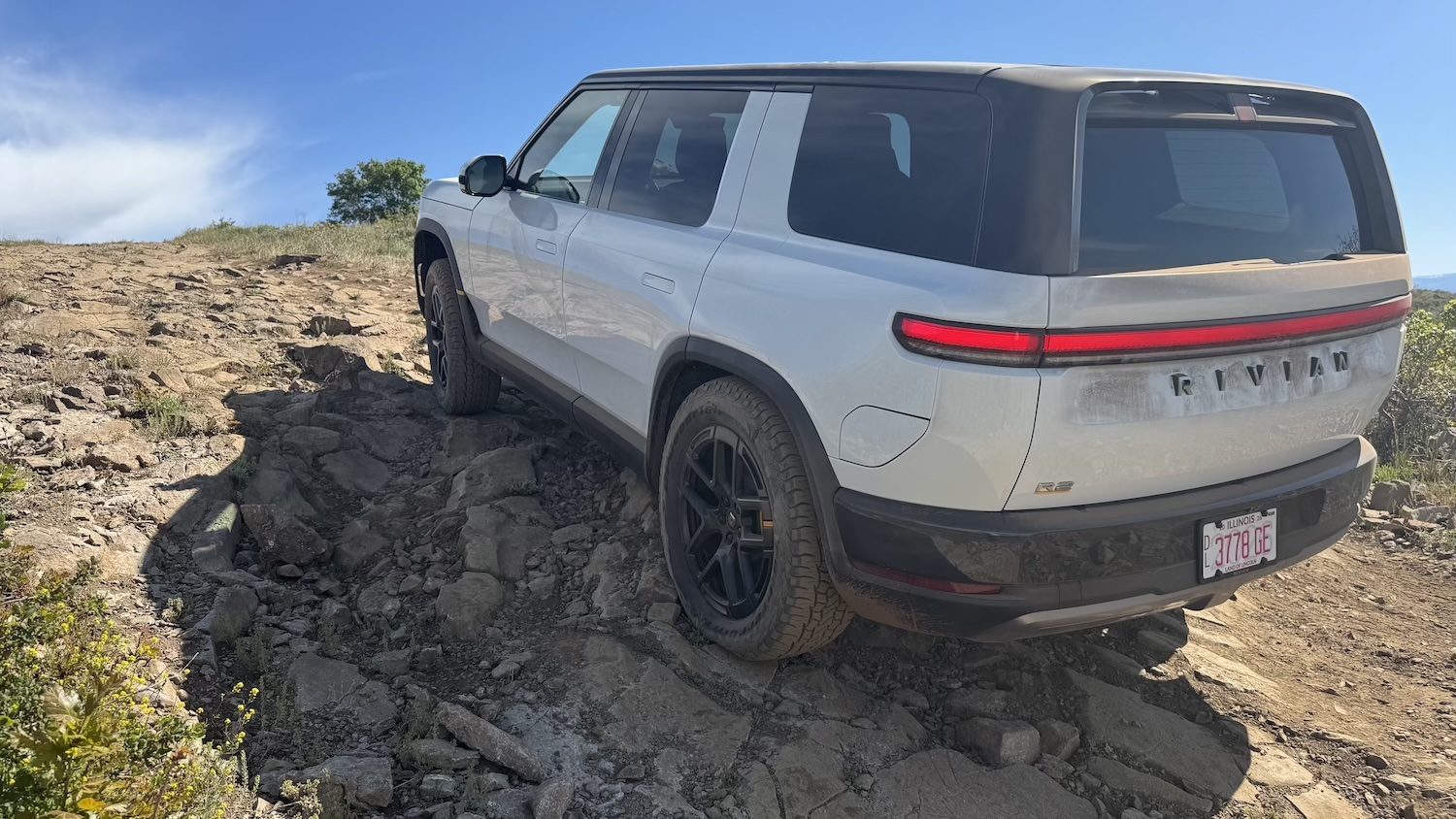
What happened is that, for reasons unknown, only that front left tire seemed to be spinning, while the others were stationary. But that tire was spinning quite slowly, so I pressed deeper on the pedal. I still wasn’t climbing the little rock, so I pressed harder, and harder, and eventually the tire got grip and tried launching the car up and over that rock.
I was able to get on the brake and prevent an overshoot, but the point is that I felt this little climb shouldn’t have been that challenging, especially given that the tires were aired down. That rear axle should have had plenty of grip, and it should have helped propel the vehicle up onto the rock with ease and control.
But this is a challenge with EVs. They’re heavy, they pretty much always feature fully independent suspensions that don’t flex particularly well, and because of the nature of having multiple completely separate drivetrains (two in this case; the R1s have four), you’re limited in how much of the overall system torque you can send to a given wheel, plus the drivetrains have to communicate with one another and with the driver understand vehicle linear speed, driver desire, and on and on. It’s a lot more challenging to develop than, say, a fully-locked drivetrain on an internal combustion engine vehicle.
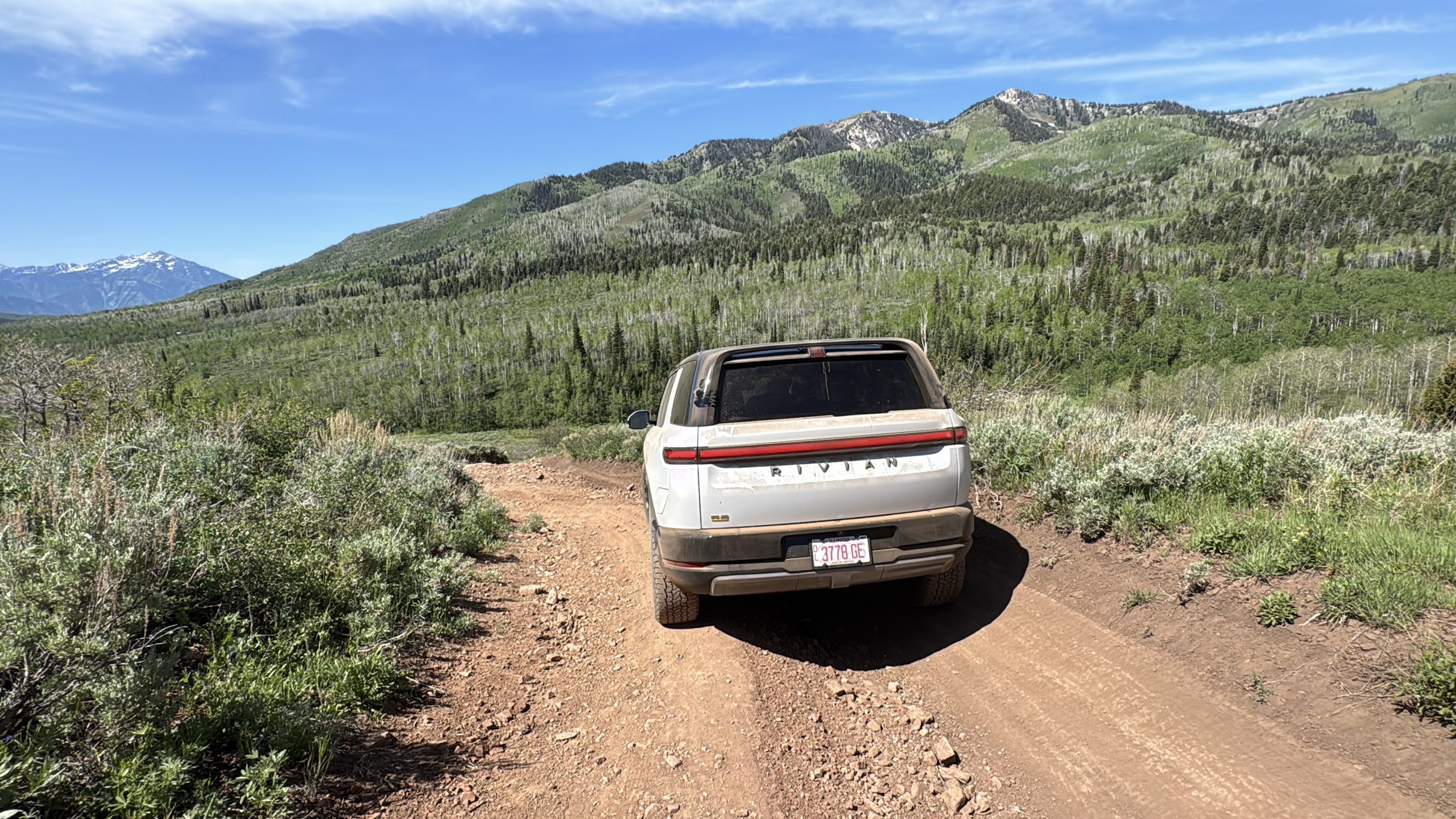
If you look at the video in this section, you’ll see that, climbing down fairly modest rocky trails, the tires would often lock up. This seemed a bit unusual, but it was a result of limited articulation and the driver trying to maintain a certain speed downhill. I have seen similar behavior when using hill descent control over a particularly bumpy, steep downhill grade, though this was a fairly modest trail and not that steep.
I also should mention that, while traveling down these loose grades, my drive partner and I attempted to park in order to switch positions, but we were unable to. We threw the shifter into park and went to open the door, only to notice the vehicle sliding down the grade!
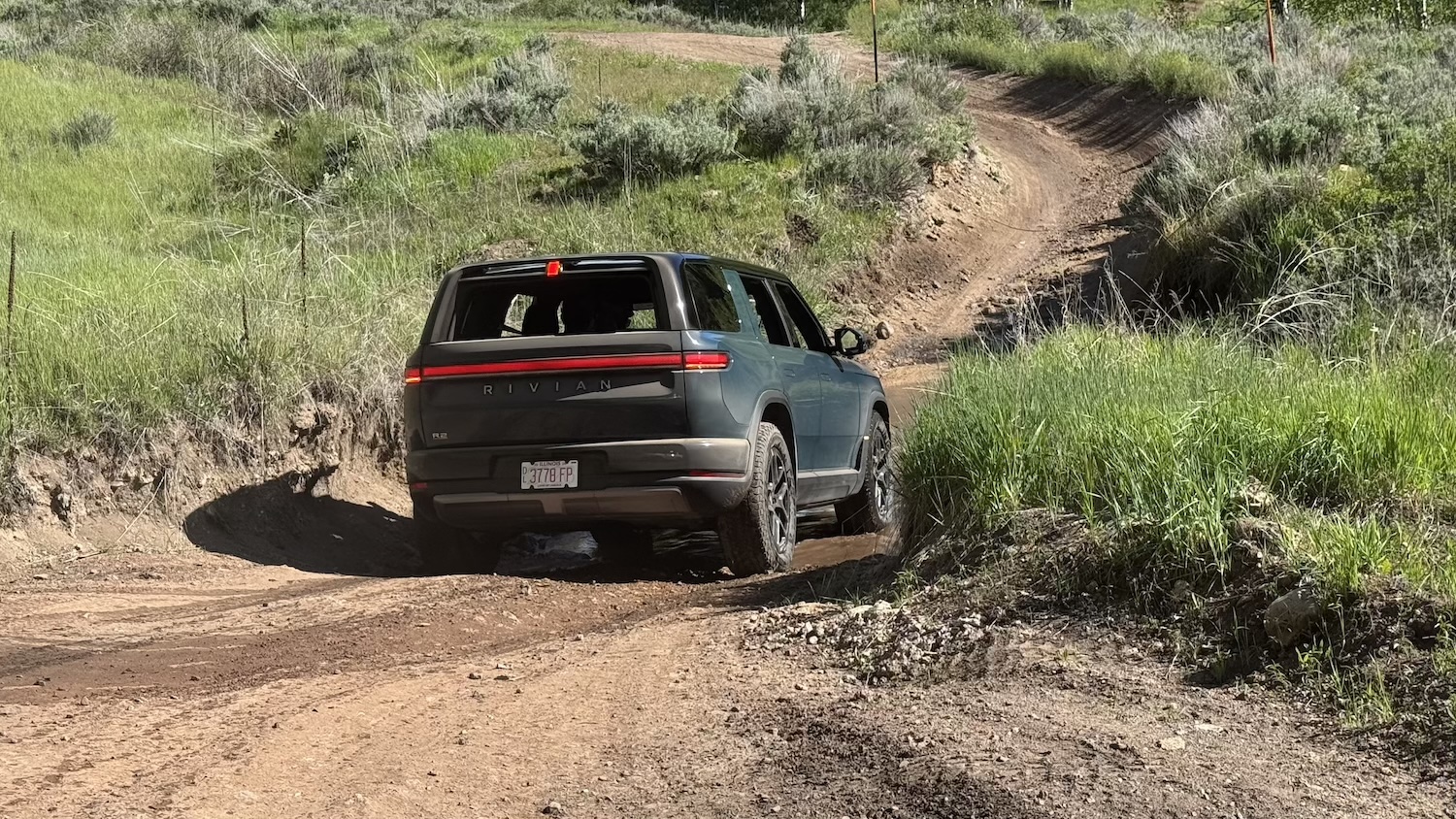
We actually had to drive to flatter parts of the trail in order to park the vehicle because the Rivian R2 (and I’m fairly sure the R1S as well?) only uses caliper-mounted motors to brake the rear wheels. As you can imagine, on a grade, that heavy battery pack tends to just pull those locked rear wheels, while the front wheels do little to encumber forward motion. The inability to park on such a modest grade was something I had never experienced with a four-wheel drive vehicle before.
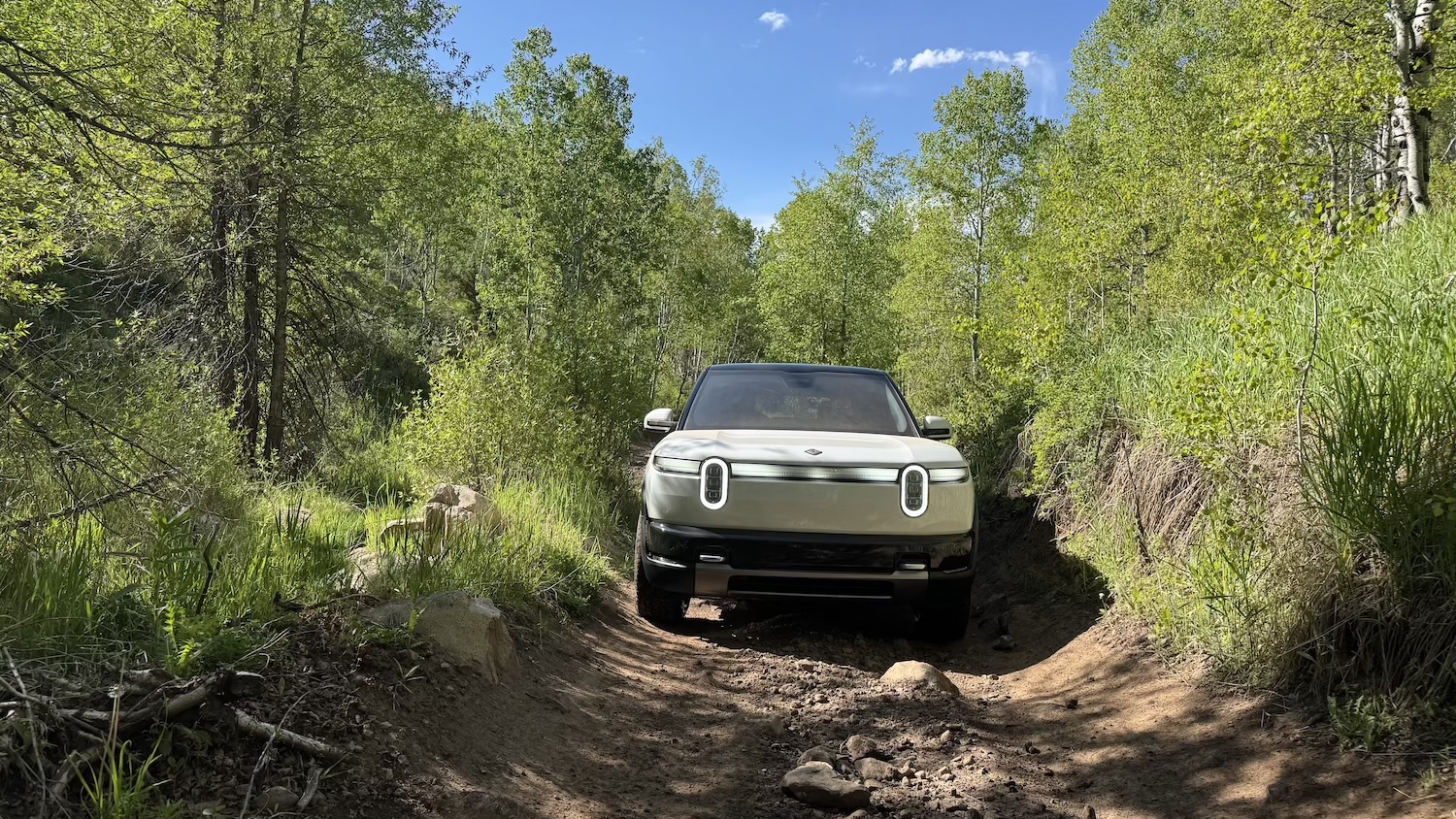
So the R2 has its off-road limitations, but it still got us to the top of our trail, and for most folks who want a vehicle with Subaru Wilderness/Jeep Cherokee-levels of capability, the Rivian definitely delivers, while also offering decent on-road range. It’s pretty much the only vehicle in the space that can do both.
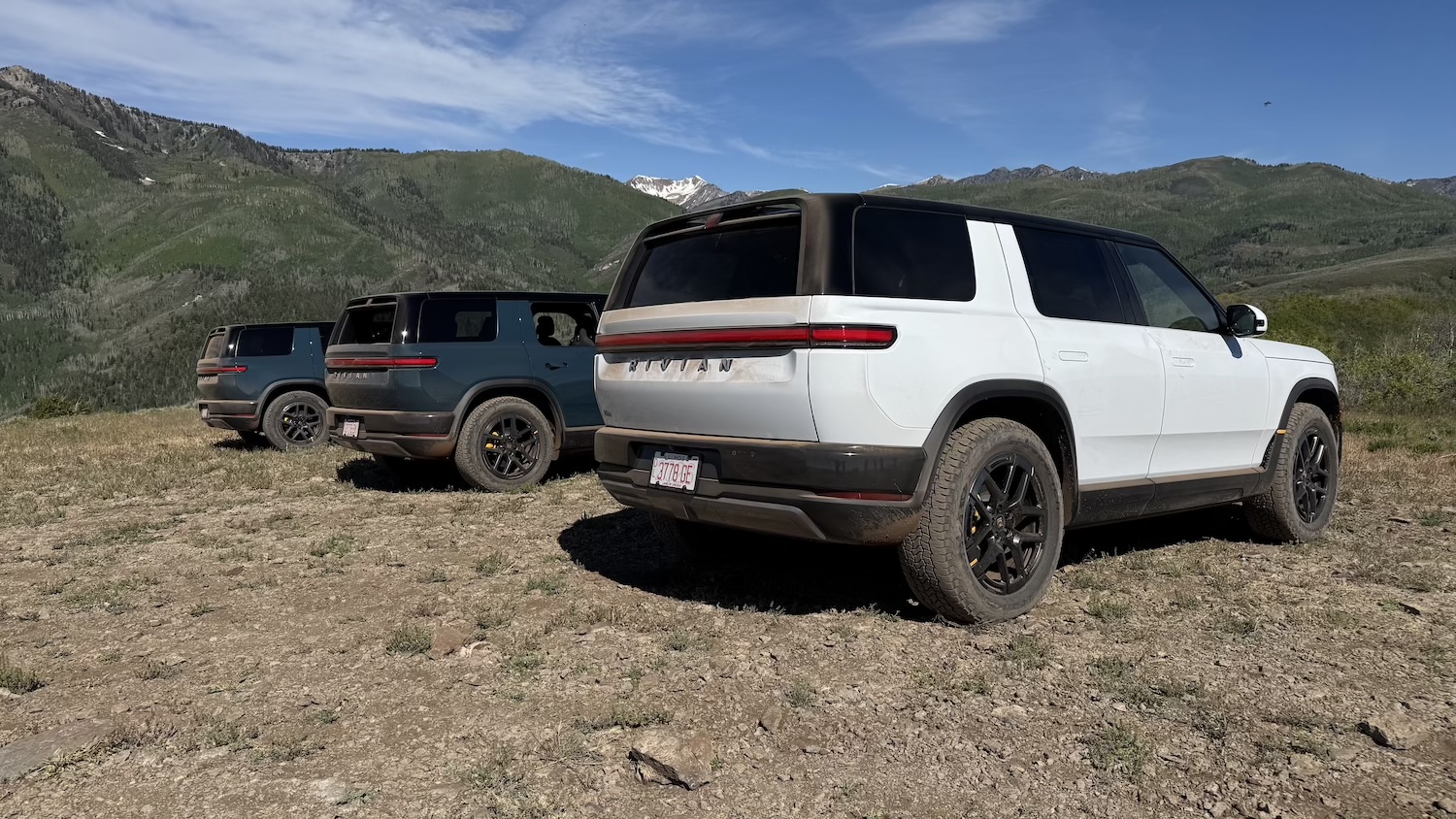
Before I conclude this off-road section, allow me to just say that I wish the R2 had any interior grab-handles whatsoever. It’s a small thing, but especially off-road as a passenger, it’s something you notice.
It’s not that I really need it to get into the vehicle, given how low the R2 is, but to stabilize my body as the vehicle bounces over obstacles, a grab-handle tends to be clutch.
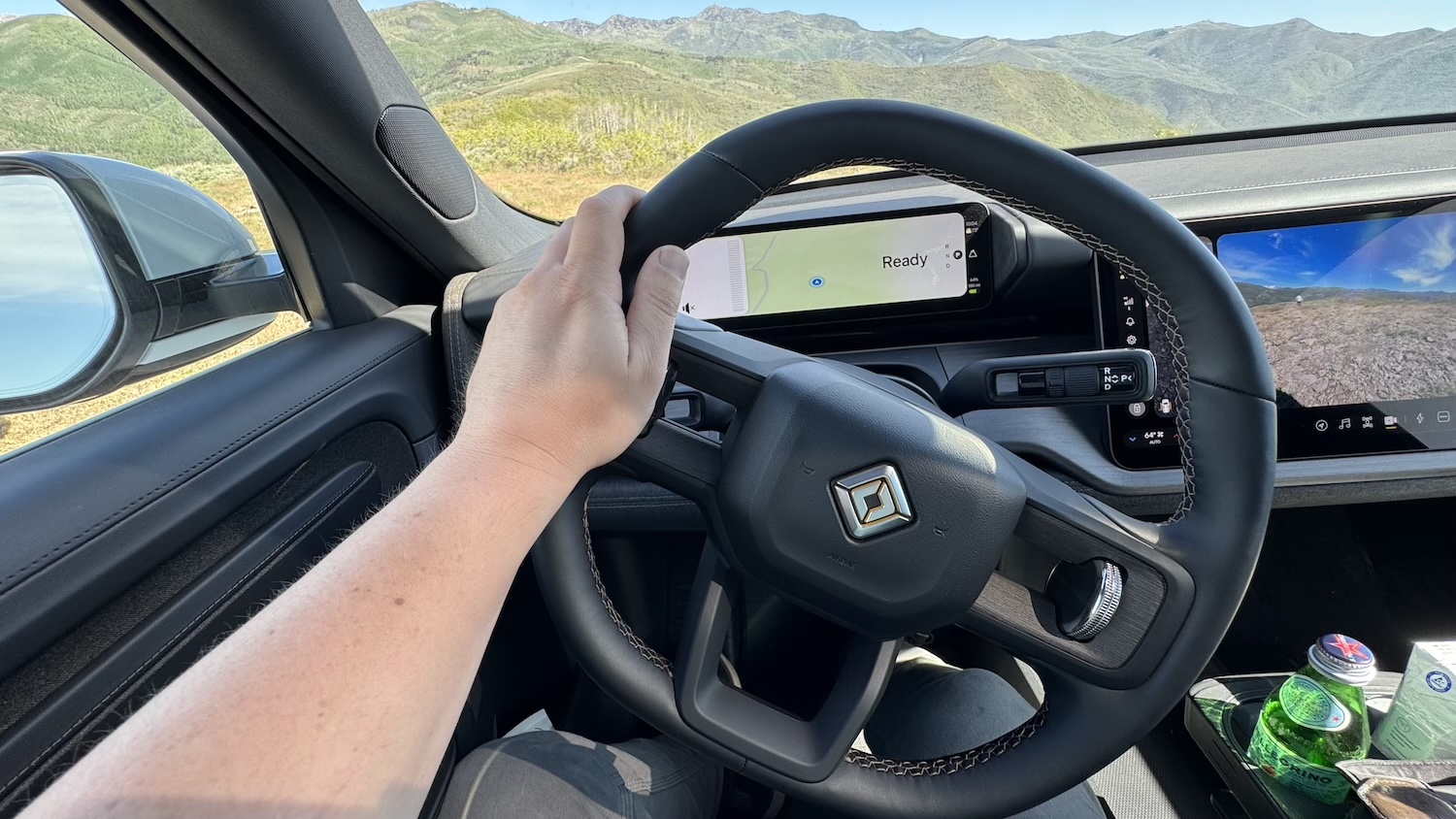
I also found myself accidentally activating those haptic halo wheels as I turned the steering wheel off-road. How big of an issue that is and if, as an owner, I’d change my behavior to avoid doing this, I don’t know.
Conclusion

Right about now, a bunch of media outlets have probably published that the Rivian R2 is a “game changer,” and I won’t lie: My initial headline was similar. But the truth is that I don’t know how to feel about the Rivian R2.
It doesn’t look that special inside or out (especially compared to R1), its range and acceleration figures aren’t mind-blowing for the segment, its off-road capability isn’t amazing, and its pricing isn’t exactly the cheapest in the midsize SUV segment. Is this vehicle really going to sell in volumes that Rivian needs for it to fulfill the role of company-savior? Is there really that much demand for midsize EV SUVs, and how much of R2 sales will be cannibalizing from the R1? (Scaringe thinks the additional visibility all the R2s on the road will give the Rivian brand will ultimately raise all ships, so to speak, and prevent a drop in R1 sales).
I spent a large chunk of my day yesterday contemplating all this, asking around and trying to understand what is drawing so many people in. Why is a modestly off-road capable, shrunken R1 going to be a game-changer for the industry when this segment has competitors with similar performance figures?
The answer really comes down to two things. First and foremost, the R2 benefits from the heavy lifting the R1T and R1S have done over the past decade or so. The R2 isn’t a Chevy, it’s not a Kia, and it’s not a Ford; this is a Rivian, and to understate that would be foolish. This is a luxury brand that, despite being ranked near the bottom of Consumer Reports’ predicted reliability scale, finds itself at the top of that very outlet’s customer satisfaction poll. This is called the Rivian Satisfaction Paradox, and it underscores the strength of the brand.

Rivian put its heart and soul into the R1S and R1T, and while all that development cost the company billions, it also accomplished the hardest and most valuable task one can complete as an automaker: It built a brand. A robust brand. Exactly how robust the brand is about to be put to the test with the R2. We’re also going to learn about how much appetite there is in the market for a cool EV SUV; Scaringe says EV demand is largely being held up by lack of choice; we’ll find out if he’s right.
I think he may be. I think the R2 may not be the cheapest vehicle in this segment, it may not offer the most range, and yes, its styling is derivative and its interior is simple. But it’s the combination of decent off-road capability with good range/efficiency, along with an unmatched cool-factor that will help it stand out in this segment.
I just wrote a 6,000 word review that contained plenty of criticism — the AC could be better, off-road performance isn’t mind-blowing, styling is similar to another car in the brand, the interior could use some switches, and on and on. And yet which car would I personally want to own in this segment? Would it be a Hyundai Ioniq 5? A Tesla Model Y? A Chevy Blazer EV? A Lexus RZ? Maybe a Polestar or a Volvo?
No, it would be the Rivian R2. Forget the spec sheet. The thing is just cool.
All photos David Tracy unless otherwise noted



Richard Hammond once said that American manufacturers design an A/C system and then build a car around it. We’re good at A/C, which is a good thing because we have this thing called “summer” that makes it rather hot here for much of the year.
Creating an A/C system that is as inconvenient as possible to operate while being unable to keep a vehicle cool on an 85-degree day should be disqualifying for buyers in a lot of this country. I’ve never felt offended at the sight of an A/C vent (the metal mesh-covered ones in my Integra are rather fetching, actually, as are the “eyeball” vents in the Miata) and I’ve never felt that turning a knob or pushing a button to adjust the temperature is an indignity to be endured.
Yeah, the 2 silliest choices here (IMO) are:
Hiding the vents makes zero sense. You do not see many cupholders in elegant homes yet Rivian made sure to include those.
If I were in the market for a $50-60K SUV, this would definitely be on the list.
Do I care about going off-road? No farther than the gravel driveways of some client’s homes – and that’s about the farthest off-road most of these will be driven, not up and down some hardscrabble, rocky hills. Which is why the suspension is set up the way it is – for comfortable, relaxed on-pavement driving.
The question I have is for vehicles which don’t have Airplay, etc – Can you send an address to the in-car Nav from your phone? Can you stream music from your phone? I’ve driven Mercedes and Polestar which have this – which I feel addresses the need for CarPlay.
Rivian just needs to offer a tinted wrap for the glass roof now – Or go with a deeper tinted glass in production.
On my wife’s EVquinox, the car just has google maps logged into her account. So if she looks at an address on her phone before she gets in the car, when she goes to google maps in the car it shows up as the first on the search list. But it does not, as my car does, automatically start a route that you have up one your phone because it isn’t mirroring your phone. It’s basically just another device linked to your google account.
Huh, I have maps history turned off, so I guess it would be fresh every time. Does it have access to Google calendar?
I think so – so you could have a calendar event setup with an address you can probably pull that in.
yes, you can use Spotify from your phone in Rivians, it’s easy.
I’m guessing this is why you worked in engineering rather than marketing.
The R2 seems nice, but I don’t think I could buy one. After reading this I can’t help but view it is a poor man’s R1S. It looks nearly identical to an R1S, but does several things worse (I can’t believe the AC struggles with a mildly warm day or that the vehicle has trouble parking downhill) and nothing better.
Overall, I think Rivian might have erred in making it too similar to the R1S. I wonder if they should have built the R3 first? It is fine for a manufacturer to release a vehicle that is different from the brand’s halo product, but it seems problematic to release a vehicle that is worse than the halo product.
I think it will probably sell fine, though. It might be inferior to original, but it is substantially cheaper. It maybe isn’t a poor man’s R1S, but it is an upper middle class man’s R1S – that is probably a win. I would opt for a used R1, though. The R1 is better and new vehicle warranties are overrated. Plus, a new R2 is going to be a used R2 in a few months anyway – you may as well let someone else eat the depreciation.
Exactly why it will sell. This is their Model 3.
I agree – like I said above, this thing will sell fine because it is cheaper.
I’m not sure the R2 is in the same situation as the Model 3, though. I have no idea what Tesla’s original intentions were, but it became clear early that the Model 3 was more of a successor to the S than a separate product. There never were substantial functional differences between the 3 and the S.
The problem is that the R1 seems superior in ways people will actually notice (better ride, better off road, better AC, more interior room, etc).
The R1 is clearly better than the R2, but it probably isn’t worth the extra cost. The R2 is clearly more affordable than the R1, but buyers will never forget they bought the inferior model. I could see this complicating the futures of both the R2 and the R1.
The Model 3 is definitely smaller than the Model S and was less powerful. When the Model S launched, it was so early in the EV development race that they couldn’t afford to equip it with fancy stuff like air suspension, plus they could get away with it. Model S development focused a lot on maturing the cost, range, and efficiency, while R1 development focused on ‘fun’ stuff like the quad-motor’s off-roading prowess much earlier on in its lifetime. If Tesla ever bothered bringing a second gen Model S, it’d likely be a lot like the Lucid Air which has several big differences similar to the Rivian R1 vs R2.
I personally think sales of the R1 are going to decrease by a lot, but the R2 will probably do fine as long as they can attract Tesla owners who aren’t put off by a lot of their shared shortcomings.
The Model 3 interior is minimally smaller than that of the S, though, even if the exterior dimensions are substantially different. Also, at this point the nicer versions of the Model 3 are extremely powerful, even if the some versions of the S are even more so. Again, the experience of driving a newer S vs a newer high-spec 3 isn’t much. When launched, though, the differences were greater.
I’m mostly surprised Rivian launched a second model instead of making a cheaper version of the R1S. It seems like a lot of effort to create an entirely new model just to create a vehicle that is similar in dimensions and appearance but with a few less luxury features/fancy off road bits.
I suspect the R1 will go the way of the Model S in a few years, though – that isn’t necessarily a bad thing. The Model 3 is a substantially better value than the S; I suspect the R2 will be a substantially better value than the R1.
For me, though, the R1 and R2 are something of a catch 22 – I wouldn’t buy an R2 because an R1 is similar but substantially better, but I also wouldn’t buy an R1 because an R2 is similar but substantially cheaper. I may literally be the only person with that opinion, though. I agree with the majority that the R2 is going to be a big seller.
It takes a lot of effort and a lot of engineering to produce a car that has $30,000 lower MSRP! Hence the entirely new model. Also, the exterior dimensions are in an entirely different size than the R1S. If they had simply took the R1S and made it cheaper, it’d be at least $10k more expensive than the R2 and would just straight up lose the comparison to the BMW iX3, Merc GLC EV, Volvo EX60, etc outside of extreme off-road performance (niche) and looks (subjective).
They’ll keep the R1 around for a while as their halo vehicle, but likely without much updating.
It takes a lot of effort and a lot of engineering to produce a car that has $30,000 lower MSRP!
Fair point – I’ll definitely give you that one. I keep forgetting how much cheaper this thing is. A ~35% reduction in MSRP is genuinely impressive. I also presume profit margin was a bigger concern with the R2 than the R1 halo car – it would be interesting to see how much cheaper it actually is to build an R2.
I thought the Model S launched with air suspension. They definitely had it at one point, but could’ve been later down the road.
I don’t necessarily agree that new vehicle warranties are overrated, but I concede I differ from many enthusiasts on that point. My main concern with the go get a used R1 option is that R1 seems to offer German luxury-car levels of complexity, combined with Rivian parts prices and availability. If you back into a pole, or the air suspension goes, you’re financially ruined.
Fair point – it does seem like repairability might be the main argument in favor of the R2. It seems like Rivian learned a lesson there.
As for new vs used, I will say Rivian did a good job pricing this thing. It may be inferior to the R1 but it is at least far cheaper. New vs used would be a harder decision if the difference in price were closer to $15k. A new R2 might not be a better value than a two year old R1, but a new R2 probably is a better value than a comparably-priced four year old R1.
I’m not a fan of warranties and I couldn’t care less about owning a brand new car, but I will acknowledge that “new” has some value in itself.
Def agree about the R3 – if that were coming out any time soon it’d be a strong contender to be my first/only new car purchase.
I really have no interest in Rivian outside the R3.
Regardless of what the Rivian guy said about rising tides lifting all boats, I suspect that Rivian is actually okay with the R2 cannibalizing the R1 sales because they want to move beyond being a niche luxury brand into a more mass market (and profitable) direction. The R1 will be like the Model S giving way to the Model 3 for Tesla.
$49,995 and you get faux-leather? Cloth please.
OEMs disdain for good cloth is infuriating. I don’t want vinyl, I want fabric.
Mercedes MB-tex proves that faux leather CAN be done well. It just often isn’t.
I see a hit here. While the Ioniq 5, Model Y, and EV6 are technically mid-size SUVs, as an owner of an Ioniq 5 I can tell you they are definitely not. They all are built on proportions that resemble hatchbacks/wagons and I suspect the reasoning for the SUV classification has something to do with a loophole. I certainly wouldn’t even think of taking our Ioniq 5 on anything resembling these trails.
I also like that it looks like the R1S and think it was wide of them to copy and paste the design language. Rivians have a distinct design and even if it’s aging, it’s doing so well IMO.
I’d argue, much like the R1S, there is nothing else on the market like the R2 despite what the spreadsheets show/classifications show. From an off road capability stand point, this will have more capability than what 99% of “off-roaders” need.
I’m also a bit biased as I have a deposit on an R2 to replace my 4Runner but this review noted a few items that may be a deal breaker for me: lack of phone projection, lack of physical controls, and the air vents being controlled through the infotainment. I also don’t love the lack of a sun shade for the vista roof. Our Ioniq 5 has a glass roof and it’s awesome but on hot summer day it’s nice to be able to close it off.
Besides the back window of the Ioniq 5 being slanted and ground clearance, it is exceptionally close dimensionally to the R2.
(R2/I5)
Wheelbase:115.6/117
Length: 185.6/181.5
Height: 66.9/61.8
Ground Clear: 9.8/6.1
Width: 75/73.7
Give the Ioniq 5 a 4″ lift and and it’s really close to the R2.
The R2 is 4” longer, 5” taller, and has (as you noted) 4” more ground clearance. These are significant deltas and not exceptionally close.
The slant of the back window is also a pretty big factor in eating cargo space.
Not enough to say one is an SUV and the other is a hatch. They are both clearly competitors and they both fall in the incredibly vague set of “midsize crossover SUV-thingies”.
The 4” of ground clearance is huge as is the additional 4” on length and I’m not sure why you’re claiming it’s not. Our Ioniq would be high centered on a parking lot curb while the R2 wouldn’t even come close to doing so.
They are not close to being competitors and it isn’t even remotely close. You can say it’s the same because they’re mid-sized SUVs on paper but park them next to each other and the differences are notable.
In our garage we have both a stock 4Runner (roughly the same size as an R2) and an Ioniq 5 and one is definitely a fat hatchback and the other is an offroady SUV.
I promise you the dimensions while seemingly nominal make a huge real world difference.
And yet, Google “Ioniq 5 vs Rivian R2” and there are loads of prospective customers comparing the two across all sorts of websites. They absolutely are competitors, despite their differences.
Yeah that search skews the results so you are getting a lot of results from people who think like you. Search ‘cross-shopping the Rivian R2’ and there are no mentions of the Ioniq 5 in the first 2 pages of results. Lots of mentions of the Model Y and the Mach E though as well as X3 and Rav4 for non-BEV options.
I’m not going to search for whether the internet thinks 9.6 inches is a lot different than 6.1 inches but I bet it does.
I think the only real competitor is the Trailseeker, with a possible nod to the Ioniq 5 XRT.
Put “Rivian R2 competitors” and it’s right in the Google AI section at the top.
The Model Y and Mach E are virtually the same size as the Ioniq 5. The RAV4 is close, the X3 is the furthest out. If you are somehow accepting that a Model Y and Mach E are competitors, seems silly to exclude the Ioniq 5.
It wasn’t exactly a secret that Rivian used the Model Y as their baseline , but they simply wanted a boxier more off-road oriented vehicle.
https://www.carsized.com/en-us/cars/compare/hyundai-ioniq-5-2021-suv-vs-tesla-model-y-2025-suv/
https://www.carsized.com/en-us/cars/compare/hyundai-ioniq-5-2021-suv-vs-ford-mustang-mach-e-2021-suv/
https://www.carsized.com/en-us/cars/compare/hyundai-ioniq-5-2021-suv-vs-toyota-rav4-2025-suv/
https://www.carsized.com/en-us/cars/compare/hyundai-ioniq-5-2021-suv-vs-bmw-x3-2024-suv/
Plus, it’s not hard to find an article that calls the Ioniq 5 an R2 competitor… heck this one even mentions the Ioniq 5.
I see the Blazer EV mentioned a couple times. Based on this review, the amount of storage space in the R2 is insane compared to the Blazer EV useless interior, not even a water bottle fits properly on the door area. The packaging is very clever in this Rivian and none of the competition can do off road like this.
This is what Jeep should be doing but they lost their plot.
The storage seems on par with our former Honda Odyssey. Similar setup with the front center console.
There seems to be something about Chevy interiors that make things smaller than they are. I was once in a long wheelbase Tahoe and I felt outright claustrophobic. At that time I had an Audi Allroad and the Tahoe was, like, two feet longer and also two feet taller.
My dad has a blazer EV and I have a Polestar 2 so when sitting in the blazer it feels much more roomier and much better cup holder placement hah (I get it two different size vehicles).
I believe that, as with pockets in clothing and bags, there can be Too Many Bins.
I hope this sells well but it isn’t for me. Why every EV start up thinks that they should have a shadeless glass roof is beyond me and the lack of buttons and meaningful vents is a hard no.
I still think this will sell well as it is a good looking car that does look like the more expensive R1S and people love looking like they have more money than they actually have.
Excellent review David. I know this was probably hard to write but review this detailed and thorough of new models are why I gladly pay for the membership.
A few things:
1). What an amazing review. David was absolutely the person to put on the Rivian beat and this is the reason I’m proud to hand this lovely site money every month.
2). Rumors of the demise of EVs have been greatly, greatly exaggerated. Most of that is driven by culture war bullshit, the oil and gas lobby, and unimaginative companies like Stellantis fanning the flames, buying politicians, etc. Do I think changing regulations and subsidizing them was the best way to get the ball rolling?
…probably not. The average American has the emotional maturity of a 12 year old that’s just started puberty and will just immediately make fart noises and do the exact opposite of what you tell them just because they can. It was never going to go over well, but at the same time I don’t know what the best solution is/would’ve been because the average American just does not care about anything but themselves and their immediate circle…and they won’t care until a problem directly affects them. See: COVID.
We’ve proven time and time again that we are unwilling to make small sacrifices for the greater good. So at the end of the day decarbonization will need to be expedited by regulations, but I’m not sure what that looks like. I’ve prattled on enough at this point and don’t want to stick my dick in a hornet’s nest any more than I already have.
3). I don’t really think price is an issue here. Consumers have proven time and time again that they’ll just take out longer and less favorable loans if they decide they want something. I know I see way, way, way more $70,000+ behemoths on the road than people that can comfortably afford them and there are countless ghastly numbers about the car market out there that say the same thing.
This starts at less than the average transaction price for a new car and IMHO that’s enough. David’s point that it’s on the high end for mid sizers is correct, but due to the packaging this can also be seen as a competitor to the Grand Cherokee, Passport, 4Runner, etc. and it’s right in line with that class. Hell you can spend $70,000 on a 4Runner or Grand Cherokee these days, which is absurd lol.
4). I want one! I’m not going to be tackling trails with it anyway and it’s a great, efficient, convenient package for city dwellers with families. It’s just about as efficient of a use of interior space as you can find this side of a minivan.
5). I think it’ll sell well. Rivian has a brand at this point. We’ve also reached the point where EVs have pretty much achieved cost parity with comparable ICE vehicles even without discounts. The initial batch of Subaru Trailseeker/BZ Woodland reviews that just dropped are pretty universally positive as well, and that car should make for an interesting case study as well.
Let’s see what happens! I think EVs are about to gain a lot of ground, especially with how goddamn expensive everything is and more rough economic waters ahead. It ain’t as cheap to run an ICE vehicle as it used to be and since the system is designed to bludgeon everyone but billionaires I don’t think it’ll suddenly become cheap again…
Well put. I want one without having been in a Rivian. I do disagree with your assertion that price is an issue; I’d wager that for every idiot willing to over-finance themselves into an $80,000 Stellantis abomination, there’s 10 people like me hoping to get a good deal on a lightly used $50,000 msrp car like the R2 in four years.
As usual, I pretty much agree with Nsane on all fronts. I genuinely think one of these will likely be my next purchase.
It’s firmly at the top of my list at the moment
All great points.
Re price: it seems like 50’s is what things cost today. Not “cheap’ by any definition of the word, but it’s becoming the norm. 4Runners, Tacoma, Pilot/Passport, etc – all around 50 or more. Up until last fall I could never picture myself spending anywhere NEAR 50, but here I am with my new Ram that stickered at 58K.. Between having some cash to put down, incentives, and a great trade in deal, it costs barely more a month than the 6-year-old 4Runner I bought in 2019 for 23K.
I too would want one of these. I was so excited to see the teasers a while back, especially the roll down rear window, which was my favorite thing about the 4Runner. I love all the storage, and the squared off styling. I don’t like egg shaped SUV’s – I want that cargo area one only gets from a box. I still think the Rivian “face” is a little goofy, but I don’t have to see it while I’m behind the wheel. The “Premium” level with AWD and 450hp seems like the sweet spot for places that get winter weather, 4.6 to 60 is plenty quick enough.
I’m a little disappointed it doesn’t have more offroad capability, but unless one lives out west, it’s usually a case of expectation vs. reality. I had visions of doing all this overlanding and off-roading with my 4Runner, reality is I live in RI and that doesn’t really exist here. Once or twice a year I’d drive 4 hours north to do off-roading, then only do the easier trails since I have to drive the thing 300 miles home. I think being able to do greens and blues with the R2 is good enough. The 9.6″ of GC is plenty for that, I imagine it has a pretty flat belly, unlike a 4Runner with 9.6″ of GC that’s always whacking the front skid and crossmember.
I still can’t wait to see the R3, but I’d consider buying a R2 if I were ever in a situation that allowed me to have an EV.
I’ve never argued that EVs are going to die; in fact my father, the first person in my family to own an EV, recently bought a 27 Bolt without there being a tax credit.
What I *have* said is that governments got over their skis on the schedule for essentially requiring most cars be EVs.
Great in depth review! I love a good deep dive into how something goes together and please do more whenever possible!
“…the base car — which is shown above and starts at $49,995…” disagrees with the table you posted. Can we please get pricing clarification?
“…despite being ranked near the bottom of Consumer Reports’ predicted reliability scale, finds itself at the top of that very outlet’s customer satisfaction poll. This is called the Rivian Satisfaction Paradox…” – CR has a tough job, and it’s hard to evaluate long-term reliability on something that hasn’t been around long-term. However, I am dubious about their scoring when a voluntary recall on a floor mat that doesn’t sit perfectly earns the same number of demerits as a frequently failing transmission. The anecdotal Rivian reliability from owners online seems to be good.
This seems like a great vehicle. It looks well positioned to attract potential 4Runner buyers, which is the Gold Standard do-it-all around here in the west. If you’re being honest, you don’t need that much off-road capability unless you’re REALLY into wheeling hard until you break something, fix, repeat. Long gone are the days of finding a poorly maintained mining road that you need a legit rig to pass. All the forest roads are well maintained, so bumpy that only a masochist drives them in their side-by-side, or closed for rehabilitation. The hardcore offroad obstacles have go-arounds that your Civic can traverse.
“…What’s more, the cooling efficiency is increased due to the increased surface area, which is why the new cells are side-cooled.”- Not really. As a cylinder increases in diameter, the ratio of surface area to volume drops. There may be something else about the construction of these cells or their orientation that enables side cooling, but it’s not that they have a larger diameter. Maybe side cooling is more efficient than top cooling? This topic alone could be a great deep dive article.
I was confused by the price thing, too. I think it’s because the table doesn’t list required delivery fees, which the team here adds in automatically when discussing starting price since that’s the true starting price.
So maybe the RWD version isn’t available even as a concept yet and the RWD Long Range is considered the base for now?
Good point. Not that $2k makes a big difference in this price range, but $2k here, another $3k there, and another $2500 for this or that feature adds up to pushing someone towards another vehicle.
Thank you; I had that wrong, it’s $44,995. Fixed!
On that last point, I think side cooling 2170 cells would be more expensive since there’s so many more cells for a given total capacity, which would require far more wavy cooling fins/tubes than fewer 4695 cells. Also, side cooling is more effective because there’s less distance from the cooling plate to the least cooled part of the cell (center axis for side cooling, opposite end to the cooling plate for top/bottom cooling) which means the pack is overall easier to cool. This means they could use cheaper/undersized cooling componentry, and they can also use a higher energy density battery cell (cheaper per kWh) while maintaining charging speed. Worse cooling methods would either necessitate worse 10-80% times or using more expensive and heavier lower-resistance battery cells.
“The result is an extremely aerodynamic, efficiently-shaped SUV, but the thing looks like a minivan. An $80,000 minivan.”
$80,000 for that?! The audacity! Hard pass!
(Lets try this again.)
The result is a un-aerodynamic, inefficiently-shaped SUV, but the thing looks like a truck. An $80,000 pickup truck.
That’s all?! What a bargain! I’ll take three!
Sigh.
And, it doesn’t work very well as a truck.
Going with the poverty spec trim in an $80k truck these days. I have no idea how people have the money to keep buying 6 figure trucks.
For 80k I can get you into two contractor spec trucks with some money to spare for taxes.
Even an $80k truck is crazy for a half ton truck.
Not up here in Canada.
And David Frieburger was just looking at a single cab XL trim truck and it was 54k USD.
So if you can get fleet pricing, maybe. But regular joes are getting hosed.
Oh ouch, I didn’t even search far because the nearest dealer had one at $39k usd. There is probably cheaper ones floating around.
Glad this covered the off road geometry that I look for in these reviews.
I am wondering what current and future EVs at or near this price point are BETTER off road than this. I will be shopping for an EV or EREV to replace my wrangler someday and do not want to have to pay near 6 figures.
Scout EREV might be a great option for you
I really hope so, Just like Ineos I expect the scout will be way more expensive than promoted.
Yeah, I can’t help but think the Scout will be priced a lot more like the R1
If it is not at first as soon as people start buying them they will shoot up in price.
If it’s approach/departure angles that you’re concerned about, not much beats a Wrangler. My conclusion is that there’s very little accessible off-road (around here) that needs an extreme vehicle. I dearly miss my modestly built Land Cruiser, but I haven’t found anything that the less-capable (on paper) replacement vehicle can’t handle.
I suspect we’ll see a Wilderness Edition Trailseeker eventually. Wonder how that’ll compare?
I see a hit. The price point seems right. Most buyers of this thing won’t care about off-road capability. Nor will they care about the lack of buttons (at first). The fact that it looks like an R1S could actually be a plus, since its going to attract a lot of people that wanted an R1S but couldn’t afford one.
Those of us who would care about off road capability may have to shop elsewhere and that is sad because this is a good price point.
It’s funny to me that they even bothered with off-road capabilities. How many buyers of the cheaper, smaller model are actually taking an R2 to climb rocks? I wonder how much cheaper it could have been if ALL they designed for was on-road family hauling.
I was hoping for it to have better off road capabilities, that it is no better than an Subaru, for me, drops it lower on my shopping list.
Good to know! Maybe I’m tainted by suburban life, where I know the Rivians I see have only touched pavement.
I go to an overlanding sat. morning coffee meeting and there is one guy there who overlands with his Rivian.
Rivian forums and subreddits are full of people taking their R1 down roads that could be traversed by FWD Civics, and praising the offroad capabilities.
I like Rivians a lot, but I also admit that a huge basis of their brand is an image, which does hinge on some offroad capability even if it doesn’t actually align with reality.
I wonder if they’re going to make an R2X that can actually handle the more aggressive off-roading that some buyers might want (or cosplay as wanting). Off-road trims are en vogue and Rivian could easily capitalize on it.
I wonder how they’ll remove another $15,000 from the R3 to get its’ base model where it needs to be. There are some obvious ones – at that price point most (all?) EVs are single motor/2wd and have tintops – but I hope they’ll also take the opportunity to ditch some unloved-by-anyone-but-design-geeks features like touchscreen vent control and flush door handles (even though the prototype had the latter). I fear they might be too high on their own supply to do that, though.
Smaller vehicle needs less battery capacity due to lower weight, which lowers weight even further. Smaller motors too.
“Converted to a single, elegant part” I keep vehicles for a long time, this is a negative for me.
““Elegant” homes have vents. They are likely less visible because of the materials and framing, but they’re visible.” uhh… and… Hubris look it up Jeff.
Can we get a go fundme started to buy David new shoes? Perhaps some Nike AirMaxs or something?
I was going to say that there isn’t anything wrong with the Adidas, but then I realized they’re the other guy’s. Yikes.
I could be wrong here, but in my opinion, I think that the early adopters (if R1 owners can still be called that) and generally people who buy top end/high performance vehicles which the R1 basically is, are buying for the performance and image that these vehicles portray/project and in order to get that are generally more forgiving of smaller foibles and reliability issues (hence, low Consumer Reports rating) than the more mainstream consumers may be, which is what Rivian with this vehicle is now aiming for. Rivian will likely have initial success with this model based on it’s looks and image, but if it has significant reliability issues it likely will end up with a bad rep and hurting the brand in the end.
First; thank you for an excellent review. This is one of those detailed, real world reviews that focuses on important stuff and doesn’t drone on and on about the style cues or the b pillar. Makes membership worthwhile.
I do wish the interior had real buttons and switches, and of course full CarPlay integration. After the previous article about the head of Rivian design going full AI in the car, there’s no way I’d put one on my list.
I’ll stick with the Hyundai/kias with the best value proposition and best warranty.
Hyundai/Kia still believes in buttons too!
If it only costs 8 miles of range to give a vehicle the boxy styling that everyone seems to prefer right now, it’s a wonder anyone else cares enough to make aero-optimized designs.
I’m the biggest range-obsessor in the world and even I don’t care about 8 extra miles.
I can’t take all these range claims seriously. “Making it boxy only cost us 8 miles!” But then they’ll turn around and say they need flush door handles because normal ones would cost them like 18 miles. None of their claims ever make sense, and I constantly think it’s one of those you can find a statistic to support whatever you want bits of nonsense.
This isn’t specifically a Rivian issue either, but a whole EV issue.
Yes, I tend to agree with you here.
We see wheels making 20-30 mile differences in range, 8 miles is pretty unlikely. But it’s interesting that it’s all they claim.
“Range was by far the most important design parameter.”
“So, why can’t I get anything smaller than 20″ wheels?”
“Well…”
I want to see an EV with 14″ wheels. It’s crazy how massive wheels and tires have gotten lately. Smaller wheels will be cheaper and more efficient.
Indeed, or at least 15″s. It ridiculous you get forced into bigger wheels on higher trims too. More money for less range? No thanks!
I think this must have been in comparison with whatever iteration they had before that was more aero, but still not a Tesla egg shape. Maybe it had some rake on the rear windshield and more drop at the rear of the roof and lost some boxiness and small tweaks made a big visual difference but not much aero difference.
I’m certain that if you slapped this hardware into a far more aero package you’d get more than 8 miles of range back.
I’ve been waiting for the R2, but just recently decided to get something else instead. I still want an R2, but it just came out to be too expensive for the build I wanted. Just put a deposit down on a loaded Ioniq 5 and it’ll likely be about $15k cheaper OTD than loaded R2 I wanted.
Maybe in a few more years when the R3 comes out, I’ll get that. Or maybe gen2 R2.
Ioniq 5 is a solid EV! We love ours (Limited AWD).
I agree with your conclusion, David. The Rivian is cooler than the competition and that excuses a lot of minor foibles.
There’s a few design choices that really turned me off.
This is not a vehicle I will ever buy.
“Elegant” homes have vents. They are likely less visible because of the materials and framing, but they’re visible. Try harder, Jeff.
The funny thing is, back in the day, vents in fancy houses were just made fancy, and it was pretty cool. Old ornate (and typically cast) vent covers were cool as hell.
The guy’s just trying to justify charging $80,000 for it.
Also I don’t operate my home’s HVAC system while driving it at 65mph around other homes.
Right? I want to say “I can’t believe this is even legal” but … I’m not surprised.
And I’m pretty sure that if you have a piano in your elegant home, there’s a good chance it’s black.
(this is by no means an endorsement of piano black in cars, which sucks. just sayin’)
David, did the design chief know it was you who was coming? Because either he’s really proud of that combined badge/sidemarker/repeater (rightly so), or he was expecting Torch and giving you the spiel he’d worked up for him. Or both.