

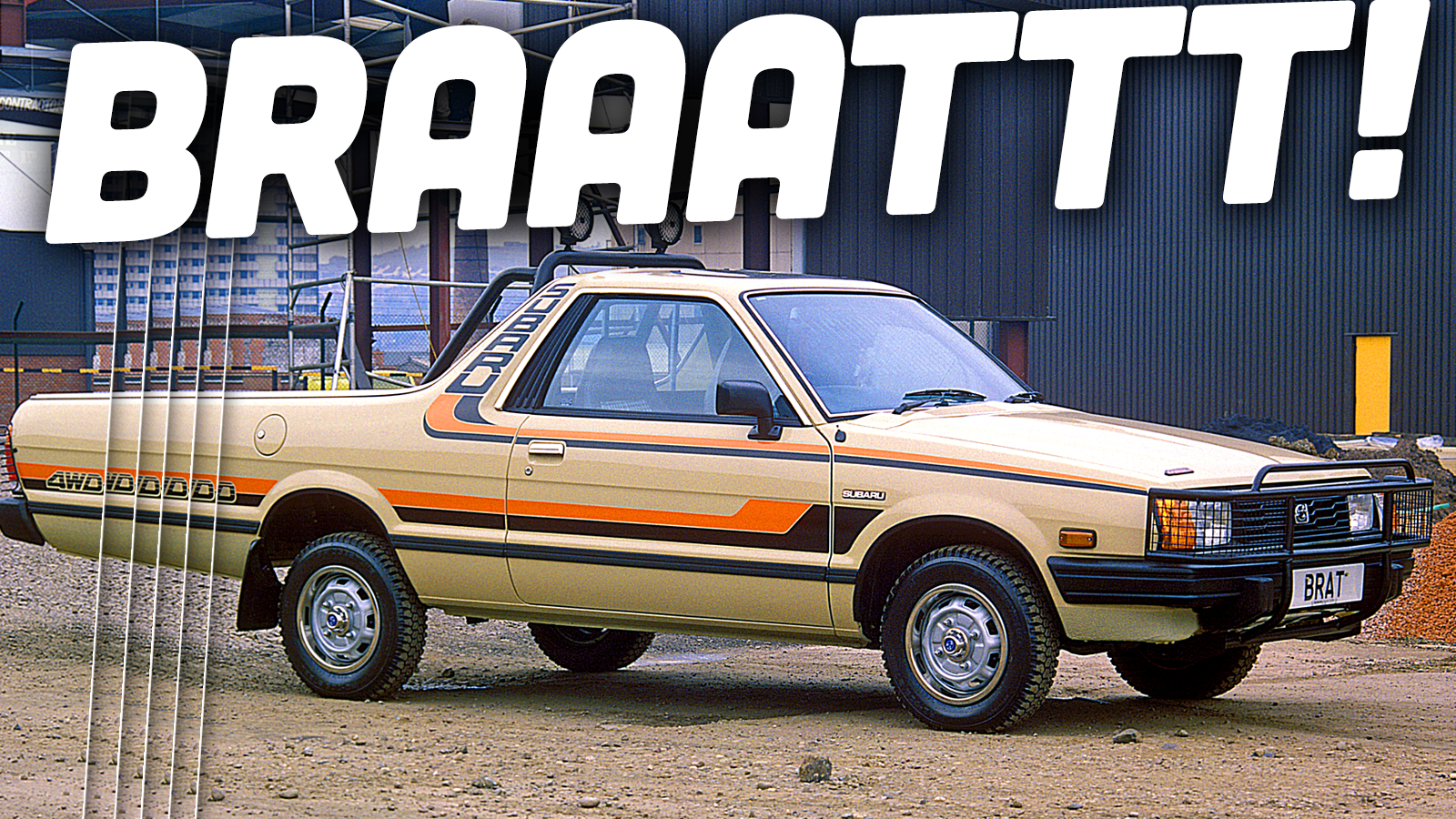
Everything might be bigger in Texas, but some Finnish pickups are longer than anywhere else in the world. This is down to some regulatory weirdness that caused some of the smaller “utes” to be stretched behind the rear axle at import in order to be classified as commercial vehicles the way they were intended in the first place.
They look kind of weird, and you can always tell when an old Subaru BRAT started its life wearing Finnish plates, even when it has appeared for sale elsewhere in the world – it’s gonna be that long.


In a comment on my Press Rally Corolla story, Ford_Timelord (great KLF reference there!) asked about a Subaru pickup he had seen in a Finnish series.
BTW we had a Finnish show (The Man Who Died) on TV here and the lead actor drovround in a Subaru Brat that had about 1 meter extra bed on the back compared to anywhere else – do you know about these?
The Man Who Died (Mies joka kuoli) is a Finnish noir comedy about a guy who runs a mushroom business and ends up poisoned. I think I only noticed him driving a Skoda Octavia, but I only watched the very beginning of the show. The main role is played by Jussi Vatanen, who has also been seen in a recent Aki Kaurismäki film, Fallen Leaves. Now, back to the extended trucks …
A Tiny Toyota Was To Blame – Or Its Marketing
The extended pickup story starts with the humble Toyota 1000, which was marketed as the Toyota Timangi here in Finland. The “Timangi” name is some sort of slang word that effectively means it’s as good as a diamond. I don’t know, it was the 1970s, and the lingo of the day was funky. Anyway, the Toyota was tiny, it was handy, and because of the differences between passenger vehicle taxation and commercial vehicle taxation, it was also very cheap. It was based on the Toyota Publica, which was some sort of an ur-Tercel.

As I mentioned in the Saab/Horizon kerosene article, one of the main things about the Finnish automotive landscape has always been cost of operation. In addition to figuring out which fuels run your car the cheapest, Finns have always wanted to get cheap cars. One way is registering your car as a commercial vehicle without rear seats, as that has a favorable effect on road taxation, especially as it nicely slices the yearly tax bills for diesel vehicles, as long as the “closed” cargo area is at least 130cm long (4,27 ft) and the rear seat mounting points have been demonstrably altered. When purchasing the vehicle, some people also go for a van conversion from new to be able to get it cheaper, plus companies can write off the VAT of a commercial vehicle.
Masses and vehicle classes are a separate rabbit hole, but historically, a good rule of thumb is that you were able to cut a vehicle’s price in half if it was registered as a van or a pickup truck instead of a regular passenger car. Take, for example, the Ford Sierra and its Ford P100 pickup version: in 1990, a base Sierra hatchback cost around 100,000 FIM and the P100 was yours for 50 grand ($17k). Of course, the P100 had a leaf-sprung Ford Transit rear axle and no rear seats, but it also had a bigger 2.0 OHC engine than the base Sierra 1.6 CVH, for half price.

Back to the Toyota! The Toyota 1000-based Timangi went on sale in 1976, and it sold like hot cakes. In fact, at 12,850 FIM new in 1976 ($13k today), it was the cheapest new vehicle in Finland and thousands cheaper than a Lada 1200. Bed length regulations had been changed in 1971 to close some other loophole about cargo areas and jump seats, and the Toyota’s bed was just over five feet, or 152 centimeters, meaning it met the regulations and dodged the taxes – at first.
Being a pickup, it was also speed-limited to 80 km/h (with a big round sticker on the tailgate), but that didn’t matter as it cost next to nothing. It weighed 740kg with a 560kg payload, and while the one-liter engine didn’t make it fast, it was sufficiently spritely with 58 horsepower. Six-foot drivers found it expectedly cramped.

The Toyota was heavily marketed at young people with magazine ads and ice hockey arena concerts, which in hindsight might have been a mistake: commercial vehicles and their light taxation is serious business, and it soon caught the taxman’s eye. In 1977, the minimum length requirement for an open bed was extended to 185cm, or over six feet, and the tiny Toyota was slapped with an expensive fly swatter. Circumventing the length requirement with a removable canopy was also off the table, even if the ad above shows one fitted. Note also the very 1976 stars and stripes on it.
Instead of being extended, the Timangi was discontinued, as it would have been classified as a passenger car from then on and probably cost double. Sales went on elsewhere in the world, and the 1000/Publica pickup was built up until 1988.
The Brat: The Worst?
Naturally, the new rule also applied to other pickup trucks. The Toyota was too tiny for the importer to do anything about it, but other pickups were lengthened behind the rear wheels to meet the regulations.

The Mk1 Volkswagen Golf-based Caddy, made until the 1990s in Yugoslavia, was a good example of this: it only needed a couple of centimeters of extra length, but it needed it all the same. The Caddy’s straight lines were not too severely affected by the extra bit of bed right next to the taillights, but some other pickup trucks suffered far more.

Let’s take the Subaru BRAT, or the Subaru 1800 Targa as it was called here. It, too, got the extension, and it didn’t help its design. With a regular, short bed, the BRAT is fun and funky looking: with the Finnish extension, it looks ridiculous.
There’s one for sale in Czechia, and you can tell it’s an original Finnish car from the bed and the license plates, even if those have been obscured in the sales pics. Also, the rear window says SUBARU NELIVETO (Subaru four-wheel-drive) on it.
Finnish Subaru pickups also didn’t get the jump seats in the bed, likely for legislative reasons.
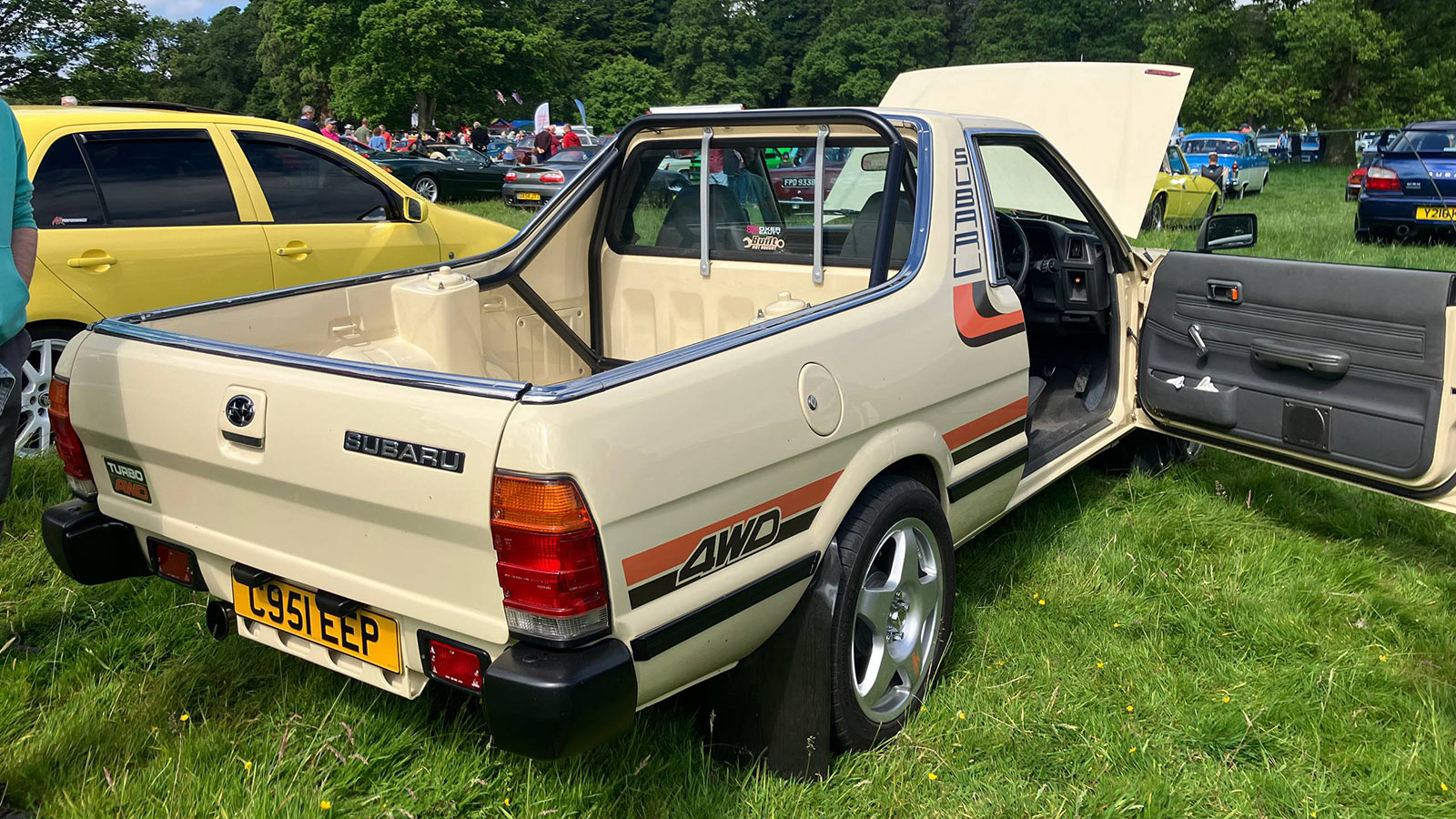
Here’s a photo of a regular-length Subaru pickup I took at a car show in the UK in 2024. You can easily see the difference in bed length when you compare it to a rusted Finnish example below.

Like the Caddy, the Subaru also usually rusts from around the extra bit, but then again: show me an ‘80s Subaru that hasn’t rusted everywhere in between the license plates.
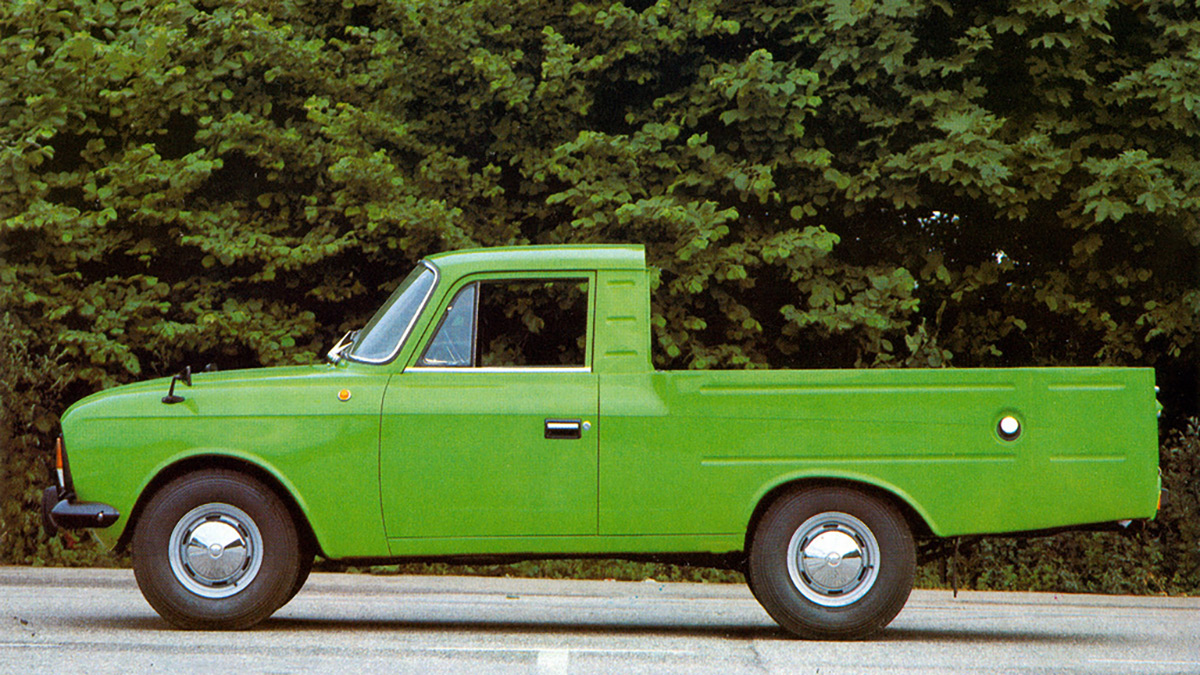
Soviet and Eastern European pickups were also imported in Finland, and they, too, were extended. The IZh-built Moskvich Elite’s bed (above) was initially only 160cm long, so it needed extra metal, as did the Polski-Fiat 125p pickup or “FSO Polle” as it was called here, with its 170cm bed.
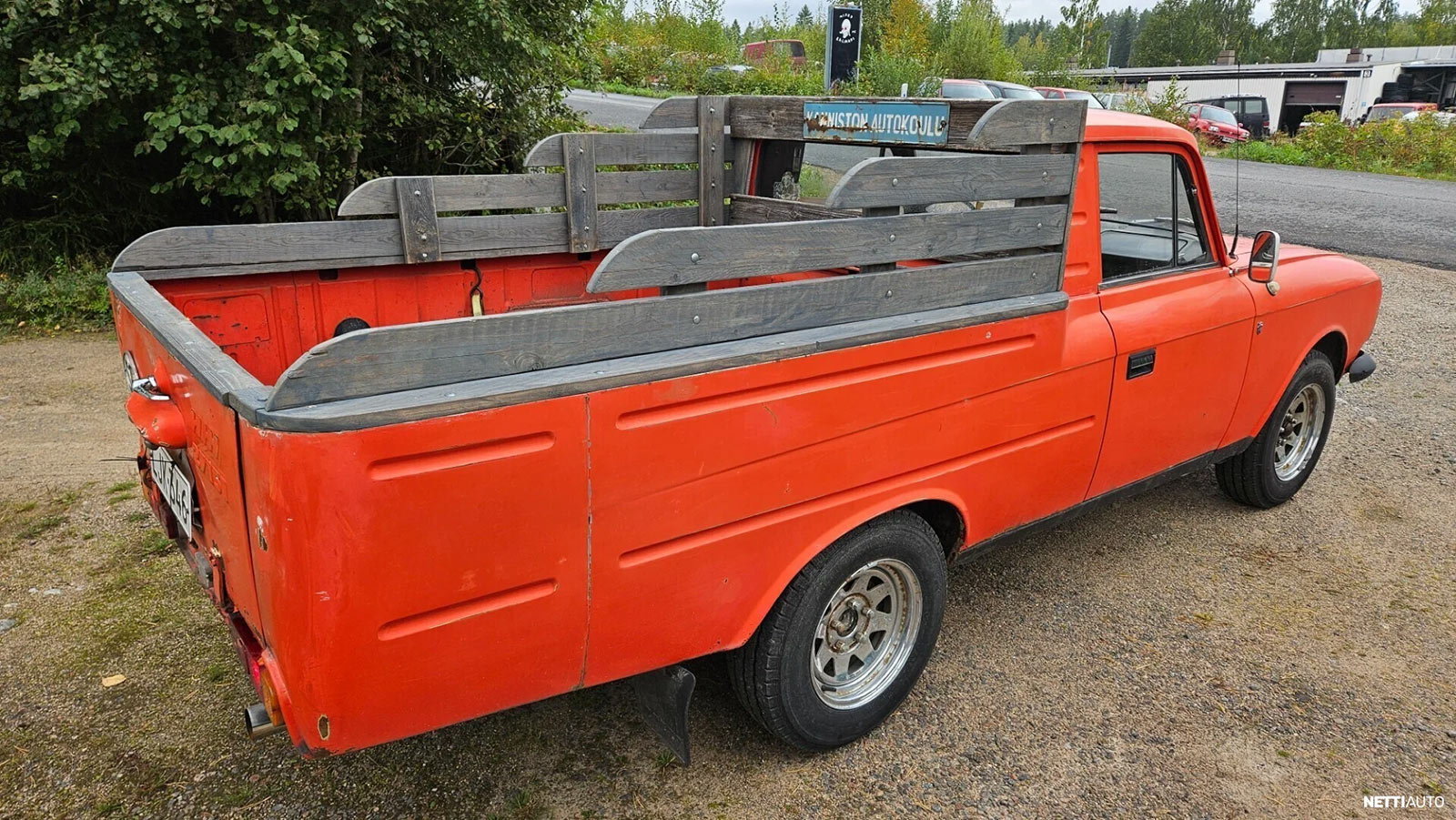
IZh started building extra-long bed versions from 1978 to fulfill the Finnish importer’s request, so the extension work was done at the factory and not at import. The seam is especially visible in the rear end of the bed.
Some of these export versions ended up sold in the Soviet Union, where they were called “the banana truck” due to their bed dimensions. They were also available in yellow, which is especially fitting.
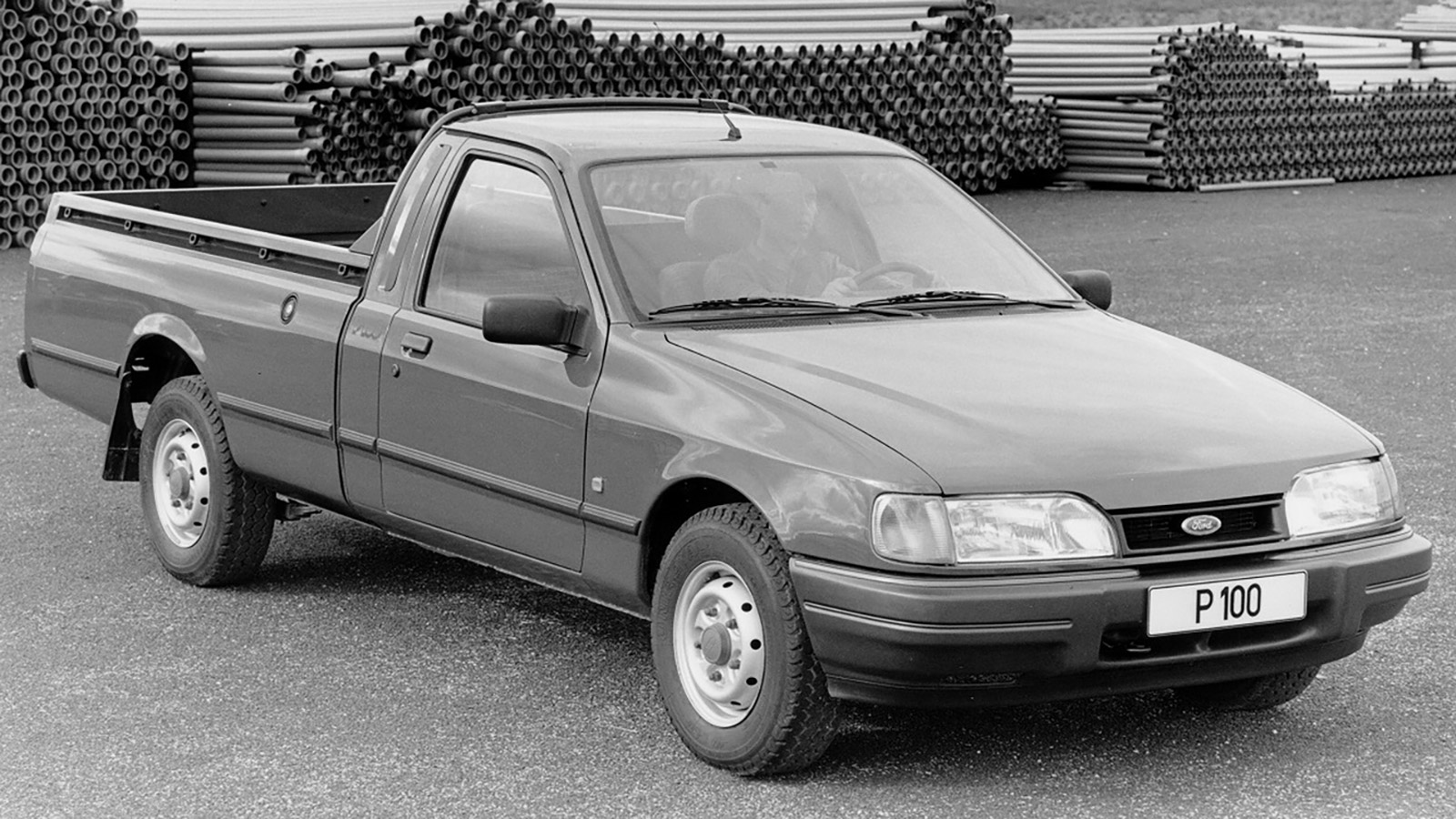
The aforementioned Ford P100 had a long, over two-meter bed, so no problems there, but in the Finnish documents its tow capacity was a ridiculously low 270kg, and it was said to be able to deliver “only greetings.”
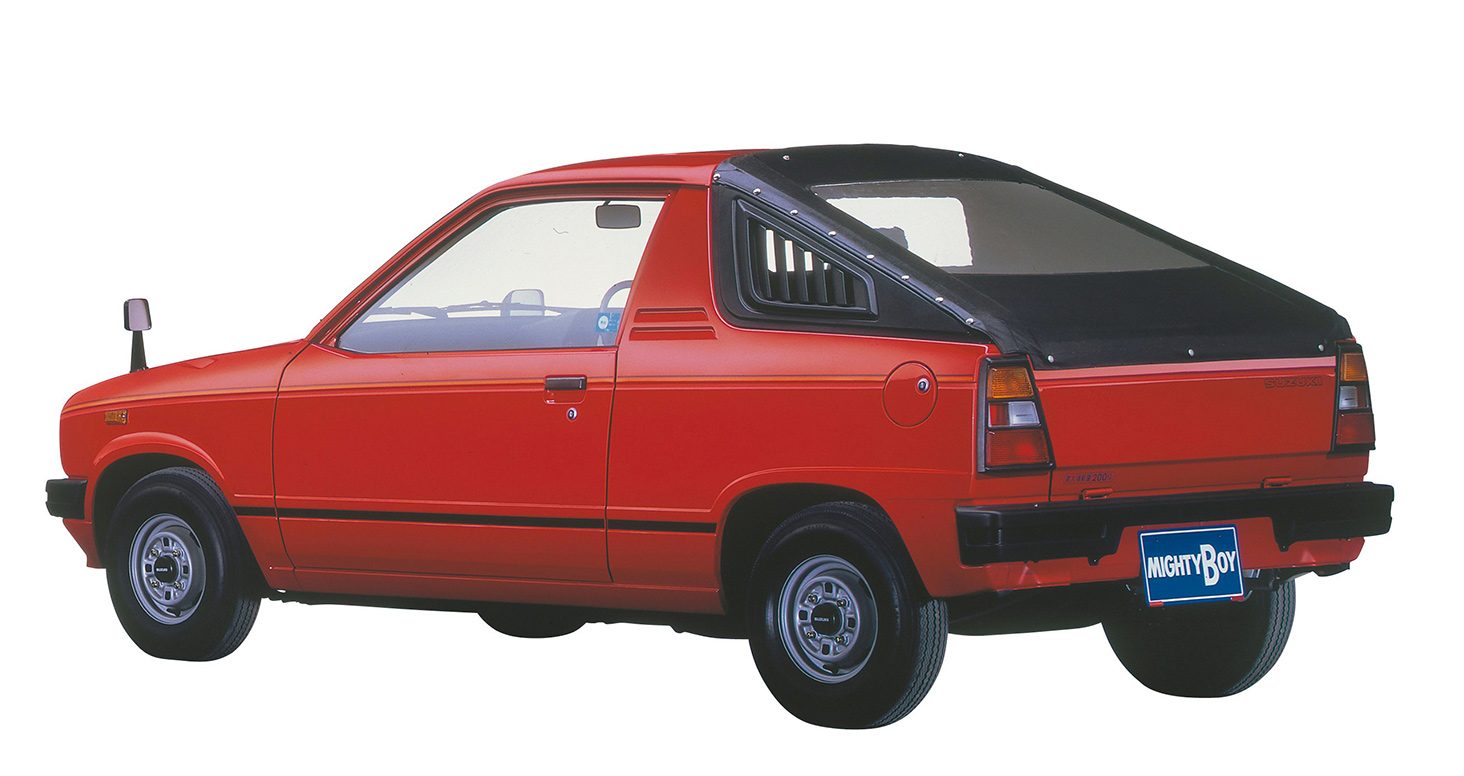
Finally, let’s imagine the 1983-1988 Suzuki Mighty Boy would have been imported alongside the Suzuki Alto and the Samurai. As it was only made in right-hand-drive configuration, it wasn’t brought here, but it would have needed over four feet of extra bed welded on it, between the fuel filler cap and the taillights, to dodge the passenger car tax.
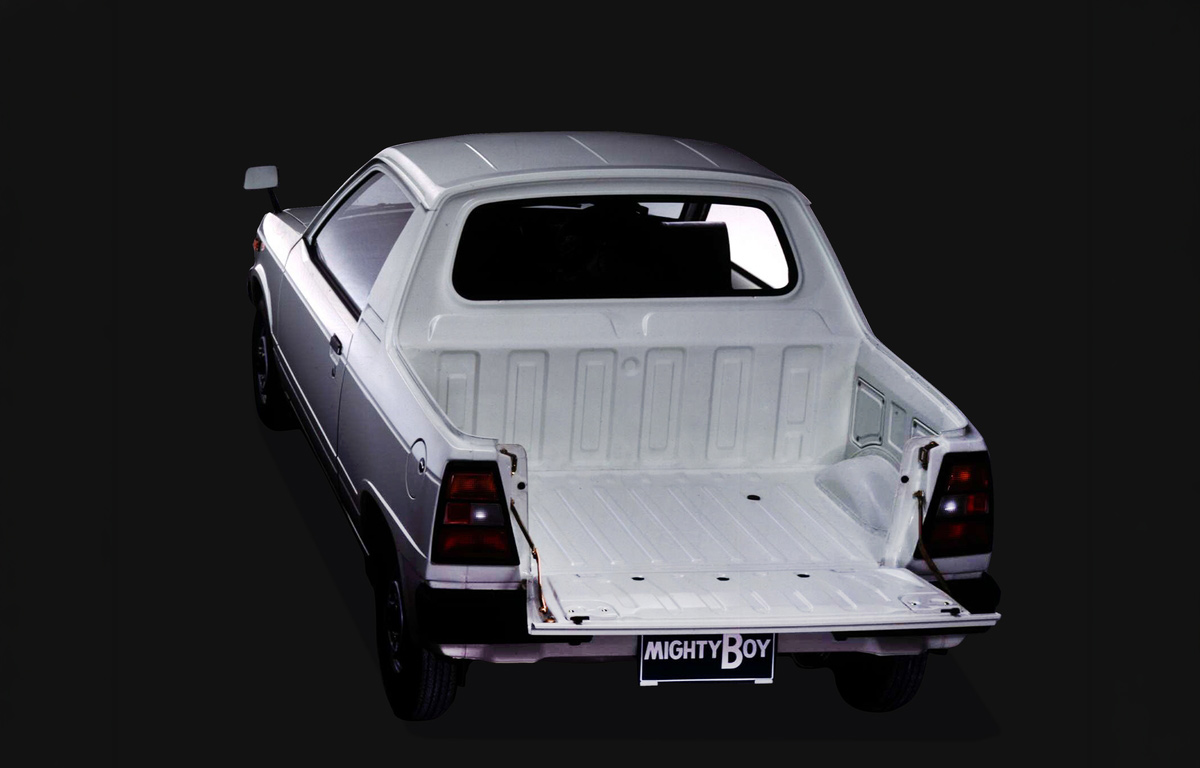
Take a look at the Mighty Boy and despair; at least the bed was just about wide enough to pass the four-foot minimum width.
To be fair, the entire deal with the extended bed is moot if you look at it from a completely pragmatic standpoint. “My lobster is too buttery, my steak is too juicy, and the bed of my pickup truck is too long.” If you’re buying a pickup for its intended purpose, nobody in their right mind is going to complain about the bed being too long, even if extending it to meet (completely arbitrary) regulations makes the dimensions look off.
If you’re buying it for coolness’s sake and not for transporting goods, then it’s a different matter, but not one that a lawmaker would really care about. The only thing is whether the conversion was done well, and since it involved sawzalling complete vehicles at import, results may have varied.
Top graphic image: Subaru


I can’t imagine driving those pick-up trucks with extra long rear overhang in San Francisco or steep streets without scruppering the rear end or lifting the rear wheels off the ground in certain circumstances…
I found the photo of Finnish Golf Caddy showing clearly the extension up close. Click on the second thumbnail photo. You can see the rust lines on the extension.
These all seem like accidents waiting to happen on 4 wheels.
A good rule of thumb is anytime you are wondering why something stupid exists, it is because of government regulations.
Not all regulations are stupid however
Not all regulations are stupid and at the same time anytime something stupid exists its because of regualtion.
Awesome article on Long boi utes! Thanks for the deep dive Antti!
I liked how they blended the back of the Brat (Brumby here in Australia) so well to integrate it into the curves of the original body rather than just added a lean to extension like on some of the other utes you showed.
Funny you should mention the Mighty Boy because it occupied a similar tax dodge niche to the Toyota Timangi in its major market of Australia.
The Dutch laws had a similar effect on some vehicles. Landrover had to make a special Defender 130 with a longer wheelbase to put enough load floor ahead of the rear axle and also a fiberglass high roof on Discovery vans to get enough load volume.
A related question is how did this bed length rule fit in with the Camaro “pickup” conversions that replaced the glass hatchback of a,third generation F body with a bed insert?
There is an interesting, similar story about Norwegian market exclusive extra long bed pickup trucks, which I don’t think a lot of people know. It would be fun to see it written up!
The BRAT’s jumpseats were also a loophole dodge! For decades the US Customs tariffs on imported trucks were 25% while those on incomplete vehicles and passenger cars were one-tenth that pre-Trump.
Most “big” Japanese pickups – Toyota Hilux and such – were imported as chassis-cabs and the beds were flatpacked in as parts (also at the low 2 1/2% tariff) and assembled shortly after arrival. It was a good time to own a welding shop in Long Beach or the South Bay. That wasn’t possible with El Camino-style trucks like the BRAT, hence the jumpseats to make it a “car”.
It’s interesting that the same vehicle was modified in two completely different directions for tax reasons in two different countries; extra seats to make it a ‘car’ in the US, and a long bed to make it a ‘work truck’ in Finland.
I wonder if anyone has fitted the US jumpseats to a Finnish long-boi?
Could fit 2 sets of jump seats in – practically a Ute Limo!
Finnish BURN, lmao
Is this true for Finnish condoms too ? asking for a friend
My Grandpa was Finnish.
Yes.
We knew he Finnish, that’s why we have you!
Large but loose
The Brat: the Worst? Very funny.
He was just trying to curry favor.
I do that all the time…
So, Really bad departure angle then?
Right? If it was in the wheelbase, I’d be more interested since it’s not a hardcore offroader, but extra length behind the wheels would really make it awkward to load well without making it ride weird, I bet.
Yeah, I was thinking that as well. Putting a pallet of concrete mix or similar just inside the tailgate would have resulted in some interesting steering.
Real life penny racers
I think I would prefer any of the trucks shown in this article to the crew-cab behemoths available today that cost $60K and more. As much as I’d like to go electric in a few years and get a Slate, I’m thinking my next truck might be a southern 1st-gen regular-cab S-10 with the 5-speed.
Hard to go wrong there. There are two OG S-10 runners right here in my NC neighborhood, not to mention a ’92 extended cab Ranger and several late ’80s to mid-’90s Toyotas. Down here they’re still just…around. No big deal.
GREAT, now I need a Toyota 1000/Timangi. Guess I’ll add it to the list.
There are two for sale, posted today! A red one and a more expensive brown one. https://www.nettiauto.com/en/toyota/timangi/15806288 https://www.nettiauto.com/en/toyota/timangi/15808901
It is delightful, is it not?
The dude in the American Special Edition already has two woman and is trying to steal a third from Guitar Guy.
We call that lead singer energy.
Meanwhile, the Piano Man is – lonely.
Jussi Vatanen… any relationship to Ari?
Weren’t there a number of ’80s Firebirds and Camaros converted to trucks over there for the same reason?
It’s funny that the commercial registration is cheaper there. For some reason here in California commercial vehicle registration (which applies to all pickup trucks and cargo vans, even if privately owned) is much more expensive. I’m in the process of converting a car to a pickup and I don’t plan to notify the DMV about this so I can save some money.
Used to be cheaper.
When I owned my ’97 Ranger, the dealer asked me if I wanted commercial plates since it was cheaper – I said sure, why not?
I don’t think so. As long as I can remember trucks in CA have always had to pay weight fees that cars don’t.
https://www.dmv.ca.gov/portal/handbook/vehicle-industry-registration-procedures-manual-2/collection-and-payment-of-fees-and-penalties/weight-fees/
Hmmm – or maybe it was just so I could park in yellow zones, which I did frequently?
It’s been a minute or two….
Yes, commercial plates do allow you to park in yellow loading zones.
MY ’91 F350 longbed dually crewcab was purchased with passenger plates on it. Upon re-registration in my name in CA I had to go to a commercial scale and get a base weight to be properly licensed (as it should be) as a commercial vehicle. The PO lived out in the boonies in CA where I suspect they found someone to license the truck as passenger a bit under the table, but still legal. I also had to swap out the aftermarket intake vortex gizmo and filter for a stock setup to pass smog. The seller had to pass smog to sell it, and again, a buddy probably did that as well.
Hmm, on the slight chance I will drive it (with camper) into town, I will take advantage of my commercial plates. I usually park out in the far reaches of parking lots unashamedly taking up four spaces.
Sounds like you’re happy with the commercial plates, but you can convert it to passenger car plates if you add a camper and “living provisions” in the back. A guy I know converted an old bread van into an “RV” by adding a mattress, small sink, and microwave in the back. He uses it to transport his Lemon racer and sleeps in it at the track, and now he no longer has to stop at weigh stations.
I saw the BRAT in the top shot, and Baby Got Back started playing in my head.
Baby Got BRAT
I hope Finland is ready for all the visa applications from long-bed loving, mouth foaming Autopians. I assume half the commentariat are making relocation plans as I type this.
All I can hear in my head is Pythons’ “Finland, Finland, Finland” song…
I would if I could…maybe eventually. If there was anywhere in the world I would want to go visit or live, it would be Finland. They are basically the happiest country in the world, plus an amazing amount of saunas! I also love all the awesome metal bands especially Insomnium- one of the best I’ve ever heard…just amazing. The next international trip, I’m going!
Saunas are great and I don’t know why they’re so rare around here.
“It’s like a sauna in here!”
-Kramer
Most of the world: regular BRATs.
Finland: Footlong BRATs.
…barbecue this weekend?
Have we got any sauerkraut & onions to go with these BRATs?
I’ll pick some up.
Sounds like a sausage fest.